

Sberbank's Crypto Wallet and Depositary: When and How the Bank's Crypto Services Will Launch
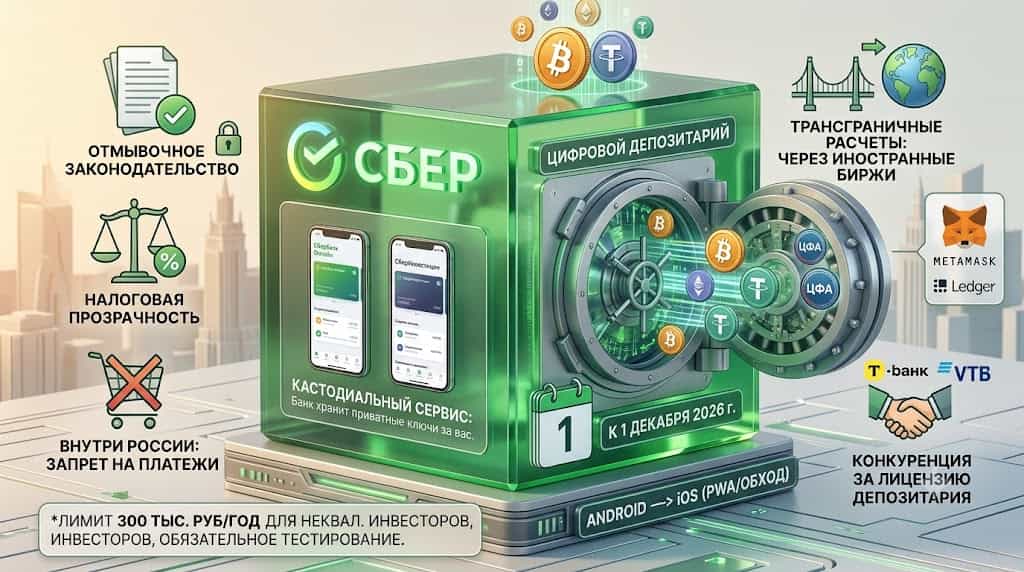
Sberbank plans to launch a crypto wallet and digital depositary as early as December 1, 2026 — First Deputy Chairman of the bank's management board Kirill Tsarev told RBC. The service will appear directly inside the familiar Sberbank Online and SberInvestments apps, with no separate app required. It's important to understand up front: the bank's crypto wallet won't give users a private key or full control over their assets — it will be a fully custodial service, with the bank holding and recording the cryptocurrency on the client's behalf. Below, we cover when the service will actually go live, what limits and restrictions the law will set, what happens with withdrawals to external wallets, and why VTB and T-Bank are racing Sberbank for depositary status.
When will Sberbank launch its crypto wallet and depositary?
The tentative launch date is December 1, 2026, but the exact timing will only become clear once the final text of the cryptocurrency regulation law is published. Kirill Tsarev directly tied the launch timeline to the pace of the legislative process, saying the bank can't commit to a firm date until the final version of the "On Digital Currency and Digital Rights" bill is out.
The bill has already passed its first reading in the State Duma in April 2026. The final vote, originally scheduled for July 1, has been pushed to the end of the spring session — July 27, 2026. The law's effective date has shifted to September 1, 2026. That said, according to the Bank of Russia, the first legal cryptocurrency transactions in the country could launch as early as November 2026, with the necessary regulatory acts expected to be ready by October.
That makes Sberbank's December target look realistic — it lands just after the market's basic regulatory infrastructure is expected to be in place.
Can you get a private key for Sberbank's crypto wallet?
No, users won't get a private key — Sberbank's service will be fully custodial. The law requires that any cryptocurrency transactions in Russia go only through licensed intermediaries — exchanges, brokers, and so-called digital depositaries. That means crypto assets will be legally and technically held and recorded by the bank itself, not in a wallet the client directly controls.
Competition for depositary status is already heating up: alongside Sberbank, VTB and T-Bank are both preparing their own digital depositaries. Andrei Yatskov, head of VTB's brokerage services department, confirmed to RBC that the bank is already listed in the registry of operators issuing digital financial assets — a ready-made foundation for launching a crypto depositary. T-Bank, for its part, intends to be the country's first crypto depositary: T-Technologies executive director Vyacheslav Tsyganov said the group will roll out the service on the Atomyze platform as soon as the regulation takes effect.
The custodial storage model also means standard banking risks carry over. Because transactions run through a fully bank-controlled channel, these assets remain subject to anti-money-laundering law — in particular, the risk of an account freeze under Federal Law 115-FZ for suspicious transactions applies just as it would for ordinary banking products.
It's worth understanding why the regulator chose a custodial model instead of letting banks give clients full control over their keys. The logic is straightforward: the entire law is built around the idea of fully controlled, traceable crypto-asset circulation within the banking system. If a user held the private key, the bank would lose the technical ability to control the movement of funds — and with it, the ability to meet client-identification and anti-money-laundering requirements. That's why the whole legal crypto-services market in Russia is being designed from the outset as a system where the intermediary — bank, broker, or exchange — is the sole point of access to the asset.
How will Sberbank's crypto services affect taxes and customer identification?
Every cryptocurrency transaction through Sberbank will be fully transparent to the tax authorities and the Bank of Russia, since the law requires such transactions to go only through a licensed intermediary with full customer identification. Any purchase, sale, top-up, or holding of crypto assets through Sberbank Online or SberInvestments will be treated as a transaction with a financial asset and fall under regulatory oversight.
That's a fundamental shift from how many private investors interact with crypto today — through foreign exchanges and P2P exchangers, where identification is often only nominal. Embedding crypto services into regulated banking infrastructure automatically means full disclosure of transactions to the state: from trade history to current account balances.
For users who value anonymity in digital-asset transactions, a bank crypto wallet is likely the wrong tool — its whole logic runs counter to anonymity and is built for fully transparent, regulated turnover.
At the same time, for many investors that transparency could be an advantage rather than just a limitation. Transactions through a licensed intermediary automatically generate an official transaction history, which simplifies calculating and paying tax on cryptocurrency income and removes the risks tied to undeclared foreign accounts. In effect, the bank takes on a share of the administrative burden that previously fell on investors dealing directly with foreign platforms.
Can you pay with cryptocurrency in Russia, and can you withdraw it to an external cold wallet?
Paying with cryptocurrency domestically is banned under all circumstances, while withdrawing to an external cold wallet depends on where the assets physically sit — inside Russia or outside it. These are two separate legal regimes, and it's important not to conflate them.
Within Russian jurisdiction, the ban on cryptocurrency payments is absolute: the law flatly prohibits using digital assets as a means of payment for goods and services on Russian territory, and this rule applies regardless of which licensed intermediary handles the transaction — bank, broker, or exchange. As long as assets sit in an account at Sberbank, VTB, or T-Bank, they are legally and technically under the bank's full custodial control: you can't withdraw them with one tap to your own hardware wallet like a Ledger, or to a non-custodial wallet like MetaMask, directly from the bank's app — this works the same way ordinary stocks do in a brokerage account.
Outside Russia, though, the picture is fundamentally different — and this is the key clarification made by the Bank of Russia's first deputy chairman. Russian law explicitly allows users to step outside the control of a domestic financial intermediary and use a non-custodial cold wallet in another jurisdiction. In other words, once an asset has been legally transferred to a foreign exchange, it can then be freely withdrawn to your own cold wallet — the same way non-custodial service users do it today.
This ability to reach foreign platforms is turning into the new system's main practical breakthrough. Ekaterina Lozgacheva, director of the Bank of Russia's financial market strategic development department, confirmed that the regulator is preparing an amendment that would let Russians access foreign cryptocurrency exchanges through domestic banks and brokers acting as intermediaries. Tsarev confirmed that Sberbank will consider becoming such a bridge to foreign markets, though the final decision will depend on requirements set by regulators — both Russian and foreign.
In effect, banks could become a legal springboard for Russian companies and individuals to reach foreign exchanges and cold wallets — including cross-border payments that route around Western sanctions. Beyond mainstream cryptocurrencies like bitcoin, ether, and USDT, major banks — VTB and T-Bank in particular — are also betting on integration with Russia's homegrown digital financial asset ecosystem, including tokenized gold and other commodities, to offer clients blended portfolios of crypto and DFAs.
This scenario looks like a logical extension of the regulator's current policy: rather than fighting the outflow of capital to gray-market foreign platforms, the Bank of Russia is trying to offer a legal, controlled channel with essentially the same capabilities. For banks, it's an additional source of fee income; for the state, it's a way to bring a significant share of shadow crypto turnover back into view of fiscal and supervisory authorities, while preserving a channel for international settlements.
What's the purchase limit for retail crypto investors?
The limit for non-qualified investors will be 300,000 rubles per year through a single intermediary — roughly $3,300–3,800 at current exchange rates. To access even this volume of transactions, an investor without qualified status will need to pass mandatory testing.
That limit is clearly aimed not at active traders but at beginner investors looking to try cryptocurrency as a small slice of their portfolio. For comparison, a typical position size for an active crypto trader can easily exceed this annual limit in a single trade. Anyone planning larger volumes will either need to obtain qualified-investor status or split transactions across several licensed intermediaries — banks, brokers, and exchanges.
Igor Marich, a representative of the Moscow Exchange, noted that a full-fledged Russian digital currency market won't take shape immediately once the law takes effect, but only by 2027: market participants will need time to build the new product into real customer journeys — from onboarding and testing non-qualified investors to setting up internal compliance procedures at each intermediary. That means even after Sberbank, VTB, and T-Bank formally launch their services, the market will operate in a limited, test mode for a while rather than at full capacity.
Here's a summary table of the key launch parameters across market players.
| Bank / platform | Product | Expected launch |
| Sberbank | Crypto wallet and digital depositary | Around December 1, 2026 |
| VTB | Digital depositary | After the law takes effect (after September 1, 2026) |
| T-Bank | Crypto depositary on the Atomyze platform + sales through T-Investments | Immediately after regulation takes effect |
| Moscow Exchange | Cryptocurrency trading | By the end of 2026; full-scale market from 2027 |
Will Sberbank's crypto app work the same on Android and iPhone?
No, Android users will get access to the crypto wallet sooner than iPhone owners. Kirill Tsarev personally acknowledged that the speed and success of the launch will depend on app-store policy — and Android and iOS face fundamentally different conditions here because of sanctions.
Android users will most likely get the update first — via RuStore or a direct APK install, which has already become standard practice for banking and fintech services in Russia. iPhone owners will be less fortunate: the usual App Store channels for distributing the bank's crypto features will most likely remain unavailable. The most realistic scenario for iPhone is access via a PWA — a web version of the app that runs directly in a browser without an app-store install — or some other workaround.
That means iPhone owners should plan for a degree of inconvenience when using the bank's crypto wallet, and may want to look at alternative ways of working with digital assets in the meantime.
The App Store restriction facing Russian banks isn't new: many fintech apps have already run into this problem since sanctions were introduced, and banks have long since worked out workarounds — from RuStore to web versions of their services. Still, for crypto features specifically, which require heightened attention to security and identification from the outset, dependence on non-standard distribution channels can add friction at first login and with subsequent updates.
Is It Worth Trading Crypto on KuCoin Instead of Waiting for Sberbank?
Yes — if you need full access to cryptocurrency operations without the 300,000-ruble annual cap, and without first having to move assets abroad just to withdraw to your own cold wallet, it's worth considering a dedicated exchange like KuCoin right now. For all its convenience, Sberbank's bank crypto wallet remains a custodial product with a strict annual limit for non-qualified investors, and direct withdrawal to an external cold wallet is still unavailable within Russian jurisdiction.
KuCoin offers a fundamentally different set of capabilities: spot and futures trading across a wide range of cryptocurrencies, staking, and free withdrawal of assets to your own wallets. For anyone who wants to actively manage a digital-asset portfolio rather than just hold a small position within a regulated banking product, this can be a more flexible option today — without waiting for December 2026 and the final version of Russia's law.
Before trading on KuCoin, it's worth completing account verification, learning the basics of risk management, and soberly sizing your positions — the crypto market is significantly more volatile than the regulated banking products Sberbank is preparing.
Conclusion
Sberbank plans to launch a crypto wallet and digital depositary inside the Sberbank Online and SberInvestments apps around December 1, 2026, though the exact timing depends on the final version of the "On Digital Currency and Digital Rights" law, expected to be approved on July 27. The service will be fully custodial: users won't get a private key, and all transactions will fall under the oversight of the Bank of Russia and the tax authorities.
Paying with cryptocurrency domestically will still be off the table, and directly withdrawing assets from a Russian bank account to a cold wallet won't be possible — but once assets are legally transferred to a foreign exchange, they can be freely withdrawn to a personal non-custodial wallet. That's the basis for the amendment under discussion, which could give Russians legal access to foreign crypto exchanges through domestic intermediaries, including Sberbank itself. Non-qualified investors will face a 300,000-ruble annual cap per intermediary, and iPhone owners will have to wait longer than Android users because of app-store restrictions.
Meanwhile, VTB, T-Bank, and the Moscow Exchange are all competing for a share of the crypto market, so 2027 could be the year a fully regulated digital currency market takes shape in Russia.
Frequently Asked Questions
Can I already open a crypto wallet at Sberbank?
No, the crypto wallet and digital depositary haven't launched yet — the tentative launch date is December 1, 2026, and it could shift depending on when the final version of the cryptocurrency regulation law is adopted.
Can I withdraw cryptocurrency from Sberbank to my own cold wallet?
Not directly from the bank's app — not while the asset sits in an account within Russian jurisdiction, since this is a fully custodial product. But once an asset has been legally transferred through the bank as an intermediary to a foreign exchange, it can then be withdrawn to your own non-custodial wallet, such as MetaMask or a Ledger — this is explicitly permitted by law once outside Russia.
Will non-qualified investors be able to buy unlimited amounts of cryptocurrency?
No, non-qualified investors face a 300,000-ruble annual limit through a single licensed intermediary, and even accessing that amount will require passing mandatory testing.
Will Sberbank's crypto wallet launch on iPhone as quickly as on Android? No, because of app-store policy amid sanctions, Android users will most likely get access to the service first — via RuStore or an APK install — while iPhone owners will probably need to rely on a web version of the app (PWA).
Which other Russian banks and exchanges are preparing crypto services besides Sberbank?
VTB, already listed in the registry of digital financial asset operators, and T-Bank, which aims to become the country's first crypto depositary on the Atomyze platform, are both preparing their own digital depositaries. The Moscow Exchange has also confirmed it will launch cryptocurrency trading by the end of 2026.