

Russia's Average Maximum Deposit Rate Rises to 12.89%: What Changed in August 2026
2026/08/14 15:58:00
Introduction
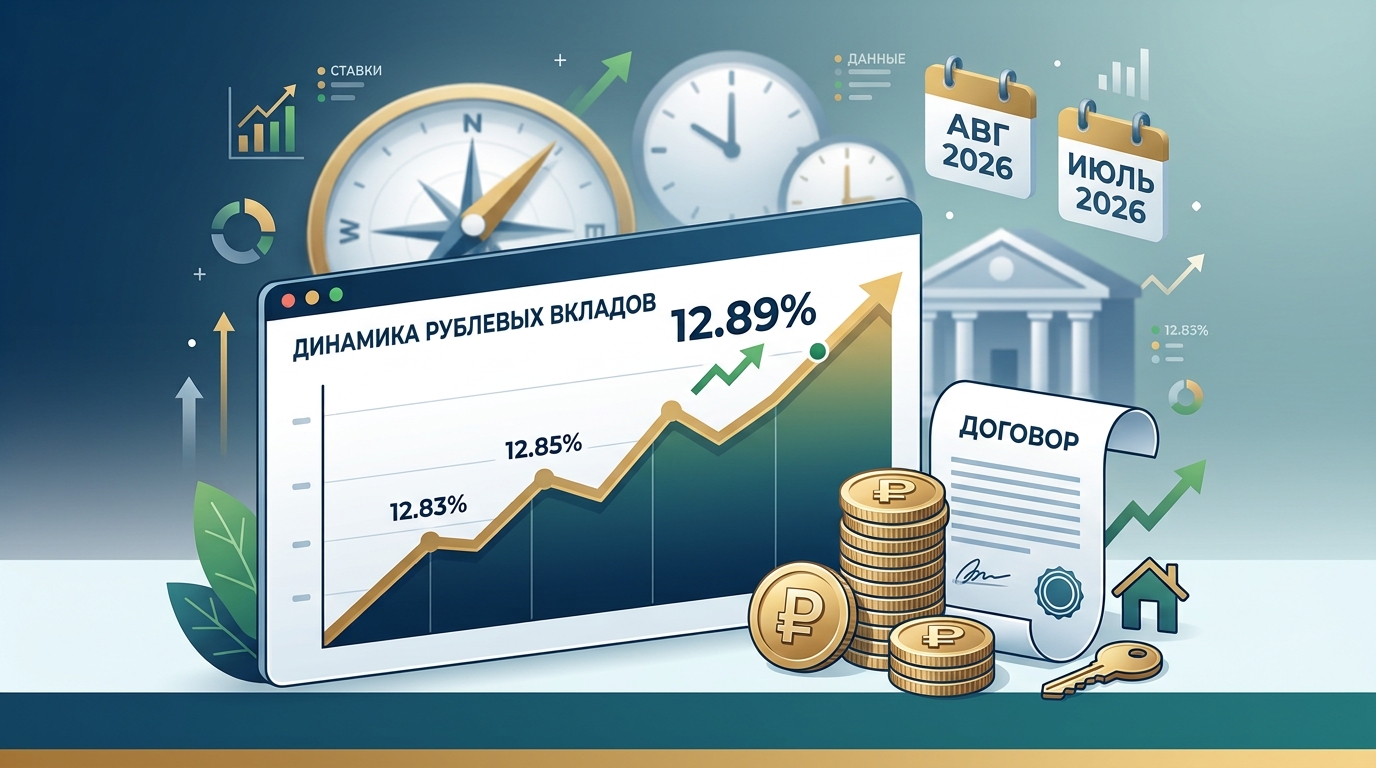
The average maximum rate on ruble-denominated deposits in Russia reached 12.89% per year in the first ten-day period of August 2026. The indicator rose by 0.04 percentage points from the third ten-day period of July, when it stood at 12.85%, and exceeded the 12.83% recorded in the second ten-day period of July. However, this does not mean that every depositor receives a 12.89% return: the Bank of Russia calculates the indicator as the arithmetic average of the maximum rates offered by the ten largest banks, rather than as the average actual return on all deposits.
The increase was modest, but it matters when assessing the market's direction. After a period of declining rates, the indicator stabilized at around 13% per year, while the structure of offers by maturity remained uneven. The highest average maximum rate in the first ten-day period of August applied to deposits with terms of 91 to 180 days — 12.65% per year.
Why Did the Average Maximum Deposit Rate Rise to 12.89%?
The key fact is that banks slightly increased the maximum rates available on ruble deposits at the beginning of August, bringing the average for the ten largest participants to 12.89% per year. The Bank of Russia did not disclose each bank's contribution to the overall change in this press release, so it would be inaccurate to attribute the increase to a decision by any single credit institution.
A change of 0.04 percentage points represents limited movement. For example, if a product's rate increased from 12.85% to 12.89%, the depositor would not automatically receive a noticeable additional return: on a simple nominal basis, placing 100,000 rubles for one year would produce a difference of about 40 rubles before tax. The actual result depends on the term, the method used to accrue interest, the opening date, and the conditions of the specific agreement.
According to the Bank of Russia, the average was 12.83% in the second ten-day period of July and 12.85% in the third. The sequence was therefore as follows:
|
Monitoring period
|
Average maximum rate
|
Change from the previous period
|
|
Second ten-day period of July 2026
|
12.83%
|
—
|
|
Third ten-day period of July 2026
|
12.85%
|
+0.02 percentage points
|
|
First ten-day period of August 2026
|
12.89%
|
+0.04 percentage points
|
This trend points more to stabilization in maximum offers than to the start of a new sharp rate-growth cycle. At the same time, the monitoring is published by ten-day periods, so it reflects market conditions during a specific short interval rather than fixing a rate for the entire month.
What Exactly Does the Bank of Russia's Indicator Measure?
The Bank of Russia's indicator is the arithmetic average of the maximum deposit rates offered by the ten credit institutions with the largest volumes of individual deposits in Russian rubles. In other words, the regulator selects the maximum rate that meets its criteria at each bank and then averages the ten figures.
This is an indicative market measure, not a promise of the return available to a client. It does not show the rate received by the average depositor after accounting for all outstanding deposits, deposit amounts, maturities, and individual conditions. In a headline, it is accurate to call the figure the “average maximum rate,” but inaccurate to describe it as the average return on all deposits.
The official list includes Sberbank, VTB, Gazprombank, Alfa-Bank, Rosselkhozbank, DOM.RF Bank, Moscow Credit Bank, T-Bank, Promsvyazbank, and Sovcombank. This list from the Bank of Russia's primary material should be used when preparing analytical content, even if individual media reports cite a different group of banks.
The purpose of the indicator is to provide the market with a comparable benchmark. RIA Novosti notes that the Bank of Russia recommends that credit institutions attract individuals' funds at a rate no higher than the average maximum rate plus two percentage points. This is a regulatory market benchmark, not a universal restriction that turns 12.89% into a guaranteed ceiling for every deposit program.
Which Conditions Are Excluded from the Maximum-Rate Calculation?
The calculation includes offers available to any client, including a prospective client, without restrictions or preconditions. The indicator therefore seeks to separate ordinary public deposit products from offers in which a higher return forms part of a complex package of services.
The Bank of Russia excludes deposits for specific categories of clients, such as pensioners or children, as well as products intended for special social or humanitarian purposes. This matters because such programs may offer higher rates but are not universal offers for the market as a whole.
Deposits whose higher rate depends on regular turnover through a bank card or on maintaining a permanent minimum balance are also excluded. Products requiring the purchase of investment units, the opening of an investment account, investment or endowment life insurance, or an additional service package are not included either.
The regulator also excludes deposits with interest capitalization. In addition, deposits whose terms are divided into several periods with different rates are not included in the monitoring. For example, a product offering one rate during the first few months and another rate later cannot be directly compared with a standard deposit paying one uniform rate throughout its term.
These rules make the indicator more consistent, but they also limit how broadly it can be applied. A depositor may see an advertised rate above 12.89%, but that rate may be calculated using a different methodology or require conditions not included in the Bank of Russia's indicator.
How Does the Rate Vary by Deposit Term?
The highest average maximum rate in the first ten-day period of August was recorded for terms of 91 to 180 days, at 12.65% per year. For terms of up to 90 days, the indicator was 12.33%; for terms from 181 days to one year, it was 12.48%; and for deposits longer than one year, it was 11.47%.
|
Deposit term
|
Average maximum rate in the first ten-day period of August 2026
|
|
Up to 90 days
|
12.33%
|
|
91 to 180 days
|
12.65%
|
|
181 days to 1 year
|
12.48%
|
|
More than 1 year
|
11.47%
|
This table shows why the single figure of 12.89% should not be treated as the rate for every term. In the short-term range of up to 90 days, the average maximum return was 0.56 percentage points below the overall indicator. For deposits longer than one year, the gap reached 1.42 percentage points.
The difference between terms reflects more than the banks' marketing strategies. A credit institution assesses the period for which it needs funding, how funding costs may change, and how predictable future rates are. For the client, however, the term is connected to liquidity: a longer deposit may restrict access to funds, while a shorter deposit may require another product selection when the agreement expires.
When comparing offers, clients should check not only the nominal rate but also the interest-payment date, the possibility of adding funds, early-withdrawal terms, automatic renewal, and the minimum deposit amount. These parameters affect the actual financial result even though they do not change the Bank of Russia's published indicator.
What Does the Rate Increase Mean for Depositors?
The rise to 12.89% means that the largest banks' maximum public offers improved slightly at the beginning of August, but it does not by itself prove that opening a deposit became more advantageous for every client. The decision depends on when the money will be needed, how much can be placed, and whether the specific rate is available without additional requirements.
A simple preliminary formula can be used to estimate the return: multiply the deposit amount by the annual rate and by the fraction of the year during which the money remains in the account. For example, at a nominal rate of 12.65% and a deposit of 100,000 rubles for 180 days, the calculated interest before tax will depend on the bank's day-count convention and the agreement's terms. The quoted percentage therefore cannot be treated as an exact promised payment without reviewing the document.
Particular attention should be paid to the phrases “up to,” “for new clients,” and “subject to conditions.” They may mean that the maximum rate applies only to part of the balance, for a limited period, or when requirements are met that the Bank of Russia does not include in its monitoring. The full return of the specific product should be compared, rather than only the headline figure.
Historical context is also important. The record high for the average maximum rate throughout the observation period was recorded in the second ten-day period of December 2024, at 22.28% per year. The minimum was recorded in the first ten-day period of October 2020, at 4.33%. Against this background, the current 12.89% lies between the extremes, and the modest August increase is not a new historical high.
How Can Deposit-Rate Data Be Read Correctly?
The first rule is to distinguish between the average maximum rate and the actual rate on a specific deposit. The former is an aggregated indicator covering ten banks; the latter is fixed by the agreement between the client and the bank. Even products at the same bank may offer different returns because of the term, amount, opening date, or client status.
The second rule is to check the monitoring date. The 12.89% figure applies to the first ten-day period of August 2026, not to the entire month of August or to all future periods. Banks may change their terms before the regulator's next publication, so clients should check the current product page before making a decision.
The third rule is to account for the exclusions in the methodology. If a rate is available only to pensioners, requires the purchase of an investment product, depends on card turnover, or involves several interest-accrual stages, it cannot automatically be compared with the Bank of Russia's indicator. This does not make the offer unattractive, but it changes the basis for comparison.
The fourth rule is to separate the nominal rate from the final return. Capitalization, monthly payments, early closure, and tax implications may affect the outcome. Capitalization is excluded from the official statistics, so a capitalized product may appear more attractive or produce a different result depending on the calculation method.
Finally, the purpose and term should be considered together. Money needed for near-term expenses should not be placed in a way that makes early withdrawal lead to a loss of interest. Funds that will not be needed for a long time can be compared with longer-term products, but only after checking renewal terms and the possibility of early termination.
What Is the Outlook for Deposit Rates After August?
A single increase of 0.04 percentage points is not enough to reliably predict the future direction of rates. The sequence of 12.83%, 12.85%, and 12.89% shows moderate growth across three ten-day periods, but it does not justify the claim that rates will continue rising at the same pace.
A more reliable approach is to follow the Bank of Russia's next publications while also comparing banks' actual offers. The average indicator may change only slightly, while individual banks may adjust their terms more substantially, especially for new clients or limited deposit amounts.
The practical conclusion for readers is straightforward: the 12.89% figure is useful as a reference point, but it does not replace a review of the deposit agreement. When choosing a deposit, it is more important to determine the term, the acceptable loss of income in case of early withdrawal, and the actual rate available without additional financial products.
KuCoin Offers A More Stable Option in A Volatile Market
If you worry about the frequent ups and downs in the market, and pursue a more stable option to earn money passively, KuCoin is the right place to come:
Simple Earn: Deposit and withdraw tokens anytime, earning stable returns.
Kucoin Earn: Earn stable profits with professional asset management.
Hold to Earn: Earn rewards by holding assets in Funding, Trading, Margin, Futures, Mining, and Unified Accounts.
Staking: Unlock the earning potential of on-chain assets.
Advanced Investments: Advanced Investments offer a variety of structured products to help your money grow in any market.
Shark Fin: Principal Protection and Guaranteed Gains
Dual Investment: Buy low and sell high with transparent return calculations.
Snowball: High yields, with price protection.
Discount Buy: Buy crypto at discount prices.
KCS Loyalty: Level up to enjoy exclusive perks by staking ≥ 1 KCS.
KuCoin Wealth: Discover future value and begin your smart investing journey.
KCS Benefits: Hold and stake KCS to access benefits across the platform.
KCS Staking 2.0: Participate in KCS on-chain governance to earn yield.

Conclusion
The average maximum rate on ruble deposits in Russia rose to 12.89% per year in the first ten-day period of August 2026. Compared with the third ten-day period of July, the indicator increased by 0.04 percentage points; compared with the second ten-day period, it rose by 0.06 percentage points. This is a moderate increase that points more to stabilization in the largest banks' maximum offers than to a sharp market reversal.
The key limitation of the statistic lies in its methodology. The Bank of Russia averages the maximum rates offered by ten of the largest banks and available to any client without additional conditions. The calculation excludes products for specific client categories, capitalized deposits, combined offers, card-turnover or minimum-balance requirements, and deposits with several rates during the term. Therefore, 12.89% is not the average actual return received by an ordinary depositor.
By term, the highest rate was 12.65% for deposits lasting 91 to 180 days, while the rate for terms longer than one year was 11.47%. When choosing a product, clients must consider the term, liquidity, interest-payment method, and early-withdrawal conditions. Current terms should be checked directly with the bank immediately before signing the agreement.
Frequently Asked Questions
1. What does a 12.89% deposit rate mean?
It is the arithmetic average of the maximum rates offered by Russia's ten largest banks on ruble deposits, calculated by the Bank of Russia for the first ten-day period of August 2026. It is a market indicator, not a guaranteed return for every depositor.
2. How much did the rate increase compared with July?
Compared with the third ten-day period of July 2026, the indicator increased by 0.04 percentage points, from 12.85% to 12.89% per year. In the second ten-day period of July, it was 12.83%.
3. Which deposit term was the most attractive according to the Bank of Russia's statistics?
The highest average maximum rate was recorded for deposits with terms of 91 to 180 days, at 12.65% per year. This does not mean that the term will suit every client: the choice depends on the need for access to the money and the specific bank's conditions.
4. Why can the rate on a specific deposit be higher or lower than 12.89%?
The Bank of Russia's indicator is based on a specific sample and excludes a number of products with additional conditions. The rate on a specific deposit depends on the term, amount, opening date, client status, interest-payment method, and contractual requirements.
5. What is the historical maximum deposit rate?
The historical maximum average maximum rate was 22.28% per year in the second ten-day period of December 2024. The historical minimum was 4.33% in the first ten-day period of October 2020.
Disclaimer : This material is provided for informational purposes only and does not constitute financial, investment, legal, or tax advice. Transactions involving cryptocurrencies and tokenized assets carry substantial risks — including price volatility, limited liquidity, counterparty exposure, and the potential for total loss of invested capital. Readers should conduct their own research and, where appropriate, consult a qualified professional before making any financial decisions.