

Russia's State Duma Passes Digital Currency Law: What Changes From September 2026
2026/07/22 10:59:00
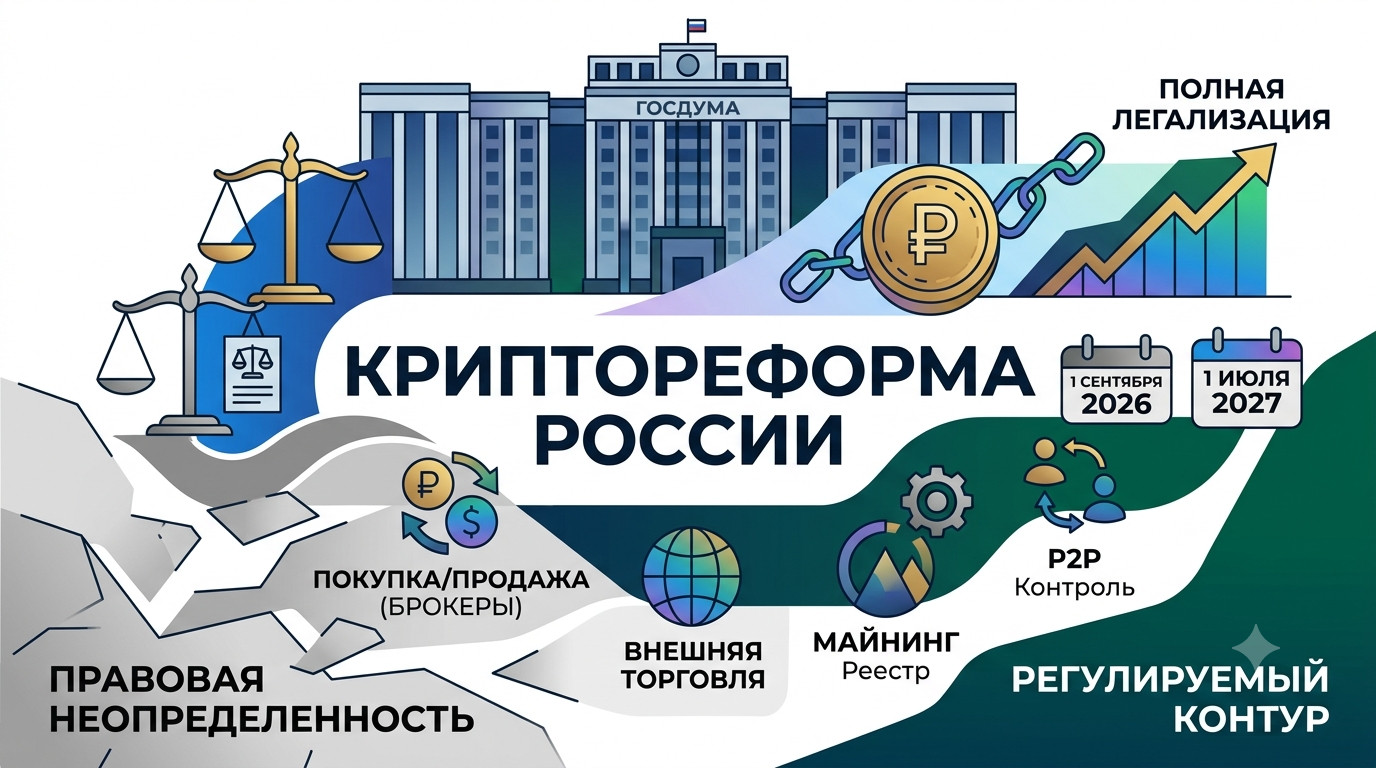
The State Duma has passed, in its second and third readings, the law "On Digital Currencies and Digital Rights" — the most far-reaching overhaul of crypto regulation in Russia's history. The law enshrines citizens' right to hold, buy, and sell cryptocurrency through licensed intermediaries, fully opens up cross-border trade settlements in digital currency, and introduces criminal liability for illegal circulation. Core provisions take effect on September 1, 2026, while the full transition to a licensed regime wraps up by July 1, 2027. This marks the end of years of legal uncertainty, during which cryptocurrency existed in the country as formally permitted but effectively unregulated.
Below, we break down what actually changes for retail investors, exporters, miners, and P2P market participants — and why crypto regulation in Russia is now built on a model of controlled legalization rather than prohibition.
| Area | What changes | Key date |
| Buying and selling | Through licensed brokers, exchanges, and crypto exchange operators | from September 1, 2026 |
| Domestic payments | Still banned, as before | unchanged |
| Foreign trade (import/export) | Unrestricted crypto settlements | from September 1, 2026 |
| P2P for rubles via a bank | Only through a licensed intermediary | from July 1, 2027 |
| Infrastructure licensing | Mandatory for exchanges, exchange operators, depositories | transition period through July 1, 2027 |
When Does the Law Take Effect, and What Happens During the Transition Period
The law takes effect in stages: baseline rules kick in on September 1, 2026, while the full licensing framework won't be operational until July 1, 2027. This timeline is confirmed by several independent sources covering the law's passage in July 2026.
According to a Finam report dated July 21, 2026, the document takes effect September 1, with the transition period for market participants running through July 1, 2027 — during which exchanges, brokers, exchange operators, and depositories must obtain licenses and bring their operations in line with the new requirements. That gives infrastructure players nearly a year to secure Bank of Russia authorization, and gives private users time to adapt to the new testing rules and limits.
One important point: the transition period doesn't mean an absence of oversight. Baseline infrastructure requirements already kick in come September, and by mid-2027 any activity outside the licensed framework — including unlicensed exchange operators and anonymous P2P platforms — becomes illegal.
Is Buying and Selling Cryptocurrency Legal in Russia
Yes — the law explicitly permits holding, buying, and selling cryptocurrency, but not using it as a means of payment inside the country. That's the key distinction the regulator itself emphasizes.
As InvestFuture analyst Evgeny Popov explains, citing the Bank of Russia, cryptocurrency can be held, bought, and sold, but it still cannot be used like ordinary money inside Russia. Paying for goods in a store with bitcoin or another digital currency remains off the table — that prohibition stays fully in place and is neither lifted nor softened by the new law.
Buying and selling crypto will now be possible through Russian brokers, exchanges, and registered crypto exchange operators. According to the Central Bank, a regulated infrastructure is being built for crypto circulation, bringing together both existing financial institutions and new market participants — crypto exchange operators and digital depositories. Crypto exchange operators will let people buy or sell digital currency, while digital depositories will record rights to those assets. Trades can also be executed through brokers and asset managers, including on organized exchanges.
What Happens to Non-Custodial Wallets
One question that comes up often: the fate of personal wallets that don't rely on an intermediary. Per InvestFuture's explanation, hardware and software wallets like Ledger and Tangem are not banned — the law explicitly recognizes whoever holds the private key and independently controls the asset as its owner. That's an important clarification for anyone who prefers to keep assets off exchanges and centralized platforms.
How Cross-Border Crypto Settlements Change Import and Export
The law's most consequential practical change is the removal of restrictions on using cryptocurrency for foreign trade settlements. Exporters and importers can now settle in digital currency without the barriers that previously applied.
According to the Bank of Russia, exporters and importers will be able to use cryptocurrency for cross-border settlements without restrictions, with such operations available both through intermediaries and directly — for all wallet types and cryptocurrencies. That gives businesses the ability to build alternative settlement channels, using blockchain to pay for imports and collect export revenue amid limited access to traditional banking infrastructure.
At the same time, residents' operations aren't confined to Russian territory alone. Per the regulator, residents will be able to conduct crypto operations abroad as well, but only using foreign bank accounts, and can transfer crypto purchased in Russia abroad through regulated intermediaries. Anyone holding crypto that's tracked abroad will need to notify tax authorities — a requirement that applies to all of a resident's foreign accounts and wallets.
For businesses operating under foreign trade contracts, the law creates a legal, predictable settlement tool — replacing the gray-market schemes that have been used in recent years because of sanctions-related restrictions.
In practice, this removes some of the administrative burden for companies that were already using digital assets to pay for supplies through intermediary jurisdictions. Such transactions can now be conducted transparently, recorded on the balance sheet, without the risk of a bank freezing a settlement account over an unclear source of funds. That said, the law doesn't eliminate currency-control or tax-reporting requirements — it simply moves crypto settlements in foreign trade from a gray area into the legal perimeter.
How Investors Will Be Split Into Qualified and Non-Qualified Categories
The law introduces mandatory testing and different levels of asset access for two categories of investors. This is a key element of protecting retail investors from excessive risk when dealing with volatile assets.
According to Finam, both non-qualified and qualified investors will be able to trade cryptocurrency through intermediaries. Non-qualified investors will be able to buy the most liquid cryptocurrencies after passing a test and within a set limit through a single intermediary. Qualified investors must also pass a test, but will have access to any cryptocurrency with no cap on transaction size.
One important nuance: the exact annual limit for non-qualified investors didn't make it into the final text of the law. As InvestFuture clarifies, the Central Bank had indeed proposed a limit of 300,000 rubles per year, but that specific figure isn't in the law as passed — the regulator will set the final number separately, through a subordinate regulation. That means businesses and private investors should keep an eye on Bank of Russia regulations that will appear after the law takes effect.
Beyond amount limits, the law allows crypto to be exchanged for digital financial assets. Per the Central Bank, investors will be able to swap cryptocurrency for securities and digital instruments issued under Russian law — so-called digital rights. Foreign stablecoins will be subject to the same requirements as ordinary cryptocurrencies, with no separate concessions.
What's in Store for Miners Under the New Law
Mining moves out of the gray zone and into regulated activity, with mandatory registration for legal entities and restrictions for home miners. For the first time, the law formally defines mining activity at the terminology level.
Industry analyses note that the amendments codify the core concepts tied to crypto mining: mining, mining pool, mining infrastructure and its operator, and the crypto wallet address identifier. In parallel, a mining registry is introduced — industrial-scale mining now requires inclusion in this registry, and mining-pool activity is formalized as a distinct type of business with its own accounting rules.
For individuals mining at home, the law doesn't impose an outright ban but rather oversight through electricity consumption and tax reporting — regions with power shortages are given the authority to restrict household mining. Evading registration carries serious consequences: penalties apply to anyone mining digital currency without registering with the Federal Tax Service if mining income exceeds 3 million rubles. For damages classified as large-scale — over 13 million rubles — penalties can include up to five years of imprisonment.
How P2P Transfers and the Gray Market Will Be Regulated
The law does not impose an outright ban on P2P exchange, but it sharply narrows the space for unregulated transactions and raises the stakes for anyone who stays outside the licensed framework. One-off deals between private individuals still won't be treated as business activity.
As InvestFuture explains, there's no blanket ban on P2P, but starting July 1, 2027, buying crypto for rubles through a Russian bank will fall under the regulated framework, and such exchanges will have to go through an official intermediary. The threshold at which an individual is treated as an exchange operator is also spelled out directly: exchange-operator status kicks in once a resident carries out two or more transactions a month totaling more than 3.5 million rubles.
For those who continue operating outside the licensed infrastructure, the risks become criminal as well as administrative. Legal analyses of the new regulation point to a dedicated article of the Criminal Code for illegal digital currency circulation — organizing illegal circulation of digital currency is now punishable under Article 171.7 of Russia's Criminal Code. In parallel, enforcement under Federal Law 115-FZ on anti-money-laundering is tightening: banks are already freezing suspicious transactions and requesting documentation for non-standard P2P transfers well before any signs of a criminal case emerge. It's the combination of bank-side anti-fraud controls under 115-FZ and the new criminal statute that's meant to push anonymous exchange operators and gray-market platforms out of the picture during the transition period through July 2027.
Administrative liability for legal entities for violations in this area includes fines, with separate sanctions for company officials — exact amounts are set out in accompanying amendments to the Administrative Offenses Code, which are being considered alongside the main law.
In practice, this means banks will keep applying a risk-based approach right now, without waiting for September. A freeze on an account under 115-FZ doesn't by itself mean a criminal case is opening — it's a signal that the bank found the transaction suspicious, and the client will need to explain the source of funds and the purpose of the payment. But the closer the transition period gets to its end, the more likely it becomes that systematic transfers through unlicensed channels will be treated as evidence of organizing an illegal exchange rather than a one-off personal transaction.
Should You Buy and Trade Cryptocurrency on KuCoin
With the new law in place, crypto trading becomes more predictable, but it still requires attention to a platform's jurisdiction and an investor's status. Legalization doesn't remove the need to choose a reliable platform with transparent trading terms and a clear fee policy.
KuCoin offers a wide range of trading pairs, tools for spot and futures trading, and educational materials that help with understanding risk testing and the specifics of working with different asset categories. For anyone looking to diversify a digital asset portfolio amid shifting regulation, it's worth studying limits, identification requirements, and the tax implications of transactions in advance — whether that's a spot purchase, staking, or derivatives.
Before making trades, it's worth assessing your own status — qualified or non-qualified investor — and confirming that the platform and settlement method you choose comply with the laws of your country of residence. Registering on an exchange with a proven track record and a clear verification process reduces the risks tied to the transition period, while Russia's licensed infrastructure is still being finalized.
Conclusion
The new digital currency law changes the fundamental logic of how the Russian state engages with cryptocurrency: instead of a gray zone, a structured system is emerging with licensed intermediaries, mandatory investor testing, and a split between qualified and non-qualified market participants. The key dates — September 1, 2026 for baseline rules and July 1, 2027 for the full licensing framework — set the timeline businesses and private investors will need to adapt to.
The main changes fall into four areas: legalizing the purchase, sale, and custody of cryptocurrency while keeping the ban on using it for payments inside the country; fully removing restrictions on crypto settlements in foreign trade; formalizing mining through a registry and electricity-consumption controls; and tightening enforcement against P2P transactions and the gray market through 115-FZ and the new Article 171.7 of the Criminal Code.
For private investors, the practical takeaway is this: exact limits for non-qualified participants haven't been set yet, so it's worth tracking the Bank of Russia's subordinate regulations. For businesses involved in foreign trade, the law opens a legal settlement channel that didn't exist before. Over the coming year, it's worth keeping a close eye on the regulator's clarifications and the requirements of specific licensed platforms.
Frequently Asked Questions
1. Can you pay for goods with cryptocurrency in Russia once the law takes effect?
No. The law explicitly bans using cryptocurrency as a means of payment inside the country — it remains a tool for custody, investment, and cross-border settlements, but not for retail payments for goods and services.
2. Do you need to report cryptocurrency held on foreign platforms to the tax authorities?
Yes. Residents are required to notify tax authorities about cryptocurrency tracked abroad, even if it wasn't purchased in Russia and is held in a foreign account or wallet.
3. What happens to crypto exchanges between neighbors or acquaintances for small amounts?
A one-off transaction doesn't make someone an exchange operator. Exchange-operator status and the associated licensing requirements only kick in with systematic activity — starting at two or more transactions a month totaling over 3.5 million rubles.
4. Is cryptocurrency taxed like ordinary income?
Cryptocurrency is classified as property, so individuals pay personal income tax on profit — the difference between the sale price and documented purchase costs — rather than on the full transaction amount.
5. What happens to crypto exchanges and exchange operators that don't get licensed by July 1, 2027?
Their activity becomes illegal. The law requires all infrastructure participants — brokers, exchanges, exchange operators, and digital depositories — to obtain a Bank of Russia license before the transition period ends, or their operations will be classified as illegal digital currency circulation under Article 171.7 of the Criminal Code.