

Rules for Storing Seized Cryptocurrency in Russia: What Resolution No. 808 Established
2026/07/14 15:16:00
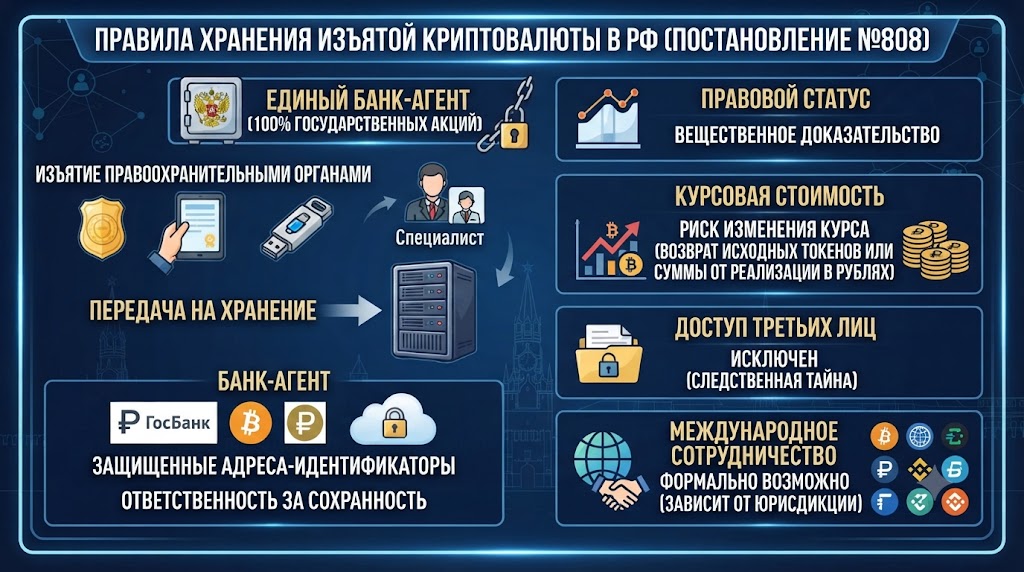
The Russian government has, for the first time, answered the question of where cryptocurrency seized by law enforcement will physically be held: on July 7, 2026, ComNews revealed details of Resolution No. 808, which approves rules for storing, transferring, and accounting for digital currency in criminal proceedings. Custody of such assets will fall to a single designated agent bank, 100% of whose voting shares belong to the Russian Federation, rather than to an ordinary commercial bank or the investigative body itself. This is the country's first concrete mechanism for cryptocurrency seized in criminal cases — until now, the law merely permitted seizure without specifying where the assets actually go once confiscated. Below we break down which bank could become the agent, how the transfer of assets into custody works, what happens to their market value, and whether the state can reach cryptocurrency held abroad.
What Did Resolution No. 808 on Storing Seized Cryptocurrency Establish?
Government Resolution No. 808, "On the Approval of Rules for Storing, Transferring, and Accounting for Digital Currency in Criminal Proceedings," establishes a single operator for all cryptocurrency seized in Russia. Custody of digital currency will be provided free of charge by a credit institution 100% of whose voting shares belong to the state — referred to in the document as the "Agent."
The Agent provides each authorized body — the Ministry of Internal Affairs, the Ministry of Emergency Situations, the Federal Security Service, the Federal Customs Service, the Prosecutor General's Office, the Investigative Committee, and their territorial divisions — with its own dedicated address-identifiers for transferring and storing digital currency. Access to these addresses by outside parties is technically excluded, and the bank itself bears legal responsibility for the safekeeping of the assets, uninterrupted system operation, and protection of confidential information about specific cases.
Experts describe this as the first deliberate step toward pulling cryptocurrency out of its semi-shadow status and extending to it the same legal protections that apply to ordinary seized property — while keeping the storage infrastructure itself under tight state control. As Daria Titkova, attorney and head of dispute resolution practice at SSP-Consult, noted, a single-operator model specifically for digital currency is new to legal practice, though the underlying logic resembles how funds are handled on special seizure accounts.
Which Bank Could Become the Agent for Storing Seized Cryptocurrency?
Only two credit institutions formally meet the requirement of 100% state-owned voting shares — Rosselkhozbank JSC and MSP Bank JSC. This was stated by Valery Petrov, a member of the expert council of RACIB (the Russian Association of Crypto-economy, Artificial Intelligence and Blockchain), based on an analysis of ownership structures; he noted that better-known state banks — Sberbank, VTB, Gazprombank, DOM.RF Bank, Promsvyazbank — don't meet this criterion, since the state doesn't hold the full 100% of voting shares specifically in these institutions.
Experts consider Rosselkhozbank the most likely candidate: its assets are estimated at 7–8 trillion rubles, it operates more than 1,300 branches nationwide, and it has its own data centers along with years of experience serving millions of individual and hundreds of thousands of corporate clients. MSP Bank is the second formal candidate, but it is a specialized development institution with assets of roughly 1 trillion rubles — considerably smaller in infrastructure scale.
Alexey Golovchenko, managing partner at the law firm Enso, pointed out that analogues of a single property operator already exist in criminal proceedings — for instance, Rosimushchestvo, which manages seized and confiscated property in certain categories of cases. According to him, the agent bank will essentially replicate that same centralized-operator model, but applied to digital currency as a distinct object of storage and accounting that requires its own technical infrastructure for transferring funds to secured addresses.
How Does the Seizure and Transfer of Cryptocurrency Into Custody Work?
When digital currency is seized or placed under arrest, the authorized body is required to act together with a specialist engaged in accordance with Russia's Criminal Procedure Code and transfer the assets to an address-identifier issued by the agent bank, notifying the bank of the transfer within three days. Each authorized organization keeps its own records of the seized currency independently, on its own technical platform — the agent bank is responsible for custody itself, not for the case materials.
Keys and address-identifier data are physically stored on specialized digital media housed in facilities with full physical security, which rules out unauthorized outside access. The agent bank acts as a trustee and is responsible for ensuring the asset isn't harmed by improper storage throughout the entire investigation and trial.
The seizure procedure must be documented in writing and carried out with witnesses present — this reduces corruption risk and creates a verifiable paper trail for every operation. At the same time, the process doesn't become an open public registry: outside parties cannot track the movement of specific seized assets, since this information falls under protected investigative secrecy rather than publicly available blockchain data.
The record of the investigative action notes the type of digital currency — for example, BTC, ETH, or USDT — its quantity, and the sender's and recipient's address-identifiers when funds are transferred into custody. This level of detail is needed to later unambiguously prove that specific assets belong to a specific case — according to Titkova, proving ownership of an asset, rather than the provisions of the resolution itself, will be the main practical challenge for investigators.
Will Owners Be Compensated for Losses From Exchange-Rate Fluctuations in Seized Cryptocurrency?
No, the law currently does not provide for direct compensation for market fluctuations in the value of cryptocurrency during the period it's held in custody after seizure. When seizing assets, law enforcement records the type and quantity of the specific digital asset, not its ruble equivalent at the time of arrest — meaning the asset itself is formally seized, not its value at that moment.
If a court later decides to return the property to the owner, they will get back the original asset itself — the same quantity of the same tokens as they exist on the blockchain. But if the legally established mechanism for forced liquidation of the asset was used during the custody period, the owner will instead be paid the ruble amount raised from that sale upon return, rather than the equivalent at the current exchange rate on the day of return. This means that if an asset's value rises sharply during the investigation, the owner risks receiving compensation at a substantially lower price than the current market rate.
Can the State Seize Cryptocurrency Held Abroad?
Yes, formally, Russian law enforcement agencies are entitled to approach foreign exchanges through international cooperation mechanisms and request that funds connected to a crime be frozen or handed over. This possibility is explicitly provided for under the new regulation and extends to cryptocurrency held in accounts on foreign trading platforms.
In practice, the effectiveness of such requests depends heavily on the specific jurisdiction. Cooperation works fairly predictably with exchanges where channels of legal assistance with Russia are already established, whereas offshore platforms without agreements with Russian authorities present serious technical and sovereignty barriers to enforcing such demands. This means that, at this stage, such operations tend to rely on targeted engagement between specific agencies and specific exchanges rather than automatic cross-border tracking of all of a suspect's assets.
For holders of assets on a foreign platform, this means the real risk of seizure depends directly on the jurisdiction of the specific exchange and on how actively it cooperates with foreign law enforcement under its own compliance policy — not solely on the formal provisions of Russian law.
How Is Access to Cryptocurrency Obtained If the Owner Refuses to Cooperate?
By law, investigators are entitled to demand that a suspect provide the means of access to a digital wallet — that is, the private keys or seed phrase needed to transfer assets to the agent bank's address-identifier. This follows directly from the logic of Article 164.2 of the Criminal Procedure Code, which governs an investigator's actions when handling digital currency as physical evidence.
If the owner refuses to provide access voluntarily, the court and investigative bodies may apply legally prescribed coercive measures or use available technical means to obtain access where feasible. The blockchain is structured such that it's technically impossible to "block" cryptocurrency without the keys — in reality, the only option is to physically restrict the owner's access to the storage medium or access code, which is why the law requires a qualified specialist to be involved at this stage.
In practice, this means that seizing a computer, hardware wallet, or a written-down seed phrase doesn't guarantee investigators immediate access to the assets — without the voluntary provision of keys or the successful application of technical or procedural measures, cryptocurrency can remain inaccessible even while formally "under arrest." This is exactly why the specialist brought in for the investigative action assesses the specific type of digital currency and the specific storage method, in order to determine what measures will actually secure the asset and enable its subsequent transfer to the agent bank's address-identifier.
How Do the Rules for Storing Seized Cryptocurrency Differ From General Crypto Custody Rules?
The agent bank's rules apply only to assets already involved in a criminal case — this is a separate regime, unrelated to how ordinary Russians store their own cryptocurrency. General market regulation is structured differently: according to Vladimir Chistyukhin, First Deputy Governor of the Bank of Russia, speaking at the Bank of Russia's Financial Congress, the regulator intends to permit predominantly custodial storage — that is, through licensed intermediaries such as digital depositories, rather than directly by the user.
Self-custody in non-custodial wallets — including hardware devices like Ledger and Trezor — isn't explicitly banned, but will legally be treated as storage "outside Russian jurisdiction." An outright ban here is technically impossible: a hardware wallet only stores the access key, while the asset itself exists on the blockchain outside any particular territory — so a device physically sitting in an apartment in Moscow will legally be considered a foreign storage location.
Liability arises not from simply owning a personal wallet, but from specific operations conducted through it: accepting funds from third parties or engaging in regular exchange via a personal wallet could be classified as illegal intermediary activity, for which criminal liability will be introduced starting in July 2027. Those who simply hold previously purchased cryptocurrency without such operations face no risk, but experts recommend keeping documentation proving the currency was legally acquired — without such proof, an owner doesn't automatically lose the asset, but could lose legal protection of their rights to it if a dispute arises.
| Parameter | Seized Cryptocurrency (Resolution No. 808) | Personal Cryptocurrency in a Non-Custodial Wallet |
| Who holds it | Agent bank with 100% state-owned voting shares | The owner themselves; keys aren't handed to third parties |
| Legal status | Physical evidence in a criminal case | Formally an asset outside Russian jurisdiction |
| Liability | Borne by the agent bank for safekeeping and accounting | Borne by the owner; risk arises from third-party operations |
| Third-party access | Technically and legally excluded | Depends on who the owner gave the keys to |
How to Secure Your Crypto Assets and Use Them Legally on KuCoin
The best defense against risks tied to seizure and any subsequent dispute over asset ownership is a transparent acquisition history and custody on a clear, verifiable platform. KuCoin provides a complete transaction history, trade statements, and transfer confirmations that help users confirm the lawful origin of their assets at any time.
To get started, it's enough to register, complete standard identity verification, and fund the account through one of the available methods. Built-in fund-protection tools — including cold storage of reserves and multi-factor authentication — reduce operational risk, while access to hundreds of trading pairs across spot and futures markets makes it possible to build an investment strategy without needing to keep all assets in less transparent or fully anonymous wallets. Maintaining complete documentation for every transaction on the platform removes the need to hunt for supporting paperwork after the fact, should the question ever arise.
Conclusion
Resolution No. 808 lays out, for the first time, a concrete mechanism for storing cryptocurrency seized in criminal cases: the sole operator will be an agent bank with 100% state-owned voting shares, with Rosselkhozbank and MSP Bank cited by experts as the most likely candidates for the role. The bank will issue separate, secured address-identifiers to each law enforcement body, with third-party access technically excluded, and the entire seizure process must be documented in writing with witnesses and a specialist present.
At the same time, the law does not yet guarantee owners compensation for market fluctuations in asset value during the custody period — if forced liquidation occurs, the amount returned is the proceeds in rubles, not the current equivalent. Cross-border seizure of cryptocurrency is formally possible through international cooperation, but in practice works effectively only with exchanges that already have channels of legal assistance established with Russia. For ordinary crypto holders, the main practical takeaway is to maintain a transparent history of asset acquisition and keep transaction records, since it's the provability of lawful origin — not the mere fact of holding cryptocurrency — that determines the outcome of a dispute in the event of seizure.
Frequently Asked Questions
1. Does the agent bank charge a fee for storing seized cryptocurrency?
No, under Resolution No. 808 the agent bank stores digital currency free of charge — meaning no fee is charged to the owner or the budget for the custody itself.
2. Can an outside party find out whose cryptocurrency is stored at a specific address-identifier?
No, access to address-identifiers and the data associated with them is technically and legally excluded for outside parties, and information about specific seized assets falls under protected investigative secrecy rather than a public registry.
3. What happens to the cryptocurrency if a criminal case is closed without a conviction?
In that case, the asset must be returned to the owner in the form in which it was seized — unless it was liquidated under the legally established procedure during the custody period, in which case the ruble proceeds from the sale are returned instead.
4. Do the new storage rules apply to cryptocurrency voluntarily declared by citizens?
No, Resolution No. 808 governs exclusively the procedure for storing digital currency seized or placed under arrest in criminal proceedings, not the general procedure for declaring or tax-reporting crypto assets.
5. Do Russian cryptocurrency owners need to urgently move assets from personal wallets to exchanges?
No, the law creates no urgent legal necessity to do so — the rules concern assets already involved in a criminal case, not the general custody practices of law-abiding cryptocurrency holders under normal circumstances.