

Digital Ruble Top-Up Limit Set at 300,000 Rubles per Month: What Will Change for Russians from September 1, 2026?
Introduction
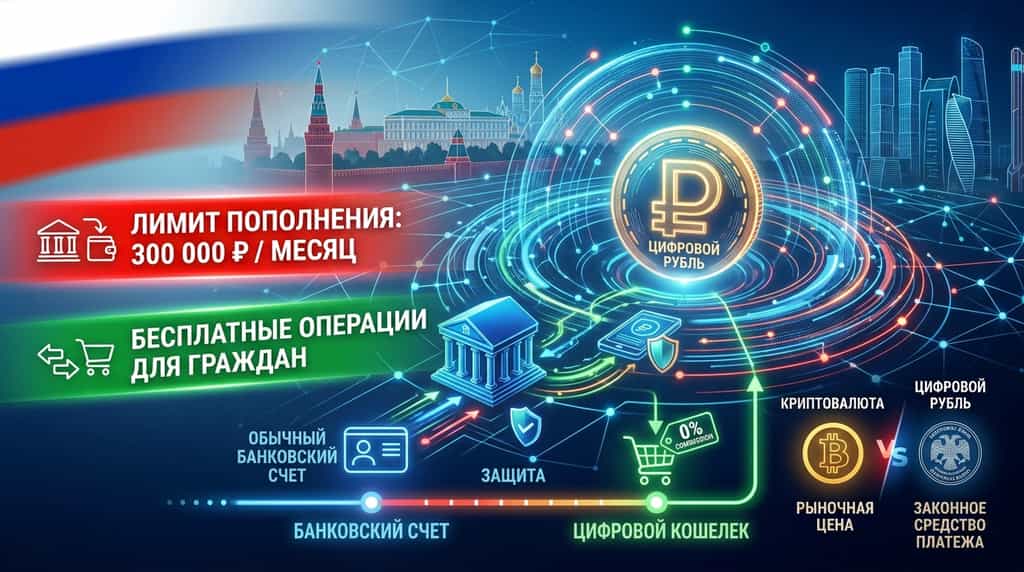
What happens when money can be transferred from an ordinary bank account into a digital wallet and then spent without a fee? From September 1, 2026, Russia will begin the large-scale, phased rollout of the digital ruble. For individuals, the key restriction will not be a payment limit, but a wallet top-up limit of 300,000 rubles per month. According to Alla Bakina, Director of the Bank of Russia’s National Payment System Department, this is the maximum amount that can be transferred from a person’s non-cash account at one bank to a digital account; no limits on transfers within the platform are planned.
It is important not to confuse the digital ruble with cryptocurrency. The digital ruble is the third form of legal tender issued by the Bank of Russia alongside cash and non-cash rubles—in other words, Russia’s central bank digital currency. Bitcoin, Ether, and stablecoins, by contrast, are digital assets that are not equal to Russia’s national currency and operate according to a different economic model. Operations with the digital ruble are expected to be free for individuals, but the wallet will not pay interest or provide a purchase rebate.
What Does the 300,000-Ruble Monthly Limit Mean?
The 300,000-ruble limit applies only to topping up a digital wallet from a person’s own non-cash account at one bank. It does not limit the balance already held in the wallet, nor does it establish a monthly ceiling for purchases or transfers between digital-ruble users.
In other words, an individual will be able to transfer no more than 300,000 rubles to a digital wallet through this channel during a calendar month. Once the money is in the wallet, it can be used freely on the platform to pay for purchases, send transfers, or convert digital rubles into ordinary non-cash money. The Bank of Russia has separately emphasized that there will be no limits on transfers within the platform.
|
Operation
|
Information available at the time of publication
|
Fee for individuals
|
|
Topping up a digital wallet from one’s own non-cash account
|
Up to 300,000 rubles per month
|
Free
|
|
Transfer between digital-ruble wallets
|
No separate limit established
|
Free
|
|
Paying for a purchase in digital rubles
|
The restriction depends on the merchant and transaction terms; no general limit for individuals has been announced
|
Free
|
|
Conversion into ordinary non-cash rubles
|
At a one-to-one exchange rate
|
Free
|
|
Cash withdrawal
|
Conversion into non-cash rubles is required first
|
May depend on ordinary bank withdrawal rules
|
Therefore, the phrase “300,000-ruble digital-ruble limit” is imprecise. It is more accurate to refer to a monthly digital-wallet top-up limit. This distinction matters to users who fear that reaching the threshold will prevent them from paying for purchases or receiving transfers. The published explanations indicate the opposite: the restriction applies to an incoming transfer from a specific bank account, not to the use of funds already held within the digital platform.
Why Is the Bank of Russia Introducing a Top-Up Restriction?
The main reason for the limit is the need to introduce a new form of money without triggering a sharp transfer of deposits from commercial banks into digital wallets. If customers could move large sums directly from bank accounts into the digital-ruble infrastructure without restriction, commercial banks could face an accelerated liquidity outflow. The 300,000-ruble monthly limit therefore acts as a protective barrier while the system is being scaled up.
This logic is connected with the risk of banking panic and mass deposit outflows. A traditional deposit is both a source of funding for a bank and a liquid asset for the customer. If deposits were transferred into digital form on a mass scale, a bank could lose funding faster than it could replace it. The regulator therefore needs to maintain a controlled transition in which citizens receive a new payment instrument while the banking system adapts gradually.
The second reason is financial-risk management. Any new payment infrastructure can be used for fraud, unlawful movement of funds, and money laundering. Restricting the initial funding channel reduces the speed at which large sums can enter the new system and gives participants time to refine identification, monitoring, and anti-money-laundering and counter-terrorist-financing procedures. This does not mean that every user is treated as a potential offender; it is a matter of managing financial-system risks.
At the same time, publicly available explanations present the limit as the only restriction on transfers from a person’s own non-cash account to a digital account. It is therefore incorrect to call it a fee or a hidden tax. No portion of the money is withheld, and the payment amount is not reduced. A user can top up the wallet free of charge within the established threshold and then spend digital rubles without a fee as an individual.
How Is the Digital Ruble Different from Ordinary Money and Cryptocurrency?
The digital ruble is a form of the Russian ruble, not an independent speculative asset. It is issued by the Bank of Russia, has the same nominal value as an ordinary ruble, and can be converted into non-cash rubles at a one-to-one rate. Its primary economic function is payments, transfers, and programmable settlements—not earning a return from changes in market price.
Ordinary non-cash rubles exist in commercial-bank accounts. Digital rubles circulate through a separate digital-ruble platform, while access to the wallet is provided through a banking application. Users can therefore interact with the new infrastructure in a familiar way, but a digital wallet should not automatically be treated as another interest-bearing deposit account at a commercial bank.
Cryptocurrencies work differently. Bitcoin and Ether are not issued by the Bank of Russia; their prices are determined by the market, and transactions depend on the rules of the relevant blockchain networks and platforms. Stablecoins seek to maintain a link to the dollar or another underlying value, but they are also not Russian legal tender. Confusing these categories can create the false impression that the digital-ruble limit is a restriction on cryptocurrency purchases. They are different products subject to different regulatory regimes.
How Will Russians Use a Digital Wallet?
A wallet will be opened through the mobile application of a bank participating in the digital-ruble launch. According to TASS, the large-scale rollout will begin on September 1, 2026, in stages. The largest banks will provide access first, and all credit organizations are expected to join the system by September 2028.
After registering on the platform, users will be able to choose digital rubles for receiving salaries and other payments, pay for goods in stores, and send transfers. At retail locations, purchases are expected to use a special payment code: the customer scans it in the banking application, selects digital rubles as the source of funds, and confirms the transaction.
Conversion of digital rubles into ordinary non-cash money will also be available. It will be carried out at a one-to-one exchange rate without a fee for individuals. This reduces the risk that users will become trapped in a closed system and unable to return their funds to the familiar banking form.
The wallet has one practical restriction: each citizen will be allowed to have only one digital-ruble wallet. Digital rubles cannot be withdrawn directly from an ATM. To receive cash, users must first convert the digital currency into non-cash rubles, after which ordinary bank cash-withdrawal procedures apply.
Will Operations Be Free for Individuals?
Yes. The Bank of Russia states that digital-ruble operations will be free for individuals. Alla Bakina clarified that citizens will not pay fees for operations, while business tariffs are also expected to be minimal compared with existing bank charges.
Free operations are part of the adoption strategy. The regulator is using a zero-fee model for individuals to reduce the cost of trying the new system and to dispel the concern that the 300,000-ruble limit represents a charge for topping up a wallet. In practice, the limit defines the volume of the incoming transfer rather than the amount withheld.
Comparisons with commercial banks require caution. In the ordinary banking system, certain transfers—especially interbank transfers or transactions exceeding the free limits of a particular tariff—may incur fees. The announced digital-ruble model for individuals assumes free transfers, payments, and conversions. Users should nevertheless check their bank’s terms for operations that take place in the ordinary ruble infrastructure, such as a later cash withdrawal.
For businesses, minimal tariffs—not absolute fee-free service—are planned. This could encourage stores, supermarkets, and online marketplaces to accept digital rubles. The lower the merchant’s settlement costs, the stronger the incentive to offer customers a new payment method. As a result, adoption of the digital ruble may be driven not only by banking applications but also by retail platforms.
Why Will the Digital Wallet Pay No Interest or Purchase Rebates?
The digital ruble is a payment instrument, not a savings deposit. Wallet balances will not earn interest, and digital transactions will not include the customary bank purchase rebate. Holding money there solely for yield or rewards is therefore less attractive than using commercial-bank products designed specifically for savings.
The absence of interest changes the way users may manage the wallet. It is rational to top up a digital wallet before making payments, receive designated payments there, or use it for free transfers. If funds are not needed for current transactions, a user may prefer a bank account or deposit with its own income and protection terms.
The absence of purchase rebates may also slow voluntary adoption among some customers. For many shoppers, the choice of payment method depends not only on fees but also on rewards. To offset this disadvantage, retailers may offer discounts, special prices, or loyalty programs. The availability of such offers, however, will depend on the individual merchant rather than on the digital-ruble platform itself.
Will the Digital Ruble Be Fully Transparent to the Regulator?
Digital-ruble transactions will pass through centralized infrastructure, making the movement of funds more transparent to the Bank of Russia and authorized financial-control participants than cash transactions. This is part of the digital-currency architecture and one of its most important public-policy questions.
Transparency can help identify suspicious payment chains, investigate fraud more quickly, and monitor the execution of government payments. It also has a downside: users who place a high value on financial privacy may not want to move all everyday spending into digital form. For groups seeking to conceal income or evade taxes, centralized transaction records are particularly unattractive.
This should not be interpreted as a complete rejection of cash or ordinary non-cash rubles. At launch, the digital ruble is being positioned as an additional form of national currency. Its use is intended to be voluntary, and the speed of adoption will depend on wallet convenience, the readiness of banks and retailers, and public trust in data-processing rules.
How Will the Limit Affect Banks, Businesses, and Users?
For commercial banks, the limit reduces the risk of a sudden deposit outflow but does not eliminate competitive pressure. If a digital wallet provides free transfers, convenient payments by special code, and direct receipt of certain payments, banks may lose part of their fee income from settlement operations. At the same time, they retain the customer-facing role because wallets are opened through banking applications.
For businesses, the digital ruble may reduce payment costs and accelerate settlements. Vedomosti cites an estimate by the Central University that, under broad adoption, the instrument could generate up to 423 billion rubles a year for the Russian economy, including up to 348 billion rubles for the real sector and up to 75 billion rubles for the banking sector. This is a scenario-based estimate of potential impact rather than a guaranteed result; it depends on the scale of adoption, new products, and actual payment savings.
For ordinary users, the key question will not be “Can I transfer more than 300,000 rubles?” but rather “What do I need a digital wallet for?” The announced terms appear convenient for everyday payments and transfers. The digital ruble is less attractive for savings because it pays no interest. Cash transactions require an additional conversion. Large recurring transfers will require users to account for the monthly top-up limit and plan their funds in advance.
How Should You Use the Digital Ruble Given Its Limitations?
The most rational approach is to treat the digital ruble as a separate payment account rather than a replacement for every banking product. Users can keep funds there for current expenses, receive eligible payments, and make free transfers. Savings, liquidity reserves, and funds intended to generate interest should instead be assessed through suitable banking products.
If monthly expenses exceed 300,000 rubles, the limit does not automatically prohibit all payments above that amount. It is important to distinguish new top-ups from a non-cash account from the balance already held in the digital wallet. However, the rules for specific transactions and the ways in which payments are credited may be clarified by banks and the regulator. Before making a large transfer, users should check the current terms in their servicing bank’s application.
Finally, users should consider privacy in advance. Free operations and convenience are important advantages of the digital ruble, but centralized recordkeeping means less privacy than cash payments. The choice of payment instrument should take into account not only fees, but also the purpose of the funds, the need for income, access to cash, and the user’s attitude toward financial transparency.
How to Buy or Use the Digital Ruble Through KuCoin?
The digital ruble is not a cryptocurrency and is not traded on KuCoin like Bitcoin, Ether, or stablecoins. A digital-ruble wallet can therefore be opened and funded only through a supported banking application and the official digital-ruble platform, not through a cryptocurrency exchange.
KuCoin is designed for operations with digital assets and does not replace a Russian bank account or a central-bank digital-currency wallet. Users should keep these functions separate: the digital ruble is used for national payments and settlements, while a cryptocurrency platform is used for assets available in its jurisdiction and under applicable rules. Before any transaction, users should check product availability, regional restrictions, and identification requirements.
KuCoin Offers A More Stable Option in A Volatile Market
If you worry about the frequent ups and downs in the market, and pursue a more stable option to earn money passively, KuCoin is the right place to come:
Simple Earn: Deposit and withdraw tokens anytime, earning stable returns.
Kucoin Earn: Earn stable profits with professional asset management.
Hold to Earn: Earn rewards by holding assets in Funding, Trading, Margin, Futures, Mining, and Unified Accounts.
Staking: Unlock the earning potential of on-chain assets.
Advanced Investments: Advanced Investments offer a variety of structured products to help your money grow in any market.
Shark Fin: Principal Protection and Guaranteed Gains
Dual Investment: Buy low and sell high with transparent return calculations.
Snowball: High yields, with price protection.
Discount Buy: Buy crypto at discount prices.
KCS Loyalty: Level up to enjoy exclusive perks by staking ≥ 1 KCS.
KuCoin Wealth: Discover future value and begin your smart investing journey.
KCS Benefits: Hold and stake KCS to access benefits across the platform.
KCS Staking 2.0: Participate in KCS on-chain governance to earn yield.
Conclusion
The 300,000-ruble monthly limit applies only to topping up a digital wallet from a person’s own non-cash account at one bank. It is not a fee, does not restrict transfers within the platform, and does not establish an overall spending limit for digital rubles. From September 1, 2026, the large-scale rollout will begin in stages: the largest banks will provide access first, and the system will later expand to other credit organizations.
The Bank of Russia’s policy combines three elements. The top-up restriction is intended to reduce the risk of a sharp deposit outflow and help control financial risks. Free operations for individuals are designed to accelerate adoption of the new payment instrument. Minimal business tariffs are intended to encourage retail networks and online platforms to connect to the system.
The digital ruble should not be treated as either a deposit or a cryptocurrency. It pays no interest or purchase rebates, but it provides free payments and one-to-one conversion. Its main advantage is its settlement function; its key trade-offs are the absence of yield, the need to convert before withdrawing cash, and the high transparency of fund movements. For Russians, it will be an additional payment instrument whose usefulness will depend on individual spending patterns and attitudes toward these limitations.
Frequently Asked Questions
1. Can more than 300,000 rubles be transferred between digital wallets?
Yes. Published explanations indicate that the limit applies to topping up a wallet from one’s own non-cash account, not to transfers within the platform. No separate monthly limit for such transfers has been announced.
2. Can salaries be received in digital rubles?
Yes. Digital rubles can be selected for receiving salaries and other payments if the employer or paying organization provides this option.
3. Can digital rubles be withdrawn from an ATM?
Not directly. Users must first convert digital rubles into ordinary non-cash rubles, after which the transaction is completed through the standard bank cash-withdrawal procedure.
4. Does a digital-ruble balance earn interest?
No. A digital wallet is not a savings deposit: balances do not earn interest, and digital transactions do not provide purchase rebates.
5. Can digital rubles be purchased on a cryptocurrency exchange?
No. The Bank of Russia issues the digital ruble, which circulates through official banking infrastructure. Cryptocurrency exchanges operate with digital assets and therefore do not replace a central-bank digital-currency wallet.
Disclaimer : This material is provided for informational purposes only and does not constitute financial, investment, legal, or tax advice. Transactions involving cryptocurrencies and tokenized assets carry substantial risks — including price volatility, limited liquidity, counterparty exposure, and the potential for total loss of invested capital. Readers should conduct their own research and, where appropriate, consult a qualified professional before making any financial decisions.