

Digital Ruble in 2026: How Bank and Retail Infrastructure Is Reshaping Russia's Financial Market
2026/08/31 16:39:00
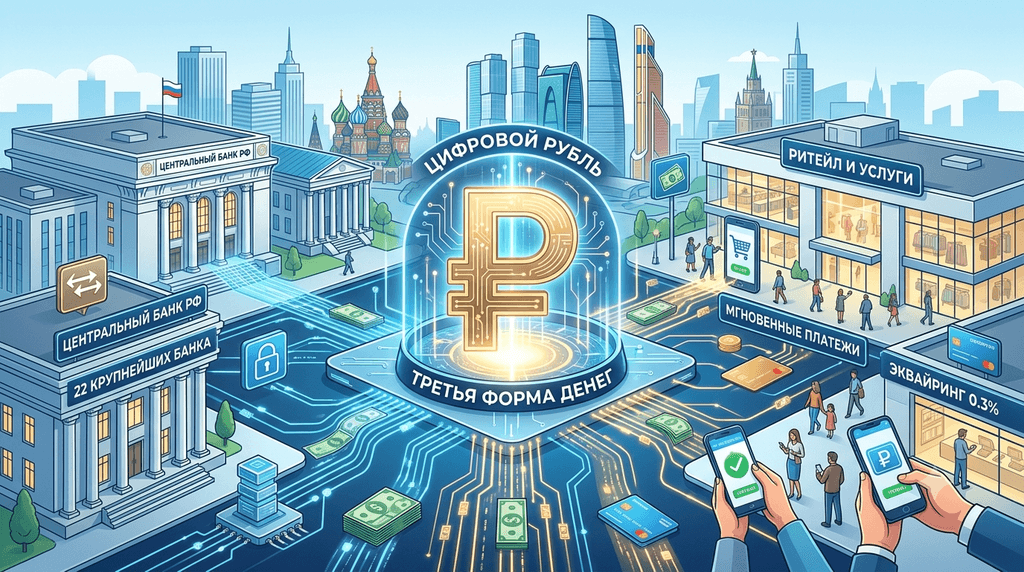
As of September 1, 2026, Russia's largest banks and retail chains are mandated to fully open their infrastructure to digital ruble operations, transforming the national currency's third form into a mainstream payment method. This step completes the phase of limited pilot projects and transitions the country's financial system to new settlement standards. According to the TASS news agency and reports from Novosti Voronezha in August 2026, 22 systemically important banks are completing their technical integration with the Central Bank of the Russian Federation's (CBR) platform. Users gain the ability to make instant fee-free transfers through their everyday mobile banking apps, while retailers significantly reduce acquiring costs. This article breaks down how the digital ruble works, current transaction limits, key differences from cryptocurrencies, and practical benefits for businesses and citizens.
What Does the Launch of Digital Ruble Infrastructure Mean for Banks and Retail Starting September 1, 2026?
The full infrastructure launch starting September 1, 2026, mandates that 22 systemically important banks and major retail chains accept and process digital ruble payments. This phase, legally mandated by the regulator, concludes the isolated testing phase. According to CityTraffic reports from August 2026, commercial banks must provide customers with the technical capability to open digital wallets and perform transactions directly within their existing mobile applications.
Key Regulatory Requirements and the List of 22 Systemically Important Banks
The Bank of Russia's regulatory framework obligates all major credit institutions to enable seamless account opening and transaction processing in the digital national currency by autumn 2026. The list of key financial institutions includes major market players such as Sberbank, VTB, Alfa-Bank, T-Bank, Gazprombank, and other systemically important entities.
Refusal or delay in providing access to the CBR platform subjects financial organizations to regulatory sanctions. The primary objective of mass onboarding is to build a unified payment environment where any citizen can pay with digital rubles at a major supermarket or service provider without downloading third-party applications.
Bank of Russia's Unified Platform and the "Single Window" Principle
All digital wallets belonging to citizens and organizations are hosted directly on the Central Bank's single technological platform, despite being accessible through mobile services offered by commercial banks. Customers do not need to register separate accounts with each credit institution.
According to clarifications from the Bank of Russia, individuals and legal entities are entitled to open strictly one digital account on the regulator's platform. An exception is made for individual entrepreneurs (IPs) and self-employed citizens: the regulator clarified that self-employed individuals and sole proprietors may hold two accounts—one for personal use and one for commercial activities. Access operates on a "single window" principle: a single tap in any connected bank's mobile app instantly connects users to their sole digital wallet at the CBR.
Will the Digital Ruble Replace Cash and Bank Cards?
The digital ruble will not replace cash or bank cards; instead, it acts as a third, equal form of national currency whose usage remains entirely voluntary. Russian law guarantees freedom of choice regarding payment methods for all citizens and legal entities.
Voluntary Use and the Concept of a Third Form of Money
Russian citizens retain the full right to decide how they wish to receive wages, pensions, or social benefits. The regulator has officially confirmed that there are no plans for mandatory transition to digital ruble payments.
If a citizen prefers traditional plastic cards or physical banknotes, they retain the right to decline opening a digital wallet entirely. The digital ruble is designed as an alternative tool to increase settlement speed and reduce transaction friction, not as a mechanism to displace existing forms of money.
Coexistence of Traditional Non-Cash, Cash, and Central Bank Digital Currency
All three forms of the Russian ruble hold identical value and convert into one another at a 1:1 ratio without losses or fees. One cash ruble equals one non-cash ruble in a bank account and one digital ruble on the Central Bank platform.
Users can transfer funds from digital form to non-cash bank cards at any time and withdraw physical cash from ATMs as needed. The parallel operation of all three currency formats ensures flexibility across the financial system while protecting the interests of all demographic groups.
What Are the Limits, Fees, and Top-Up Rules for Digital Ruble Wallets?
For individuals, the monthly top-up limit from traditional bank accounts into a digital wallet is set at 300,000 rubles, whereas businesses face no top-up limits, and transfers between individuals are completely free. These rules aim to preserve liquidity balance across the banking sector while stimulating business activity.
300,000-Ruble Limit for Individuals and Benefits for Businesses
The 300,000-ruble monthly ceiling applies exclusively to transfers from non-cash commercial bank accounts into an individual's digital wallet. This restriction prevents an abrupt outflow of client deposits from commercial banks to the CBR platform.
Once funds are deposited into a digital account, individuals can freely manage their balance without daily or monthly caps on payments and transfers. For legal entities and corporate accounts, the regulator sets no upper limit on top-ups—businesses can deposit any volume of liquidity into their digital accounts.
Zero Fees for Citizens and Grace Period for Entrepreneurs Until Year-End
All payments for goods and services, as well as peer-to-peer (C2C) transfers within the digital ruble system, are completely free of charge for individuals without transaction volume caps. The Central Bank emphasizes that citizens will never be charged fees for transactions on the platform.
For businesses and legal entities, the government has introduced a special grace period: until the end of the current year, all corporate payments and transfers carry zero fees. According to the regulator, permanent tariffs will take effect starting in 2027, offering the lowest rates in the payment market—acquiring fees for businesses will be capped at 0.3% of the transaction amount, with a maximum fee limit of 1,500 rubles per payment.
Comparison of Fees and Conditions: Cash, Bank Cards, and Digital Ruble
Comparative analysis demonstrates that the digital ruble offers optimal tariff conditions for merchants while remaining completely free for retail customers.
| Parameter | Cash | Non-Cash (Cards / FPS) | Digital Ruble |
| Issuer / Platform | Bank of Russia | Commercial Banks | Bank of Russia |
| Interest on Balance | None | Accrued on deposits/savings | Statutorily prohibited |
| Cashback & Rewards | None | Provided by banks | None |
| Transfer Fees (Individuals) | 0% | Free within FPS limits | 0% without volume limits |
| Merchant Fees | Cash handling costs | 1.2% – 2.5% (Acquiring) | 0% until year-end, then 0.3% (max. 1,500 RUB) |
| Top-Up Limit | Unlimited | Unlimited | 300,000 RUB/month for individuals; Unlimited for businesses |
Why Are Interest and Cashback Not Accrued on the Digital Ruble?
Interest on savings and merchant cashback are not accrued on digital rubles because the currency is legally designated purely as a payment settlement instrument, not a savings or investment vehicle. Introducing interest rates would contradict the fundamental concept of a national digital currency.
Statutory Prohibition on Interest Rates on Digital Accounts
Federal legislation and Bank of Russia regulations explicitly prohibit interest accruals on digital wallet balances. This restriction protects the traditional commercial banking business model.
If digital rubles earned interest comparable to bank deposits, capital would migrate en masse from commercial banks to the central bank due to its absolute creditworthiness. This would deprive credit institutions of the liquidity needed to issue mortgages and corporate loans.
Transactional Status of the National Digital Currency
The absence of cashback programs stems from the minimal acquiring fees charged to merchants, which leave no margin to fund marketing rewards. Commercial banks fund cashback offers out of higher merchant acquiring fees (1.2%–2.5%).
At a merchant fee of just 0.3%, paying out cashback becomes economically unviable. The digital ruble is engineered for instant, low-cost settlements. For wealth accumulation and yield generation, citizens will continue using traditional bank deposits and savings accounts.
How Safe Are Digital Ruble Payments and What Happens If a Bank Goes Bankrupt?
Digital ruble balances carry the highest level of security because they are held directly on the CBR platform under FSB-certified encryption and are entirely insulated from commercial bank insolvency risks. This makes them one of the safest mechanisms for holding liquid funds.
Protection of the CBR Platform by FSB Encryption Standards
The cybersecurity architecture of the digital ruble platform relies on domestic cryptographic algorithms certified by the Federal Security Service (FSB) of Russia. Every transaction carries a unique digital identifier and is signed using secure electronic keys.
System architecture eliminates the possibility of counterfeiting digital tokens, unauthorized balance modifications, or tampering with transaction histories. High-grade cybersecurity protects user data against breaches and cyberattacks.
Complete Isolation of Funds from Commercial Bank Financial Stability
Financial distress or license revocation at a commercial bank through whose app a customer accesses their digital wallet has zero impact on the safety of their digital rubles. The commercial bank functions merely as a front-end interface or technology intermediary.
Because funds reside physically on Central Bank servers, a bank failure does not lock user funds. Customers can restore access to their digital wallet within minutes using the mobile app of any other operational bank.
How Does the Digital Ruble Differ from Cryptocurrencies and How Do Smart Contracts Work?
The digital ruble is a centralized national fiat currency backed 100% by the state, setting it apart from decentralized, volatile cryptocurrencies. It serves as official legal tender denominated in the national monetary unit.
State Backing vs Cryptocurrency Asset Decentralization
The primary distinctions between a CBDC (Central Bank Digital Currency) and cryptocurrencies lie in legal status, centralized issuance, and price stability. The Bank of Russia serves as the sole issuer of the digital ruble, fully backing it with state credit.
Cryptocurrencies operate on decentralized blockchains without a sovereign guarantor, and their market valuations experience significant volatility. The digital ruble is pegged 1:1 to the traditional ruble and cannot be traded as a speculative investment asset.
Money Marking and Targeted Control via Bank of Russia Smart Contracts
The digital ruble platform supports smart contract execution, enabling programmable settlement conditions and the "marking" of specific funds. This functionality optimizes oversight over targeted public expenditure.
The state can mark government subsidies, maternity capital, or welfare payments. Consequently, marked digital rubles can only be spent on designated categories—such as children's goods, educational materials, or medical services—preventing fund misappropriation or corrupt diversion.
Comparative Analysis: Digital Ruble, Traditional Fiat, and Cryptocurrency
Evaluating key parameters across financial tools highlights their fundamental operational differences.
| Parameter | Traditional Fiat (Cards/Cash) | Digital Ruble (CBDC) | Cryptocurrency (BTC, ETH, USDT) |
| Issuer & Governance | CBR / Commercial Banks | Bank of Russia | Decentralized network / Private entities |
| Legal Status | Official Legal Tender | Official Legal Tender | Varies / Property asset |
| Price Volatility | Tied to national inflation | Tied to national inflation | High market volatility |
| Smart Contracts | Limited bank integrations | Built into central platform | Native function on most chains |
| Transaction Anonymity | High for cash, low for cards | Identified via state portals | Pseudo-anonymous / Anonymous |
What Benefits Does Retail Gain and How Will the Digital Ruble Impact Commercial Banks?
Retail chains gain substantial cost reductions on acquiring fees along with real-time settlement of revenues, while commercial banks must adapt their business models due to reduced fee income. Infrastructure rollout shifts revenue distribution across the financial services sector.
Reduction of Acquiring Rates to 0.3% and Instant Settlement of Funds
Capping acquiring fees at 0.3% (with a 1,500-ruble ceiling per transaction) allows large and mid-sized retailers to cut payment processing costs by 4 to 8 times. For merchants, this represents billions of rubles in annual operational savings.
Settlement speed offers a major operational advantage. Unlike traditional card acquiring, where settlement takes 1 to 3 business days, digital ruble payments settle instantly to merchant accounts in real time.
Transformation of Banking Revenue and Liquidity Management
Commercial banks face compressed profit margins from traditional acquiring fees alongside a gradual migration of operational liquidity to the CBR platform. In response, financial institutions are shifting toward developing value-added technological services for business clients.
The regulator's 300,000-ruble monthly top-up cap provides commercial banks with an adjustment period to manage liquidity risks. Banks are restructuring loyalty programs and credit offerings to retain deposits through competitive yields and enhanced service quality.
KuCoin Offers A More Stable Option in A Volatile Market
If you worry about the frequent ups and downs in the market, and pursue a more stable option to earn money passively, KuCoin is the right place to come:
Simple Earn: Deposit and withdraw tokens anytime, earning stable returns.
Kucoin Earn: Earn stable profits with professional asset management.
Hold to Earn: Earn rewards by holding assets in Funding, Trading, Margin, Futures, Mining, and Unified Accounts.
Staking: Unlock the earning potential of on-chain assets.
Advanced Investments: Advanced Investments offer a variety of structured products to help your money grow in any market.
Shark Fin: Principal Protection and Guaranteed Gains
Dual Investment: Buy low and sell high with transparent return calculations.
Snowball: High yields, with price protection.
Discount Buy: Buy crypto at discount prices.
KCS Loyalty: Level up to enjoy exclusive perks by staking ≥ 1 KCS.
KuCoin Wealth: Discover future value and begin your smart investing journey.
KCS Benefits: Hold and stake KCS to access benefits across the platform.
KCS Staking 2.0: Participate in KCS on-chain governance to earn yield.
Conclusion
Opening major bank and retail infrastructure to the digital ruble on September 1, 2026, marks a major milestone in the evolution of Russia's monetary framework. Introducing the national currency's third form creates a balanced ecosystem where citizens access free, secure transfers, while merchants benefit from a reduction in acquiring costs down to 0.3%. Concurrently, programmable smart contracts ensure transparent oversight of public spending and welfare disbursements.
The digital ruble operates alongside physical cash and bank cards without replacing them, preserving full payment flexibility for consumers. Combining sovereign digital currencies (CBDCs) for domestic transactions with global cryptocurrency markets provides modern investors with versatile opportunities to manage personal capital effectively.
Frequently Asked Questions (FAQs)
1. Are transactions made in digital rubles subject to additional taxes?
No, tax treatment for digital ruble transactions is identical to standard non-cash bank transfers and incurs no additional tax levies or special duties.
2. How can an individual open a digital ruble wallet?
An individual opens a digital wallet directly through the mobile application of any participating commercial bank connected to the CBR platform.
3. Can digital rubles be withdrawn directly as physical cash at an ATM?
Digital rubles cannot be withdrawn directly at an ATM; users must first transfer digital rubles to their commercial bank account and then perform a standard cash withdrawal.
4. How many digital wallets can a single user hold?
An individual or corporate entity may hold strictly one digital wallet on the CBR platform, though self-employed individuals and sole proprietors (IPs) may maintain two separate wallets—one personal and one commercial.
5. How does the fee grace period for businesses work?
The grace period waives all transaction fees for legal entities using the digital ruble platform through the end of the current year, after which merchant acquiring fees will be capped at 0.3%.
Disclaimer : This material is provided for informational purposes only and does not constitute financial, investment, legal, or tax advice. Transactions involving cryptocurrencies and tokenized assets carry substantial risks — including price volatility, limited liquidity, counterparty exposure, and the potential for total loss of invested capital. Readers should conduct their own research and, where appropriate, consult a qualified professional before making any financial decisions.