

Cryptocurrency for Import Payments in Russia: Why the Transition Period May Last Two to Three Years
Introduction
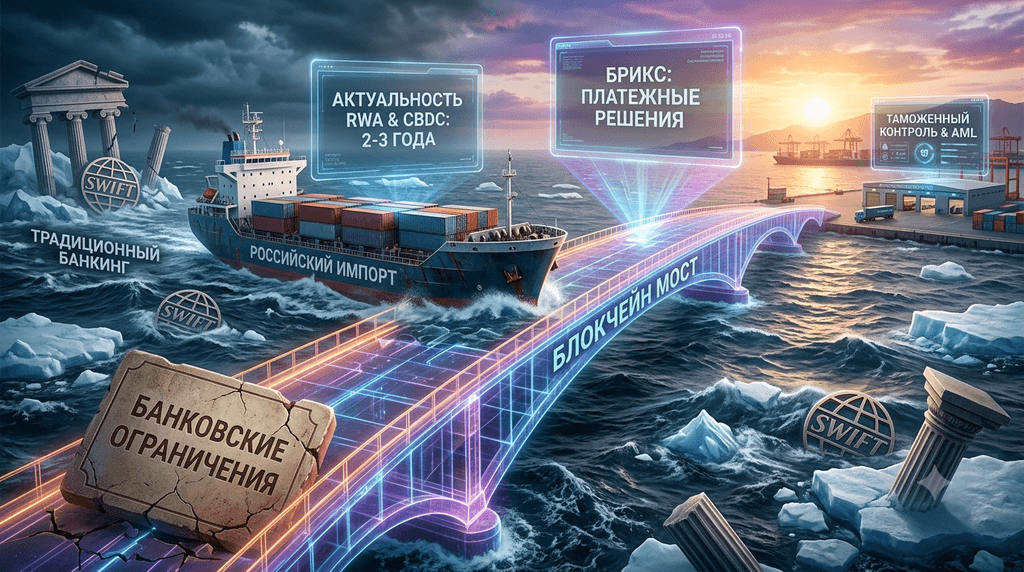
What should a Russian importer do if a bank payment is returned, a correspondent account is blocked, and an Asian supplier is unwilling to wait a month? According to Boris Titov, the Russian president's special representative for relations with international organizations, cryptocurrency will remain a relevant instrument for paying for imports over the next two to three years. As Bits.media reported, citing TASS, a cross-border payment platform is already operating, while digital assets help facilitate settlements with Asian partners amid restrictions on traditional channels.
This does not mean that cryptocurrency can be used freely inside Russia. The issue concerns foreign-trade settlements by legal entities under permitted regimes, subject to participant screening, transaction documentation, and source-of-funds controls. For businesses, cryptocurrency is becoming not a replacement for banks, but a reserve settlement route until the digital ruble, partner countries' national digital currencies, and multilateral payment platforms can operate at scale.
Why Cryptocurrency Import Payments Have Become Relevant Now
Cryptocurrency entered Russian foreign trade primarily as a response to unstable banking infrastructure, not as a fashionable investment method. A traditional payment depends on the sending bank, the correspondent bank, the contract currency, compliance procedures, and the willingness of a foreign intermediary to accept Russian-related risk. If any link in the chain refuses to process the transaction, the shipment may be delayed regardless of whether the buyer has sufficient funds.
According to an RBC Companies article dated June 15, 2026, market participants compared traditional cross-border transfers, which can take up to 14–30 days, with digital-asset transfers that may be completed within several hours. However, this is not universal data for every contract: the final timing depends on the network, liquidity, wallet screening, conversion, and the intermediary's operations. The figure should be treated as an assessment of market practice rather than a guaranteed result.
The main advantage of a cryptocurrency route is that it can reduce the number of vulnerable banking links. The supplier receives the digital asset directly or through a settlement operator instead of waiting for a long chain of correspondent accounts to process the payment. However, speed comes with volatility, AML screening, the risk of token freezes, and the need to prove the economic substance of the payment.
What Boris Titov's Statement Means
The Putin adviser's statement means that cryptocurrency is being viewed as a tactical bridge rather than as a final monetary-system model. In a publication dated September 8, 2026, Titov described crypto-based cross-border payments as an effective and reliable tool while certain channels are being closed. He also linked their relevance to the continuation of the current geopolitical situation over the next two to three years.
Therefore, businesses should not build their strategy on the assumption that one asset or one exchange will permanently replace international settlements. A rational approach is to assess several routes in advance: bank payments, digital assets through an authorized operator, digital rights, ruble-denominated or foreign stablecoins, and future central bank digital currency channels.
How the Legal Model for Cryptocurrency Import Payments Works
The legal model is built around an isolated intermediary structure: a Russian importer does not send USDT directly from a corporate wallet to the supplier, but uses an authorized operator or another approved settlement node. This intermediary identifies the parties, checks the contract and recipient address, arranges the purchase of the digital asset, and prepares accounting documentation.
The practical process usually includes several stages. First, the company enters into a foreign-trade agreement that expressly specifies the permitted settlement method. The contract is then registered in accordance with the applicable procedure, and the participant connects to an operator through an authorized bank or platform. The company transfers rubles to a dedicated account or provides funds under the operator's rules. After completing its checks, the operator purchases the agreed digital asset and transfers it to the foreign counterparty.
At the final stage, the importer receives proof of settlement: a blockchain transaction identifier, the operator's report, exchange-rate information, and details of commissions and fees. The documents must connect the payment to a specific contract, invoice, shipment, and consignment. A single transaction hash without a contract and primary documents does not prove the substance of the business transaction.
This structure is fundamentally different from an informal transfer through an acquaintance, a P2P exchange, or an anonymous wallet. A gray-market route may be faster to arrange, but it is more difficult to explain the source of funds, pass bank controls, confirm the value of the goods, and protect the payment in a dispute with the supplier.
What Documents Are Needed to Account for a Foreign-Trade Transaction
For customs and the Federal Tax Service, cryptocurrency should be treated as property or another type of digital asset rather than as legal tender for domestic payments in Russia. Accounting therefore needs to link the digital payment to the ruble value of the goods, the transaction date, and a verified exchange rate.
The working document package includes a foreign-trade contract containing the digital-settlement terms, an invoice, transport and shipping documents, confirmation that the contract has been registered, a report from a licensed or authorized operator, the transaction hash, wallet details, and a document showing the exchange rate applied. In its June 15, 2026 article, RBC Companies separately emphasized enhanced identification, currency controls, and the recording of the transaction in reporting.
The digital payment amount should be converted into rubles at the rate applicable on the transaction date — using the Bank of Russia rate where applicable, or a documented fair-market price provided by the approved operator. The precise procedure should be confirmed in advance with an accountant, bank, and customs specialist: the choice of rate source affects the value of the goods, import VAT, and the tax base.
How Customs Duties and Import VAT Are Calculated
Customs value and tax obligations do not disappear because the payment was made in cryptocurrency. The company must determine the ruble value of the goods and payment on the date specified by the applicable accounting and customs-declaration rules, and then calculate customs duties and import VAT in the ordinary manner.
The declaration and accounting documents should therefore show not only the amount of coins transferred, but also their ruble equivalent, the valuation source, and the connection to the invoice. The intermediary's commission, network fee, exchange-rate difference, and conversion expenses should be recorded separately because they do not always form part of the customs value of the goods.
The most common mistake is to treat a transaction hash as an independent payment document. It confirms that a record exists on the blockchain, but it does not confirm the equipment's price, the quality of the goods, the sender's authority, or the absence of sanctions risk. The complete evidence package must connect the technical record with the contract and the economic substance of the transaction.
How to Reduce the Risk of USDT Freezes and Secondary Sanctions
The main way to reduce the risk of a USDT freeze is to avoid building settlements around a direct corporate transfer to an arbitrary address. Tether may restrict or freeze tokens associated with certain addresses, so a centralized stablecoin should not be treated as a neutral and completely independent settlement unit.
An Isolated Agency Structure
A foreign-trade company should consider using an isolated-agent model. Under this arrangement, the importer transfers rubles or an agreed amount of liquidity to a Russian or foreign provider operating within an authorized regime, and the provider sends the asset to the supplier. The company's primary corporate wallet does not interact directly with an address that may carry a high AML risk or be linked to sanctioned entities.
The advantage of this structure is the separation of operational roles. The enterprise is responsible for the contract and the goods, the operator handles conversion and the settlement route, and the bank performs customer identification and controls monetary transactions. This does not eliminate sanctions risks, but it makes them more manageable and creates a documented trail.
Before payment, the recipient's address, transaction history, links to mixers and sanctions lists, the counterparty's country of registration, and the possibility of recovering funds should be checked. The statement that “USDT is always stable” must not be treated as a substitute for due diligence. If the operator declines the transaction, a backup route should already be defined before the goods are shipped.
Diversification of Assets and Settlement Jurisdictions
The second principle is to avoid dependence on a single issuer, network, or country. Some foreign-trade participants consider Bitcoin an asset without a single issuer or central point of control. However, its price is volatile, and transfers require careful management of market risk. For a fixed-price settlement, a regulated stablecoin issued in a neutral jurisdiction, such as the UAE or a Central Asian country, may be preferable if its legal status and liquidity have been verified.
Diversification does not mean mechanically spreading funds across a large number of coins. It means maintaining verified alternatives: Bitcoin for selected settlements, an authorized stablecoin to reduce currency volatility, and a digital right for transactions where legal integration into a platform is more important. Each asset should have a clear source of liquidity, redemption rules, and a documented price.
Counterparty risk should also be distributed. A payment through one foreign company in a neutral country does not become automatically safe. Beneficial owners must be checked, licenses confirmed, the settlement chain analyzed, and return conditions agreed in advance. The goal is not to circumvent the law or sanctions controls, but to avoid a single point of failure and operate within an acceptable legal framework.
Why Cryptocurrency Is Not Permitted for Domestic Purchases by Individuals
Cryptocurrency used to pay for imports and cryptocurrency used for an ordinary purchase in Russia are different legal situations. The ruble remains legal tender inside the country, and using digital currency to pay for goods and services does not become a generally available option for the public.
A Russian company with foreign-trade status may participate in permitted cross-border settlements if it meets the regime's conditions, passes the required checks, and has the appropriate contract. An ordinary individual may treat cryptocurrency as a personal investment asset and buy or sell it through available regulated infrastructure, but that does not give the person the right to pay for everyday goods with cryptocurrency in a Russian store.
The rules for foreign-trade settlements cannot be transferred to retail payments. The phrase “cryptocurrency has been legalized” is too broad: the specific asset, participant, jurisdiction, purpose, settlement channel, and applicable experimental legal regime must all be identified. This is especially important for businesses because an incorrect interpretation may cause problems with currency controls, tax reporting, and banking relationships.
Why the Transition Period Is Specifically Two to Three Years
The two-to-three-year horizon is explained by the fact that cryptocurrency is filling a current infrastructure gap while state-backed digital payment systems are being configured. In the short term, companies can already use blockchain technology when liquidity and a suitable partner are available. Direct connections between national CBDC systems, by contrast, require technical and political agreements.
In the coming years, the cryptocurrency channel will serve a tactical function. It can help pay for parallel imports, equipment, and selected shipments from Asian and Middle Eastern jurisdictions when the banking route is unstable. At the same time, businesses will continue using traditional transfers where they are cheaper, more transparent, and accepted by the supplier.
The medium-term goal is to connect the digital ruble with the digital currencies of friendly states. According to Sovremenny Predprinimatel dated August 27, 2026, the Bank of Russia is discussing cross-border use of the digital ruble with foreign partners. Such a model requires compatible infrastructure, the other country's willingness to participate, common data standards, and sufficient liquidity.
An Expert article dated September 2, 2026 notes that China remains Russia's key trading partner, while China and India are developing their own central bank digital currency projects. However, CBDCs do not create liquidity by themselves: participants still need currency quotations, banks, compliance procedures, hedging, and access rules.
Over a longer horizon, individual cryptocurrency routes may give way to direct corridors for the digital ruble, digital yuan, digital rupee, and other national instruments. Multilateral BRICS projects, including proposed payment platforms, could reduce the role of intermediaries, but the timing, standards, and availability of these solutions depend on intergovernmental agreements. Therefore, two to three years is a realistic window for the parallel existence of crypto-based and sovereign digital channels, not a promise that one will completely replace the other.
What Risks Importers Still Face
Cryptocurrency accelerates the transfer of value, but it does not eliminate economic, legal, or technical risks. The first risk is volatility: if a company buys Bitcoin first and the supplier receives it later, a price change may increase the cost of the goods. This can be reduced through rapid conversion, hedging, or the use of an appropriate stablecoin, but each measure adds fees and counterparty risk.
The second risk is an address error. Blockchain transfers are generally irreversible, so selecting the wrong network, memo, address, or number of confirmations may result in a loss of funds. The payment procedure should require a test transfer, dual verification of payment details, authorization limits, and separation of duties among employees.
The third risk is legal status. An experimental regime does not make every cryptocurrency transaction legal. The company must verify whether it is eligible to participate, whether the specific asset is permitted, whether the operator can serve the relevant country, and how the transaction will be reflected in currency-control reporting.
The fourth risk is sanctions and AML exposure. Even a decentralized asset may arrive from an address associated with illegal activity or a restricted entity. Source-of-funds checks, route documentation, and refusal to use anonymous services have become mandatory elements of corporate control.
The fifth risk is commercial. The supplier may be unable to legally accept the asset, convert it into local currency, or confirm receipt. Before signing the contract, the parties should agree on the network, asset, exchange rate, execution point, commission, refund procedure, and allocation of risk if the asset is frozen.
Beyond the Headlines: What KuCoin 5.0 Means for You
Market news moves fast — but where you act on it matters just as much. This October, KuCoin launches KuCoin 5.0, transforming KuCoin into a rebuilt platform. Here's what actually changes for you:
-
One account for everything. Older platforms split your money across separate "spot," "margin," and "futures" accounts and expected you to understand why. KuCoin 5.0's unified account removes that entirely — deposit once, and everything is simply there.
-
Stocks, indices, and commodities. KuCoin 5.0 expands beyond crypto into global markets. When crypto chops sideways and equities rally (or the reverse), you rotate in minutes instead of opening a brokerage account and waiting days for fiat rails.
-
Real-world assets (RWA). Tokenized exposure to traditional assets like commodities, right inside your crypto account. One of the fastest-growing segments in global finance is no longer reserved for institutions — you access it from the same balance you trade with.
-
Earn while you learn. Not ready to trade? KCUSD lets your stablecoins earn daily, auto-compounding interest. The lowest-stress way to put your idle deposit to work for 4% yield.
-
An AI assistant in plain language. Ask questions, get market context, understand what you're looking at — built into the platform, no jargon required.
-
An app that doesn't overwhelm. Faster, cleaner, and consistent — intuitive from the first tap, not after a tutorial.
-
Safety you can check, not just trust. A MiCAR-licensed EU entity, Proof of Reserves you can verify yourself, and internationally certified security (SOC 2 Type II, ISO 27001:2022).
Create your account in minutes — and start on the platform built for where crypto is going, not where it's been.
Conclusion
Paying for imports with cryptocurrency may indeed remain relevant in Russia over the next two to three years. The reason is not that digital assets have already replaced banks, but that they can provide an additional route for foreign-trade settlements when correspondent chains, SWIFT transfers, or payments through third countries become unpredictable.
For importers, legality and documentation remain the central requirements. The optimal model involves an isolated authorized intermediary, counterparty screening, recording the transaction hash, converting the payment into rubles, correctly calculating customs duties and VAT, and completing AML and currency-control procedures. Sending USDT directly from a corporate wallet to an unverified address is not a safe strategy.
At the same time, businesses must recognize the transitional nature of the cryptocurrency channel. Over the next two to three years, it may gradually be supplemented by the digital ruble, digital yuan, digital rupee, regulated stablecoins, and multilateral BRICS payment solutions. The best strategy is therefore not to choose a single “permanent” asset, but to build a diversified settlement system in which blockchain speed is combined with bank oversight, transparent accounting, and a ready backup route.
Frequently Asked Questions
1. Can a Russian individual pay for an imported product for personal use with cryptocurrency?
No. Foreign-trade status and the corporate regime for import payments do not automatically apply to individuals. A person may own and trade digital assets in accordance with permitted rules, but should not interpret this as permission to pay for goods and services with cryptocurrency inside Russia.
2. Is it mandatory to use USDT for a foreign-trade settlement?
No. The appropriate asset depends on the applicable regime, operator, liquidity, supplier's country, and contract terms. USDT is convenient because it is widely used, but it carries the risk of centralized freezing. Bitcoin, a regulated foreign stablecoin, or a digital right may be considered as alternatives if they are permitted and economically viable.
3. Is it sufficient to record the transaction hash in the accounting records?
No. A hash confirms that a transaction was recorded on the blockchain, but it does not replace the contract, invoice, commercial documents, operator's report, or ruble valuation. Tax and customs accounting must establish the connection between the payment, the specific shipment, and the value of the goods.
4. Will the digital ruble fully replace cryptocurrency within three years?
This cannot be guaranteed. The digital ruble may become an important cross-border instrument, but full-scale operation requires agreements with partners, compatible protocols, liquidity, banking infrastructure, and common compliance rules. Cryptocurrency channels may continue operating in parallel.
5. What is the main risk of paying for imports with cryptocurrency?
The main risk is the combination of legal uncertainty, asset freezes, and the irreversibility of transfers. It can be reduced by using an authorized intermediary, checking addresses and counterparties, making a test payment, diversifying assets, documenting the exchange rate, and agreeing on the route in advance with the bank and foreign-trade specialists.
Disclaimer : This material is provided for informational purposes only and does not constitute financial, investment, legal, or tax advice. Transactions involving cryptocurrencies and tokenized assets carry substantial risks — including price volatility, limited liquidity, counterparty exposure, and the potential for total loss of invested capital. Readers should conduct their own research and, where appropriate, consult a qualified professional before making any financial decisions.