

Crypto Regulation in Russia in 2026: How the Central Bank Is Building a Legal Infrastructure for Crypto Assets
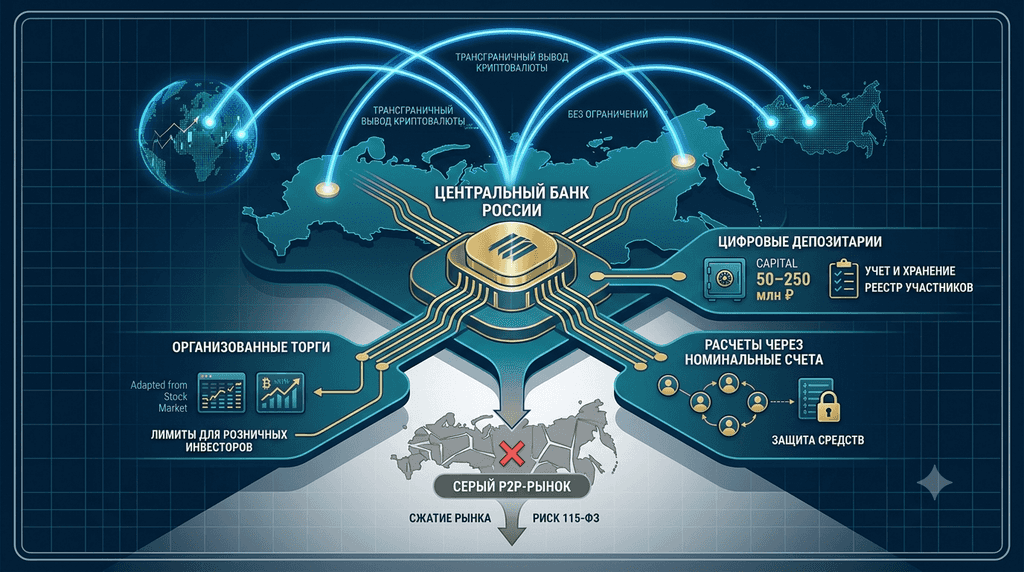
Since late July 2026, the Bank of Russia has effectively finished designing an entire architecture for a legal crypto market — from exchanges to depositories. Within a few days, the regulator published three key documents: the conditions for organized trading in digital currencies, capital requirements for digital depositories, and rules for accounting digital rights. At the same time, Central Bank Governor Elvira Nabiullina publicly confirmed that withdrawing crypto abroad is not restricted for either qualified or non-qualified investors.
This means crypto regulation in Russia is moving from the stage of declarations to the stage of concrete infrastructure: exchanges, depositories, nominee accounts, and registries. Below is a breakdown of who will custody crypto assets and how, what limits retail investors can expect, what happens with withdrawing funds abroad, and why the gray P2P market is set to shrink faster than it might seem.
What Regulatory Model Has the Bank of Russia Chosen for 2026?
The Bank of Russia is building its model on the analogy of the securities market, not creating crypto regulation from scratch. Under the draft directive prepared by the regulator, mechanisms for organized trading previously applied to securities and other instruments are being extended to digital currencies and digital rights.
The trading organizer — that is, the exchange — gets the right to set its own trading regime in its own rules and is obligated to calculate the market price and volume-weighted average price for crypto and digital rights. The exchange is also required to disclose trading information and report data to the Bank of Russia. The planned effective date for the amendments is 10 days after the official publication of the Central Bank's regulatory act.
Alongside the exchange infrastructure, an accounting system is being built in parallel — digital depositories, which the regulator announced the same day.
Why the Central Bank Chose the Securities-Market Model Instead of a Separate Crypto Law
This approach reduces regulatory uncertainty for market participants. Instead of creating a fundamentally new legal construct, the regulator is adapting already proven mechanisms — information disclosure, volume-weighted price calculation, oversight of the trading organizer — to a new asset class. For an investor, this means that the process of trading crypto on a regulated platform will largely resemble familiar securities trading: order books, price queues, clearing, and settlement through an intermediary, rather than a direct wallet-to-wallet transfer.
In addition, integrating crypto into the existing organized-trading mechanism means the exchange is required to continuously report trading data to the Bank of Russia. This gives the regulator the ability to track volumes, price anomalies, and potential market manipulation in near real time — the same level of oversight already applied to the securities and currency markets today.
How Will Digital Depositories Work, and Who Is Responsible for Custody of Crypto Assets?
Digital depositories — a new type of market participant with strict capital requirements — will be responsible for custody and accounting of crypto in Russia. Under the published requirements, a depository's minimum equity capital must be between 50 million and 250 million rubles.
The exact amount depends on the nature of the depository's activity: whether it plans to work with open distributed ledgers or to handle settlements following exchange trading. The regulator separately emphasizes that the property making up the depository's equity capital must be highly liquid, and the financial assets included in it must have a high credit quality.
The regulator's logic is straightforward: a digital depository will operate on the same principles as depositories in the securities market do today. It keeps records of assets and logs data on depositors and on who is granted access to the system. Similar capital requirements are being introduced for electronic platform operators — their functions will be taken over by information system operators, which will process settlements for digital financial assets through a nominee account.
The Bank of Russia itself will maintain the official registry of digital depositories — giving investors a simple way to check whether a given intermediary is legitimate before entrusting it with crypto assets.
Why the High Capital Threshold Is Necessary
The 50–250 million ruble capital requirement functions as a filter: it screens out small, opaque companies unable to cover operational risks or compensate clients for potential technical failures. A similar logic applies to depositories and clearing organizations in the securities market — the greater a participant's responsibility to clients, the stricter the requirements for its balance-sheet resilience.
The requirement for high credit quality of the assets making up the depository's equity capital is also deliberate: it rules out a situation where capital exists on paper but is tied up in illiquid or risky instruments that cannot quickly be converted to cash if the company runs into trouble. For investors, this means an additional layer of protection: a depository that has met all Central Bank requirements and made it into the official registry must have a real, not merely a paper, safety margin.
What Changes for Settlements and Nominee Accounts
Settlements following trades in digital currencies and digital rights will go through electronic platforms using nominee accounts — a mechanism already familiar to securities-market participants. This reduces the risk of losing assets if an intermediary goes bankrupt, since a nominee account legally separates client funds from the platform operator's own funds.
Can Ordinary Investors Buy Crypto, and What Limits Await Them?
Yes — both qualified and non-qualified investors will be able to buy and sell crypto in Russia, but not on equal terms. The Bank of Russia's regulatory concept explicitly allows both categories of investors to participate in crypto asset transactions.
The difference is that for non-qualified investors, the regulator is introducing separate trading limits and, likely, restrictions on the range of available instruments. The goal of this split is to reduce risk for retail investors, who face high crypto volatility without the hedging and risk-assessment experience that comes with it. No such restrictions are envisioned for qualified investors — they get broader access to instruments, including crypto derivatives, which individual brokers have already started offering.
This two-tier system resembles the approach applied to complex financial instruments in the securities market, and it will likely be fine-tuned further as the exchange infrastructure launches.
How to Obtain Qualified Investor Status
Qualification criteria for crypto asset transactions will most likely draw on rules already in place for the securities market: asset size, trading experience, or relevant education and certifications. The regulator has not yet published a final list of criteria specifically for the crypto segment, but the logic of splitting investors into categories is already built into the regulatory concept. It's reasonable to expect that market participants will use the transition period to pre-register qualified investor status through a broker or asset manager, if doing so unlocks access to a wider range of instruments.
Below is a comparison of what market access for the two investor categories may look like, based on data published so far.
| Parameter | Non-Qualified Investor | Qualified Investor |
| Access to buying crypto | Yes, with limits | Yes, no special limits |
| Access to crypto derivatives | Restricted | Broad, including hedging strategies |
| Withdrawing crypto abroad | Unrestricted | Unrestricted |
| Intermediary requirements | Licensed platform from the CB registry | Licensed platform from the CB registry |
As the table shows, the main difference isn't about market access itself, but about the range of available instruments and the volume of permitted operations — not the fundamental ability to buy or sell crypto.
Can You Withdraw Crypto Abroad, and What Risks Does That Involve?
There are no formal restrictions on withdrawing crypto abroad for Russian investors. Bank of Russia Governor Elvira Nabiullina stated this at a press conference following a monetary policy board meeting: there are no restrictions whatsoever on transferring crypto abroad, and qualified and non-qualified investors have equal rights and opportunities in this regard.
However, the regulator immediately flagged the key risk of such a withdrawal. According to the Central Bank governor, crypto transactions at a global level fall outside Russian jurisdiction, meaning that outside the country an investor loses the protection of Russian law. Nabiullina specifically mentioned cases of so-called crypto "coloring" (окраска) — the seizure of assets from their legitimate owners by foreign platforms or regulators simply on suspicion of a connection to Russia, driven by international sanctions. On top of this comes ordinary crypto market volatility, which doesn't disappear regardless of jurisdiction.
The practical takeaway for investors is simple: legally, the transfer is not prohibited, but economically it carries the risk of funds being frozen abroad with no guarantee of recovery through Russian courts or regulators.
What the "Coloring" Risk Means in Practice
The "coloring" (screening) mechanism works by analyzing the transaction history of a specific crypto wallet. Foreign platforms and compliance services use analytics tools that trace chains of transfers and flag addresses ever linked to Russian services, exchanges, or users — regardless of whether the original transaction was legal. If such a wallet becomes suspect, a foreign platform may freeze the funds pending review or refuse further service, with no right of appeal within Russian jurisdiction.
This is a structural risk stemming from international sanctions, not a result of actions by the Russian regulator — which is exactly why Nabiullina stresses that Russian law offers no protection against such situations. For investors, this means the decision to withdraw crypto assets abroad should factor in the history of the specific wallet and the reputation of the receiving platform, not just the formal legality of the operation itself.
What Happens to P2P Transfers and Cards Amid Tighter Controls?
The gray P2P crypto market is set to shrink, not grow, as Russia's official exchange and depository infrastructure comes online. The logic is simple: once licensed platforms and digital depositories with full customer identification appear, the regulator and banks gain a tool for distinguishing legal transactions from shadow ones.
This directly affects users who continue running private P2P deals outside official platforms. The more the "white" infrastructure with mandatory KYC develops, the greater the risk that a bank will freeze a card under Federal Law 115-FZ — Russia's anti-money-laundering law. The blocking mechanism formally existed before, but with the appearance of an official alternative channel — the exchange and the depository — banks and the regulator will have less reason to treat frequent unregulated P2P transfers as coincidental rather than as an attempt to evade oversight.
For investors, this means one thing: the sooner you move to licensed platforms with transparent identification, the lower the risk of your account being frozen over crypto transactions.
What Red Flags Alert Banks to Crypto-Related Transfers
Banks apply risk scoring to transactions based on Central Bank methodological guidance under 115-FZ: transfer frequency, transaction volumes unusual for the client, numerous small incoming transfers from different individuals, and patterns matching typical P2P cash-out schemes. None of these signs alone constitutes a violation of the law, but their combination raises the likelihood that a card or account will be frozen pending clarification of the source of funds.
With the launch of official exchanges and digital depositories, banks gain a clear benchmark for a "legal" crypto transaction channel: if a client has the option to trade through a licensed platform with full identification but instead systematically relies on private P2P transfers, this raises suspicion in the eyes of the bank's compliance department. In other words, the existence of an alternative makes private schemes more, not less, conspicuous to the monitoring system.
How to Buy and Trade Crypto on KuCoin?
Registering on KuCoin takes just a few minutes and gives access to a wide selection of cryptocurrencies, including Bitcoin, Ethereum, and dozens of altcoins available for spot and margin trading. After creating an account and completing verification, users can fund their balance through supported deposit methods and start trading.
For those tracking Russian regulation, it's worth remembering: while the national exchange and depository infrastructure is still being built, using an international platform with a proven track record, deep liquidity, and a broad set of instruments remains a practical way to access the crypto market. KuCoin offers built-in risk-management tools — limit orders, stop-loss — plus educational materials that help investors understand asset volatility before placing a trade.
Before carrying out any transactions, it's worth assessing your own risk tolerance, reviewing current fees and trading pairs, and keeping in mind the need to comply with the legal requirements applicable in your jurisdiction.
Join KuCoin 9th Anniversary Trading Campaign
KuCoin is celebrating its 9th anniversary with a special platform campaign filled with exclusive rewards, trading activities, and limited-time offers. Don’t miss the chance to participate and enjoy the benefits as the exchange marks nine years of growth and innovation. Visit the official campaign page now:
Conclusion
Crypto regulation in Russia in 2026 is moving toward a structure familiar to securities-market participants: organized exchange trading, digital depositories with capital requirements of 50 to 250 million rubles, nominee accounts for settlement, and a single participant registry maintained by the Bank of Russia.
Retail investors get market access on par with qualified investors, but with separate limits designed to reduce volatility risk. Withdrawing crypto abroad is formally unrestricted, but it carries the risk of asset "coloring" and the loss of Russian legal protection overseas. At the same time, controls on gray P2P transfers are tightening: the more the official infrastructure develops, the higher the risk of card freezes under 115-FZ for those who continue operating outside licensed platforms.
For investors, this means legal infrastructure — exchanges, depositories, licensed intermediaries — is becoming not just a formality, but a practical way to reduce legal and financial risk when working with crypto assets.
Frequently Asked Questions
1. When will the Bank of Russia's new digital currency rules take effect?
The draft directive on organized trading provides for entry into force 10 days after the official publication of the corresponding Bank of Russia regulatory act. The exact date will depend on how long the approval and publication process takes.
2. Does an individual need a license to buy crypto in Russia?
No, individuals don't need a license — both qualified and non-qualified investors will be able to buy crypto. Licensing requirements apply to infrastructure participants: exchanges, depositories, and information system operators through which transactions pass.
3. How does a digital depository differ from a crypto exchange?
A depository is responsible for accounting and custody of crypto and digital rights, recording data on asset owners, while an exchange organizes the actual trading process and calculates market prices. This division of functions mirrors how the securities market works, where the depository and the exchange are separate infrastructure participants.
4. What are digital rights, and how do they differ from crypto?
Digital rights are a broader category of assets issued on a distributed ledger, which includes, for example, digital financial assets (DFAs). Crypto is a decentralized asset with no issuer, whereas digital rights most often have an issuer and are governed by separate DFA rules.
5. Is selling crypto taxed in Russia?
Income from an individual's sale of crypto in Russia is subject to declaration and taxation as income from property transactions, at standard personal income tax rates. The exact procedure for calculating the tax base is worth confirming with a tax advisor, since case law and enforcement practice around digital assets is still developing.
Disclaimer : This material is provided for informational purposes only and does not constitute financial, investment, legal, or tax advice. Transactions involving cryptocurrencies and tokenized assets carry substantial risks — including price volatility, limited liquidity, counterparty exposure, and the potential for total loss of invested capital. Readers should conduct their own research and, where appropriate, consult a qualified professional before making any financial decisions.