

Russia's Key Rate Outlook for 2027 Raised to 12% — Takeaways from the 2026 Financial Congress
2026/07/20 12:01:00
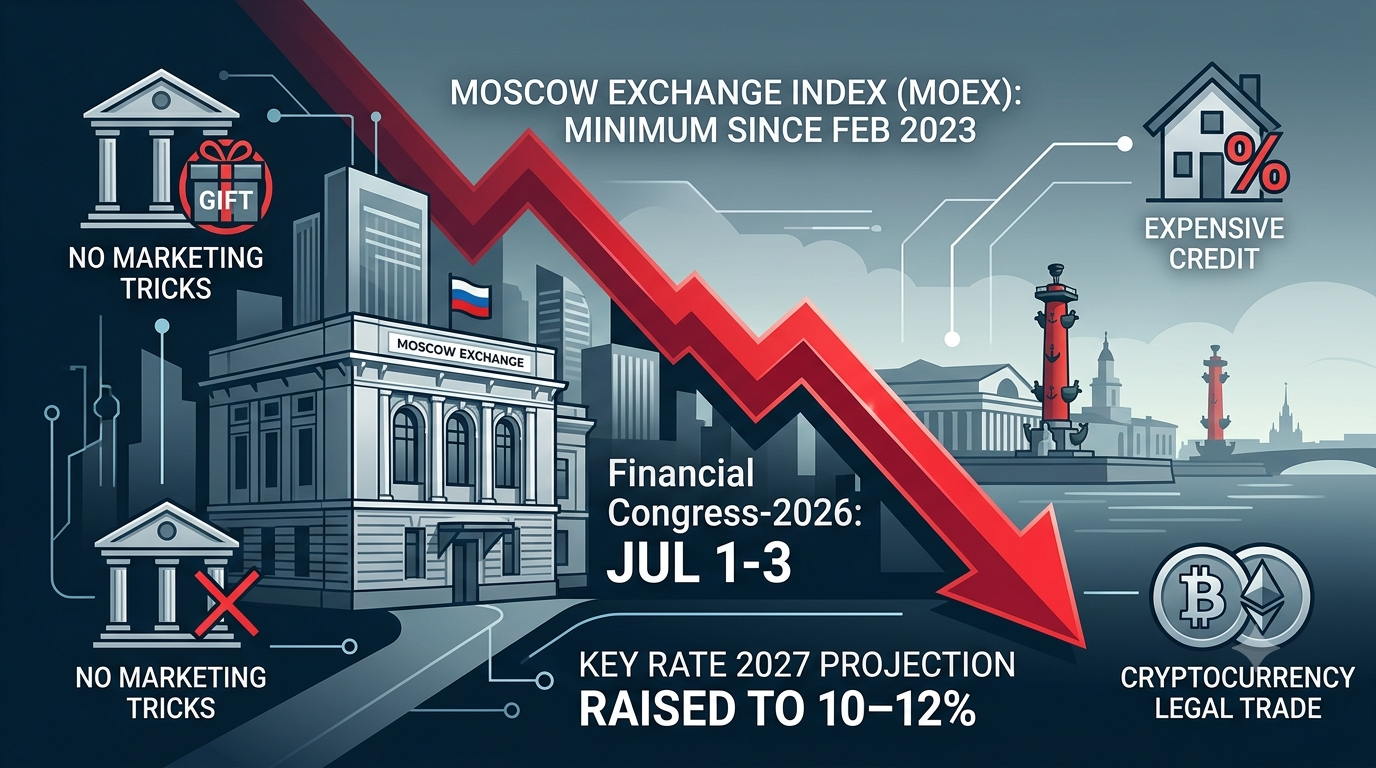
The MOEX Index plunged from 2,360.9 to 2,242.84 points over the three days of the 2026 Financial Congress — its lowest level since February 2023. The trigger wasn't sanctions or geopolitics, but a single statement from Bank of Russia Governor Elvira Nabiullina. She confirmed that the regulator had raised its forecast path for the key rate in 2027 from 8–10% to 10–12%. In practical terms, that means cheap credit is off the table for at least the next year and a half.
The Bank of Russia's forum, held in St. Petersburg from July 1 to 3, 2026, drew 1,150 participants, including 19 foreign delegations. The takeaway from this year's event was clear: tight monetary policy is here to stay, banks are collectively abandoning aggressive deposit marketing, and investors rattled by the falling stock market are being offered a new alternative — legal cryptocurrency trading.
What did the central bank decide on the key rate, and why did the 2027 forecast rise?
The Bank of Russia has no intention of loosening monetary policy in the foreseeable future, and its rate outlook for 2027 has become noticeably tighter. According to Nabiullina's remarks at the 2026 Financial Congress, the regulator revised its forecast path for the key rate from the 8–10% range up to 10–12% annually.
In practice, this means businesses and households won't see a single-digit rate — anything below 10% — for at least a year and a half. Anyone planning to take out a loan for a home or a car will have to put those plans on hold, since access to credit will remain limited. For savers, though, the central bank's hardline stance is good news: the window for high-yield deposits will stay open longer than expected back in spring 2026.
At the same time, Nabiullina stressed that the regulator "is not an advocate of high rates" — credit availability is driven by the pace of inflation, not the rate itself. Deputy Governor Alexei Zabotkin added at the congress that pro-inflationary pressures continue to build, and that the federal budget remains a major source of risk to price stability.
According to Rosstat data as of June 22, 2026, annual inflation has settled at around 5.86% — well above the central bank's target. Weekly price growth accelerated to 0.25% for the week of June 16–22, up from 0.15% the week before, while consumer prices had already risen 0.63% since the start of summer and nearly 4% since the start of the year. Persistently elevated inflation — rather than any desire to "punish" businesses with high rates — was, according to regulator officials, the main driver behind the tougher rhetoric.
It's worth noting that before the congress, the regulator had been steadily cutting the key rate — a ninth consecutive cut had brought it down to 14.25% — and most analysts surveyed expected the easing cycle to continue. The new 2027 forecast suggests the opposite: conditions shifted so quickly that the question is no longer "when will the rate fall again," but rather "will the central bank hold its pause, or pivot back to tightening within the current cycle." That makes the planning horizon for businesses and private borrowers noticeably less predictable than it appeared back in spring 2026.
How did the market react to the central bank's hard line?
The market reacted to Nabiullina's remarks with a sharp sell-off. The MOEX Index, which opened trading on July 1 at 2,360.9 points, had fallen to 2,242.84 points by the close of the congress's final day — its lowest level since February 2023. The RGBI government bond index also slid over the same period, from 113.57 to 112.08 points.
Market participants privately admitted on the sidelines of the forum that they had hoped for at least some clarity from the central bank, if not outright good news — instead, they got a signal of an even longer stretch of expensive money ahead. That came as a cold shower for investors who had been counting on a gradual rate decline following several rounds of cuts in the first half of 2026.
The congress also featured a separate assessment of the ruble's exchange rate. Deputy Governor Alexei Zabotkin described the current trend as stable: for most of the past 12 months, the rate has traded within a corridor of 75–85 rubles per dollar, and it currently sits roughly in the middle of that range. He cautioned against reading too much into weekly inflation figures, calling them "a very noisy indicator." At the same time, he noted that pro-inflationary pressures in the economy keep building, and that fiscal policy remains one of the central bank's key risk factors in hitting its inflation target.
Is Russia's economy at risk of "overcooling"?
There is no recession in the Russian economy, and the "overcooling" model simply doesn't apply to the current situation — that was Nabiullina's direct answer to reporters at a briefing held during the congress on July 2, 2026. She acknowledged that some signs of a cooling labor market are indeed present, with a significant share of companies reporting labor shortages.
However, she said, diagnosing genuine "overcooling" requires other markers as well — a decline in real household incomes and inflation falling below target. Neither is currently happening; if anything, inflation remains above the central bank's target. Uneven development across individual sectors, the governor said, is a natural byproduct of the economy's ongoing structural transformation, not a sign of crisis.
That view directly contradicted remarks made at the congress by Sberbank CEO German Gref, who argued in a panel session that the economy couldn't sustain the current key rate for much longer. His argument found no support from the central bank's leadership — Nabiullina made clear that curbing inflation remains the top priority, even if that means sacrificing stock market growth and squeezing profits at some companies.
Banks ditch "marketing tricks" — what changes for depositors?
Russia's seven largest banks signed a memorandum on honest disclosure of deposit terms to customers, meaning aggressive marketing tactics in deposit sales are now expected to become a thing of the past. The document was drafted by the Association of Banks of Russia and the National Financial Market Council, working together with the central bank and the Federal Antimonopoly Service (FAS).
The memorandum explicitly bans three common practices:
-
Featuring a deposit's maximum rate prominently without fully disclosing the conditions required to actually earn it;
-
Using visual design tricks that highlight the benefit while burying restrictions in fine print;
-
Auto-checking boxes in online calculators that artificially inflate the displayed yield.
All key information about rates, terms, and conditions must now fit on a bank's homepage or the first screen of its mobile app — no more digging through lengthy fine print looking for a catch. "The development of this memorandum proves the market has matured enough for self-regulation," said Denis Lipaev, president of the Association of Banks of Russia, at the congress. The central bank gave banks a six-month transition period to update their systems and marketing materials.
| Practice | Before the memorandum | After the memorandum |
| Maximum rate display | Large, prominent, without conditions | Must appear together with eligibility conditions |
| Terms and restrictions | Fine print, hidden sections | Must be disclosed on the homepage |
| Yield calculator | Auto-checked boxes inflating returns | Disabled by default |
What's changing in loan insurance starting October 2026?
Starting October 19, 2026, two new mandatory standards will take effect in the credit life insurance market — one for consumer loans, one for mortgages — and actual payout levels on these policies are set to rise sharply. Congress participants noted that some insurers currently pay out just 3–5% of collected premiums, with the rest effectively absorbed by intermediaries.
Once the new standards take effect, the average payout ratio could reach 30% for consumer-loan policies and 50% for mortgage insurance. The new rules will also cap claim review times at five days and cut back the long list of exclusions banks and insurers have historically used to deny claims. According to expert estimates cited at the forum, up to two-thirds of premiums currently go toward commissions for bank intermediaries — the new standards are designed to break that pattern.
The standards have already been approved by the presidium of the All-Russian Insurance Association and are being coordinated with the Bank of Russia. Once in force, they will be mandatory for all association members operating in credit life insurance.
How does the central bank plan to regulate AI in banking?
The Bank of Russia has opted for a light-touch approach to regulating AI in credit risk assessment — rather than imposing strict requirements right away, the regulator will first monitor how banks are actually applying algorithms. The next step will be issuing methodological guidance, with stricter rules to follow only if necessary.
That said, a firm deadline has been set for systemically important credit institutions: by January 1, 2030, they must transition to a model-based approach to credit risk assessment. That sends a long-term signal to major banks that AI use in lending will keep growing, but under gradually tightening oversight. This phased approach — monitor first, then advise, then regulate only if needed — broadly mirrors the logic the central bank applies to other fast-moving financial technologies, including digital assets.
Where will investors' money go next: the digital ruble and crypto legalization
The banking system and large businesses are already prepared for the large-scale rollout of the digital ruble, Nabiullina said in her opening remarks at the congress. "Everything is ready from a process standpoint — we've done enormous preparatory work for this stage," she said, adding that systemically important banks and major retail businesses are ready to accept digital ruble payments. The central bank is also exploring the possibility of opening digital ruble wallets on banks' balance sheets and using smart contracts for business.
Alongside that, the congress delivered another piece of news of particular interest to retail investors: the Moscow Exchange still expects to launch cryptocurrency trading before the end of 2026. That's according to Igor Marich, a representative of the Moscow Exchange Group, speaking at the event. Bill No. 1194918-8, which establishes a legal framework for the circulation of digital currencies in Russia, already passed its first reading in the State Duma on April 21, 2026, and is expected to go through its second and third readings before the end of the spring session.
Under the current regulatory concept, non-qualified investors would face an annual limit of 300,000 rubles on crypto-asset purchases through a single intermediary. Within that limit, investors would be able to buy a restricted list of digital currencies to be determined by the central bank — expected to include Bitcoin, Ethereum, USDT, and USDC. Qualified investors, by contrast, are expected to gain access to any cryptocurrency except anonymous coins. Using cryptocurrency to pay for goods and services within Russia will remain prohibited — the framework is designed strictly as an investment instrument, not a payment method.
For investors who watched the MOEX Index slide during the congress, the prospect of legal access to cryptocurrency looks like a logical diversification option — particularly against a backdrop of prolonged high rates and limited upside for equities.
Is it worth trading cryptocurrency on KuCoin given the central bank's tighter policy?
The central bank's tougher rhetoric, combined with the falling Russian stock market, is pushing some investors to look for instruments whose returns aren't directly tied to the key rate or regulatory decisions — and cryptocurrency is one logical diversification option in that search. While Russia's domestic crypto-asset regulation is still taking shape, and retail investor limits are capped at 300,000 rubles a year, many are already opening accounts on international platforms that offer a much wider range of instruments.
KuCoin provides access to hundreds of cryptocurrencies, including Bitcoin, Ethereum, and various stablecoins, along with tools for spot and margin trading, staking, and recurring investments. Before trading, it's worth soberly assessing crypto market volatility, which tends to run higher than that of traditional financial instruments and calls for careful risk management — including diversification and sensible position sizing.
Getting started is straightforward: register an account on KuCoin, complete verification, and fund the account through a convenient method. Beginners should start with small amounts and get familiar with basic market analysis tools before moving on to more advanced strategies like margin trading or derivatives.
Conclusion
The 2026 Financial Congress sent the market an unambiguous signal: the Bank of Russia has no intention of loosening monetary policy to prop up short-term growth. The key rate forecast for 2027 has been raised to 10–12%, meaning the combination of expensive loans and high-yield deposits will persist for at least a year and a half. The MOEX Index reacted to the tougher rhetoric by falling to its lowest level since February 2023, but according to the central bank governor, there are no signs of "overcooling" or recession in the economy — only structural adjustment and elevated inflation.
At the same time, the market saw a number of changes that favor consumers: seven of the largest banks have abandoned marketing tricks in deposit sales, and new credit life insurance standards taking effect October 19, 2026 will push payouts up to 30–50%. Light-touch regulation of AI in bank lending is also in the works.
For investors disappointed by the falling stock market, the forum pointed to a new direction — the legalization of cryptocurrency trading on the Moscow Exchange by the end of 2026, alongside the active rollout of the digital ruble. Anyone looking to get ahead of the curve and start familiarizing themselves with crypto instruments now may want to take a look at platforms like KuCoin.
Frequently Asked Questions
1. When will the Bank of Russia's next key rate meeting take place?
The Bank of Russia's board holds several key rate meetings each year — both pivotal and interim sessions — on a pre-announced schedule; the latest meeting dates are published and updated on the central bank's official website.
2. Is the "no marketing tricks" memorandum binding on all Russian banks?
Formally, only the seven largest banks have signed the memorandum so far, and for the rest of the market it currently carries recommended status — though the central bank and FAS have signaled they expect more credit institutions to join the voluntary standard over time.
3. What will happen to mortgage rates given the central bank's higher 2027 forecast?
Market mortgage rates will remain elevated and are unlikely to fall into single digits over the next year and a half, meaning demand will continue to shift toward subsidized state mortgage programs.
4. Can you already legally buy cryptocurrency in Russia?
As of the 2026 Financial Congress, the law governing cryptocurrency circulation in Russia had not yet been finally passed by the State Duma, so legally purchasing crypto assets through licensed Russian intermediaries isn't yet possible — that's expected to change before the end of 2026.
5. What's the difference between the digital ruble and cryptocurrency?
The digital ruble is a third form of Russia's national currency, issued and fully controlled by the Bank of Russia, whereas cryptocurrencies like Bitcoin or Ethereum are decentralized and aren't issued by any central bank or government.