

Unified BRICS Gold Depository in Russia: Why It Has Been Proposed and What It Could Change
2026/08/18 14:49:00
Introduction
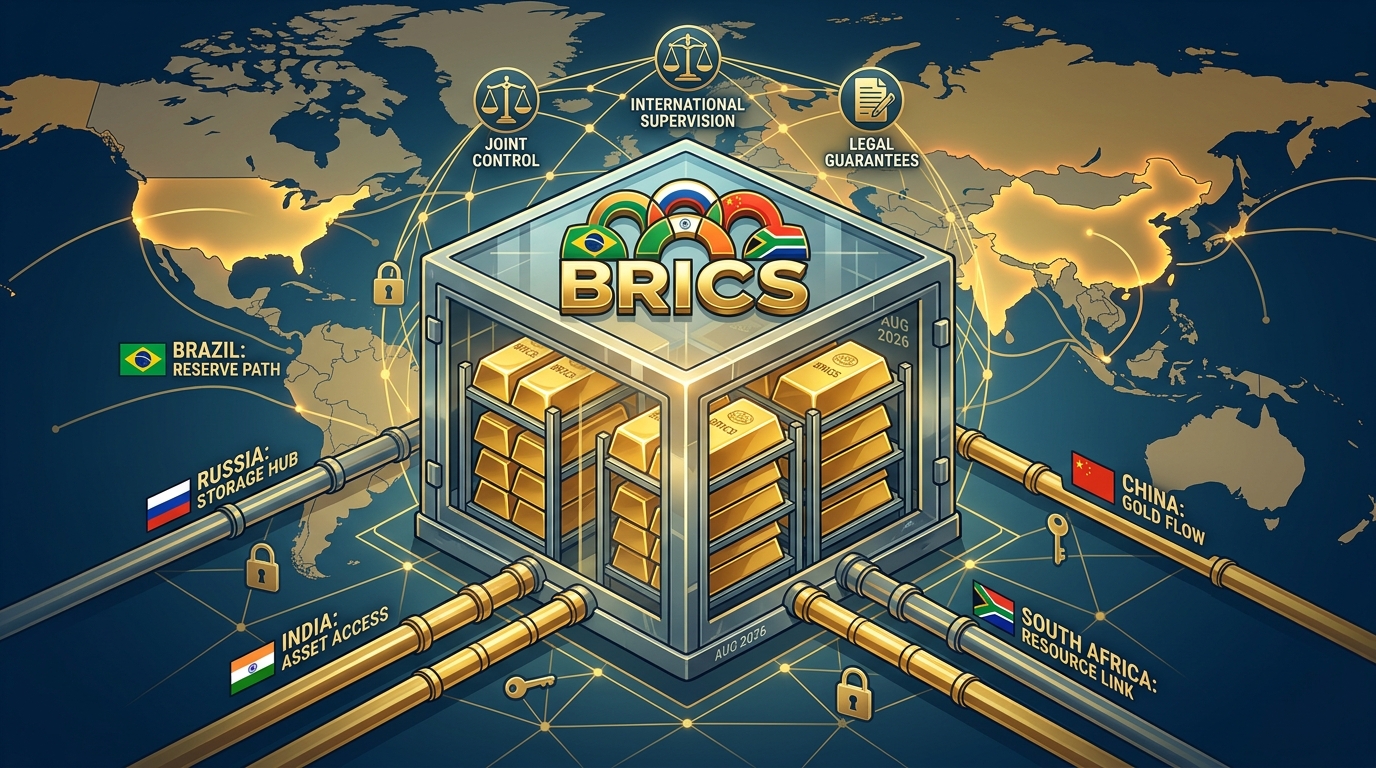
Could a single gold depository become part of a new financial infrastructure? On August 16, 2026, Artem Kiryanov, Deputy Chairman of the State Duma Committee on Economic Policy, proposed creating a unified international center in Russia for storing the gold of BRICS countries. The idea envisages joint management, international oversight, and legal guarantees that each country will be able to access its own assets. For now, this is a political proposal rather than an approved multilateral project. However, it reflects a broader shift: central banks continue to view gold as a tool for reserve diversification, while BRICS countries are seeking ways to reduce their dependence on financial infrastructure controlled by Western jurisdictions.
The initiative should therefore be assessed from two perspectives. In the short term, it is primarily symbolic. In the long term, it could become part of a future system for settling transactions and storing reserves if participants agree on ownership, auditing, insurance, and protection against sanctions-related risks.
What Exactly Did the State Duma Deputy Propose?
Kiryanov proposed establishing a unified international BRICS gold storage center in Russia, with the participation of all member states and continuous access for owners to their deposited bullion. Under the model he described, the facility would operate under international oversight, while access rules would be legally guaranteed.
The initiative emerged amid discussions about frozen Russian reserves and the vulnerability of assets held in foreign depositories. Its logic is to create a separate financial-security circuit that does not depend on decisions by a single group of states, Western clearing systems, or access to SWIFT infrastructure. It is important to emphasize that the published reports do not mention a decision approved by BRICS countries, an agreed budget, or a construction timeline. The proposal still needs to undergo diplomatic, legal, and technical evaluation.
According to the parliamentarian, the future model could include independent audits, insurance, transparent reporting, and oversight by the countries that own the gold. These elements will determine whether the project becomes a genuine international depository or remains a political signal.
Why Has Gold Become the Foundation of the Initiative?
Gold is attractive for an interstate reserve system because it is not a liability of a specific issuer and does not require constant access to a single payment network. Physical metal can be stored, transported, and inspected separately from cash reserves held in correspondent accounts.
This does not mean that gold is completely protected from restrictions. It remains subject to rules governing ownership, customs controls, insurance, transportation, and the jurisdiction of the depository. Bullion can also be physically blocked if the operator or host country changes the conditions of access. Gold therefore reduces dependence on particular financial channels but does not eliminate political and operational risks.
Central-bank interest in the metal remains high. According to the World Gold Council, central banks purchased 289 tonnes of gold in the second quarter of 2026. This represented a notable recovery after the slowdown in the first quarter, which was linked to revisions to previously published data. Total global gold demand, including the over-the-counter market, reached 1,269 tonnes in the second quarter and 2,522 tonnes in the first half of the year, up 2% from a year earlier.
China’s example shows that official-sector demand has a strategic character. The People’s Bank of China increased its gold reserves by 20 tonnes in July 2026, bringing them to 2,366 tonnes, or 8% of the country’s foreign-exchange reserves. Purchases continued for 21 consecutive months, which the World Gold Council described as the longest streak in its available historical record.
Why Is Russia Being Considered as the Host Location?
Russia combines substantial gold production, domestic refining capacity, existing storage infrastructure, and experience managing national reserves. In Kiryanov’s public argument, the country also offers modern vaults, security systems, and independence from external pressure. These are potential advantages for an operator, but they do not prove that the international community would automatically consider a Russian facility acceptable.
Russia’s selection can also be explained geographically. For some BRICS participants, storing reserves within the group could reduce dependence on London, New York, and other traditional storage and trading centers. Such an arrangement could create an additional route for settlements between countries, especially if physical gold were linked to digital certificates, clearing accounts, or a special settlement unit.
At the same time, Russia’s resource base should not be confused with other countries’ willingness to transfer their assets there. A participant may recognize Russia’s production capabilities while still preferring to keep its own bullion in domestic vaults. For an international depository, the decisive factors will include not only production volumes and security standards but also exit rules, auditor independence, dispute-resolution mechanisms, and political predictability.
How Could a Unified Depository Support BRICS Settlements?
The most realistic mechanism would be to use the facility as a reserve foundation for accounting and mutual settlements, rather than as a mandatory replacement for national currencies. Bullion could be recorded under standardized rules, regularly inspected, and used to support the issuance of digital claims or settlement units between authorized banks.
Several layers could exist under such a scenario. The first would be the depository layer: the facility would confirm the existence, quality, and ownership of the gold. The second would be the clearing layer: participants would record mutual obligations and periodically net them against one another. The third would be the payment layer: a digital system, such as potential BRICS Pay infrastructure, would transmit instructions between banks. However, a payment platform alone would not turn these assets into a gold-backed currency. That would require conversion rules, liquidity, collateral valuation, and a mechanism for redeeming claims.
Gold reserves could also serve as a confidence anchor for a settlement unit if participants defined its content in advance. For example, they could establish that one unit represents a fixed share of metal or a basket of assets. Such a structure would nevertheless require agreement on valuation, the frequency of revaluation, and the allocation of losses. If gold or currency prices changed sharply, participants would have to decide who bears the market risk.
A unified depository could therefore support settlements only as part of a broader system. Without a common legal framework, technical standards, and sufficient liquidity, it would remain a storage facility rather than a fully-fledged financial center.
Could the Project Change the Global Gold-Storage Infrastructure?
The project could potentially expand the geography of gold storage and settlements, but it would not eliminate the role of London and New York in the short term. Traditional centers offer deep liquidity, a large number of participants, developed lending systems backed by metal, and established delivery standards. Their influence is based not only on the number of vaults but also on network effects.
A new center would need to compete through measurable advantages rather than slogans: more transparent accounting, faster owner access to assets, clear insurance arrangements, independent audits, and reasonable costs. If central banks and commercial participants from different regions began using these services, the Russian facility could gradually strengthen the role of non-Western infrastructure.
Changing price formation would be a more difficult task. International prices are formed not in a single building but across a system of futures, spot, and over-the-counter markets. To influence that process, BRICS would need significant trading volumes, standardized contracts, transparent quotations, and the confidence of global investors. It is therefore more accurate to speak of potential diversification among trading and storage centers than of a rapid relocation of the global market to Russia.
What Obstacles Could Prevent the Depository from Being Created?
The main obstacle is trust in the governance mechanism, not the physical ability to construct a secure building. Sovereign states regard gold reserves as strategic assets and will demand proof that no single participant can unilaterally change the rules governing access.
Sovereignty and Ownership Rights
Each country must retain clearly documented ownership rights over its bullion. An agreement would have to specify who is responsible for the metal during a political crisis, an operator’s bankruptcy, a change in legislation, or the closure of borders. Emergency removal procedures would be equally important, as would a ban on using another country’s gold as collateral without the owner’s separate consent.
International oversight could reduce the risk, but it would not eliminate it automatically. The system would require a supervisory board, an independent depository register, regular physical inspections, and the publication of aggregated reports. Participants would also have to balance transparency against the need to protect information about the precise location and volume of their reserves.
Competition Among BRICS Centers
Potential participants already have their own facilities and financial ecosystems. China has the Shanghai Gold Exchange, India has a developed domestic market, and the United Arab Emirates uses Dubai as a regional trading and storage center. The question would therefore not simply be, “Does Russia have a suitable vault?” It would be, “What additional value would a country receive by transferring part of its reserves to a joint facility?”
Russia could offer neutral rules for participants, joint insurance, more convenient logistics, or a connection to settlement infrastructure. Without specific advantages, however, countries may prefer a distributed model in which gold remains in national vaults while participants exchange only certificates and data.
Sanctions, Insurance, and Logistics
Storing foreign assets in Russia could create risks related to secondary sanctions, limits on insurance coverage, and difficulties with international transportation. Even if the bullion itself were physically secure, its owner might find it difficult to prove the right to remove or sell it to a counterparty outside the group.
Reducing this risk would require a dedicated insurance pool involving companies from several jurisdictions, backup transportation routes, and rules agreed in advance for a scenario involving sanctions pressure. A key test would be whether independent auditors, insurers, and banks could participate without violating applicable laws. A political statement cannot substitute for this infrastructure.
What Do the Latest Data Mean for Assessing the Initiative?
Recent statistics confirm the existence of demand for gold, but they do not confirm an immediate readiness to create a common depository. In July, the People’s Bank of China continued buying the metal, while global central-bank purchases reached 289 tonnes in the second quarter. These figures strengthen the economic rationale for discussing reserve diversification.
At the same time, the price of gold was above $4,300 per ounce, according to comments by Kiryanov reported on August 16–17, 2026. This level increases the value of accumulated reserves and makes storage issues more visible. However, a higher price also increases requirements for security, insurance, and liquidity. The more valuable the asset, the greater the potential damage from an accounting error, an ownership dispute, or an interruption of access.
The initiative should therefore be viewed as part of a broader trend rather than as a ready-made investment product. Assessing real progress will require official statements from governments and central banks, the text of an international agreement, the facility’s capital parameters, a list of operators, and the results of an independent audit.
What Are the Short- and Long-Term Implications?
In the short term, the proposal will most likely have greater political and symbolic significance than practical impact. It expresses a demand for financial autonomy and shows that gold is being considered not only as a reserve asset but also as a possible component of a multipolar infrastructure. Creating a unified facility with agreed ownership and access rules would be difficult to accomplish quickly.
In the medium term, less ambitious steps could emerge: exchanging data on bullion, mutually recognizing standards, signing agreements between individual depositories, settling transactions in national currencies, and conducting pilot clearing operations. A phased approach would reduce political risk and make it possible to test the technical compatibility of the systems.
In the long term, success would depend on trust. If participants see that audits are independent, access is guaranteed, and disputes are resolved according to pre-approved rules, a unified center could become part of the BRICS reserve network. If the project is instead perceived as an instrument of a single country, its appeal will remain limited.
KuCoin Offers A More Stable Option in A Volatile Market
If you worry about the frequent ups and downs in the market, and pursue a more stable option to earn money passively, KuCoin is the right place to come:
Simple Earn: Deposit and withdraw tokens anytime, earning stable returns.
Kucoin Earn: Earn stable profits with professional asset management.
Hold to Earn: Earn rewards by holding assets in Funding, Trading, Margin, Futures, Mining, and Unified Accounts.
Staking: Unlock the earning potential of on-chain assets.
Advanced Investments: Advanced Investments offer a variety of structured products to help your money grow in any market.
Shark Fin: Principal Protection and Guaranteed Gains
Dual Investment: Buy low and sell high with transparent return calculations.
Snowball: High yields, with price protection.
Discount Buy: Buy crypto at discount prices.
KCS Loyalty: Level up to enjoy exclusive perks by staking ≥ 1 KCS.
KuCoin Wealth: Discover future value and begin your smart investing journey.
KCS Benefits: Hold and stake KCS to access benefits across the platform.
KCS Staking 2.0: Participate in KCS on-chain governance to earn yield.

Conclusion
Artem Kiryanov’s proposal to create a unified BRICS gold depository in Russia reflects two parallel processes: growing central-bank interest in gold and the group’s search for more autonomous financial infrastructure. The public model includes international oversight, participation by all countries, legal access guarantees, independent audits, insurance, and transparent reporting.
The idea has an economic rationale. According to the World Gold Council, central banks purchased 289 tonnes of gold in the second quarter of 2026, while the People’s Bank of China increased its holdings by 20 tonnes in July. However, demand for gold does not by itself mean that states are prepared to transfer their reserves into a common jurisdiction.
The main questions concern trust, sovereignty, competition among BRICS centers, sanctions risks, insurance, and logistics. For now, the initiative should reasonably be viewed as a political signal and a possible starting point for negotiations. It will become a real project only after an interstate agreement, clear ownership rules, independent oversight, and a functioning access system are established. For investors, the main takeaway is not a guarantee of any specific return, but that gold remains central to discussions about reserve diversification and the future global financial architecture.
Frequently Asked Questions
1. Has a unified BRICS gold depository already been created in Russia?
No. As of the reports published on August 16–17, 2026, the initiative remains a proposal by State Duma Deputy Artem Kiryanov, not an approved decision or an operating international project.
2. Who would own the gold stored in such a facility?
The proposed model should preserve ownership rights for the states that own the bullion. The precise rules have not yet been published, so the issue would require a separate international agreement.
3. Is the depository directly connected to BRICS Pay?
There is no confirmed direct connection. In the future, the facility could theoretically serve as a physical foundation for clearing or a settlement unit, but BRICS Pay and a gold depository are separate infrastructure components.
4. Could Russia use other countries’ gold without their consent?
Not under a legitimate depository model. Such a system would require contractual restrictions, an ownership register, audits, and procedures guaranteeing the owner’s access to the asset. Specific legal mechanisms have not yet been presented.
5. What should investors monitor after this news?
Investors should review official statements from BRICS governments and central banks, the publication of any draft agreement, insurance and audit conditions, and actual data on central-bank gold purchases. The news itself does not confirm the launch of a new tradable asset and does not guarantee an increase in the price of gold or cryptocurrencies.
Disclaimer : This material is provided for informational purposes only and does not constitute financial, investment, legal, or tax advice. Transactions involving cryptocurrencies and tokenized assets carry substantial risks — including price volatility, limited liquidity, counterparty exposure, and the potential for total loss of invested capital. Readers should conduct their own research and, where appropriate, consult a qualified professional before making any financial decisions.