

Russia's Crypto Market SRO: What Self-Regulation of Digital Currencies Means for Investors in 2026
2026/07/06 11:08:00
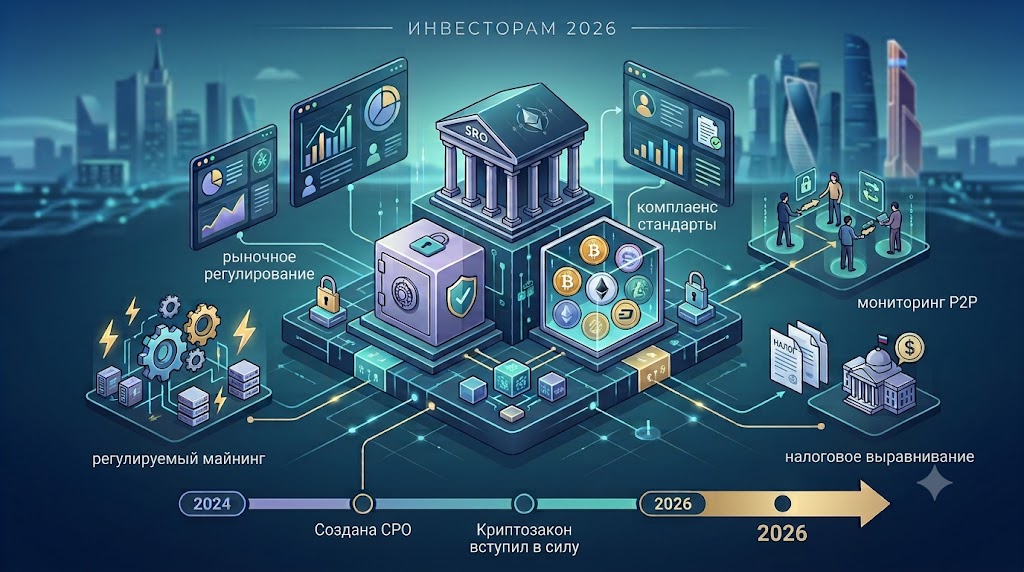
More than 20 organizations have already confirmed they are ready to become founders of Russia's new crypto market self-regulatory organization, and even more players are considering joining. The Association of Banks of Russia (ABR) announced the creation of a professional union of digital currency market participants that will eventually seek self-regulatory organization (SRO) status — and almost simultaneously, the National Association of Securities Market Participants (NAUFOR) declared its own ambitions in the same direction. For investors, this is not an abstract bureaucratic formality but a concrete shift: the market is preparing for the launch of the digital currency law, and it is the SRO that will write the practical rules of the game for exchanges, exchangers, and depositories. Below, we break down who will actually join the new structure, and how it will affect P2P deals, taxes, asset protection, and mining.
What Is a Crypto Market SRO and Why Is It Being Created
A crypto market SRO is a professional union of companies — not a government body and not a club for retail traders. The Association of Banks of Russia is building it on the base of the Expert Center on Digital Financial Assets and Digital Currencies, which has been operating since 2022 and has held more than 50 working sessions with banks, infrastructure companies, AML services, and mining organizations.
Olga Goncharova, head of the ABR's Expert Center, has clarified that the registration of the union will be resolved in the near future, while formalizing SRO status is the next stage, which will launch once key market players join the union and the digital currency law is passed. Formalizing SRO status under Federal Law No. 41-FZ "On Self-Regulatory Organizations in the Financial Market" will happen only after draft law No. 1194918-8 "On Digital Currency and Digital Rights" takes effect. The State Duma plans to pass this law before the end of the spring session, i.e., by July 27, 2026, and it is meant to enter into force on September 1, 2026. The organization's task is to develop unified practical standards: compliance and monitoring of suspicious transactions, custodial storage of client assets, resilience to sanctions risk, node and infrastructure localization requirements, as well as Travel Rule data-exchange rules.
Tellingly, the market is preparing for the law's launch ahead of time, without waiting for it to formally take effect. The Moscow Exchange has already stated it is ready to begin digital currency operations as soon as the bill is passed, and market participants are discussing the cost of launching digital depositories — estimated at anywhere from 500 million to 10 billion rubles, with a payback period of up to eight years. This shows the scale of the infrastructure investment behind the phrase "self-regulatory organization": this is not a formal signboard but a genuine rebuilding of market infrastructure.
Who Will Join the Union: Institutions, Not Retail Traders
Membership in the SRO is designed for institutional and professional market participants, not individuals. Potential founders include systemically important banks, subsidiaries of state corporations, investment companies, licensed Russian crypto exchanges, digital financial asset issuance platforms, as well as large industrial mining farms and legally operating mining pools. According to the ABR's Expert Center, more than 20 organizations have already confirmed their readiness to become founders, and the total number of parties wanting to join the union is significantly higher — interest has been confirmed by banks, state and investment structures, international partners, and professional crypto market participants.
An ordinary retail user does not need to — and technically cannot — join the SRO; membership is open only to legal entities that have passed the relevant qualification. But that doesn't mean the changes won't affect them. If the platform a person trades on becomes a member of the organization, that platform's client operations and data will fall under stricter oversight — both from the SRO itself and from regulators, including the Bank of Russia. In effect, a private investor will feel the effect of self-regulation not as direct membership, but as tighter rules on the side of the intermediary they've chosen.
How Will This Affect OTC and P2P Deals
One of the officially stated goals of the union is to help the state combat money laundering and illegal movement of capital. This directly concerns over-the-counter (OTC) and P2P operations, which have long remained the least controlled segment of the market.
The standards the future SRO is preparing include risk-assessment models and operating procedures under sanctions conditions, as well as requirements for Travel Rule data exchange — the rule governing the transfer of information about the payer and recipient of a transfer. In practice, this means unauthorized private P2P transfers will face tighter bank risk controls. Russia is simultaneously promoting pilot projects for cross-border settlements in digital currency, and the regulator's logic is built around gradually shifting ruble-to-digital-currency exchange onto platforms that fall within the regulated and self-regulated perimeter.
Is This Linked to Tighter Tax Oversight
One of the future SRO's practical functions is to build unified data-collection and reporting standards that make life easier for the Federal Financial Monitoring Service (Rosfinmonitoring) and tax authorities. Members of the organization that fall within the regulated perimeter will be required to follow common reporting rules — meaning regulators will gain a unified channel for obtaining transaction information instead of scattered data from dozens of different platforms.
An additional element of this logic is the institution of digital depositories introduced by the digital currency law. Rights to crypto assets will be recorded through specialized depositories rather than directly in user wallets, which makes asset movement transparent to regulators "by default," rather than only at the moment of a targeted audit.
Russia already has rules taxing income from cryptocurrency transactions and mining, and the new law on digital currency and digital rights is meant to formalize the legal status of the operations themselves. Creating an industry union is, in essence, infrastructure preparation to make existing tax obligations more consistently enforced — not a separate new tax measure.
Will the SRO Protect Investor Rights, or Is It Just a Formality
Under Russian law, financial market self-regulatory organizations create compensation funds — a mechanism through which clients are reimbursed for part of their losses if an SRO member violates the rules and this causes harm. This model is also being discussed as part of the future architecture for the crypto market: if a licensed exchange or exchanger that belongs to the union violates requirements and a client loses assets, the organization becomes responsible for compensation within established limits.
At the same time, the SRO functions as a feedback channel between the industry and the state — the union announced by the ABR has already prepared recommendations on draft law No. 1194918-8, a review of Russian and foreign infrastructure solutions, and the market's position on stablecoin regulation. But it's important to understand the limits of this protection: the compensation mechanism and SRO standards apply only to platforms within its perimeter. If a user trades through an unlicensed foreign exchange or a shadow exchanger, they will get no protection whatsoever from a Russian SRO.
What's Happening With the 300,000-Ruble Limit for Non-Qualified Investors
The SRO does not set limits for retail investors directly — that is the prerogative of the Bank of Russia and federal law — but the union will be responsible for ensuring that platforms technically and organizationally comply with these restrictions. Under the current regulatory concept, a non-qualified investor will be able to buy the most liquid digital currencies after mandatory testing and within a limit of 300,000 rubles per year through one licensed intermediary. Vladimir Chistyukhin, First Deputy Chairman of the Bank of Russia, has emphasized that this figure is fixed and will not be raised.
| Investor Category | Available Assets | Annual Limit | Additional Conditions |
| Non-qualified investor | Limited list of the most liquid digital currencies | Up to 300,000 ₽ per intermediary | Mandatory testing |
| Qualified investor | Almost any digital currency except anonymous ones | No limit on amount | Mandatory testing; qualification threshold raised to 24 million ₽ |
One nuance is worth noting: the limit applies "per intermediary," not per person overall, so the total amount actually available will depend on how many licensed platforms exist on the market — a question industry representatives call the main uncertainty of the new model.
Two Competing SROs: Association of Banks of Russia vs. NAUFOR
Two SRO candidates are forming on the market at the same time, and this isn't a technicality — it's a factor that will determine whose standards become the industry default. The Association of Banks of Russia is building its union around the banking sector and its affiliated crypto structures. NAUFOR, for its part, plans to apply for crypto market SRO status right after registering changes to its charter — expected around late August or early September 2026 — and is already coordinating future baseline standards for the industry in parallel with the Bank of Russia.
Anatoly Aksakov, chairman of the State Duma Committee on the Financial Market, has publicly called this competition a positive factor for the market. For an investor, the practical takeaway is that asset-storage, compliance, and reporting standards may differ slightly during the transition period depending on which SRO the chosen platform gravitates toward — until the Bank of Russia's Committee on Baseline Standards unifies the requirements, which is expected by the end of 2026.
NAUFOR head Alexei Timofeev has noted that work on the standards is already underway in parallel with the Central Bank, and that once the norms are submitted to the Committee on Baseline Standards, coordinating them could take just a month or two. That means the transition period of uncertainty is likely to be short: the market expects to get a unified set of mandatory rules before the end of 2026, rather than stretching this work out over years, as happened with the regulation of digital financial assets after Federal Law No. 259-FZ was passed in 2021.
What This Means for the Mining Industry
Large industrial mining farms and legal mining pools are one of the driving forces behind the creation of the SRO, not passive observers of the process. The Expert Center on which the ABR's union is built has worked systematically with mining companies on compliance and infrastructure standards since 2022.
For good-faith, "white" miners, joining the SRO means the ability to influence unified industry rules: power-supply requirements, node and key infrastructure operating standards, and a coordinated position on mining taxation issues. For illegal operators — those using unmetered electricity or not declaring income — stronger self-regulation instead means faster displacement from the market, since the organization has a direct interest in cleaning its perimeter of bad-faith participants who create reputational and regulatory risk for the whole industry.
Large industrial operators working within the legal framework are already building their own infrastructure with an eye on the new rules — from coordinating power supply with regional grids to setting up subsidiary structures for settlements in digital currency. Building unified standards through the SRO reduces regulatory uncertainty for such companies: instead of piecemeal inspections and scattered requirements, a predictable set of rules emerges, agreed in advance with the Bank of Russia and the relevant State Duma committee.
How to Trade Cryptocurrency on KuCoin Given Russia's New Rules?
While Russian legislation builds out its framework of licensed intermediaries, depositories, and SROs, international platforms remain a space where investors retain access to a broad list of assets and global liquidity. KuCoin provides tools for trading leading digital currencies, spot and derivatives trading, and built-in risk-management mechanisms — which is especially important during a period when national rules are still forming and subject to change. Before trading, it's worth reviewing the current tax and regulatory status of cryptocurrency transactions in your jurisdiction and choosing a strategy that matches your own risk tolerance.
Conclusion
The creation of a crypto market self-regulatory organization in Russia is not a one-off news item but a systemic step in preparation for the digital currency and digital rights law taking effect. The key thing to understand: SRO membership is designed for banks, exchanges, depositories, and mining companies — not private investors — but the effect of the new standards, including stronger compliance, oversight of P2P operations, and unified reporting to tax authorities, will touch everyone who uses platforms within the regulated perimeter. At the same time, at least two candidates — the Association of Banks of Russia and NAUFOR — are competing for SRO status, and the outcome of that competition will determine whose practical standards become the industry benchmark. Compensation funds and investor-rights protections will only apply to legal platforms within the SRO, while the 300,000-ruble limit for non-qualified investors and the requirements facing the mining industry will remain in force regardless of which structure earns official status first.
Frequently Asked Questions
Does an ordinary user need to join the crypto market SRO? No, membership is available only to legal entities — exchanges, banks, depositories, and mining companies — not to individual traders.
When will the crypto market SRO officially start operating in Russia? Registration of the professional union is expected in the near future, while formal SRO status is expected to follow once the digital currency law takes effect, which could happen as early as September 1, 2026.
Could two SROs appear on the market at once? Yes, in addition to the Association of Banks of Russia's union, NAUFOR also plans to obtain crypto market SRO status — expected around late August or early September 2026.
What happens to exchangers that don't join an SRO? The law requires operations through licensed intermediaries; platforms outside the regulated and self-regulated perimeter risk facing restrictions from banks and heightened scrutiny from regulators.
How is the SRO connected to the 300,000-ruble cryptocurrency purchase limit? The SRO does not set the limit itself, but it is responsible for ensuring that its member platforms technically comply with the restrictions set by the Bank of Russia for non-qualified investors.