

Russia's Crypto Payment Law 2026: What Changes for Digital Currency Rules
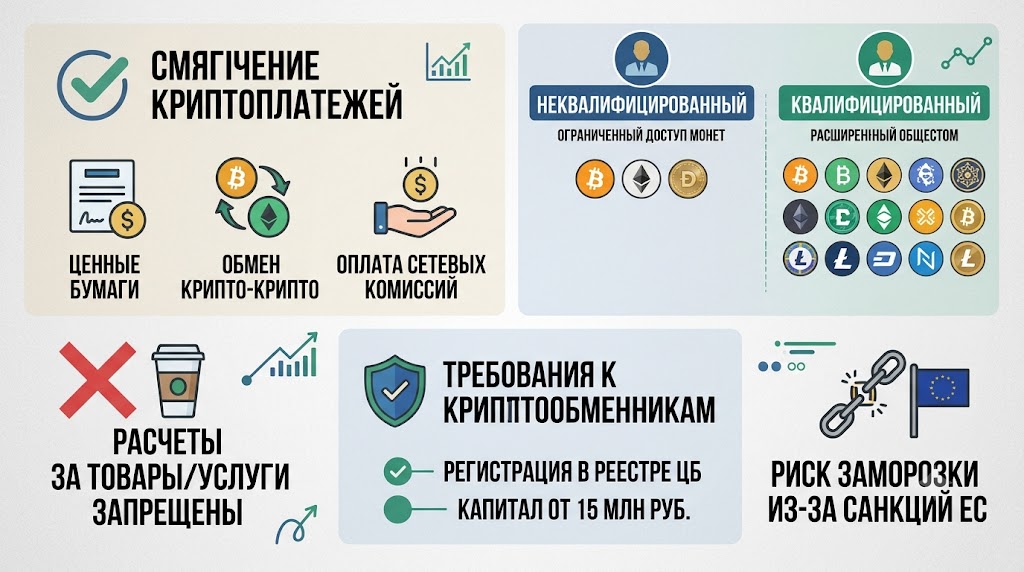
The State Duma's Financial Market Committee has prepared the bill "On Digital Currency and Digital Rights" for its second reading, and the main takeaway is clear: the blanket ban on domestic crypto payments is being eased — but only for a narrow, tightly defined set of scenarios. This isn't about being able to pay for coffee or a car with crypto — that remains banned. The new version of the document permits paying for securities outside a public offering with cryptocurrency, exchanging one digital currency for another, and paying blockchain network fees. At the same time, requirements for crypto exchangers are being tightened, and investors are being split into two unequal categories — qualified and non-qualified. Below we break down exactly what's changing, who it affects, and how these rules relate to trading on international platforms like KuCoin.
What exactly does the bill ease ahead of the second reading?
The bill expands three specific cases in which digital currency can serve as a means of payment inside Russia. Based on Interfax data from July 7, 2026, a provision was added ahead of the second reading allowing cryptocurrency to be used to pay for securities, other digital currencies, and digital rights.
In the first reading, approved by the State Duma on April 1, 2026, the general ban on using cryptocurrency as a means of payment had only two exceptions — mining rewards and settlements under foreign trade contracts. According to Pravo.ru, by the second reading the list had grown to include exchanging one cryptocurrency for another on a licensed platform, buying stocks and bonds with cryptocurrency outside a public offering, and paying gas fees for transfers within blockchain systems.
It's important to understand the limits of this liberalization. This concerns three closed scenarios, applicable only within the regulated perimeter: crypto-to-crypto exchange on licensed platforms, purchase of non-public securities, and payment of network fees. Any everyday transactions — buying goods, services, real estate, or cars with bitcoin — remain completely banned.
The first-reading provision on issuing new digital currencies within Russia — that is, creating new units of cryptocurrency on Russian information infrastructure — has also disappeared from the draft. This means the law is betting on regulating the circulation of already-existing assets (primarily BTC and ETH), rather than the emission of homegrown crypto tokens domestically. At the same time, clearing organizations have been fully incorporated: while in the first reading they were mentioned only as a reference term, they are now explicitly included among market participants, allowed to act as lenders for crypto loans and as participants in settlements following exchange clearing.
Who will get access to which cryptocurrencies?
Access to cryptocurrencies on the exchange is strictly divided by investor status: non-qualified investors will get only a limited list of coins, while qualified investors get essentially unrestricted access. According to Interfax, non-qualified investors will only have access to coins that the Central Bank's board of directors temporarily approves for public trading, for a period of up to six months.
Qualified investors are in a fundamentally different position. Through a trading organizer, they will be able to get access to virtually any cryptocurrency outside the Central Bank's list, since such organized trading is formally not considered public circulation of digital currency. This creates a two-tier system: large, qualified capital gets broad freedom of asset choice, while retail investors get a narrow and temporarily approved list.
The basic criteria for admitting a cryptocurrency to public circulation remain unchanged in the bill: average market cap over two years above 5 trillion rubles, average daily trading volume over two years above 1 trillion rubles, and at least five years of price history on a licensed foreign exchange with turnover from 100 billion rubles. Today, only bitcoin (BTC) and ether (ETH) meet these criteria.
Ahead of the second reading, an important caveat was added to the text: the Central Bank's board of directors may, for up to six months, allow public admission of currencies that don't meet the three capitalization and turnover criteria listed above. This gives the regulator a flexible tool for selectively expanding the retail coin list without amending the law itself. At the same time, a trading organizer separately has the right to admit any cryptocurrencies outside the Central Bank's list to organized trading, but exclusively for qualified investors, and such trading is explicitly not recognized as public circulation of digital currency. Formally, this means qualified investors within the legal Russian perimeter get virtually unrestricted access to cryptocurrency circulation, while retail traders remain within a narrow and temporary list.
| Investor Category | Available Cryptocurrencies | Admission Conditions |
| Non-qualified (retail) | Only coins temporarily approved by the Central Bank's board of directors (up to 6 months) | Public trading on a licensed exchange |
| Qualified | Virtually any cryptocurrency outside the Central Bank's list | Trading through a trading organizer, not considered public circulation |
What will happen to the USDT and USDC stablecoins?
The USDT and USDC stablecoins risk falling outside the legal scope of the new system, since they don't meet the bill's formal definition of digital currency. The issue lies in the legal construction: digital currency is defined as an asset for which there is no obligated party toward its holders. Issuers of USDT and USDC, by contrast, carry direct obligations to maintain the peg and redeem tokens.
This creates a practical problem for the payments market, where stablecoins have historically been the most popular settlement instrument, including in foreign trade operations. Formally, such assets may fall outside regulation as "digital currency," leaving them in a gray zone without clear rules on circulation, custodial storage, and taxation. Market participants relying on stablecoins should closely watch the final version of the law and the Central Bank's implementing regulations.
In practice, this could mean that operations with USDT and USDC within the Russian regulated perimeter end up either fully banned or governed by separate rules that haven't yet been formulated. For traders who use stablecoins to settle foreign trade contracts or to quickly move value between exchanges, this creates additional uncertainty and raises the importance of international platforms, where the status of such assets doesn't depend on Russian legal classification.
How will requirements for crypto exchangers change?
Crypto exchangers will be required to exit the gray zone and operate only through registration in the Central Bank's registry once turnover exceeds 3.5 million rubles per month. According to the revised bill, only a Russian business entity can act as an exchanger, and the minimum capital for such a company is fixed at no less than 15 million rubles, following the methodology for professional market participants.
Requirements for the software and hardware of exchangers and the Central Bank's digital depositories will be coordinated with the FSTEC and FSB — meaning control over settlement infrastructure shifts to state security and technical oversight. In essence, this amounts to the complete elimination of the unregulated P2P segment and shadow exchange points, which had long remained the main channel for retail crypto settlements in Russia.
The regime for crypto loans has been eased somewhat, however. In the first reading, issuing crypto loans without a licensed intermediary was completely banned. Ahead of the second reading, it was established that only a broker, trust manager, exchanger, or clearing organization can act as a lender for such a loan, and a non-qualified individual investor gained the right to repay the loan in either rubles or cryptocurrency.
This easing should be assessed alongside the tightening of capital requirements for exchangers themselves. The bar of 15 million rubles in minimum capital and mandatory approval of software and hardware by the FSB and FSTEC effectively cut off small and semi-legal services from the market, leaving room only for large, institutionally structured players. For the average user, this means legal access to crypto exchange within the country will be concentrated among a limited number of licensed companies, rather than the many small exchange points that existed before.
How have EU sanctions affected the risk of Russian crypto being "tainted"?
The EU's 20th sanctions package, adopted in April 2026, for the first time introduced a sectoral ban on operations by EU-jurisdiction citizens and companies with any crypto providers and exchanges registered in Russia. This sharply raised the risk of so-called "tainting" — the automatic flagging of any cryptocurrency linked to the Russian circuit as high-risk, followed by blocking on foreign platforms.
The problem is that there's no direct response to this threat in the bill ahead of the second reading. The law requires holding cryptocurrency exclusively in digital depositories under Central Bank oversight, doesn't allow withdrawing assets to personal wallets, and permits transfers only to licensed foreign organizations — many of which are themselves obligated to comply with European sanctions requirements. The result is a dual situation: the state encourages the use of cryptocurrency in foreign trade to get around Western restrictions, but tying assets to Russia's regulated infrastructure raises the risk of them being blocked abroad.
Domestic monitoring is referred to by the term "digital analysis" (previously "digital control"): coins and addresses are checked for links to criminal activity, but this procedure operates domestically and doesn't protect against sanctions-related "tainting" on foreign platforms.
The state's underlying logic here is dual and, in essence, contradictory. On one hand, the law directly encourages the use of cryptocurrency in foreign trade settlements (FTS) as a tool for countering Western sanctions, going as far as introducing clearing organizations capable of issuing crypto loans for foreign trade operations. On the other hand, the requirement to hold assets in Central-Bank-controlled digital depositories makes those same assets more vulnerable to international blocking, since any link to Russia's regulated infrastructure increases the likelihood of falling under restrictions imposed by foreign exchanges and payment systems.
When do the new rules take effect?
The key date for the law's entry into force has been moved from July 1 to September 1, 2026. According to Interfax and Pravo.ru, this is a delay compared to the original first-reading timeline, giving market participants additional time to prepare infrastructure and obtain the necessary licenses.
Some provisions have been pushed back even further — to July 1, 2027. This concerns the mandatory requirement to conduct cryptocurrency transactions only through licensed intermediaries, and restrictions on bank transfers in cases of illegal organization of digital currency circulation — in other words, a one-year transition period is being given specifically for the complete elimination of the illegal P2P segment.
Separately, starting September 1, 2027, a provision on protecting clients from transactions made without their voluntary consent will take effect — an obligation for exchangers and digital depositories to counter fraud.
The Russian government, in coordination with the Central Bank and FSB, additionally gains the right to introduce a special regime for cryptocurrency circulation to protect the constitutional order, economic interests, defense, and security of the country — a provision that wasn't in the first reading.
How to Trade Cryptocurrency on KuCoin from Russia?
For traders working with international platforms rather than within Russia's regulated perimeter, global liquidity and a wide selection of trading pairs are what matter most. KuCoin provides access to hundreds of cryptocurrencies, spot and futures trading, and risk management tools that are especially relevant amid the regulatory uncertainty and volatility triggered by news of legislative changes.
Before starting to trade, it's worth assessing your own risk profile: crypto market volatility intensifies during periods when new versions of bills are published, and liquidity for individual coins can shift sharply. Registering on KuCoin takes just a few minutes and includes identity verification, after which full functionality becomes available — from simple spot trades to advanced derivatives. For those looking to diversify assets beyond the narrow list permitted for non-qualified investors domestically, platforms like KuCoin remain one of the few ways to get broad market access.
Whatever strategy you choose, it's important to keep basic risk-management principles in mind: don't invest funds whose loss would critically affect your financial position, use protective orders, and keep an eye on the news, since Russia's regulatory environment continues to change.
Conclusion
The bill on digital currency and digital rights, refined ahead of its second reading, doesn't lift the ban on crypto payments in Russia — it selectively expands three scenarios: exchanging cryptocurrency for cryptocurrency, paying for non-public securities, and paying blockchain network fees. Everyday transactions with cryptocurrency — from coffee to cars — remain outside the law.
At the same time, a two-tier trading access system is being introduced: retail investors get a narrow list of coins temporarily approved by the Central Bank, while qualified investors get virtually unrestricted access through trading organizers. Crypto exchangers are required to register with capital of at least 15 million rubles and gain approval from the FSB and FSTEC, effectively eliminating the gray P2P market. USDT and USDC stablecoins end up in a legally uncertain position due to their mismatch with the formal definition of digital currency.
The main body of the law will take effect on September 1, 2026, while the toughest control measures — mandatory operation through licensed intermediaries — will kick in from July 1, 2027. Against the backdrop of EU sanctions and the risk of Russian cryptocurrency being "tainted" abroad, international platforms like KuCoin remain an important channel for diversification and access to global liquidity.
Frequently Asked Questions
Can you already pay for goods with cryptocurrency in Russian stores?
No, paying for goods and services with cryptocurrency in retail remains fully banned. Only payment for securities outside a public offering, exchanging one digital currency for another, and paying network fees are permitted.
What's the difference between qualified and non-qualified investor status when it comes to cryptocurrency?
A qualified investor gets access to virtually any cryptocurrency through a trading organizer, while a non-qualified investor gets access only to coins temporarily approved by the Central Bank's board of directors for up to six months.
Why might USDT and USDC stablecoins fall outside the new law?
Because the bill defines digital currency as an asset with no obligated party, whereas USDT and USDC issuers carry direct obligations to maintain the peg and redeem tokens, which formally excludes these assets from the definition.
What happens to illegal crypto exchangers once the law takes effect?
After the transition period ends on July 1, 2027, all transactions not conducted through licensed intermediaries — including P2P transfers and illegal bank transactions — will be blocked, and exchangers themselves will be required to hold capital of at least 15 million rubles and pass FSB and FSTEC approval.
How will EU sanctions affect holders of Russian cryptocurrency?
Due to the sectoral ban introduced by the EU's 20th sanctions package in April 2026, any cryptocurrency linked to Russia's regulated infrastructure risks being automatically flagged as high-risk and blocked on foreign platforms — a risk the bill doesn't yet resolve.