

FATF Crypto Rules in Russia in 2026: What the Group Requires and How It Will Reshape the Market
Introduction
More than 250 stablecoins with a combined market cap above $300 billion are already in the crosshairs of the global regulator — and according to Chainalysis, stablecoins accounted for 84% of all illicit crypto transaction volume in 2025. This isn't an abstract statistic: it's the exact trigger behind the new wave of requirements from FATF (the Financial Action Task Force).
The short answer: FATF requires crypto exchanges, custodians, and stablecoin issuers to implement the "Travel Rule," build freeze-and-block controls directly into stablecoins, and bring DeFi protocols and self-custody wallets under supervision. For a trader, this means stricter KYC, a shrinking list of available coins, and the gradual closing of anonymous withdrawal channels.
Below, we break down exactly what FATF is demanding, how these rules are already showing up in Russian legislation, and what it all means for the average crypto holder.
What Is the Travel Rule and Why Is FATF Pushing It
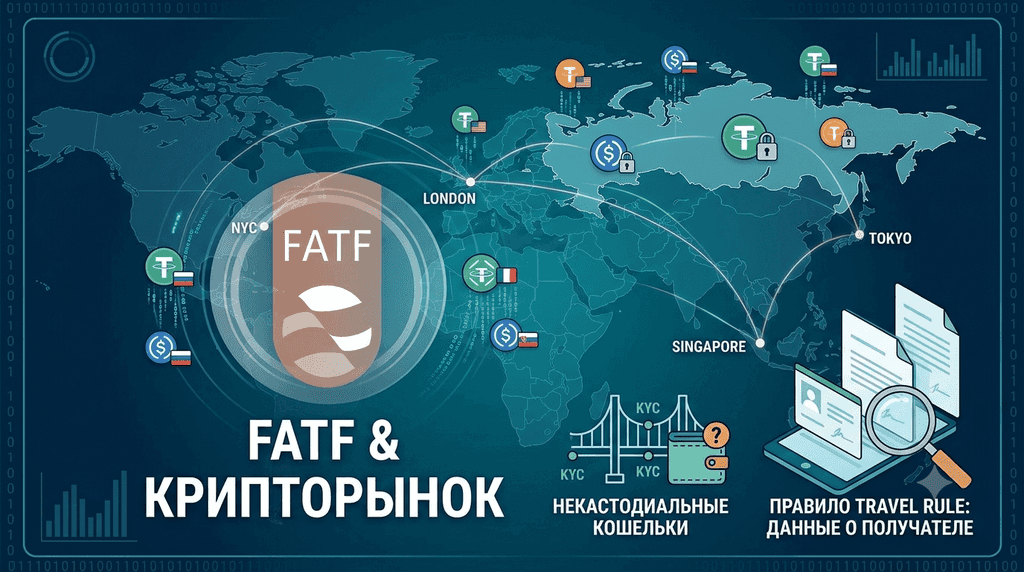
The Travel Rule is FATF Recommendation 16, which requires virtual asset service providers (VASPs — exchanges, brokers, custodians) to collect and pass on sender and receiver information when transferring crypto, the same way banks have done for years through SWIFT.
According to 2026 industry surveys, roughly 73-85% of more than 100 assessed jurisdictions have already passed relevant legislation, and the rule is now in force in over 70 countries, including the EU, the UK, the US, Japan, Singapore, and Canada. In the European Union, the Transfer of Funds Regulation (TFR) has applied since December 2024 and set a zero threshold: full sender and receiver data is now required for any transfer between exchanges, regardless of amount.
A separate headache for regulators is transfers to self-custody (personal) wallets. In the EU, transfers above 1,000 euros to such wallets already require additional verification of the source of funds. In its mid-2025 update, FATF explicitly asked countries to clarify who — the sending or the receiving exchange — is responsible for passing along the data, so that a transaction doesn't fall into a legal vacuum.
The practical question regulators now ask every exchange is whether its systems can exchange Travel Rule data fast enough to make a real-time decision on a given transaction. In other words, simply having a policy on paper is no longer enough — a working technical infrastructure is required.
Below is a comparison of Travel Rule thresholds across key jurisdictions, showing just how differently regulators approach the same FATF requirement.
| Jurisdiction | Threshold for exchange-to-exchange transfers | Threshold for self-custody wallets |
| European Union (TFR) | €0 — data always transmitted | €1,000 |
| United Kingdom | £1,000 domestically | £0 for cross-border transfers |
| Canada | CAD 1,000 | Direct data request from the customer required |
| US, Singapore, Japan | Around $1,000 | Regulated at individual VASP level |
The table shows that the EU and UK have effectively eliminated the minimum threshold for cross-border transactions, while North America and Asia still keep a formal $1,000-equivalent limit. This gap creates risk for global transfers: funds passing through jurisdictions with incomplete Travel Rule implementation may not carry the same level of transparency — a problem FATF flags directly in its latest reviews, publicly naming countries with partial or inconsistent rollout.
An important nuance: Travel Rule data isn't exchanged directly between platforms but through specialized intermediary protocols such as TRP, TRISA, or Notabene. These networks currently handle the bulk of compliance traffic between VASPs worldwide, and their interoperability determines whether a transfer can even go through between two different exchanges without delay.
What Requirements Does FATF Set for Stablecoins
FATF requires stablecoin issuers to build technical control mechanisms directly into the tokens — blacklists, whitelisted addresses, and the ability to freeze or burn tokens at any moment. This is the central finding of FATF's targeted report on stablecoins and self-custody wallets, published on March 3, 2026.
The report explicitly states that jurisdictions should require issuers to retain the technical capability to "freeze" and "burn" stablecoins even in secondary circulation — that is, after the token has already left a regulated exchange and landed in a user's personal wallet. At the same time, FATF insists on strict KYC checks at the point of redemption — when a stablecoin is converted back into fiat currency.
This marks a fundamental shift in regulatory logic. Oversight used to be limited to entry and exit points — the moment crypto is bought or sold for fiat. Now FATF proposes extending monitoring across the entire secondary market, including transfers between personal wallets, using the programmable nature of stablecoins as a supervisory tool.
The regulator also encourages jurisdictions that have already adopted advanced practices: multi-hop transaction tracing across several wallets in sequence, automatic screening of addresses against sanctions and high-risk lists, and mandatory identity checks at redemption. These measures directly concern the largest issuers, including Tether, which has previously shown willingness to freeze wallets at the request of law enforcement.
The scale of the problem explains why FATF chose such a strict approach. According to Chainalysis, by mid-2025 more than 250 stablecoins with a combined market cap above $300 billion were in circulation, and this asset class has become the primary tool for money laundering in the crypto industry. Among the users of such schemes, FATF specifically names groups linked to cybercrime and weapons-proliferation financing, including structures associated with North Korea.
For a stablecoin holder, this means the following: simply holding USDT or USDC in a personal wallet won't freeze the funds, but attempting to withdraw them through a regulated exchange or service will trigger a full check of the tokens' transaction history. If that chain reveals a connection to a sanctioned address, a mixer, or a platform on a high-risk list, the issuer or exchange is entitled to freeze the asset even before the review is complete — not only afterward.
How FATF Regulates DeFi and Self-Custody Wallets
FATF views self-custody wallets as the biggest gap in anti-money-laundering defenses, since transfers between such wallets happen directly, bypassing the regulated intermediary that would otherwise be obligated to report suspicious activity. That's exactly why, in its new targeted report on decentralized finance published on July 21, 2026, the group updated and expanded its 2021 position on DeFi protocols.
According to the report, 132 of 142 surveyed jurisdictions have still failed to identify or regulate DeFi protocols that fall under FATF Recommendation 15 on new technologies. FATF stresses that a platform's marketing claims of being "fully decentralized" don't exempt it from obligations if the protocol in fact has controlling parties — developers, admin-key holders, or governance structures capable of influencing how it operates.
The practical implication is a push toward licensing DeFi protocols wherever a responsible legal entity can be identified, along with heightened scrutiny of cross-border and cross-chain transfers between self-custody wallets. For criminal networks, including groups linked to North Korea, such transfers have long been a way to break the chain of traceability.
FATF specifically highlights the gap between a protocol's declared and actual decentralization. If a DeFi platform has a development team holding admin keys, a foundation or organization that influences protocol parameters, or an interface controlled by a single company, FATF treats it as a potential VASP regardless of how the project brands itself in marketing materials. This fundamentally changes the risk calculus for teams that previously relied on formal decentralization to avoid licensing.
For a trader using DeFi protocols, the practical consequence is that interacting with an unlicensed platform becomes, by itself, a risk factor when funds are later withdrawn to a regulated exchange. Even if the protocol itself doesn't require KYC, on-chain transaction history remains transparent — and that history is exactly what exchange compliance systems analyze when checking the source of funds.
What Direct Impact Do the FATF Rules Have on Ordinary Users
The main practical consequence for the average crypto holder is a sharp tightening of KYC and source-of-funds checks at every stage — not just at exchange sign-up. Any deposit or withdrawal of stablecoins like USDT or USDC through a regulated platform will now come with tracing of the funds' origin all the way back to the start of the chain.
If the transaction history shows any use of mixers or unregulated platforms, funds can be frozen immediately, even before the review is finished. This is already happening: major stablecoin issuers routinely block addresses at the request of law enforcement, and the new FATF report cements this practice as a mandatory standard rather than a company's goodwill gesture.
A second consequence is a shrinking selection of coins available to retail traders. As global compliance costs rise, exchanges will be forced to cut listings for assets that are hard to verify against the requirements. At risk are privacy-focused anonymous coins like Monero, along with small and mid-cap altcoins lacking a transparent issuance history — these are the first to leave regulated platforms.
Will P2P Trading and Self-Custody Wallets Be Banned Outright
An outright ban on P2P trading and personal wallets is unlikely, but their use is becoming significantly more restricted and now requires going through a licensed intermediary whenever it touches regulated infrastructure. A good example of this "differentiated" approach is Russia's new digital-currency legislation.
The foundational document remains Federal Law No. 259-FZ "On Digital Financial Assets, Digital Currency," under which digital currency is recognized as property of value but is not legal tender. The newer law "On Digital Currencies and Digital Rights," passed by the State Duma, channels crypto operations into regulated infrastructure — through exchanges, brokers, and licensed digital depositories.
Self-custody wallets themselves are not banned, but any interaction between such a wallet and a licensed exchange or service provider now falls under source-of-funds verification requirements. Privacy-oriented anonymous coins (Monero, Zcash) are expected to be fully banned on licensed platforms — a direct consequence of FATF's logic of minimizing opaque channels.
How Retail Investors in Russia Are Allowed to Buy Crypto
Russian non-qualified investors can now buy crypto only from a limited "whitelist" and only after mandatory risk-comprehension testing. This is the regulator's response to FATF's requirements while still preserving retail market access to basic instruments.
The whitelist includes only the most liquid assets with a long trading history — in practice, Bitcoin, Ethereum, and USDT (with some sources also citing XRP and USDC). The selection criteria are strict: an asset's average two-year market cap must exceed roughly 5 trillion rubles, and average daily trading volume must be around 1 trillion rubles.
The annual purchase limit for a non-qualified investor is capped at 300,000 rubles per intermediary — roughly $3,300-3,800 a year. Qualified investors who have passed testing are exempt from both the amount cap and the list of permitted assets.
All operations — buying, selling, and custody — must go exclusively through officially recognized licensed brokers and digital depositories. Anonymous cross-border transfers are being rapidly shut down as a result — a direct mirror of the Travel Rule and FATF's recommendations on monitoring the secondary market.
How to Buy and Trade Crypto on KuCoin
If you want to buy Bitcoin, Ethereum, or other liquid assets under these new transparency requirements, KuCoin offers a regulated and straightforward entry point into the market. The exchange supports identity verification (KYC), which resolves the source-of-funds question at the registration stage and removes the risk of a sudden freeze at withdrawal.
To start trading on KuCoin, register an account and complete verification by submitting the required documents. Once your identity is confirmed, you can fund your balance via bank card, the P2P section with verified counterparties, or a transfer from another wallet, staying within the platform's stated limits. From there, open the spot or futures trading section, pick the trading pair you want — for example BTC/USDT or ETH/USDT — and place a market or limit order.
For newcomers who are just getting familiar with tightening regulation, KuCoin also offers educational materials and a demo trading feature, which helps you get comfortable with order mechanics without immediate capital risk. Given the trend toward token whitelists and mandatory risk testing in some jurisdictions, it's sensible to start with the most liquid, longest-listed assets, which are least likely to fall under future restrictions.
Conclusion
FATF's 2026 rules shifted the focus of regulation from entry and exit points to the entire lifecycle of a crypto asset, including transfers between personal wallets. The group's core requirements are: universal rollout of the Travel Rule with sender/receiver data exchange, freeze-and-block functionality built directly into stablecoins, and expanded oversight of DeFi protocols, even those that position themselves as fully decentralized.
For the average user, this means stricter KYC at every stage funds move through, the risk of assets being frozen if a link to unregulated services is detected, and a narrower list of coins available for purchase. Russia has responded to these requirements with its own law, introducing a whitelist of the most liquid assets and an annual purchase cap for non-qualified investors, while routing all operations through licensed infrastructure.
The trend is clear: anonymity and decentralization aren't disappearing as technologies, but they are becoming significantly harder to access through regulated financial channels. Operating through vetted platforms with full KYC is no longer just a recommendation — it's a practical requirement of the new regulatory reality.
Frequently Asked Questions
1. What does FATF stand for, and what is its legal status?
FATF stands for the Financial Action Task Force, an intergovernmental body that sets standards for combating money laundering and terrorist financing. Its recommendations carry no direct legal force, but member countries commit to writing them into national law, and non-compliance risks placement on the organization's "grey" or "black" list.
2. Do FATF requirements apply to crypto casinos and NFT platforms?
Yes — if a platform acts as an intermediary for exchanging or holding virtual assets, it falls under the VASP definition regardless of what the service calls itself. FATF's key criterion is a platform's actual function (exchange, transfer, or custody of assets), not its marketing positioning.
3. Can you get around the Travel Rule by splitting a transfer into smaller amounts?
Structuring transfers to dodge a reporting threshold is itself a red flag for suspicious activity and separate grounds for an account freeze. Regulated exchanges use analytics systems that specifically track these behavioral patterns, not just one-off amounts.
4. What will happen to privacy-focused cryptocurrencies like Monero?
Their listings on regulated exchanges and licensed platforms are shrinking, since such assets directly conflict with the transaction-transparency logic FATF promotes. In several jurisdictions, including Russia, the circulation of anonymous coins on licensed infrastructure is already being directly restricted.
5. How can I check if a specific exchange is on the registry of licensed intermediaries?
You can check status on your country's national financial regulator's website — most publish an official registry of licensed VASPs or digital financial intermediaries. Using an unlicensed platform doesn't exempt you from KYC requirements; it only raises the risk of your funds being blocked at withdrawal.