



KuCoin AMA With Gaia (GAIA) — Pioneering Open-Source Deployment for AI Agents
Dear KuCoin Users,
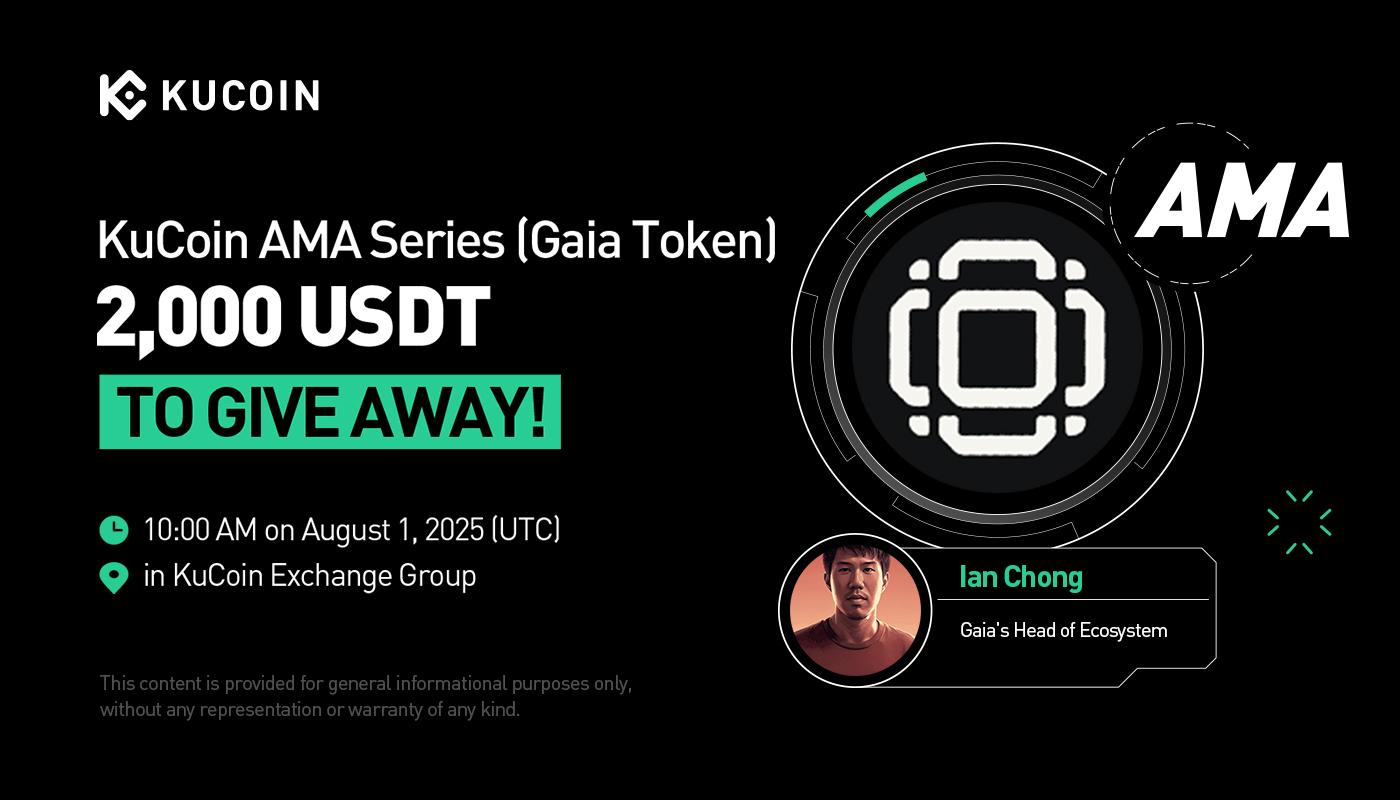
Time: August 01, 2025, 10:00 AM - 10:59 AM (UTC)
KuCoin recently hosted an AMA (Ask Me Anything) session in the KuCoin Exchange Group, featuring Ian Chong, Head of Ecosystem of Gaia.
Official Website: https://gaianet.ai
Follow Gaia on X, Telegram & Discord
Q&A from KuCoin to Gaia
Q: What is Gaia’s Network Launch?
Ian: The Gaia Network Launch marks the activation of GAIA on-chain, enabling decentralized coordination, staking, and infrastructure access throughout the Gaia ecosystem. This transition moves Gaia from its testnet and beta infrastructure into a fully live, modular protocol for decentralized AI inference.
Q: What is GAIA?
Ian: Certainly! While it’s a complex topic, let’s break it down. GAIA serves as the native coordination asset of the Gaia Network. It plays a critical role in securing operations, configuring domains, and enabling infrastructure-level participation across a globally distributed network of independently operated nodes and services.
Q: What can GAIA tokens be used for?
Ian: GAIA is designed to support protocol-level functionality, which includes the following capabilities:
- Staking to participate in various network roles such as Verifiers, Miners, and Domain Operators.
- Configuring and routing traffic across Gaia Domains.
- Accessing decentralized inference services and agent execution.
Q: Why does the Gaia Network use a token?
Ian: Unlike centralized AI, decentralized AI requires secure coordination across a trustless infrastructure. The GAIA token enables this by:
- Enforcing role-based accountability through staking and slashing mechanisms.
- Managing inference consensus via statistical verification.
- Supporting modular routing through human-readable, policy-driven Domains.
- Aligning participation across independently operated nodes and services.
For a deeper understanding, we invite you to visit our website and explore the whitepaper, which outlines the architecture and mechanisms in greater detail.
Q: How is GAIA distributed?
Ian: That’s a great question and really important to know. GAIA follows a fixed-supply distribution model outlined in the Token Whitepaper (which can be found on our website). Allocations are designed to support long-term protocol development, infrastructure operation, and decentralized growth.
Overall: GAIA is structured to balance fairness, sustainability, and decentralization.
Max Supply: 1,000,000,000 GAIA
The main utility covers Governance, coordination, service payments, and protocol participation and lastly - the distribution breakdown is the following:
32%: Network Operations (operators and validators)
20%: Early Backers (vesting schedules in place)
16%: Foundation Treasury
15%: Team and Contributors (multi-year vesting)
8%: Ecosystem Growth (builders, partners, infrastructure)
5%: Community Participation (XP, domain, and node contributors)
4%: Token Availability Pool
Q: Where can GAIA be accessed?
Ian: It’s not a one-off, and we’re constantly working to make it more available across additional platforms. GAIA may be accessible through third-party exchanges or decentralized platforms such as KuCoin. Gaia Labs does not sell tokens directly to individuals, and availability may vary depending on your region and platform. An important thing to note is that users are responsible for ensuring compliance with applicable local laws.
Q: Can users stake GAIA tokens?
Ian: It’s definitely part of the roadmap — so yes. Staking is required to participate in certain roles within the Gaia Network, including running a node, verifying inference results, or managing Domains. Each role has its own technical requirements and operational responsibilities, all of which are outlined in the protocol documentation. If you have more in-depth questions, please visit our website to read the whitepaper or join our Discord/Telegram to learn directly from the community.
Free-Ask from the KuCoin Community to Gaia
Q: What incentive mechanisms and governance structures does Gaia implement to encourage node operators to contribute high-quality inference throughput and keep the shared knowledge bases up-to-date?
Ian: That’s a great question! As mentioned Gaia is set up to be the inference and rewards layer for a decentralised AI ecosystem. So the quality of inference is one of the most important factor in ensuring the usability of the network for builders. This led us to introduce a novel performance bonding approach, that measures the performance and implements graduated penalties from revenue sharing reduction to potentially service suspension. This will ensure that inference quality is high across the network to service the future DeAI applications and agents. Of course this is a heavy topic — so more details can be found on our whitepaper on the Gaia website!
Q: Can you share more about Gaia’s tokenomics and how it incentivizes long-term utility rather than short-term speculation?
Ian: Of course! That’s a very popular question. First of all, GAIA is a utility token that enables participation in the Gaia protocol. It does not represent equity, ownership, or any right to future value. But in a nutshell, we have set responsible and aligned milestones and parameters that focus on rewarding contributors, early supporters, and builders within the Gaia ecosystem. You can find specific details on the emissions, % allocation to various components of the ecosystem in the whitepaper on the website. Also, we have shared the distribution breakdown earlier.
Q: Gaia positions itself as a purpose-driven project. Could you elaborate on how its core vision extends beyond the realm of crypto, and how it intends to drive real-world impact while ensuring meaningful value for token holders?
Ian: We love questions that explore real-world impact! Gaia Network places ownership at its core, empowering developers, contributors, and users to shape a sovereign AI infrastructure. Unlike centralized AI—which often creates walled gardens that restrict data, hoard intellectual property, and enforce misaligned economic models—Gaia flips the script. It’s a transparent, user-owned network where value and decision-making remain with the community, driving open innovation in the knowledge economy. At the same time, we’re working hard to bring Gaia into the hands of everyday users—Gaia is going MOBILE.
We are going to be built on the Galaxy S25 Edge, running AI agents directly on your device—no cloud required. Just you, your data, and local compute. This is true sovereignty in your hand. mobile.gaianet.ai (Sorry mods, please remove this if I’m not supposed to share links).
On tokens side lastly - $GAIA is the native token and engine of the network, powering:
- Onchain governance and protocol upgrades
- Staking for security and trust of inference being served
- Payments for coordination of AI inference and domains resources
- Validator support
- Community incentives
As you can observe, the tokenomics are designed for alignment and sustainability—balancing network usage, growth, and the interests of token holders.
Q: What plans do you have to engage younger or less crypto-savvy audiences to bring them into your ecosystem?
Ian: It’s a common question all Web3 projects need to answer—how to tap into the Web2 or non-crypto native audience. The team is working hard to onboard builders and projects across various verticals, from DeFi to more traditional sectors like gaming and SocialFi, in order to reach a broader audience. The Gaia AI phone mentioned above is also another example of breaking into a different segment or hardware paradigm to tap into a wider, mobile-centric market.
Q: Gaia aims to create meaningful impact, but in Web3, value often gets lost without strong user incentives. How does Gaia align its mission-driven goals with token holder profitability? Can purpose and profit truly coexist in your model without compromise?
Ian: That’s a big hurdle that a lot of projects need to balance. As mentioned before, we are focused on long-term growth and our vision of decentralization. That means a responsible token distribution schedule aligned with the vision of the technology and the world we want to build. I’d urge everyone here to check out our website and whitepaper to really understand the tech, vision, and how we’re balancing interests.
Q: What future partnerships can we expect to see with GAIA?
Ian: TGE was a major milestone, but it’s just the beginning. By taking a step-by-step approach with our exchange listings, network activation, and future airdrops, we’re ensuring that every phase of growth is intentional and community-focused. We have an exciting pipeline of partnerships lined up — including Web3 household names like KuCoin and notable Web2 IPs — so stay tuned and keep supporting Gaia!
Q: What is GaiaNet’s planned long-term token emission schedule—including inflation rates, staking reward curves, and slashing parameters? Additionally, how can GaiaNet token holders leverage on-chain governance to adjust these parameters over time in order to balance network security, incentivize node participation, and sustain or increase the token’s value?
Ian: But in a nutshell, we’ve established responsible and aligned milestones and parameters focused on rewarding contributors, early supporters, and builders within the Gaia ecosystem. Specific details on emissions and percentage allocations to various components of the ecosystem can be found in the whitepaper and future content we’ll be sharing. So be sure to join our Discord or Telegram to stay updated!
Q: How can knowledge workers leverage GaiaNet to develop digital twins that accurately represent their expertise and personal values?
Ian: I have a personal bond with builders and developers within our ecosystem! Following our Docs on the website is the best way to start experiencing setting up a node and deploying an agent! Our Devrels and ecosystem team are constantly adding new content and guides for various use cases that includes digital twins and others. If you’re building something and would need guidance please don’t hesitate to reach out to use via Discord ticket so that we can support your use case. Come meet us at events as well such as hackathons / our guardian workshops.
Q: What specific real-world problems is the $GAIA token designed to address, and in what ways does its utility extend beyond conventional cryptocurrency use cases?
Ian: As mentioned earlier the current centralized AI = walled gardens that lock up data, hoard IP and assert misaligned economics. Gaia flips the model: a transparent, user-owned network where value and decisions stay with the community—driving open innovation in the knowledge economy. This also means we are able to access and open up use cases that is previously not attainable - e.g. IP / SociaFi, health AI, AI used in institutions like governments where data / security / soverignty is of the highest priority. And at the foundation, lies the GAIA token.
It acts as the engine of the network, powering:
- Onchain governance and protocol upgrades
- Staking for security and trust of inference being served
- Payments for coordination of AI inference and domains resources
- Validator support
- Community incentives
Q: Could you elaborate on how users can monetize their AI agents within the Gaia ecosystem? Additionally, what types of tradable assets and services can be created and exchanged in the Gaia marketplace?
Ian: Of course! We believe the digital world in future is no longer run with applications but with agents. So any builders who would want to easily deploy and provide services via their AI agents can simply do so by spinning up a node and domain on Gaia (check our docs), select a LLM, train it and open a chat UI/API for others to intereact with.
Building on Gaia also provides the AI Agent an additional distribution channel, where other builders might need the service of your ai agent. However if you’re not a developer, but holds invaluable proprietary datasets - you can also host it and provide it on Gaia as an asset. GAIA would be the rewards layer that would split revenue across all contributors (knowledge, models, agents, compute) accordingly. More details can be found on our whitepaper as always on our website!
KuCoin Post AMA Activity — Gaia
🎁 Participate in the Gaia AMA quiz now for a chance to win 10 USDT.

The form will remain open for five days from publishing this AMA recap
Gaia AMA - GAIA Giveaway Section
KuCoin and Gaia have prepared a total of 2,000 USDT to give away to AMA participants.
1. Pre-AMA activity: 800 USDT
2. Free-ask section (Main group): 50 USDT
3. Free-ask section (Other groups): 100 USDT
3. Flash mini-game: 300 USDT
4. Post-AMA quiz: 750 USDT
Sign up for a KuCoin account if you haven’t done so yet, and ensure you complete your KYC verification to be eligible for the rewards.