



KuCoin AMA With BNB Attestation Service (BAS) — Enabling Reusable Proofs for Secure Decentralized Applications
Dear KuCoin Users,
Time: August 23, 2025, 10:00 AM - 11:03 PM (UTC)
KuCoin recently hosted an AMA (Ask Me Anything) session in the KuCoin Exchange Group, featuring Jacqueline Zan, Community Lead of BAS.
Official Website: https://www.passport.bnbattest.io/
Follow BNB Attestation Service on X & Telegram
Q&A from KuCoin to BNB Attestation Service
Q: What is BAS and why is it important for the BNB Chain ecosystem?
Jacqueline: BAS (BNB Attestation Service) is the native verification and reputation layer of the BNB Chain. We provide on-chain/ off-chain attestations — reusable proofs of identity, assets, and activity — that help projects identify real users and filter out bots.
Q: What kind of problems in Web3 does BAS solve?
Jacqueline: Web3 is full of fake accounts, bot farming, and low-quality users. This causes:
• Wasted airdrop budgets
• Broken reputation systems
• Poor trust in DeFi & RWA onboarding
BAS solves this by giving projects and users verifiable, portable, and composable proofs — like KYC, asset holdings, or participation records — so that trust becomes programmable on-chain.
Q: What BAS has achieved so far?
Jacqueline: - Angel Investors: Backed by founders and core members of Dao5, Galxe, Mask, Consensys, Formless, Animoca, Waterdrip, UOB, Signum, and more.
- BNB Hackathon Winner
- BNB Grant + Binance MVB8 Cohort
- 30M+ attestations generated
- BNB Passport: 104,996 unique passports issued; 342,937+ asset verifications completed
- 50+ verified attestation data sources onboarded — including Binance KYC, Coinbase KYC, Alpha active asset proofs, Binance balance verifications
- Serving the BNB Chain ecosystem with 100+ partners, powering airdrop campaigns and user stratification across projects, like four.meme, Aspecta, etc
Q: What can everyday users gain by participating in BAS?
Jacqueline: For users, BAS is your on-chain passport. With it, you can:
- Get qualified for airdrops and rewards.
- Build your on-chain reputation.
- Use one verification everywhere, without repeating KYC.
- Become more trusted in DeFi, RWA, and even AI social platforms.
Q: What is the long-term vision for BAS?
Jacqueline: BAS vision: The coming decade of Web3 will be shaped not only by faster chains or deeper liquidity, but by the ability to embed trust as a first-class primitive. Without trust — verifiable identity, accountable reputation, and provable credentials — the digital economy cannot scale to billions of real users.
BAS exists to become the trust layer of @BNBCHAIN. Our vision is to create a decentralized fabric where every proof of identity, asset, or reputation is secure, portable, and composable — forming the backbone of a new generation of applications across RWA, DeFi, AI, and SocialFi.
BAS is building towards a world where:
- Users own their reputation, carrying it across platforms and ecosystems.
- Developers integrate trust seamlessly, unlocking compliant and human-centered applications.
- Communities thrive on verifiable contributions, not speculation or bots.
Just as smart contracts once unlocked the DeFi revolution, verifiable trust will unlock the human revolution of Web3. BAS is laying that foundation today — to ensure BNB Chain becomes the most trusted, human-centric, and future-proof L1 in the decentralized world.
Q: What are BAS products?
Jacqueline: BAS is a modular, verifiable identity and reputation layer for BNB Chain and beyond, built on three pillars:
- BNB Passport → BNB Passport is the master identity on BNB Chain. It combines KYC data with asset and activity verification — such as holdings, Alpha IDO participation, and on-chain behavior — to create a portable, verifiable user profile.
- Attestation Registry → A standard and platform where anyone can make attestations for anything. BAS provides both onchain: Attestations are recorded on-chain, publicly accessible to anyone. Offchain: Attestations are stored in Greenfield, allowing users to control access permissions for attestations.
Q: Could you tell us everything we should know about the $BAS token?
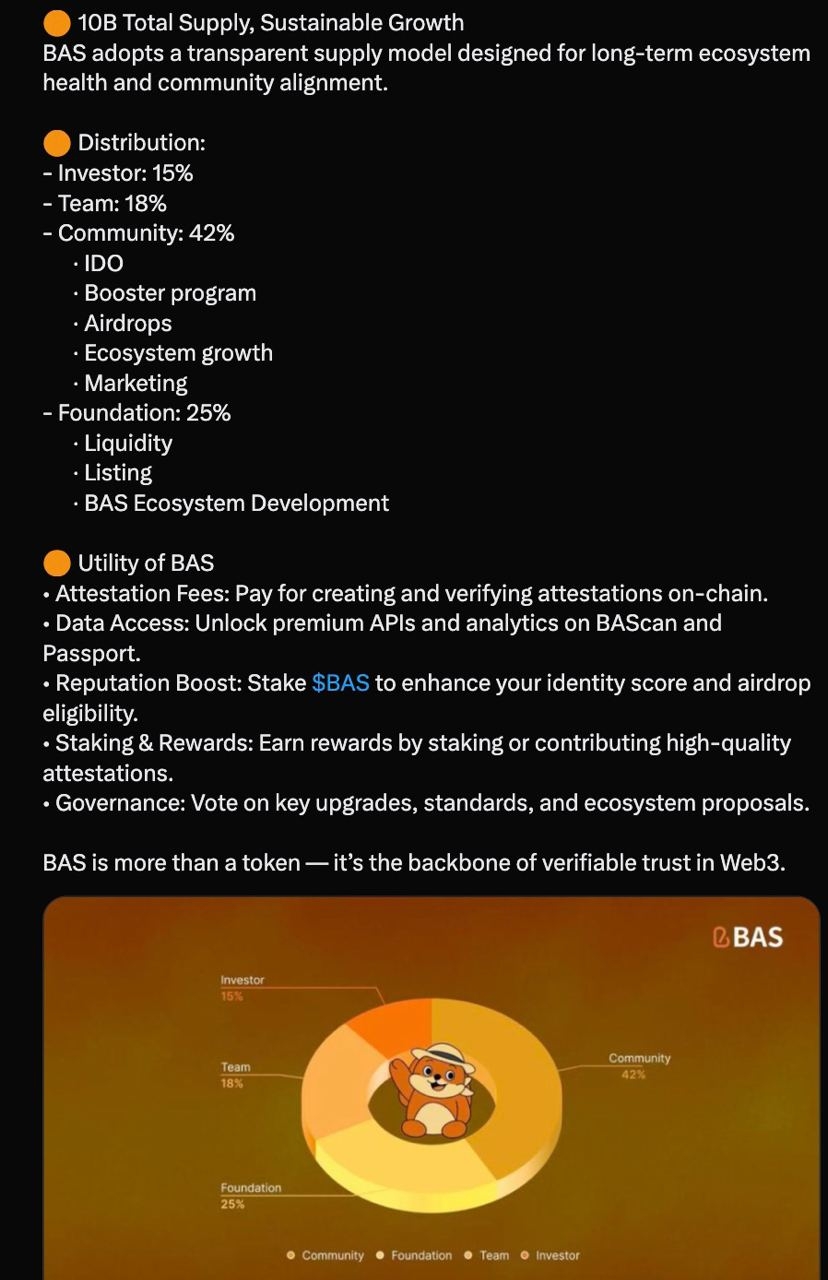
Jacqueline: Total Supply: 10B
Distribution:
- Investor: 15%
- Team: 18%
- Community: 42%
· IDO
· Booster program
· Airdrops
· Ecosystem growth
· Marketing
- Foundation: 25%
· Liquidity
· Listing
· BAS Ecosystem Development
Token Utility:
• Attestation Fees: Pay for creating and verifying attestations on-chain.
• Data Access: Unlock premium APIs and analytics on BAScan and Passport.
• Reputation Boost: Stake $BAS to enhance your identity score and airdrop eligibility.
• Staking & Rewards: Earn rewards by staking or contributing high-quality attestations.
• Governance: Vote on key upgrades, standards, and ecosystem proposals.
Free-Ask from the KuCoin Community to BNB Attestation Service
Q: How does BASBNBs plan to provide a seamless user experience for both hosts and guests on its platform?
Jacqueline: BAS is designed to make verification invisible but powerful. For projects (hosts), we provide APIs and SDKs that are simple to integrate into airdrops, governance, or DeFi products, without complex setups. For users (guests), we offer BNB Passport, which already has over 100,000 users and more than 300,000 independent asset verifications. You can think of it as the asset-verification version of Yapp. Through BNB Passport, users can easily log in, join ongoing campaigns, and claim rewards seamlessly.
Q: Why did you choose the name ‘BNB Attestation Service’ (BAS)? What specific meaning and strategic positioning does the term ‘Attestation’ convey in relation to the project’s mission and capabilities?
Jacqueline: We chose “Attestation” because it represents verifiable claims—the foundation of digital trust. In Web3, anyone can say, “I’m a trader” or “I hold this asset,” but without attestations, it’s just words. BAS turns those claims into cryptographic proofs that can be reused, trusted, and composed into new applications. Strategically, BAS positions itself as BNB Chain’s trust and reputation backbone—just like EAS for Ethereum or SAS for Solana.
Inside the team, we call it “5A: Anyone Attest Anything at Anytime”— which reflects our mission to make verification universal, permissionless, and always available.
Q: Privacy is a major concern in identity and verification systems. How does BAS protect sensitive user data while still enabling trusted verification for protocols, RWAs, AI agents, and DeFi platforms?
Jacqueline: Privacy is core to our design. BAS follows a selective disclosure model, meaning users control what to share, when, and with whom. Sensitive data is never exposed on-chain directly—only the attestation proof is visible.
For example, public-facing data is simplified into yes/no checks: “Do you have a BNB account?” → Yes/No. This allows dApps or protocols to get the verification they need without ever seeing the raw data. With integrations like BNB Greenfield, more sensitive attestations can be stored off-chain, encrypted, and permissioned, ensuring protocols can validate trust while users keep their full identity private.
Q: For KuCoin users who are new to Web3, how does BAS simplify the process of verifying credentials or assets when interacting with dApps? What steps is the BAS team taking to make this user experience as seamless as logging into a Web2 platform?
Jacqueline: We make the Web3 login experience as simple as Web2. Instead of creating multiple wallets and uploading IDs repeatedly, KuCoin users can verify once (for example, their KYC or asset holdings) and reuse that attestation across dApps. We’re also working on wallet-native flows (such as Binance Wallet and OKX Wallet) so that users interact just like logging into Facebook or Google—but with full ownership of their proofs.
Q: How does BAS integrate with BNB Greenfield to enhance user data ownership and privacy?
Jacqueline: BNB Greenfield is a natural fit. With BAS, attestations can reference data stored on Greenfield—encrypted, decentralized, and user-permissioned. This means off-chain attestations (such as a real-world ID, academic certificate, or financial statement) are stored securely in Greenfield, while BAS provides the verifiable on-chain link. This approach bridges privacy, ownership, and composability.
Q: It looks like you can use BAS for everything from DAO governance to RWA tokenization. What are the most exciting real-world apps you've seen so far, like verifying KYC, enabling permissioned DeFi, or supply chain tracking?
Jacqueline: Verified airdrops with meme launchpad (four.meme) — ensuring tokens go to real traders, not bots.
Permissioned DeFi — Allowing institutions to join while meeting compliance needs.
Talent and developer reputation — Proving skills, contributions, or past DAO work.
RWA/depin tokenization — Linking verified off-chain ownership (like real estate or bonds) with on-chain assets.
Social trust — Integrating with DeSocial platforms to verify human identity.
Q: BAS has issued over 30 million attestations and integrated with more than 50 data sources across Web2 and Web3—an impressive achievement. What’s driving this adoption, and how does BAS balance scalability, cost, and developer engagement?
Jacqueline: Adoption comes from a real need: every project struggles with bots, Sybils, and low-quality users. BAS addresses this pain point directly. For scalability, we deploy on both BNB Chain and opBNB, optimizing costs for high-volume attestations.
For developers, we provide easy-to-use APIs, SDKs, and schemas—and actively co-launch campaigns with partners so that adoption grows alongside ours.
At the same time, BAS primarily serves the BNB Chain ecosystem, helping projects segment their user base and run activities with more accurate targeting and improved reward distribution. This alignment with BNB-native users is a major driver of adoption.
Q: What core problem does the BNB Attestation Service aim to solve within the blockchain ecosystem?
Jacqueline: The coming decade of Web3 will be shaped not only by faster chains or deeper liquidity, but by the ability to embed trust as a first-class primitive. Without trust—verifiable identity, accountable reputation, and provable credentials—the digital economy cannot scale to billions of real users.
The core problem is trust. Blockchain is open and permissionless, but that also means it is full of bots, fake accounts, and unverifiable claims. BAS solves this by making trust programmable—turning human identity, reputation, and actions into verifiable attestations.
BAS is building toward a world where:
- Users own their reputation, carrying it across platforms and ecosystems.
- Developers integrate trust seamlessly, unlocking compliant and human-centered applications.
- Communities thrive on verifiable contributions, not speculation or bots.
Just as smart contracts once unlocked the DeFi revolution, verifiable trust will unlock the human revolution of Web3. BAS is laying that foundation today to ensure BNB Chain becomes the most trusted, human-centric, and future-proof L1 in the decentralized world.
Q: How will the BNB Attestation Service (BAS) drive adoption across the wider blockchain ecosystem, and what strategies are being implemented to encourage both developers and users to integrate and trust the service?
Jacqueline: We focus on three strategies:
1. Ecosystem-first: Work closely with BNB Chain projects (airdrop, DeFi, RWA, social) to integrate BAS as their trusted verification and reputation layer.
2. Developer experience: Provide open schemas, plug-and-play APIs, and a rich data marketplace, so builders can integrate attestations without friction.
3. User incentives with BNB Passport: This is our flagship product with over 100,000 users and 300,000+ independent asset verifications. BNB Passport acts as a user’s on-chain identity card, ensuring that rewards and airdrops go to the right participants — the real traders, contributors, and loyal community members, not bots or Sybils. By giving projects a way to distribute incentives more fairly and effectively, we’re helping them save costs and build stronger communities.
Q: Can you explain how the distinction between on-chain and off-chain attestations (using Greenfield) works, and how you ensure the confidentiality of off-chain data?
Jacqueline: -On-chain attestations: Stored directly on BNB/opBNB chain. They are lightweight, composable, and public (e.g., “this wallet holds X token”).
-Off-chain attestations (Greenfield): Sensitive data (like KYC, documents, certificates) is encrypted and stored in Greenfield. The chain only stores a hash/proof link, so the actual data stays confidential. Access is fully permissioned by the user.
This way, BAS combines the transparency of on-chain proofs with the privacy of decentralized storage.
Q: I want to know if your $BAS token is still available on any exchange. How can I buy $BAS tokens?
Jacqueline: You can buy $BAS on MEXC, KuCoin, Binance Alpha, and Binance CEX ‘Alpha.’ More CEX listings are coming soon!
Q: How does BAS enhance security and transparency compared to traditional KYC or proof-of-reserve methods?
Jacqueline: Compared with traditional KYC providers, we do not require users to upload ID photos. Using zero-knowledge (ZK) technology, users only need to download the ZK plugin and prove ownership of their Binance or Coinbase account, since these CEXs have already verified their KYC. Projects like ROAM, Polyflow, and others are already using this solution.
Q: What is the total supply of the token? Could you share detailed tokenomics of the mainnet token’s supply distribution?
Jacqueline: 10 billion tokens will unlock 25% of the total supply within 6 months. You may check here. It’s best to check CMC and Binance for data, as we only upload information to these two platforms.
Q: How does BAS enhance trust and security for decentralized applications using real-world data, and how does it compare to traditional oracles?
Jacqueline: BAS enhances trust by turning real-world credentials and actions into user-authorized attestations. Instead of relying on centralized databases, dApps can verify cryptographic proofs issued with the user’s consent—such as KYC verification, asset holdings, or social reputation. This ensures that only real, qualified users interact with protocols, reducing fraud, Sybil attacks, and compliance risks.
Compared to traditional oracles like Chainlink, there’s a fundamental difference:
- Oracles: You must trust the nodes not to misbehave, and even rely on third-party data cleaning and labeling. This introduces trust assumptions and potential data risks.
- BAS: All verification is directly authorized by the user. There is no hidden data processing, no dependency on a third party, and therefore no data integrity or compliance risks.
In short: oracles bring facts on-chain, while BAS brings trust on-chain—powered directly by the users themselves.
Q: Do you have any plans to burn tokens in the future to reduce the supply and increase the token’s investment attractiveness?
Jacqueline: Of course, there will be, but we haven’t published it publicly yet, as we’re waiting to share more exciting news. You can check our X so you won’t miss any news.
Q: Almost 80% of investors focus only on the short-term price of a token instead of understanding the real value of the project. Can you explain the motivations and benefits for investors to hold your token long-term?
Jacqueline: That’s a great question! While price action matters in the short term, the real value of $BAS is tied to the adoption of the verification layer on BNB Chain. Every attestation—whether for KYC, asset proof, or activity verification—is powered by $BAS. As usage grows across airdrops, DeFi, RWA, and AI integrations, demand for $BAS naturally scales.
For long-term holders, $BAS represents:
- Utility: Required for staking, verification fees, and governance.
- Growth alignment: More projects using BAS → more attestations → higher token utility.
- Ecosystem position: BAS is becoming the trust backbone of BNB Chain
- Incentives: Holders and stakers gain access to rewards, campaigns, and ecosystem benefits that bots or non-verified users cannot access.
So holding $BAS long-term isn’t just speculation—it’s owning a stake in the infrastructure of trust for BNB Chain. Looking ahead, where will BAS focus its efforts, especially in terms of ecosystem development?
Going forward, we will focus even more on ecosystem building. Our goal is to encourage more BNB Chain infrastructure and applications to build directly on top of BAS. By doing so, projects don’t need to reinvent the wheel for verification, reputation, or compliance—they can leverage BAS as their foundation.
We already see several projects doing this today: airdrop platforms using BAS for anti-Sybil protection, DeFi protocols adopting BAS for permissioned access, and social and RWA applications integrating BAS attestations for user identity and asset verification. These early adopters are just the beginning, and we’re excited to see a growing ecosystem built around BAS.
KuCoin Post AMA Activity — BAS
🎁 Participate in the BNB Attestation Service AMA quiz now for a chance to win 92 BAS.

The form will remain open for five days from publishing this AMA recap
BNB Attestation Service - BAS Giveaway Section
KuCoin and BNB Attestation Service have prepared a total of 18,400 BAS to give away to AMA participants.
1. Pre-AMA activity: 7,400 BAS
2. Free-ask section (Main group): 450 BAS
3. Free-ask section (Other groups): 900 BAS
4. Flash Mini-Game: 2,750 BAS
4. Post-AMA quiz: 6,900 BAS
Sign up for a KuCoin account if you haven’t done so yet, and ensure you complete your KYC verification to be eligible for the rewards.