

Rosatom Enters the Digital Financial Assets Market: What a 50 Billion Ruble Issuance Means for Russia's Crypto Market
2026/07/13 17:17:00
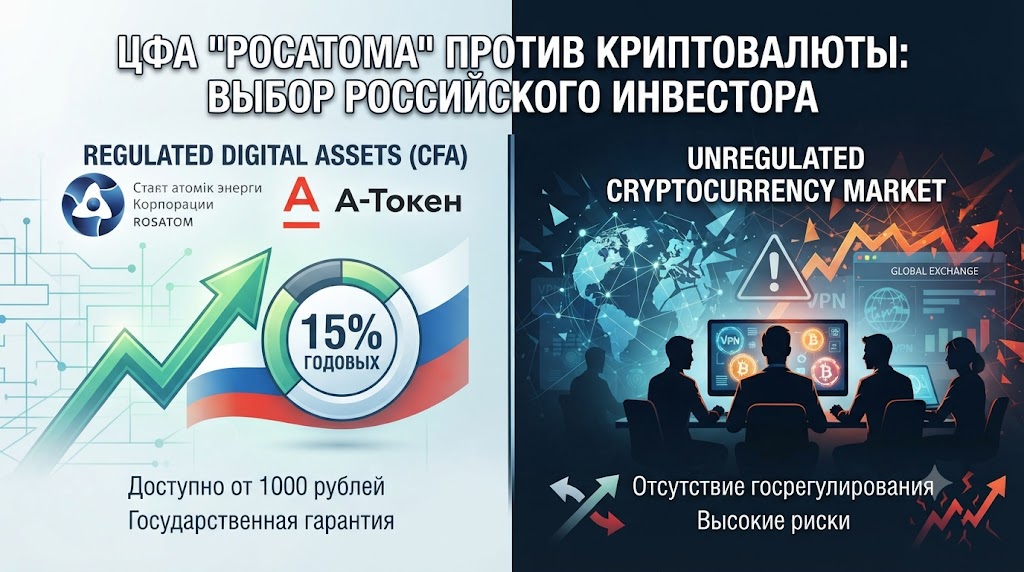
While some Russian investors still seek access to cryptocurrency through foreign exchanges and VPNs, state nuclear corporation Rosatom has offered an alternative right inside the regulated perimeter — digital financial assets (DFAs) yielding 15% annually with an entry threshold of just 1,000 rubles. This is far from an ordinary corporate placement: a state corporation of this scale entering the DFA market is itself a signal that Russian authorities are betting on controllable digital instruments and gradually pushing the unregulated crypto market to the margins.
The key takeaway for crypto market participants: legalized, fully transparent DFAs are becoming an official competitor for Russian retail investors' money, while the parallel tightening of criminal liability for illegal cryptocurrency circulation reinforces this pressure. Below is how Rosatom's issuance is structured, why it accelerates the regulatory cleanup of the crypto market, what this means for miners and ordinary cryptocurrency holders, and what this new landscape looks like for trading on KuCoin.
Why Is Rosatom's DFA Issuance a Signal for the Crypto Market, Not Just Corporate News?
A state corporation of this scale entering the digital asset market confirms that the government views regulated DFAs as the preferred model for the digital economy — as a counterweight to anonymous cryptocurrency circulation. Rosatom plans to raise up to 50 billion rubles in several tranches by July 31, 2027, with a pilot tranche of up to 5 billion rubles already placed between July 13–20, 2026 through Alfa-Bank's "A-Token" platform.
For the market, what matters is less the placement itself than its demonstration effect. A fully controlled, automatically taxed asset recorded in the operator's information system becomes a model of the "correct" digital economy — in contrast to decentralized cryptocurrency operations that regulators simply cannot fully track. This contrast explains why such issuances are appearing precisely as pressure on the gray crypto market intensifies, not in a vacuum.
It's worth noting that Rosatom is not a pioneer in this space: as of mid-2026, more than 1,500 DFA issuances have been registered in Russia, with issuers already including Nornickel, Ozon, and the RWB Group. But it's the entry of a state corporation with open access for retail investors that turns a niche instrument into a mass-market, recognizable product — something Russian cryptocurrency currently cannot claim, given the lack of comparable state backing.
How Is Tightening Crypto Regulation Connected to the Growth of the DFA Market?
Alongside promoting DFAs, Russia is actively tightening controls on illegal cryptocurrency circulation, and successful state-corporate placements serve as an additional argument for further squeezing the gray-market segment. In 2026, the State Duma passed, in its first reading, a package of amendments introducing a new Criminal Code article for illegal organization of digital currency circulation — with penalties reaching actual prison terms for income or damage exceeding 3.5 million rubles.
The regulator's logic here is consistent: if the state can offer a legal, profitable, and easy-to-use instrument like Rosatom's DFA, it has more grounds to crack down hard on those who continue operating through opaque channels. Every successful DFA issuance by a major state company reinforces the public-facing message: "You already have a legal alternative — use it."
This doesn't mean cryptocurrency as an asset class will be automatically banned — rather, a clear two-track split is forming: on one side, a fully transparent, controlled market of DFAs and bonds for domestic ruble investors; on the other, a cryptocurrency segment carrying higher regulatory risk, increasingly falling under criminal statutes whenever signs of organized illegal activity appear.
What's Happening to Russia's Retail Cryptocurrency Holders?
A significant share of retail investors who previously viewed cryptocurrency mainly as a hedge against ruble depreciation now have a more convenient, regulated alternative — and it's likely that some portion of this capital will shift toward instruments like Rosatom's DFA. For many ordinary users, entering foreign crypto exchanges was driven more by fear of savings losing value than by any principled interest in blockchain itself, which makes the convenience gap decisive.
Buying Rosatom's DFA takes just a few taps through the familiar Alfa-Bank app — no VPN needed, no risk of a foreign platform account being blocked, and no need to understand how crypto wallets work. Meanwhile, a 15% annual yield maturing in six months looks competitive against typical deposit rates, and the party responsible for fulfilling obligations is an issuer with a high credit rating and effective state backing.
This reallocation shouldn't be read as a disappearance of interest in cryptocurrency overall, but rather as an outflow of a specific user segment — those for whom buying crypto was more a reluctant necessity than a deliberate choice. Users who genuinely value cryptocurrency's core properties — cross-border mobility, independence from a single issuer, access to global liquidity — will keep their interest in crypto platforms regardless of how many new ruble-denominated instruments appear.
Do Russian Miners Benefit From the Growth of the DFA Market?
A successful DFA issuance by a major state corporation effectively validates this mechanism as a viable financing channel — opening a potential funding path for large mining companies.
Russia's mining industry has already been legalized and is now paying taxes, but it still faces limited access to traditional financing: Western equipment suppliers, constrained by sanctions, are reluctant to offer deferred payments or credit lines, and issuing ordinary bonds on an exchange is technically and reputationally harder for mining companies than for industrial giants like Rosatom.
The DFA model, now validated by a state corporation, potentially solves this problem. Large compliant mining companies could theoretically follow Rosatom's example and issue their own DFAs backed by hashrate or future mining revenue, raising several billion rubles for data center expansion and equipment purchases while bypassing Western sanctions restrictions.
That said, this scenario currently remains a possibility rather than a confirmed fact — no major mining operator has yet announced plans to issue its own DFA following Rosatom's model. Nevertheless, the precedent itself — a state corporation successfully raising capital through a transparently regulated blockchain instrument — lowers reputational and legal barriers for an industry that operated in a gray zone for a long time and only recently gained official legal status.
What Will Happen to "Hardcore" Cryptocurrency Users?
Users who value anonymity and cross-border capital mobility will likely move even more actively away from fully transparent, centrally-controlled instruments like DFAs, shifting instead toward decentralized finance (DeFi) or cold wallets. The logic here runs exactly opposite to that of the mass retail investor: the more convenient and state-endorsed a regulated alternative becomes, the less appealing it looks to those whose entire goal is to escape control by financial intermediaries and the state.
The rising popularity of DFAs as a "showcase" of the legal digital economy effectively sharpens the contrast between two ways of using blockchain technology in Russia: one fully transparent and embedded in the banking system, the other deliberately decentralized and privacy-focused. For the regulator, this means that once mass-market users drain away, the remaining crypto market segment will consist of more technically sophisticated, more motivated participants — who are harder to control through standard methods.
This, in turn, may push the regulator toward further tightening control specifically over infrastructure that provides access to decentralized tools — from blocking interfaces to stepping up monitoring of large transfers through crypto exchangers. Under this logic, the technological standoff between those seeking to preserve transactional anonymity and a state pursuing full financial transparency will only intensify.
How Is Rosatom's DFA Issuance Structured?
To understand the scale of this development, it helps to know the basic parameters: Rosatom's DFA is a digital analogue of a bond, carrying a fixed 15% annual coupon, available to any adult Russian citizen starting from 1,000 rubles. The pilot tranche, worth up to 5 billion rubles, was placed between July 13–20, 2026 through Alfa-Bank, with a six-month maturity and a coupon paid in a single lump sum at the end of the term.
| Parameter | Value |
| Total issuance volume | Up to 50 billion rubles by July 31, 2027 |
| Pilot tranche volume | Up to 5 billion rubles |
| Coupon rate | 15% annually, paid in a lump sum |
| Minimum purchase amount | 1,000 rubles |
| Pilot tranche maturity | 6 months |
| Issuance operator | Alfa-Bank, "A-Token" platform |
The funds raised will go toward national-priority projects — the construction of floating power units, activities under the state technological order program, and the construction of the National Center for Physics and Mathematics, as well as the development of the Northern Sea Route, including the construction of a nuclear icebreaker fleet. It's precisely the scale and strategic significance of these goals that explain why this issuance has received such high public attention — this is not routine corporate financing, but a showcase for a new model of the digital economy.
Should Investors Choose DFAs or Trade Cryptocurrency on KuCoin?
Regulated DFAs and cryptocurrency serve different purposes — for investors who value global liquidity, access to thousands of assets, and independence from a single issuer or jurisdiction, trading on KuCoin remains the relevant option. Rosatom's DFA offers fixed ruble-denominated returns and state-level guarantees, but is limited to a specific issuer, a six-month horizon, and the Russian legal framework — whereas the cryptocurrency market provides access to assets that aren't tied to any single country or currency.
To start trading on KuCoin, users need to register on the platform, complete identity verification, and fund their account through a convenient method — card payment, bank transfer, or a crypto transfer from another wallet. The exchange supports simple spot trading in major cryptocurrencies as well as more advanced instruments, including futures and staking, for investors looking to diversify their portfolio beyond ruble-denominated instruments.
As Russian regulators simultaneously crack down harder on illegal cryptocurrency circulation and actively promote controlled DFAs, choosing a reliable, transparent international platform for crypto operations only becomes more important. Combining domestic regulated ruble instruments with a diversified crypto portfolio on a trusted exchange allows an investor to manage risk across both the ruble and global dimensions at once.
Conclusion
Rosatom's DFA issuance of up to 50 billion rubles is more than a large corporate financing deal — it's a telling signal of where digital asset regulation in Russia is headed. The state is betting on transparent, fully controllable instruments like DFAs while simultaneously increasing criminal penalties for illegal cryptocurrency circulation — and these two processes are reinforcing each other.
For retail cryptocurrency holders who entered the market more out of fear of ruble depreciation than genuine conviction, regulated alternatives like Rosatom's DFA offer a convenient path back into the controlled system. For compliant mining companies, this successful precedent opens a potential channel for financing modeled on the state corporation's approach. And users who value anonymity and cross-border capital mobility will likely lean increasingly toward decentralized solutions — intensifying the technological standoff with regulators.
In this environment, choosing between ruble-denominated regulated instruments and the international cryptocurrency market is no longer an ideological question but a practical decision shaped by each investor's individual goals — and both directions deserve serious consideration when building a portfolio.
Frequently Asked Questions
Does the growth of the DFA market mean cryptocurrency will be fully banned in Russia?
No. This is effectively a two-track split — one side consists of legal, controlled segments like DFAs and bonds, while the other is a separately regulated cryptocurrency market, where tightening liability is aimed primarily at illegal, undeclared operations.
Can a retail investor hold both DFAs and cryptocurrency at the same time?
Yes, there are no formal restrictions on holding both asset types simultaneously — they are two different instruments with different risk and return profiles.
Are other companies planning to issue DFAs following Rosatom's example?
Other major issuers are already active in the market, including Nornickel, Ozon, and the RWB Group, and Rosatom's precedent could encourage mining companies to consider a similar instrument, though no specific announcements have been made yet.
How will Russia's tougher criminal penalties affect users of foreign crypto exchanges?
The new Criminal Code article targets organizers of illegal circulation with income or damage exceeding 3.5 million rubles, not ordinary users operating through legal, identity-verified platforms.
Why doesn't buying Rosatom's DFA require opening a brokerage account?
DFAs are registered and traded directly within the operator's information system — Alfa-Bank — allowing investors to complete transactions through the banking app itself, without needing a separate brokerage account or exchange infrastructure.