

Sber's 2026 Profit: The Bank Beats Market Expectations Again
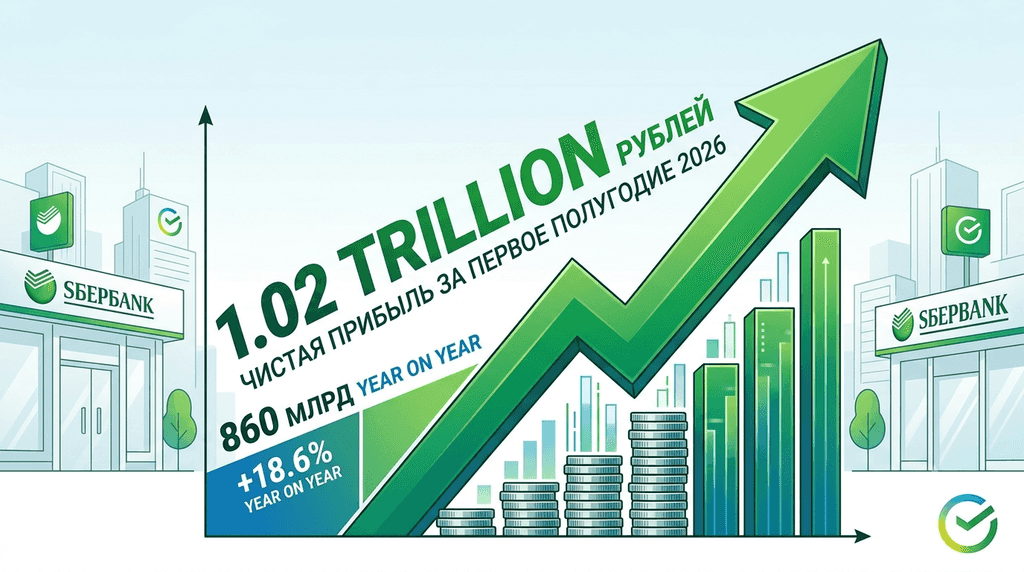
Sber earned 1.02 trillion rubles in net profit for the first half of 2026 — up 18.6% year-on-year, and the first time the bank's six-month profit has crossed the trillion-ruble mark. Return on equity (ROE) came in at 24.2%, an exceptionally high figure for the banking sector. The key question on investors' and depositors' minds: how is the bank growing profit while Russia's central bank eases monetary policy? The answer is straightforward — Sber's cost of funding is falling faster than the yield on its loan portfolio, and provisioning expenses for potential losses are declining.
The trend was even more pronounced in the second quarter of 2026: net profit rose 20.9% year-on-year to 511.2 billion rubles, with quarterly ROE reaching 24%. Market Power analysts noted that the results beat both market expectations and their own forecast. Below, we break down where this profit is coming from, how much shareholders stand to earn in dividends, and whether Sber shares are now a better bet than a bank deposit.
How Much Did Sber's Profit Grow in Q2 2026
Sber's net profit in the second quarter of 2026 rose 20.9% year-on-year to reach 511.2 billion rubles. This came alongside a 26.7% increase in net interest income, to 1 trillion rubles, and a 10.4% rise in fee income, to 215.3 billion rubles. Return on equity for the quarter stood at 24%.
For the first half as a whole, the bank's net interest income exceeded 2.05 trillion rubles, up 22.5% year-on-year, according to Market Power. Net fee and commission income for the six-month period rose to 419.8 billion rubles — 5.4% higher than the same period in 2025. The group's operating income grew nearly 19%, reaching 1.99 trillion rubles.
The financial results, published under IFRS standards, came in stronger than the market consensus forecast, according to Market Power analysts. Investors reacted positively: on July 29, Sber's ordinary shares gained 0.9% and preferred shares 0.6%, while the MOEX index closed the day above 2,200 points, supported in part by strong earnings from major issuers, including Sber itself.
Why Is Sber's Profit Growing Despite a Falling Key Rate
The main driver of profit growth is the expansion of the net interest margin — not rising rates. Market Power analysts point directly to the cause: the cost of raising funds (deposits and financing) is falling faster than the yield on the bank's loan portfolio is declining. This is a classic transition-period effect during monetary easing — the bank manages to reprice its liabilities before fully adjusting the yield on its assets.
The trend in interest expenses confirms this. According to the results, Sber's interest expenses fell from 3.07 trillion to 2.75 trillion rubles — a drop of nearly 320 billion rubles — while interest income held steady at around 4.80 trillion rubles.
The second driver of profit growth is a lower cost of risk. Provisioning expenses for potential losses on new loans decreased, meaning the bank did not need to set aside as large a share of operating profit into reserves as before. That freed up more funds to flow directly into net profit.
The third driver is moderate but steady loan growth. The bank's loan portfolio grew to almost 50 trillion rubles (49.98 trillion rubles), with mortgage lending and project financing accounting for the bulk of the increase. Market Power analysts expect these segments to remain the key growth drivers for the bank's business through the end of 2026.
It's worth noting that loan portfolio growth is happening alongside — not despite — the central bank's more cautious rhetoric. The regulator is gradually easing monetary policy but without abrupt moves, which allows banks to adjust their product lineups in advance rather than face sudden swings in loan demand. For Sber, this means a more predictable revenue trajectory for the second half of the year, although the bank itself does not rule out that profit growth could slow somewhat compared with the first half.
The bank's operational efficiency also contributed to the result. Operating income growth of nearly 19%, against more restrained growth in operating expenses, allowed the bank to maintain — and even improve — its cost-to-income ratio, a key efficiency metric for any large bank. It is this combination of three factors — margin expansion, lower cost of risk, and cost control — that explains why Sber's profit is growing faster than one might expect during a period of monetary easing.
Sber's Key Financial Metrics for H1 2026
| Metric | Value | YoY Change |
| Net profit | RUB 1.02 trillion | 0.186 |
| Net interest income | RUB 2.05 trillion | 0.225 |
| Net fee and commission income | RUB 419.8 billion | 0.054 |
| Group assets | RUB 69.1 trillion | — |
| Loan portfolio | RUB 49.98 trillion | — |
| Equity | RUB 8.53 trillion | — |
| ROE | 24.20% | — |
How Much in Dividends Will Sber Pay for 2026
Under its dividend policy, Sber allocates 50% of net profit under IFRS attributable to shareholders to payouts. First-half profit alone — 1.02 trillion rubles — already locks in a dividend base of roughly 22.6 rubles per share, based on the bank's total share count of about 22.58 billion shares.
If the bank maintains a similar pace of profit growth in the second half, the total payout for the full year 2026 could reach approximately 45–48 rubles per share. At Sber's current share price of around 275–277 rubles, that translates into a dividend yield that looks noticeably more attractive than most alternatives on the Russian market.
It's worth keeping in mind that the final dividend amount is approved by the shareholders' meeting based on full-year results, not calculated automatically from half-year figures. Management, however, has already confirmed an optimistic outlook for all of 2026 and stated it expects to earn more profit than in 2025 — while cautioning that the cost of risk on corporate loans could rise somewhat in the second half.
Choosing between a deposit and Sber shares requires looking at where interest rates in the economy are headed. As Russia's central bank moves toward cutting or stabilizing its key rate, commercial banks are gradually lowering deposit rates — a trend confirmed by Sber's own results, where interest expenses (including the cost of servicing deposits) fell by roughly 320 billion rubles.
Against this backdrop, the dividend yield on Sber shares is instead rising along with the bank's profit, while an ROE of 24.2% points to highly efficient use of the bank's own capital. For an investor willing to accept moderate stock market volatility, the combined return from holding shares — dividends plus potential price appreciation — starts to compete with deposit returns, and according to analyst consensus forecasts, the upside in Sber shares is not yet exhausted.
That said, a deposit remains the more predictable instrument: the return is fixed in advance, and there is no risk of capital loss. Shares, on the other hand, depend on market conditions, geopolitical factors, and regulatory decisions. So the choice between a deposit and shares essentially comes down to a trade-off between stability and potentially higher, but less guaranteed, returns.
A practical approach used by many retail investors is not to choose one instrument exclusively but to combine both. Part of one's capital can be kept in a deposit or bonds as a liquidity cushion, while another part goes into shares of issuers like Sber to gain exposure to potential dividend and price growth. This approach reduces the impact of short-term stock market volatility on the overall portfolio while still preserving access to the higher long-term returns that shares of a growing, profitable company can offer.
Is Sber's Profit Real, and Does It Come With Hidden Risks
Sber's profit is backed by growth across all key operating metrics, not one-off factors. Net interest income for the half-year came in at 2.05 trillion rubles (+22.5%), net fee income at 419.8 billion rubles (+5.4%), group assets grew to 69.1 trillion rubles, and equity rose to 8.53 trillion rubles. This is structural growth, not a one-time asset revaluation.
One thing that requires separate explanation is the bank's negative operating cash flow of 1.87 trillion rubles for the half-year. This is not a loss and not a sign of solvency problems. Negative cash flow means that during the reporting period the bank spent more on issuing new loans and buying securities than it received from operating activities — in other words, it was actively expanding its business. For a bank growing its loan portfolio and bond holdings, this kind of cash flow pattern is normal for an active growth phase, not a warning sign.
As for loan portfolio quality, a lower cost of risk on new originations actually points to improvement rather than deterioration: the bank needs relatively fewer provisions for potential losses than in previous periods. That said, Sber's management itself has flagged that it expects some increase in the cost of risk on corporate loans in the second half — a standard conservative caveat rather than a sign of hidden problems.
Will Russia Introduce a Windfall Profit Tax for Sber
There are currently no direct signals of a one-off windfall tax being introduced specifically for Sber. The main mechanism through which the state already captures a significant share of the bank's profit is dividends: Sber's controlling shareholder is Russia's National Wealth Fund, and as the largest shareholder, the state receives half of the bank's net profit in dividends every year.
From an economic-logic standpoint, maintaining Sber's high profitability and paying dividends on a well-established formula looks like a more predictable path for the authorities than a one-off extraction of excess profit. This approach sustains investor confidence in the Moscow Exchange and reduces the risk of capital flight from blue-chip stocks, whereas a one-off tax could hit the entire financial sector's market capitalization and set a precedent for other major issuers.
Join KuCoin 9th Anniversary Trading Campaign
KuCoin is celebrating its 9th anniversary with a special platform campaign filled with exclusive rewards, trading activities, and limited-time offers. Don’t miss the chance to participate and enjoy the benefits as the exchange marks nine years of growth and innovation. Visit the official campaign page now:

Conclusion
Sber closed the first half of 2026 with a record net profit of 1.02 trillion rubles — up 18.6% year-on-year, with ROE at 24.2%. The key drivers of this growth were an expanding net interest margin, driven by funding costs falling faster than asset yields, lower provisioning expenses, and moderate but steady loan portfolio growth, primarily from mortgages and project financing.
The dividend base already stands at roughly 22.6 rubles per share based on half-year results, and the full-year payout could reach 45–48 rubles per share if the current profit trend holds. The negative operating cash flow is explained by an active business-growth phase, not by any problems with the bank's solvency. A one-off windfall tax for Sber doesn't appear to be on the horizon for now — the state already captures its share through the standard dividend mechanism as the controlling shareholder.
Market Power analysts remain positive on Sber shares, citing the bank's leadership in the Russian financial sector in terms of profit growth and profitability. For investors and depositors, this means it's worth closely watching the central bank's rate trajectory, the cost of risk on corporate loans, and the shareholders' meeting decision on the final dividend amount in the second half of 2026.
Frequently Asked Questions
1. When will Sber publish its Q3 2026 financial results?
The bank traditionally publishes IFRS results within a month of each quarter's end, so Q3 2026 results should be expected in October or early November 2026.
2. How does Sber's IFRS reporting differ from its RAS (Russian Accounting Standards) reporting?
IFRS reflects the consolidated results of the entire banking group, including subsidiaries and the insurance business, while RAS shows only the parent bank's results under Russian accounting standards — so net profit figures under the two standards can differ significantly.
3. How often does Sber pay dividends — once or twice a year?
Historically, Sber pays dividends once a year based on full-year results, though bank management periodically discusses the possibility of moving to interim payouts, similar to other major issuers.
4. What happens to Sber's profit if the central bank raises the key rate again?
A rate hike could temporarily compress the bank's net interest margin if funding costs rise faster than loan portfolio yields, but historically Sber has adapted to rate changes faster than most competitors thanks to its scale and balance sheet structure.
Sber shares, like the broader Russian stock market, react to news of new sanctions and geopolitical tensions, but the bank's share price is also heavily influenced by its own operating results — strong earnings can support the stock even against a negative external backdrop.
Disclaimer : This material is provided for informational purposes only and does not constitute financial, investment, legal, or tax advice. Transactions involving cryptocurrencies and tokenized assets carry substantial risks — including price volatility, limited liquidity, counterparty exposure, and the potential for total loss of invested capital. Readers should conduct their own research and, where appropriate, consult a qualified professional before making any financial decisions.