

New Crypto Law in Russia: State Duma to Finalize Market Regulation by Late July 2026
2026/07/02 11:12:00
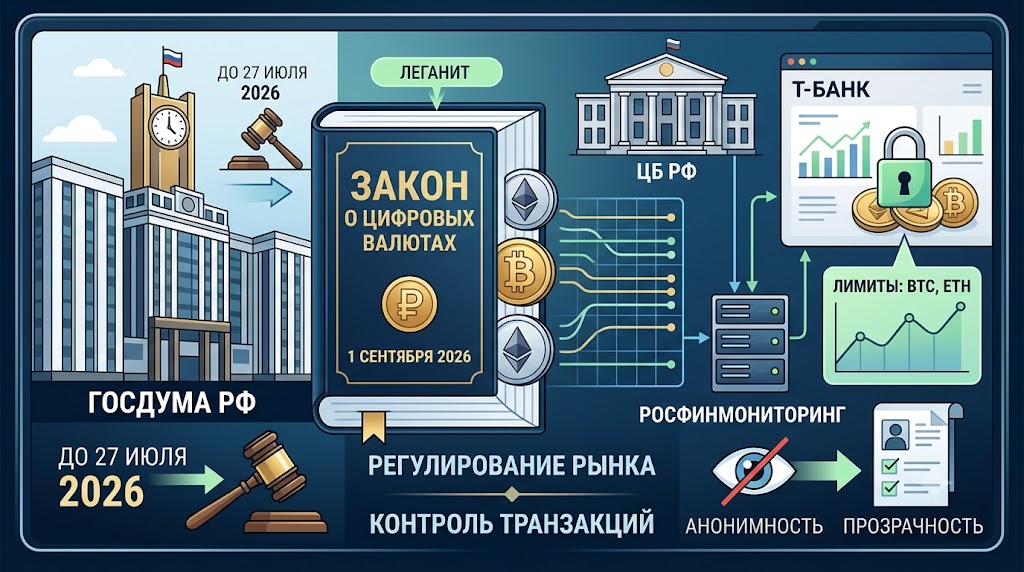
Will the state fully regulate the circulation of digital assets by the end of this month? Yes, according to an official statement by Anatoly Aksakov, Chairman of the State Duma Committee on the Financial Market, at the Bank of Russia Financial Congress in July 2026, the bill "On Digital Currency and Digital Rights" will be finally adopted before the end of the spring session — by July 27, 2026. This piece of legislation will officially enter into legal force on September 1, 2026. The initiative radically changes the rules of the game for Russian retail and corporate market participants. The document forms a so-called "walled garden" — a strictly controlled perimeter where legal transactions are allowed only within state-accredited intermediaries, including digital depositories and authorized banking platforms. Crypto transactions in the country are effectively equated to traditional bank transfers in terms of regulatory oversight and mandatory identification.
What Are the Main Goals and Timelines for the New Law "On Digital Currency and Digital Rights"?
The State Duma will adopt the law on cryptocurrency by the end of July 2026 to create a transparent, civilized infrastructure that protects the interests of national business and suppresses illegal operations. Anatoly Aksakov emphasized that the regulation of the crypto market will be completely streamlined by July 27, and the implementation of regulatory requirements will begin in phases from September 1, 2026. The first reading of the document took place in mid-April 2026, and by the second reading, lawmakers had formed a compromise model. The core logic of the authors of the reform is to utilize digital currencies for external settlements and bypassing international sanctions, while strictly isolating the domestic retail market of citizens from uncontrolled financial flows. The restrictive barriers are designed to minimize capital flight and protect retail investors from excessive market risks.
How Will the Legal Status of Cryptocurrencies Change and Why Will Transaction Anonymity Disappear?
The bill confirms the legal status of cryptocurrency as "property," but through the integration of strict KYC/AML standards and the Travel Rule, its economic essence approaches that of classic shares and bank deposits. According to Rosfinmonitoring data as of June 2026, the agency is fully integrating crypto transactions into its monitoring systems. This means that the anonymity of decentralized networks within the Russian jurisdiction will be completely eliminated.
Digital depositories, brokers, and other licensed platforms are now required to accompany every transfer with detailed information about both the sender and the recipient of funds. Any operations on the platform will require users to undergo deep "additional identification" specifying the ultimate beneficiaries and recipients of profit. The previous formats of simplified identification for most operations are being abolished, making the market maximally transparent for tax and control authorities.
Why Are Crypto Transactions Equated to Bank Transfers and How Will They Be Controlled?
The control of crypto transactions is equated to the verification of regular bank transfers due to the mandatory connection of all exchange operators to the Bank of Russia's "Know Your Customer" (KYC) platform and the automatic transmission of data to Rosfinmonitoring. Vlada Korchagina, Advisor to the Director of the Federal Financial Monitoring Service, confirmed in June 2026 that the regulator intends to mandatorily track five key types of operations with digital assets.
At the same time, all large transactions — exceeding the dynamic threshold of 1,000,000 rubles — are subject to automatic declaration and verification. The Central Bank of the Russian Federation will directly transmit information about the risk level of investors to digital depositories, which are obliged to instantly block or strictly limit transactions for high-risk clients. Thus, regulatory oversight over the movement of tokens becomes identical to the supervision of fiat rubles in bank accounts.
Who Are "Digital Depositories" and How Will the Law Affect P2P Trades and Non-Custodial Wallets?
From September 1, 2026, the concept of a "legal transaction" will mean exclusively an operation conducted through a licensed digital depository or an authorized platform, which makes traditional p2p exchange illegal. According to the requirements of the Central Bank, all commercial operations for the purchase, sale, or conversion of cryptocurrency must pass through approved intermediaries. Direct transfers between users outside the regulated perimeter are stripped of legal protection, and ways to withdraw funds into fiat through unlicensed exchange services will be blocked.
Although the state is technically unable to ban individuals from storing assets on personal cold, non-custodial wallets — since cryptocurrency is recognized as legal private property — legal pathways for directly replenishing a balance or cashing out funds through such wallets by bypassing banking gateways will be completely shut down.
How Do Major Financial Institutions and T-Bank Plan to Develop the Legal Market?
Major Russian financial organizations plan to launch official services for trading cryptocurrency directly inside their banking applications immediately after the law comes into force. Vyacheslav Tsyganov, Deputy Chairman of the Management Board of JSC "T-Bank," announced at the Financial Congress in July 2026 that the group expects to become one of the first certified digital depositories in the country based on its own blockchain platform "Atomyze."
The bank plans to provide clients with the ability to buy, sell, safely store crypto-assets, and track portfolio analytics within a familiar mobile interface before the end of the current year. The integration of cryptocurrencies into the products of such giants as T-Bank is expected to attract mass retail investors seeking legal, safe ways to invest, albeit within the tight purchase limits set by the Bank of Russia.
What Limits and Restrictions Are Being Introduced for Retail Investors by the Second Reading?
The Central Bank of the Russian Federation refused to increase the limits on the purchase of cryptocurrencies for non-qualified investors by the second reading, maintaining tight annual restrictions on investment volumes. Based on current regulatory documents, the regulator leaves the conservative limit for retail individuals in place. Additionally, a list of permitted assets has been formed by the second reading: non-professional investors are planned to be allowed access to a highly limited number of the most liquid cryptocurrencies — Bitcoin (BTC) and Ethereum (ETH), as well as a number of the largest stablecoins pegged to the US dollar, such as USDT and USDC. Access to high-risk altcoins, anonymous coins, and complex decentralized finance (DeFi) tools for ordinary citizens will be completely closed, and legal trading of stablecoins will be allowed only after the autumn session of the State Duma, where deputies will separately discuss their legal frameworks.
Is It Worth Trading Cryptocurrency on the KuCoin Exchange Under the New Regulation?
Utilizing the international liquid platform KuCoin remains an effective solution for diversifying a portfolio, gaining access to a wide range of spot and futures markets, and maintaining investment flexibility during a period of large-scale regulatory reforms. Since Russian legislation narrows the domestic legal market to a few assets (BTC, ETH) and strictly limits annual purchase volumes through domestic digital depositories, KuCoin provides investors with access to hundreds of promising tokens, advanced trading tools, and deep international liquidity.
Registering on the exchange allows users to maintain access to the global Web3 ecosystem and protect their strategies from local infrastructural risks. The platform ensures a high level of user data security, strictly adheres to international asset protection standards (Proof of Reserves), and offers intuitive tools for effective trading to both professionals and beginners.
Conclusion
The review and guaranteed adoption by the State Duma of the Russian Federation of the bill "On Digital Currency and Digital Rights" before July 27, 2026, marks the end of the era of an unregulated and wild cryptocurrency market in the country. Starting September 1, 2026, a strict state model of a "walled garden" will be built in Russia, where all legal exchange operations are transferred under the control of authorized digital depositories and major banking structures, such as T-Bank. Equating cryptocurrency transactions to bank transfers, implementing strict Travel Rule identification regulations, and mandatory monitoring of operations by Rosfinmonitoring completely eliminate transaction anonymity within the country. Despite the fact that citizens retain the right to own private cold wallets as personal property, the legal gateways for entering and exiting fiat funds will be entirely controlled by the state. In the face of strict asset purchase limits introduced by the Bank of Russia for retail investors and the restriction of the available token list to only Bitcoin and Ethereum, international trading platforms continue to perform a critical role, providing users with the necessary freedom of action, deep liquidity, and full access to the global financial market.
Frequently Asked Questions (FAQs)
-
Will it be legal to pay with cryptocurrency for goods and services inside Russia after September 1, 2026?
No, using cryptocurrency as a means of payment for any goods, works, or services within the Russian Federation remains under a strict legislative ban. Digital currency is recognized exclusively as property and a tool for investment or foreign trade settlements, but not as a legal tender inside the country.
-
Am I obliged to declare cryptocurrency stored on my non-custodial wallet?
Yes, according to the norms of tax legislation and the new regulation, citizens are obliged to inform tax authorities about the ownership of digital currency and operations performed with it if the total amount of transactions for a calendar year exceeds the limit established by law. The recognition of assets as "property" automatically imposes obligations on owners to pay income tax on profits from their realization.
-
Will Russian banks block transfers to foreign crypto exchanges?
Banks will be obliged to block any suspicious transfers addressed to unlicensed exchange services and platforms that are not included in the official registry of digital depositories of the Russian Federation. Direct fiat transactions to foreign platforms from cards of Russian banks will be subjected to automatic verification by compliance systems for adherence to currency control rules.
-
What will happen if I continue to conduct p2p trades through unofficial Telegram bots?
Such operations will be classified as illegal activity in the financial market carried out in bypass of authorized digital depositories. Banks will immediately block the cards and accounts of participants in such deals on the basis of Federal Law No. 115-FZ, and information about suspicious transactions will be transferred to Rosfinmonitoring.
-
Will operations involving the exchange of one cryptocurrency for another within a wallet be taxed?
Taxation arises at the moment of fixing a material benefit — that is, when exchanging a digital asset for fiat money (rubles or foreign currency). However, the exact regulations for accounting for "crypto-to-crypto" trades will be detailed in sub-legislative acts of the Federal Tax Service, which the government plans to approve before the main law comes into force.