

MOEX Digital Depository: A Complete Guide to Cryptocurrency Legalization in Russia in 2026
2026/08/07 15:00:00
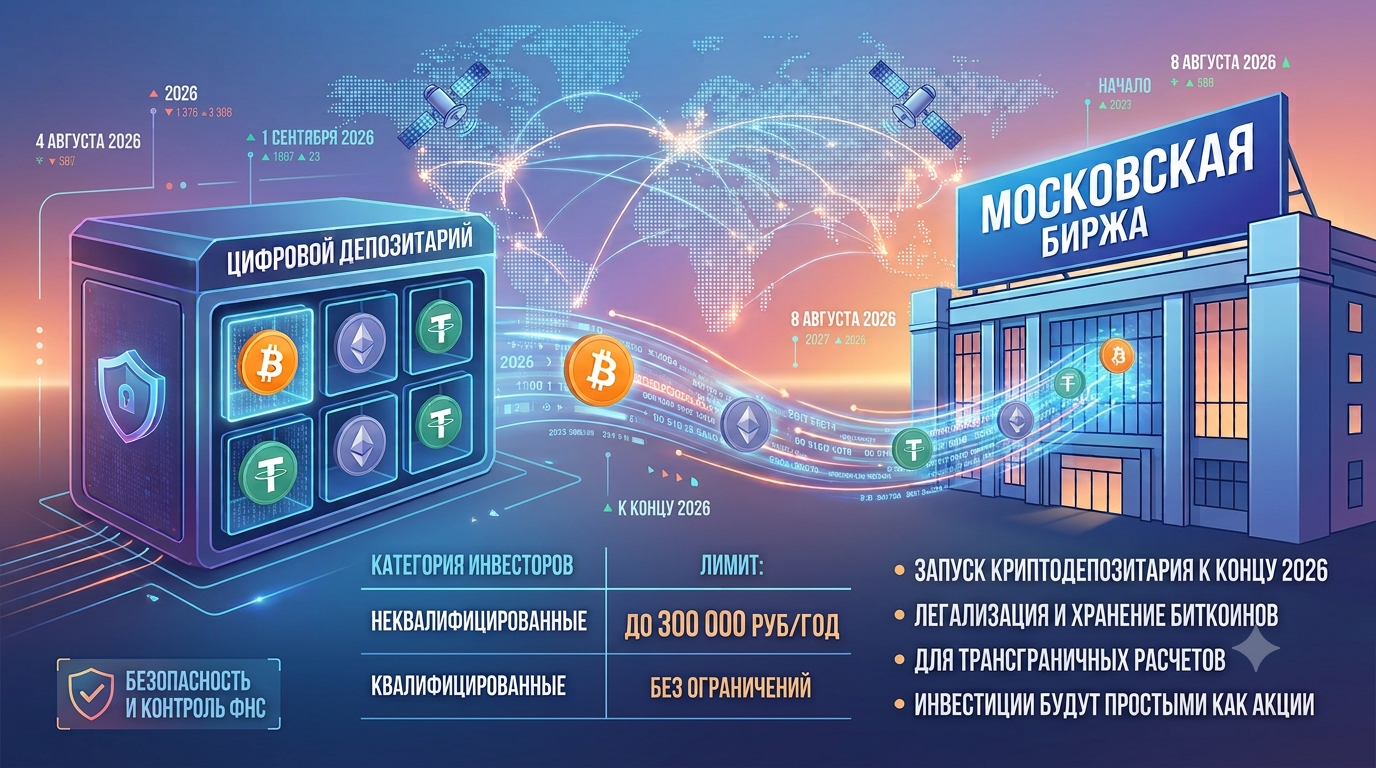
Did you know that by the end of 2026, investing in Bitcoin for the average Russian citizen will become as simple and legal as buying shares in Gazprom or Sberbank? The Moscow Exchange (MOEX) has officially confirmed preparations to launch its own digital depository for crypto-assets, marking the end of the "grey era" for cryptocurrencies in the country. According to the latest data as of August 2026, this initiative will become the foundation of a new financial system, allowing for the bypass of external restrictions and the execution of cross-border settlements. MOEX plans to launch the infrastructure in late 2026 or early 2027, creating a completely independent structure for the accounting and storage of digital currencies. This step is supported by a package of laws signed by the President on August 4, 2026, which legalize mining and the use of crypto for international trade. Now, Russian investors will have a protected mechanism for asset ownership, while the state gains a transparent tool for control and taxation.
Why is the Moscow Exchange launching a digital depository right now?
The launch of the digital depository is driven by the need to create an alternative financial infrastructure to bypass Western sanctions and the disconnection from the SWIFT system. According to the Ministry of Finance of the Russian Federation as of July 2026, the volume of frozen funds of Russian companies in foreign jurisdictions continues to grow, making the use of decentralized assets the only effective way to conduct international payments. Previously, Russian authorities took a hardline stance against cryptocurrencies; however, the geopolitical reality of 2026 has forced regulators to shift from a policy of bans to the creation of a state-controlled gateway.
According to a report by the "RBC Investments" analytical center published on August 6, 2026, the creation of a depository based on MOEX will allow Russian companies to legally convert export revenues into digital currencies to pay for import supplies. This is critically important for maintaining supply chains under sanction pressure. The state recognizes that a total ban on cryptocurrencies only drives the market into the shadows, depriving the budget of tax revenues and control over money flows. Therefore, the MOEX digital depository will become the "entry point" where crypto-assets acquire legal status within the Russian jurisdiction.
Furthermore, in 2026, there is a sharp increase in interest in Digital Financial Assets (DFAs) among institutional investors. Traditional banks and funds need a reliable custodian to take on the risks of storing private keys and ensure compliance with AML (Anti-Money Laundering) requirements. MOEX, with its years of experience in the stock market, is an ideal candidate to create such a trusted environment that bridges the world of traditional finance and blockchain technology.
How will the crypto-asset storage mechanism work on the Moscow Exchange?
The MOEX digital depository will function as a completely independent structure, not linked to the National Settlement Depository (NSD), to minimize the risks of secondary sanctions. According to sources close to the Moscow Exchange Group, the new organization will use distributed ledger technology (DLT) to account for rights to assets such as Bitcoin (BTC), Ethereum (ETH), and stablecoins like USDT. The core operating principle involves opening anonymous digital accounts for clients through licensed brokers, who will act as intermediaries.
The technical implementation suggests that the end investor will not interact with the depository directly. Instead, according to data from Bits.media as of August 6, 2026, brokers will open nominal holder accounts in the central depository. This means that the depository will only see the total volume of assets on the broker's balance sheet, while the detailed accounting of specific owners will remain on the broker's side. This approach allows for maintaining a certain level of privacy for investors while simultaneously ensuring high-speed operations within the exchange circuit.
A crucial aspect is the question of "withdrawal" of funds. Unlike classic crypto exchanges, the MOEX digital depository may initially operate in a "closed loop" mode. This means that assets purchased through the exchange infrastructure may be restricted from moving to external non-custodial wallets. Such a mechanism is necessary for the regulator to prevent uncontrolled capital flight and ensure compliance with currency control requirements. However, special gateways will be provided for foreign trade participants to conduct cross-border transactions.
What are the key provisions of the new cryptocurrency law from August 2026?
The new package of laws regulating digital currencies, signed on August 4, 2026, establishes clear rules of the game for all market participants starting September 1, 2026. According to the text of the document, an "experimental legal regime" (ELR) is introduced in Russia, under which exchange trading of cryptocurrency and the use of digital assets for settlements under foreign trade contracts are permitted. This is a fundamental shift, as previously any payments in cryptocurrency within the Russian Federation were effectively prohibited.
According to data from relevant State Duma committees, the law legalizes the activities of miners, requiring them to register in a special FNS (Federal Tax Service) registry. Now, mining is recognized as an industry of the economy, and the mined cryptocurrency can be legally sold through Russian exchange platforms or specialized exchange offices. This decision is aimed at allowing Russia, which holds one of the leading positions in the world by hashrate, to use accumulated crypto-assets for the needs of the state economy and business support.
At the same time, the law maintains the ban on using cryptocurrency as a means of payment within the country for goods and services. This means that you will not be able to buy a cup of coffee for Bitcoins in Moscow, but you can use them to purchase industrial equipment in China or India through authorized intermediaries. The Central Bank of the Russian Federation emphasizes that the priority remains the protection of the national currency—the ruble—while cryptocurrencies are viewed exclusively as an investment tool or a means for international settlements.
What limits and restrictions are set for Russian investors?
The Bank of the Russian Federation has set a limit on the purchase of cryptocurrencies at 300,000 rubles per year for non-qualified investors. According to regulatory acts from August 2026, this restriction applies to the total volume of all transactions on Russian platforms. The goal is to minimize risks for citizens while maintaining the possibility of legal entry into the industry.
Below is a comparison of conditions for different categories of investors:
|
Parameter
|
Non-qualified Investors
|
Qualified Investors
|
|
Annual Purchase Limit
|
300,000 Rubles
|
No limits
|
|
Available Assets
|
BTC, ETH, major stablecoins
|
Full range of crypto-assets and DFAs
|
|
Capital Requirements
|
None
|
From 6 million Rubles
|
|
Rights Protection
|
Full (under Russian law)
|
Full (under Russian law)
|
|
Risk Profiling
|
Mandatory testing
|
Not required
|
Qualified investors, on the other hand, have no restrictions on the volume of investments. To obtain this status, an investor must meet several criteria, such as having assets worth more than 6 million rubles or having relevant education and experience in financial organizations. According to a NAUFOR survey conducted in July 2026, more than 15% of active traders in Russia already hold "qual" status and are ready to direct a significant portion of their capital into crypto-assets through the MOEX infrastructure.
In addition to monetary limits, there are procedural restrictions. All operations within the MOEX digital depository require mandatory identity verification (KYC). Anonymous transactions are completely excluded. This means that every Bitcoin purchase will be linked to the investor's passport data and their Tax ID (INN). On one hand, this deprives cryptocurrency of its original anonymity, but on the other, it gives the investor legal protection: in case of asset theft or disputes with a broker, the owner's rights will be protected by Russian law, which is impossible when working with illegal P2P platforms.
Who will be the main competitors of MOEX in the crypto-depository market?
The Moscow Exchange is not the only player seeking to occupy the niche of legal storage for digital assets. In August 2026, the country's largest banking conglomerates, including Sberbank, VTB, and T-Bank, announced plans to launch similar structures. According to Frank RG, competition between depositories will lead to a struggle for income and customers. Sberbank plans to launch by December 1, 2026, through "SberInvestments."
The competitive advantage of banks lies in their proximity to the retail customer. It is much more convenient for a user to press one button in their main bank's mobile app than to open a separate brokerage account to access the MOEX infrastructure. However, MOEX possesses the unique status of a central liquidity hub. The exchange will provide access to a single order book, where the price is formed based on market demand.
Furthermore, VTB and Alfa-Bank are actively developing directions for corporate clients, offering custodial services for foreign trade participants. Banks will compete in integration with customs control systems. Investors will be able to choose between the reliability of the exchange and the convenience of neo-banks.
How will the new infrastructure affect taxes and transaction transparency?
One of the main consequences of launching the MOEX digital depository will be full transparency of the crypto market for the Federal Tax Service (FNS). According to new rules that came into force in August 2026, all licensed Russian crypto-depositories are required to automatically transmit data on transactions and client account balances to the tax authorities. This means that the era of voluntary declaration of income from cryptocurrency is coming to an end, giving way to automated tax administration.
For private investors, this carries both pros and cons. On one hand, the need to independently calculate the tax base and fill out complex 3-NDFL declarations disappears—brokers and depositories will act as tax agents, withholding tax upon withdrawal of profit. The tax rate in 2026 remains standard: 13% for income up to 5 million rubles per year and 15% for amounts exceeding this threshold. On the other hand, investors lose the ability to hide their income from the state, which may deter part of the audience accustomed to blockchain anonymity.
Transparency will also affect AML (Anti-Money Laundering) procedures. According to a Rosfinmonitoring report from July 2026, the implementation of centralized depositories will allow for the almost complete exclusion of the use of cryptocurrency for illegal operations within the Russian financial system. Every Bitcoin entering the MOEX circuit will undergo a check for the "cleanliness" of its origin. This will make Russian crypto-assets more acceptable to international counterparties in friendly countries, as they will have a clear legal status and a confirmed ownership history.
What are the main risks of using a state crypto-depository?
Despite the obvious benefits of legalization, the centralized storage of cryptocurrency in Russia involves serious risks, the main one being the threat of secondary sanctions. The US Office of Foreign Assets Control (OFAC) closely monitors Russia's attempts to use digital assets to bypass restrictions. In August 2026, cybersecurity experts warned that any infrastructure associated with MOEX could become a target for sanctions, leading to the blocking of associated wallets at the blockchain level.
The risk of blocking stablecoins poses a particular danger. Issuing companies such as Tether (USDT) or Circle (USDC) have the technical capability to freeze addresses at the request of US regulators. If the MOEX digital depository is identified as a sanctioned entity, all stablecoins stored in it could turn into "wrappers." This is why Russian authorities are actively discussing the creation of their own national stablecoins backed by gold or other real assets, which would be invulnerable to external pressure.
Another risk is related to the very nature of cryptocurrencies—decentralization. By handing over their private keys for storage to a custodian (MOEX or a bank), the investor trusts their funds to a third party. In the crypto community, the phrase "Not your keys, not your coins" is popular. In the event of technical failures, hacker attacks on centralized infrastructure, or changes in state policy regarding private property, the investor may face difficulties in accessing their assets. Additionally, the risk of a "closed loop" means that you will not be able to quickly transfer your Bitcoin to a personal cold wallet for maximum security.
How will the launch of the depository affect the P2P market and grey exchange offices?
The legalization of crypto-trading through MOEX will deal a crushing blow to the P2P exchange market and illegal physical exchange offices in "Moscow City." According to expert estimates, as of August 2026, the share of the grey market in Russia is more than 60% of the total volume of operations. However, with the emergence of a convenient and legal alternative, a significant portion of retail users will prefer the safety and transparency of exchange transactions over the risks of bank card blocking under 115-FZ, which are inevitable in P2P trading.
Banks, in turn, will tighten control over transfers between individuals that look like cryptocurrency operations. While the regulator previously looked the other way due to the lack of a legal alternative, starting September 2026, any attempts to buy crypto bypassing official depositories will be regarded as suspicious activity. This will lead to an increase in commissions on the grey market and the gradual displacement of the mass user from it, leaving P2P platforms only for those to whom anonymity is critical at any cost.
Nevertheless, the grey market will not disappear completely. The limits of 300,000 rubles for non-qualified investors and strict tax control will force some traders to seek workarounds. However, the market structure will change: P2P will become a niche tool for professionals and those working with foreign platforms that do not have direct access in the RF. The bulk of capital will flow into legal channels, which in the long term will benefit the stability of the Russian financial sector.
How to trade cryptocurrency on KuCoin safely and profitably?
While the Russian infrastructure is just beginning to form, global platforms such as KuCoin continue to offer investors access to the widest range of tools and liquidity. KuCoin remains one of the most popular exchanges among Russian-speaking users thanks to its support for many trading pairs, advanced trading features, and a high level of security. If you are looking for a way to go beyond the limits of the local market and gain access to global trends, KuCoin will be your reliable partner in the world of digital finance.
To start trading on KuCoin, you need to go through a simple registration and identity verification procedure, which will ensure the protection of your account. The platform offers unique opportunities such as trading bots, high-yield staking, and access to new tokens through the Spotlight mechanism. KuCoin allows you to freely dispose of assets, transferring them to external wallets or using them in DeFi projects.
Investing in cryptocurrency on KuCoin is not just about buying Bitcoin, but also an opportunity to diversify your portfolio with hundreds of altcoins that are not yet available on Russian platforms. Thanks to the intuitive interface and mobile app, you can manage your assets from anywhere in the world. Join millions of users worldwide and start your journey in the crypto industry with one of the world's leading exchanges today.
Join KuCoin 9th Anniversary Trading Campaign
KuCoin is celebrating its 9th anniversary with a special platform campaign filled with exclusive rewards, trading activities, and limited-time offers. Don’t miss the chance to participate and enjoy the benefits as the exchange marks nine years of growth and innovation. Visit the official campaign page now:
Conclusion
The launch of the Moscow Exchange digital depository in 2026 is not just a technical infrastructure update, but a fundamental shift in Russia's state financial policy. From total rejection and attempts to ban cryptocurrencies, the country has moved to creating one of the most structured and strictly regulated systems for accounting for digital assets in the world. This step will allow for the resolution of several strategic tasks at once: ensuring the stability of cross-border settlements under sanctions, creating a safe environment for institutional and private investors, and bringing the multi-billion dollar turnover of the crypto market out of the shadows. Despite the remaining risks of secondary sanctions and technical difficulties in implementing a "closed loop," the legalization of cryptocurrencies through exchange infrastructure makes digital assets a full-fledged element of the Russian economy.
For the average investor, this marks the beginning of a new era of transparency and legal protection. The ability to legally buy Bitcoin through familiar banking apps with automatic tax payment significantly lowers the barrier to entry and eliminates the fear of law enforcement agencies. However, it is important to remember that state infrastructure is only part of the global crypto world. For those who value the true freedom of the blockchain and access to advanced financial tools, international platforms remain an indispensable addition to local solutions. 2026 will be the year when cryptocurrency in Russia finally stops being an exotic thing for enthusiasts, turning into a standard financial tool for millions of citizens.
Frequently Asked Questions (FAQs)
1. Will it be possible to withdraw cryptocurrency from MOEX to my personal wallet?
In the initial stage, the launch of the MOEX digital depository assumes operation in a "closed loop" mode, which may restrict the withdrawal of assets to external non-custodial wallets. This is done to ensure currency control and prevent unauthorized capital flight. However, for legal entities participating in cross-border settlements, special mechanisms will be provided for transferring funds to foreign counterparties.
2. Do I need to pay taxes if I just store cryptocurrency in the depository?
No, the obligation to pay tax arises only at the moment of fixing a profit—that is, when selling cryptocurrency for fiat money (rubles) or when using it to pay for goods and services within authorized operations. In 2026, Russian brokers will act as tax agents, automatically calculating and withholding personal income tax (NDFL) at a rate of 13% or 15% upon withdrawal of funds from the brokerage account.
3. What will happen to my Bitcoins if MOEX falls under new sanctions?
MOEX is creating the digital depository as a separate legal entity to minimize the risks of direct blocking. Nevertheless, the risk of secondary sanctions exists. In the event of infrastructure blocking at the blockchain level (e.g., freezing of addresses by a stablecoin issuer), access to assets may be difficult. Investors are advised to diversify storage, using both local and international platforms.
4. Can a non-qualified investor buy cryptocurrency for an amount exceeding 300,000 rubles?
The limit for non-qualified investors is restricted to 300,000 rubles per year. For investments in larger amounts, qualified investor status is required, confirmed by assets of 6 million rubles or more or relevant professional experience.
5. Will MOEX support anonymous transactions?
No, anonymity is completely excluded within the legal Russian infrastructure. To access trading and the services of the digital depository, every user is required to undergo a full identification procedure (KYC). All operations are transparent to regulators, the FNS, and Rosfinmonitoring, which is a mandatory condition for the legalization of crypto-assets in the Russian jurisdiction.
Disclaimer : This material is provided for informational purposes only and does not constitute financial, investment, legal, or tax advice. Transactions involving cryptocurrencies and tokenized assets carry substantial risks — including price volatility, limited liquidity, counterparty exposure, and the potential for total loss of invested capital. Readers should conduct their own research and, where appropriate, consult a qualified professional before making any financial decisions.