

Alfa-Bank Executes First Crypto-Purchase Financing for Mining Enterprise
Introduction
Can mined cryptocurrency become a source of working capital for business without a classic collateralized loan? On September 1, 2026, Alfa-Bank announced its first structured financing transaction through the purchase of digital currency. The partner was Intelion Data, an operator of mining data centers: it sold freshly mined cryptocurrency to the bank and received short-term liquidity in rubles.
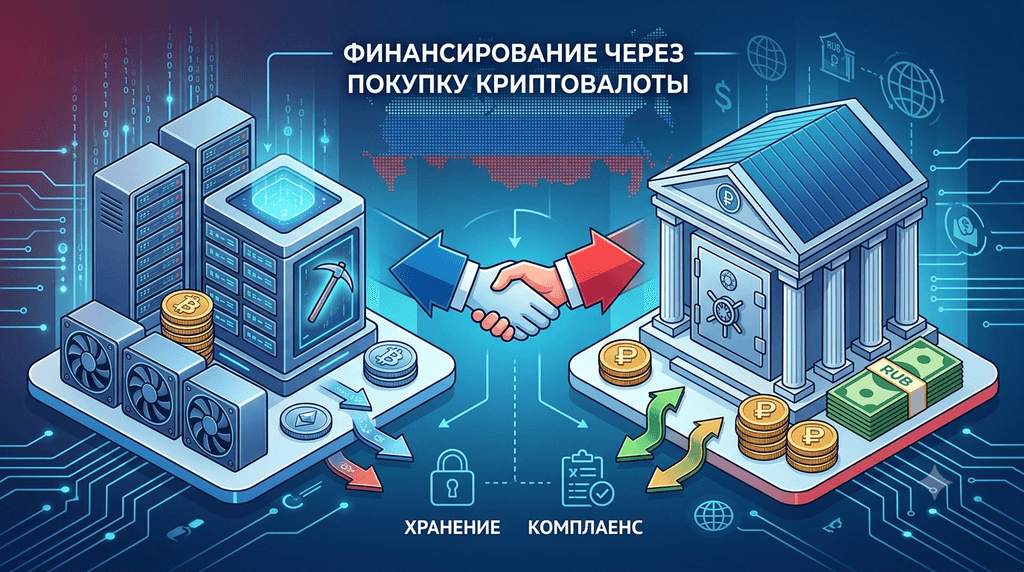
This is not retail bitcoin trading or an option to pledge coins in a mobile app. The bank temporarily purchases the crypto asset, stores it, verifies its origin, and controls operations. This approach allows financing the mining business while the legal status of cryptocurrency as collateral remains uncertain. Below, we break down how the scheme works, why it appeared right now, and what it means for foreign trade settlements.
What Alfa-Bank Actually Did
Alfa-Bank provided Intelion Data with ruble liquidity not through a standard collateralized loan, but through the temporary purchase of mined digital currency. The bank announced the transaction on September 1, 2026, and industry sources confirmed that this was the first transaction of its kind for a credit institution.
The practical challenge for a miner lies in the time gap between mining the cryptocurrency and receiving rubles. A company incurs costs for electricity, equipment maintenance, facility rental, and infrastructure expansion today, whereas selling the digital asset at a favorable price may be deferred. Selling part of the already mined coins to the bank provides the business with cash without immediate liquidation on the open market.
The amount, specific digital asset, purchase price, and terms of the buyback operation were not publicly disclosed. Therefore, while it is accurate to discuss the principle of the transaction, specific yield, financing volume, or guaranteed financial results cannot be attributed to it.
Why This Is Not a Bitcoin-Collateralized Loan
The key difference lies in the legal form. In a pledge (collateral), the borrower retains ownership of the property, while the lender receives security in case of default. Alfa-Bank chose a direct purchase of digital currency because the legal uncertainty surrounding the use of crypto assets as collateral does not yet meet business expectations regarding financing speed and conditions.
In this model, the company transfers mined cryptocurrency to the bank under a contractual arrangement, and the bank transfers rubles. For a pre-agreed period, the bank assumes the functions of storing and controlling the asset. Subsequent conditions—return mechanism, buyback price, commission calculation, and distribution of market risk—depend on the agreement between the parties and were not disclosed.
Consequently, the phrase "crypto financing" does not mean that the bank issued a loan in bitcoins or permitted the use of cryptocurrency as universal collateral. It is more accurate to describe the operation as the bank acquiring digital currency in exchange for short-term ruble liquidity for a corporate client.
How the Crypto Financing Scheme Works
The economic essence of the transaction lies in converting an asset that is illiquid for current operational expenses into a ruble cash flow, with the bank taking centralized control over the cryptocurrency side of the operation. The scheme can be represented as a sequence of five steps.
First, the mining company mines digital currency and confirms the legality of its operations, asset origin, and compliance with accounting requirements. Next, the parties agree on the volume of coins, price, duration, and settlement terms. In the third step, the company sells the cryptocurrency to the bank and receives rubles. These funds can be used to pay for electricity, data center maintenance, or capacity expansion.
After the purchase, the bank does not leave the asset uncontrolled. It organizes storage, conducts digital compliance, tracks cryptocurrency movement, and records the operation in accounting. At the end of the agreed period, the parties fulfill their contractual obligations. It is these contractual terms that determine whether the asset returns to the company, whether settlement is made in rubles, or whether another permissible structure is applied.
| Transaction Element | Role of the Mining Company | Role of the Bank |
| Asset | Transfers previously mined digital currency | Acquires and accepts it for custody/storage |
| Liquidity | Receives short-term rubles for operational expenses | Allocates ruble funds per transaction terms |
| Control | Provides information on asset origin and accounting | Conducts digital compliance and monitoring |
| Completion | Fulfills contractual obligations | Manages asset until expiration of deal term |
Why Miners Need Rubles
A mining company's main need is not necessarily to sell its entire cryptocurrency reserve, but to smooth out liquidity and cash flow gaps. Electricity and operational expenses are paid in national currency, whereas miner revenues depend on the digital asset's exchange rate and time of sale.
Short-term financing allows miners to avoid selling coins during local market downturns. While this does not eliminate price risk, it can alter its temporal structure: the company receives rubles now, while the terms for handling the digital asset are locked in by contract. At the same time, the business must factor in transaction costs, storage expenses, potential liquidity requirements, and the risk of crypto price volatility.
According to Frank Media, citing SPARK-Interfax, Intelion Data's revenue at the end of 2025 exceeded 17.7 billion rubles. The company's short-term liabilities as of December 31, 2025, stood at 3.6 billion rubles, with long-term liabilities approaching 1 billion rubles. These metrics illustrate the scale of the business, though they do not disclose the specific parameters of the pilot banking transaction.
What the "One-Stop-Shop" Format Means
The "one-stop-shop" format means that within a single corporate infrastructure, the bank integrates storage, compliance, monitoring, and accounting of the digital asset. For the client, this is more significant than simple crypto-to-ruble conversion, as every aspect of the transaction must align with internal control requirements and financial reporting standards.
Storage mitigates the risk of the asset moving between unrelated wallets without transparent oversight. Digital compliance helps verify the source of coins, transaction history, and adherence to anti-money laundering (AML) requirements. Monitoring tracks asset movement throughout the transaction term. Accounting enables the company to properly document the transaction in its financial statements.
This approach is particularly critical for mining because cryptocurrency origin is tied to specific wallet addresses, equipment, power consumption, and tax documentation. If a financial institution only sees the transfer of coins, that is insufficient for risk assessment. Comprehensive verification links blockchain data with corporate documents and the client's operational activities.
Why the Bank Didn't Use Cryptocurrency as Collateral
The reason for avoiding the classic collateral model is the legal uncertainty of digital currency's legal status and the difficulty of quickly framing security structures. Alfa-Bank explicitly noted that business expectations regarding financing timelines and terms diverge from how crypto-asset operations can legally be structured today.
Purchasing digital currency gives the bank a clearer role in the specific transaction. Instead of executing controversial collateral arrangements, it becomes a direct party to an asset transaction and oversees it until a pre-agreed moment. This can reduce legal complexity, though it does not eliminate the need to verify contracts, ownership rights, asset origin, and fulfillment procedures.
Publicly, it remains unknown how the parties allocated crypto price fluctuation risks. Thus, a successful pilot demonstrates the feasibility of the model, but does not prove it is universally suitable for all companies and digital assets.
The bank stated that it is testing more flexible financing structures and intends to adapt the pilot experience to new regulatory frameworks. This underscores the experimental nature of the transaction: the market is still formulating standard contracts, control procedures, and risk assessment standards.
How Law 282-FZ Changes Conditions for Business
Federal Law No. 282-FZ "On Digital Currencies and Digital Rights" was officially published on August 4, 2026, and took effect on September 1, 2026. The law recognizes digital currency as property and establishes specific rules for its mining, circulation, accounting, and regulation. The full text includes dedicated chapters on mining, digital analysis, custody, and organizations facilitating transactions with digital currencies.
At the same time, the law does not convert cryptocurrency into regular money for domestic settlements. Its use as a means of payment in Russia is restricted. Industry analyses highlight exceptions related to foreign trade contracts, mining rewards, network fee payments, and purchases of securities or other digital assets. Therefore, selling mined cryptocurrency to a bank for rubles and using cryptocurrency to pay for goods domestically are distinct legal scenarios.
For mining businesses, the new regime is important for two reasons. First, it establishes a clearer status for mined assets as property. Second, it ties the legality of operations to compliance with requirements imposed on miners themselves. According to source materials, legal mining is available to companies and sole proprietors registered in a specialized register, as well as individuals without sole proprietor status within an energy consumption limit of up to 6,000 kWh per month.
| Question | Key Takeaways from Available Information |
| Can I buy crypto in the Alfa-Bank app? | The pilot operation is not a retail service and does not confirm such functionality for individuals. |
| Can I pledge Bitcoin to a bank as collateral? | The specific deal used a purchase of mined currency rather than classic collateral. Legal certainty around collateral remains an issue. |
| Are domestic payments in crypto allowed? | No, the general ban remains; the law provides specific exceptions, including foreign trade contracts. |
| Who can legally mine cryptocurrency? | Registered entities meeting legal requirements, as well as individuals within the established power consumption limit. |
Did the New Law Eliminate 115-FZ Blocking Risks?
No, 282-FZ did not eliminate banking controls under 115-FZ (AML Law) nor did it make private cryptocurrency transactions automatically safe. In this pilot deal, compliance was ensured through bank-led digital compliance, documented asset origin, and a structured corporate setup.
This differs fundamentally from unreported P2P schemes where individuals receive regular transfers from multiple senders, cannot prove the economic rationale, or cash out through private exchanges. Banks can request documentation, source of funds evidence, tax status, and explanations of payment purpose. Without sufficient transparency, transactions can trigger additional scrutiny, service restrictions, or account freezes.
Therefore, one cannot conclude that 115-FZ risks are cleared for all crypto holders following Alfa-Bank's transaction. On the contrary, the pilot illustrates what conditions enable corporate operations to pass control: a clear counterparty, verifiable origin of digital currency, pre-arranged contracts, asset movement tracking, and complete accounting records.
Can the Scheme Assist Foreign Trade Settlements?
Yes, structured financing can serve as a component of foreign trade settlement infrastructure, but it is not inherently a sanction bypass mechanism or a universal payment channel. Law 282-FZ permits digital currency in foreign trade contract settlements, while domestic use as a payment medium remains generally prohibited.
Alfa-Bank's logic lies in building operational expertise with legally mined digital currency. If the bank can verify, store, track, and account for the asset, it establishes a foundation for more sophisticated corporate products. Prospectively, this infrastructure could be utilized in international settlement chains for companies needing alternative cross-border execution channels.
However, a legal exception does not automatically eliminate sanctions, currency control, tax, or counterparty risks. Each foreign trade contract will require separate checks regarding jurisdictions, goods, participants, wallet addresses, and applicable regulatory regimes. Digital currency may alter the settlement mechanism, but it does not remove financial monitoring requirements or liability for regulatory breaches.
How Alfa-Bank's Deal Differs from Sber's Pilot
The primary difference lies in the collateral vs. purchase structure. In late 2025, Sber conducted a pilot transaction lending to Intelion Data where mined digital currency served as collateral; the amount and term were undisclosed. In September 2026, Alfa-Bank announced the direct purchase of mined cryptocurrency in exchange for short-term ruble liquidity.
Both transactions demonstrate banking interest in financing mining operations, but they represent distinct product models. Sber's approach resembles a secured loan, whereas Alfa-Bank's scheme relies on asset purchase alongside asset administration. Comparing them by yield, financing cost, or efficiency is impossible due to lack of public data.
The emergence of two distinct models shows that banks are exploring legal mechanisms to handle crypto assets without substituting corporate procedures with retail trading. Competition may shift toward compliance quality, execution speed, and accounting transparency.
What Risks Remain for Companies and Banks
The primary risk for both parties is crypto asset volatility. Even short-term deals can face sharp price movements, illiquidity, or widening spreads. Technological risks are equally significant: address errors, key compromise, storage infrastructure outages, and reliance on external blockchain services.
Legal risks stem from contract interpretation. Parties must define upfront what constitutes execution, who bears exchange rate risk, how asset valuation is conducted, how returns are executed, and what occurs upon default. Until the market establishes standardized documentation, each deal requires bespoke legal customization.
Compliance risk arises if digital currency possesses an opaque history or links to wallet addresses flagged by financial monitoring. For miners, this requires maintaining mining registries, proving equipment ownership and power usage, retaining counterparty documents, and properly recording operations.
Finally, there is operational scaling risk. What succeeds in a pilot with a major corporate client and transparent asset does not automatically translate into a mass-market product. Banks will need automated verification, exposure limits, dispute resolution procedures, and specialized personnel skilled in finance, blockchain, and regulatory compliance.
How to Evaluate the Prospects of Crypto Financing
Market prospects will depend not on the publicity of the initial deal, but on the ability to replicate it in a transparent, economically viable manner. In the short term, corporate operations with legal miners, verified asset histories, and ruble liquidity needs are most likely. For retail clients, this case does not signal an imminent rollout of bank services for purchasing or collateralizing Bitcoin.
The next phase will involve standardization. Banks must define eligible assets, valuation methods, custody standards, and protocols for market drops. Companies will need to establish documented workflows from mining to realization: registration, taxation, accounting, coin origin verification, and operational reporting.
The foreign trade exception creates demand for verifiable infrastructure. Sustainable growth will require distinguishing three concepts: mining as asset production, financing as a corporate transaction, and payment as contractual execution. Alfa-Bank combined the first two elements, and future products may bridge them with international settlements.
How to Use KuCoin Crypto Services for Market Analysis
KuCoin provides tools for researching digital asset markets, including market quotes, trading pairs, and analytical data, though service availability depends on jurisdiction and local regulations. Users should not interpret a corporate banking transaction as a recommendation to replicate it via retail trading accounts. Individual risk tolerance must be assessed, source of funds verified, and only legal channels utilized.
KuCoin Offers A More Stable Option in A Volatile Market
If you worry about the frequent ups and downs in the market, and pursue a more stable option to earn money passively, KuCoin is the right place to come:
Simple Earn: Deposit and withdraw tokens anytime, earning stable returns.
Kucoin Earn: Earn stable profits with professional asset management.
Hold to Earn: Earn rewards by holding assets in Funding, Trading, Margin, Futures, Mining, and Unified Accounts.
Staking: Unlock the earning potential of on-chain assets.
Advanced Investments: Advanced Investments offer a variety of structured products to help your money grow in any market.
Shark Fin: Principal Protection and Guaranteed Gains
Dual Investment: Buy low and sell high with transparent return calculations.
Snowball: High yields, with price protection.
Discount Buy: Buy crypto at discount prices.
KCS Loyalty: Level up to enjoy exclusive perks by staking ≥ 1 KCS.
KuCoin Wealth: Discover future value and begin your smart investing journey.
KCS Benefits: Hold and stake KCS to access benefits across the platform.
KCS Staking 2.0: Participate in KCS on-chain governance to earn yield.

Conclusion
Alfa-Bank's inaugural crypto-financing transaction represents a notable corporate experiment in the Russian financial market. Intelion Data secured short-term ruble liquidity by selling mined digital currency to the bank, while the bank assumed responsibility for custody, digital compliance, monitoring, and accounting.
The key takeaway is that the operation was neither a retail Bitcoin purchase nor a traditional crypto-backed loan. The bank opted for direct purchase due to ongoing legal ambiguity surrounding collateral structures. This setup enables financing for miner operational costs, but requires tailored contracts, strict origin tracking, and active management of market and tech risks.
The implementation of Law 282-FZ provides clearer rules for digital currency, mining, and foreign trade settlements, but does not bypass 115-FZ AML controls or allow unrestricted domestic payments. Consequently, Alfa-Bank's case opens a pathway toward regulated B2B services rather than turning cryptocurrency into an everyday retail banking product. Its broader impact will hinge on deal replicability, compliance quality, and transparent infrastructure development.
Frequently Asked Questions
1. Can an individual buy or pledge Bitcoin in the Alfa-Bank app?
No. The described operation is not a retail product. It is a corporate structured financing transaction between a bank and a mining enterprise. It does not indicate that individuals can buy, sell, or pledge Bitcoin through the mobile app.
2. Does a miner need to pay taxes on the sale of mined cryptocurrency?
Yes. The sale of mined digital currency must be reported according to applicable tax laws and accounting standards. Exact obligations depend on entity status, income structure, and official tax guidance; companies should consult tax professionals and retain documentation verifying mining and asset disposition.
3. Can a bank refuse a cryptocurrency transaction even if the mining is legal?
Yes. Legal mining status is necessary but insufficient. The bank independently evaluates the client, asset origin, transaction history, economic rationale, counterparty risks, and its own ability to meet financial monitoring standards.
4. What happens to the asset if the cryptocurrency price crashes?
The outcome is determined by contractual terms between the parties. Contracts must outline valuation methodologies, revaluation triggers, collateral/liquidity calls, and loss allocation. Public disclosures regarding Alfa-Bank's deal did not reveal these specific terms.
5. Can this model be used to pay a domestic Russian supplier?
No. Financing via digital asset purchase does not legalize domestic cryptocurrency payments. Law 282-FZ restricts using digital currency as a payment medium inside Russia, establishing specific exceptions primarily for select foreign trade transactions. Individual contracts and statutory requirements must be reviewed prior to settlement.
Disclaimer : This material is provided for informational purposes only and does not constitute financial, investment, legal, or tax advice. Transactions involving cryptocurrencies and tokenized assets carry substantial risks — including price volatility, limited liquidity, counterparty exposure, and the potential for total loss of invested capital. Readers should conduct their own research and, where appropriate, consult a qualified professional before making any financial decisions.