

What Will Change in Russia’s Finance From September 1, 2026: the Digital Ruble, Cryptocurrency, Tax Deductions, and Mortgage Holidays
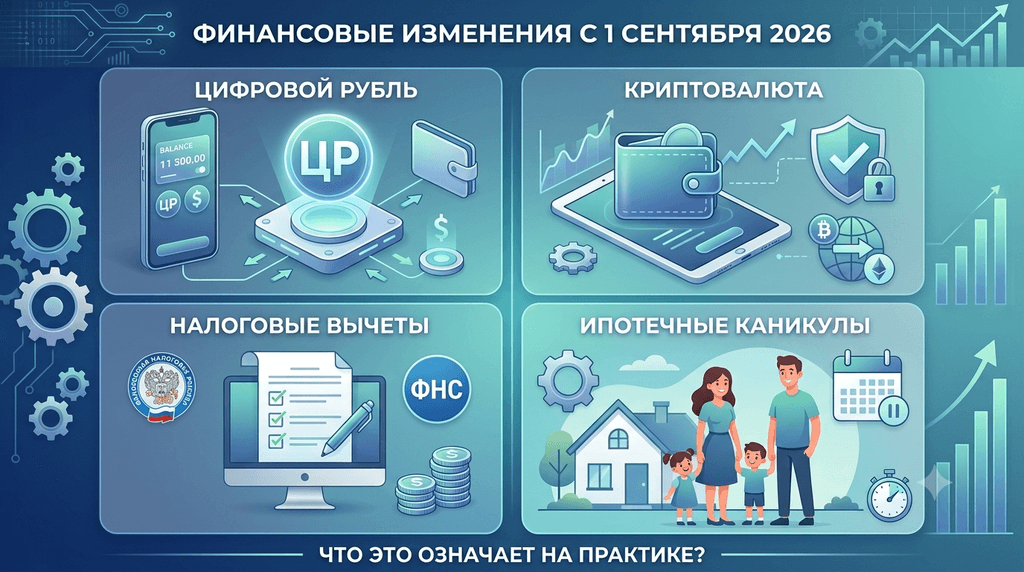
From September 1, 2026, Russia will simultaneously change the rules for digital payments, cryptocurrency circulation, tax deductions, and borrower support. What does this mean in practice? For citizens, the digital ruble remains a voluntary form of the national currency, and its use and transfers carry no fees. Cryptocurrency is given a more defined legal regime but does not become a regular means of payment within the country. Families with two or more children receive an additional ground for mortgage holidays, while certain deductions and their application procedures become more convenient. Below, we break down which rules are already coming into force, who they apply to, and what restrictions are important to consider.
How will the digital ruble change payments from September 1, 2026?
The digital ruble begins to be used as the third form of the Russian ruble alongside cash and non-cash money. It is stored not in a regular bank account but in a digital wallet on the Bank of Russia’s platform. Therefore, the digital ruble is a liability of the central bank, whereas funds in a commercial bank account are a liability of that bank.
For users, the difference is primarily in the storage and settlement infrastructure. The digital wallet will be accessible through connected banks that a person already uses. Each individual will be able to open one digital wallet. Transfers between one’s own bank accounts and the wallet will be fee-free within the established monthly limit.
Is it mandatory to receive salary or pension in digital rubles?
No, switching to the digital ruble is voluntary for individuals. The state is not entitled to forcibly convert salaries, pensions, benefits, or other social payments into digital form. A person independently decides whether to open a wallet and use it for purchases or transfers.
This means that the digital ruble does not cancel out cash and non-cash rubles. All three forms of the national currency continue to exist in parallel, and the choice depends on the convenience of the specific user. Refusing a digital wallet by itself should not restrict access to a regular bank account or social payments.
What are the costs for the digital wallet and top-ups?
Opening a wallet, transfers, and core operations for individuals are provided free of charge. You can top up the digital wallet from a bank account for up to 300 000 rubles per month without a fee. Do not confuse this limit with the overall balance: funds already credited can be used without such a restriction.
The Bank of Russia does not pay interest on digital ruble balances and does not issue loans in this form. Therefore, the digital wallet is primarily intended for payments rather than interest-bearing savings. Users should assess in advance whether they need this new payment infrastructure if a regular account already covers their daily needs.
How will the universal QR code work?
The universal QR code will unify the payment interfaces of banks, the Faster Payments System (FPS), and the digital ruble. A merchant will not need to display separate codes for each banking system, and a buyer will be able to choose the funding source after scanning.
In practice, the same code may offer a choice between payment via the FPS, a banking app, or a digital wallet. This approach reduces dependency on a specific bank and simplifies merchant onboarding. Bonuses and loyalty programs, including cashback, should be preserved where provided by the selected payment method and bank terms.
For businesses, the universal QR code means updating cash register software and payment processes. For customers, changes will only be noticeable at checkout: instead of multiple codes, there will be a single entry point where you can choose the appropriate payment method.
What will change for cryptocurrency and mining in Russia?
From September 1, 2026, cryptocurrency receives a clearer legal status, but its use within Russia remains limited. Digital currencies cannot be accepted as a means of payment for goods, works, services, information, and results of intellectual activity. This restriction is enshrined in Federal Law of August 4, 2026 No. 282-FZ and amendments to the regulation of digital financial assets.
Thus, the legalization of certain operations does not equal permission to pay with cryptocurrency for coffee, rent, household services, or purchases in a Russian store. A seller should not accept Bitcoin, Ethereum, or USDT instead of rubles unless the transaction falls under a specially provided exception.
Are cryptocurrency settlements allowed in foreign trade?
Within an experimental legal regime (EPR), cryptocurrency may be used for cross-border settlements under foreign trade contracts between residents and nonresidents. Such operations are conducted under the regulator’s supervision and do not turn cryptocurrency into a universal means of payment within the country.
For businesses, this is potentially an important settlement channel when access to certain international payment routes and traditional banking infrastructure is limited. However, using digital currency within the EPR requires meeting special conditions, identifying participants, and documenting the transaction. You cannot automatically extend the rules of the foreign trade experiment to domestic purchases or private settlements.
What restrictions apply to a private investor?
A non-qualified investor will be able to work only with a prescribed list of cryptocurrencies and within a set annual limit. Published clarifications list Bitcoin, Ethereum, and USDT, and the maximum investment volume through one intermediary is 300 000 rubles. Qualified investors have access to a broader set of digital currencies, but this does not remove market, technological, and legal risks.
Pre-trade testing may be required. Intermediaries must be organizations operating under the established legal regime: brokers, digital depositories, crypto exchanges, or asset managers included in the relevant register within the prescribed timeframe. It is important for users to verify the platform’s status and the transaction terms before transferring funds, rather than relying solely on the presence of a mobile app or advertising.
How are mining and cryptocurrency income taxed?
Cryptocurrency is treated as property, and income from its mining and disposal is subject to taxation. Individuals’ income from operations and mining is subject to personal income tax (NDFL) at rates of 13–15 percent, and organizations’ income is taken into account when calculating corporate income tax.
Mining is also moving into a regulated area. Participants must consider registration and reporting requirements, and industrial mining may be subject to quotas and energy consumption limits. Legal status does not guarantee profitability: miners still bear the costs of equipment, electricity, maintenance, and tax obligations.
Which tax deductions will be easier to claim?
From September 1, 2026, automation should simplify claiming social deductions for healthcare, education, sports, and contributions to an individual investment account of the third type — IIS-3. The Federal Tax Service (FTS) receives information from banks and organizations, pre-fills the data, and the taxpayer only needs to review and confirm the application in the FTS personal account or on Gosuslugi.
The automated procedure reduces the number of certificates and manual entries but does not cancel the obligation to verify documents. An error in the amount, contract, period, or organization’s status can lead to a refund delay. Before confirming the application, you should check accrued income, NDFL withheld, and information on services actually paid.
How is the deduction for contributions in favor of children changing?
The maximum amount of expenses eligible for deduction on parents’ contributions made in favor of children increases from 400 000 to 500 000 rubles. If both parents make contributions and the established conditions are met, the combined family limit may reach 1 million rubles per year.
The increased limit applies to financial products arranged in favor of a child, including the long-term savings program and other prescribed instruments. The child’s age also matters: typically up to 18 years, and for full-time students — up to 24 years. The specific refund amount depends not on the expense limit itself but on the amount of NDFL paid and the applicable tax rate.
What is the limit for long-term life insurance?
For long-term voluntary life insurance contracts, the maximum amount of expenses for a social deduction is 400 000 rubles for an adult and 500 000 rubles if a parent contributes in favor of a child. Previously, a lower limit of 150 000 rubles applied to such contracts.
It is important to distinguish between the amount of expenses and the refund amount. The 500 000 rubles limit is the base to which the NDFL rate is applied, not a guaranteed budget payout. If a person has not paid the corresponding amount of tax for the year, they cannot receive a refund exceeding the NDFL actually withheld.
Who will receive mortgage holidays from September 1, 2026?
Families will be able to apply for mortgage holidays after the birth or adoption of a second and subsequent child. For this basis, it is not required to prove a drop in income: the very fact of a child’s appearance gives the borrower an additional right to a grace period, subject to the law and the loan agreement.
The standard duration of holidays is up to six months. For families with two or more children, the grace period may reach 18 months or continue until the child reaches one and a half years. The borrower has the right to determine the start date and duration of the holidays within the prescribed limits, as well as to end the grace period early.
What other circumstances allow payments to be suspended?
Mortgage holidays also remain available to borrowers who face other difficulties established by law. Grounds may include a decrease in average income over the last two months by more than 30 percent compared to the previous period, being located in an emergency zone, or belonging to certain social categories.
During the holidays, the bank should not charge penalties for missed payments or worsen the borrower’s credit history solely due to a legally arranged grace period. The accrual and deferral of interest depend on the specific ground and the duration of the holidays. For the child-related ground, the period after the sixth month may be calculated at the rate provided in the loan agreement, so the borrower should request a full schedule from the bank in advance.
Should mortgage holidays be considered debt write-off?
No, mortgage holidays shift the payment burden but usually do not cancel the debt. Amounts not paid during the grace period are deferred to a later date, and interest may be repaid at the end of the agreement or according to a new schedule. Therefore, before applying, it is important to compare the future overpayment, the loan end date, and the payment amount after the holidays.
To exercise the right, the borrower should submit an application to the bank and attach documents confirming the birth or adoption of a child or another ground. The bank verifies compliance with the requirements of the specific loan. A legally available deferral does not mean automatic approval of any term without an application and supporting documents.
What does the new oversight of transfers via QR code mean?
From September 1, 2026, Rosfinmonitoring will be able to obtain data on transfers via the FPS, Mir cards, and the universal QR code. The purpose of this mechanism is to identify suspicious transactions and counter the laundering of criminal proceeds.
For an ordinary client, a transfer via QR code does not in itself constitute a violation or imply automatic account blocking. However, banks and the payment infrastructure will more carefully analyze unusual transfer chains, sharp changes in turnover, a large number of recipients, and operations that do not match the client’s usual profile.
The practical takeaway is simple: keep confirmations of the purpose of large transfers, contracts, and documents on the source of funds. This is especially important for entrepreneurs, freelancers, digital asset sellers, and people who regularly receive cross-border payments.
How to prepare for the financial changes in September?
The main change for citizens is that the choice of financial instruments is expanding, but so is the importance of checking terms and conditions. The digital ruble can be connected voluntarily after comparing the wallet’s convenience with that of a regular account. When dealing with cryptocurrency, it is necessary to distinguish permitted cross-border transactions and investment procedures from the prohibited domestic payment for goods and services.
Those counting on a deduction should check their FTS personal account, contracts, and payment confirmations. Parents should determine in advance who the financial product is issued to and who actually made the contributions. Families with a mortgage should contact the bank immediately after the basis for holidays arises, requesting a new schedule and interest calculation.
KuCoin Offers A More Stable Option in A Volatile Market
If you worry about the frequent ups and downs in the market, and pursue a more stable option to earn money passively, KuCoin is the right place to come:
Simple Earn: Deposit and withdraw tokens anytime, earning stable returns.
Kucoin Earn: Earn stable profits with professional asset management.
Hold to Earn: Earn rewards by holding assets in Funding, Trading, Margin, Futures, Mining, and Unified Accounts.
Staking: Unlock the earning potential of on-chain assets.
Advanced Investments: Advanced Investments offer a variety of structured products to help your money grow in any market.
Shark Fin: Principal Protection and Guaranteed Gains
Dual Investment: Buy low and sell high with transparent return calculations.
Snowball: High yields, with price protection.
Discount Buy: Buy crypto at discount prices.
KCS Loyalty: Level up to enjoy exclusive perks by staking ≥ 1 KCS.
KuCoin Wealth: Discover future value and begin your smart investing journey.
KCS Benefits: Hold and stake KCS to access benefits across the platform.
KCS Staking 2.0: Participate in KCS on-chain governance to earn yield.
Conclusion
From September 1, 2026, Russia’s financial rules become more digital and detailed. The digital ruble is launched as an independent form of the national currency but remains voluntary for individuals. The wallet and transfers are free, and top-ups from a bank account are limited to 300 000 rubles per month. The universal QR code unites different payment methods and allows you to choose the funding source yourself.
Cryptocurrency receives clearer regulation: mining and income are subject to accounting and taxation, certain cross-border settlements are possible within the EPR, but domestic payment for goods and services with digital currencies is prohibited. Tax deductions become more convenient thanks to automatic data exchange, and the limit on parents’ contributions in favor of children increases to 500 000 rubles. Families after the birth or adoption of a second child receive a new ground for mortgage holidays for up to 18 months. All these measures provide additional opportunities; however, they should be used only after checking the conditions of the law, the bank, tax status, and the specific transaction. For readers, the main guidepost is not the launch date but a precise understanding of what is allowed, what is restricted, and which documents confirm the right to a benefit.
Frequently Asked Questions
1. Can I opt out of the digital ruble after opening a wallet?
Yes. Using the digital ruble is voluntary, so a citizen may stop using the wallet and return to cash or non-cash rubles within available banking procedures.
2. Is interest paid on digital ruble balances?
No. Interest is not paid on digital ruble balances, and digital loans to individuals are not issued.
3. Can I pay with cryptocurrency in a Russian store?
No. From September 1, 2026, digital currency cannot be accepted as a means of payment for goods, works, or services within Russia unless the transaction falls under a statutory exception.
4. Will a family receive cash during mortgage holidays?
No. Mortgage holidays mean a deferral or a change in the payment schedule, not a payout to the borrower. Deferred amounts and interest are repaid later under the specific loan’s rules.
5. Will the automatic deduction refund the entire amount of expenses?
No. The expense limit is the base for calculating the deduction. The actual refund is limited by the amount of personal income tax (NDFL) paid by the taxpayer and the conditions of the corresponding type of deduction.
Disclaimer : This material is provided for informational purposes only and does not constitute financial, investment, legal, or tax advice. Transactions involving cryptocurrencies and tokenized assets carry substantial risks — including price volatility, limited liquidity, counterparty exposure, and the potential for total loss of invested capital. Readers should conduct their own research and, where appropriate, consult a qualified professional before making any financial decisions.