

Digital Ruble Enters the Market in 2026: How the Platform Works and Should You Use It
2026/08/28 14:45:00
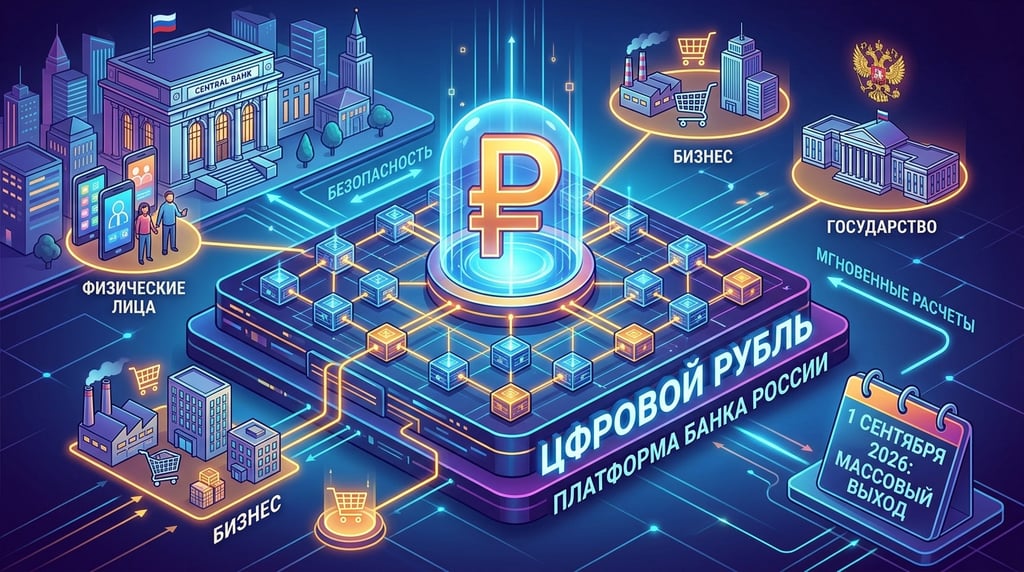
According to the Bank of Russia in August 2026, over 75% of the economically active population is actively interested in new state payment forms. The digital ruble is the official third form of the Russian national currency, entering the mass market on September 1, 2026, and is designed exclusively for settlements. This innovative asset exists alongside cash and non-cash money, exchanging with them at a strict one-to-one ratio. This technology fundamentally changes the country's financial landscape, offering new mechanisms for interaction between the state, businesses, and citizens. Unlike conventional bank accounts, the new currency is stored on the regulator's single centralized platform, guaranteeing absolute fund safety. This article details how the system works, who benefits from it, existing limits, and answers key questions about pensions, cashback, and the security of your savings.
What is the Digital Ruble and How Does the New Financial Platform Work?
The digital ruble is an electronic form of fiat national currency issued exclusively by the Central Bank of Russia, with all funds physically stored on its secure servers. According to the regulator's official report published in late July 2026, commercial banks in this ecosystem act solely as client interfaces. Users access their wallets through their banks' familiar mobile apps, but the money itself does not sit on these credit institutions' balance sheets. This architecture allows the state to fully control the emission and movement of funds, making the financial system more transparent. The platform is built on distributed ledger technology, ensuring high transaction processing speed and protection against forgery.
Interaction with the platform occurs through special cryptographic keys generated for each user. The technical implementation eliminates the possibility of double-spending the same funds, as each token has a unique digital footprint. The Bank of Russia assumes all infrastructure maintenance costs, lifting this financial burden from commercial market participants.
Will the Digital Currency Replace Cash and Bank Cards?
No, the digital ruble does not replace but only complements existing forms of money—paper banknotes and familiar non-cash bank accounts. Citizens have the full right to freely transfer their funds between these three forms at any time. The government has no plans to withdraw cash from circulation or forcibly close card accounts. The new currency form was created solely to expand the population's payment capabilities and reduce transaction costs.
Each of the three forms of money has its specific purpose in the economy. Cash provides anonymity and the ability to settle offline, non-cash accounts in commercial banks allow earning interest income on the balance, and the digital ruble guarantees instant, free, and absolutely reliable transfers. Users can combine these instruments depending on their current financial needs and level of trust in specific banking products.
How Are Funds Protected in Case of Commercial Bank Bankruptcy?
Your digital rubles are in absolute safety and will not burn even in the event of a complete bankruptcy of your commercial bank, as they are physically stored on the Bank of Russia's single platform. Ordinary non-cash money on cards represents the financial obligations of credit institutions to you. If a bank loses its license, clients have to rely on the deposit insurance system, which has strict payout limits and requires time for paperwork. With the new currency form, this risk is completely neutralized.
Even if the bank's app through which you accessed your wallet stops working, you will not lose a single penny. To access your funds, you simply need to log into the system through the mobile app of any other bank connected to the platform. The Central Bank acts as a 100% guarantor for the safety of every token, making this instrument the most reliable way to store funds for current settlements in the Russian jurisdiction.
Will Pensions and Salaries Be Forcibly Converted to the Digital Ruble?
The transition to using the digital ruble is absolutely voluntary—the government has legally prohibited the forced conversion of pension payments, social benefits, or salaries into the new format. According to the Ministry of Finance of the Russian Federation as of August 2026, the law strictly secures citizens' right to independently choose how they receive their money. If a pensioner is accustomed to receiving their pension in cash through a postman or on a national payment system bank card, they will continue to receive it exactly that way. No administrative pressure levers on citizens are provided.
If a user wants to receive their salary in the new currency, they must submit a corresponding request to their employer. For employers, this means integrating their accounting systems with the Bank of Russia's platform. However, commercial banks and large retailers are obliged to prepare the infrastructure to accept such payments from clients who have personally expressed a desire to use the new technologies. This creates freedom of choice for the consumer without imposing services.
Is It Profitable to Store Money in Digital Rubles: Interest and Cashback
No interest is accrued on digital ruble balances, and commercial banks do not pay out the usual cashback for such transactions. The Bank of Russia repeatedly emphasized in its directives in July-August 2026 that this asset is positioned exclusively as a convenient payment instrument, not as a means for capital multiplication or savings. If citizens want to earn on deposits or receive savings income, they must keep their money in standard non-cash accounts in commercial banks.
The absence of cashback is explained by the economic model of the new system itself. Bank card cashback is generated through high acquiring interchange fees that banks charge stores. Since operations on the Central Bank's platform cost businesses significantly less, there is simply no source for funding generous buyer reward programs. The platform was created to reduce costs for the entire economy, not to sponsor the loyalty programs of individual banks.
Smart Contracts and Payment Automation
Smart contracts on the digital ruble platform allow fully automating payments without intermediaries, radically transforming relationships between counterparties. This technology is a software code built into the platform that instantly transfers funds when pre-defined conditions are met. According to logistics market analytical reports for August 2026, implementing smart contracts reduces settlement times between suppliers and clients from several days to a few seconds.
This tool shows exceptionally high efficiency in public procurement and targeted financing. A smart contract allows tokens to be "colored," permitting their spending only for specific purposes—for instance, purchasing construction materials for a particular project. If a contractor attempts to transfer this money for personal needs or cash it out, the system will automatically block the transaction. This makes the misuse of budget funds or subsidies technically impossible.
What Are the Fees and Limits for Individuals?
For individuals, absolutely all operations, including transfers to other people, paying for goods via QR code, and wallet top-ups, are completely free; however, there is a strict monthly top-up limit of 300,000 rubles. This limit applies only to transferring funds from your regular bank accounts to your personal digital wallet. If you reach this ceiling, you will have to wait until the beginning of the next calendar month to deposit new funds onto the platform.
Inside the Bank of Russia's system itself, there are no artificial limits on capital movement. You can transfer any amount to other users or make large purchases if the funds are already in your wallet. The top-up limit was introduced to prevent a sudden outflow of liquidity from commercial banks, which could lead to a shortage of credit funds in the economy and a sharp increase in mortgage and consumer loan rates.
Comparison of National Currency Formats
| Characteristic | Cash | Non-Cash Accounts | Digital Ruble |
| Storage Location | Client's wallet | Commercial bank | Bank of Russia Platform |
| Interest Accrual | No | Yes (on deposits) | No |
| Transfer Fees | No | Possible if limits exceeded | Completely absent |
| Bank Bankruptcy Risk | Absent | Insured (up to 1.4m rubles) | Absent (stored in CB) |
| Cashback Availability | No | Yes (bank loyalty programs) | No |
What Benefits Will Businesses Get and What Are the Acquiring Rates?
Businesses will save billions of rubles thanks to unprecedentedly low payment acceptance fees, strictly capped by the government at 0.3% of the transaction amount. According to research by specialized agencies in August 2026, standard bank card acquiring rates range from 1.5% to 3.5%. This difference allows retail networks to radically cut their costs, which is especially critical for low-margin companies. For utility service providers, the government has set an even more preferential rate—just 0.2%.
These funds saved on bank fees directly remain in the working capital of real sector enterprises. Besides direct financial benefits, businesses gain an advantage in settlement speed. In traditional acquiring, money for sold goods arrives in the seller's account the next business day, and weekend delays occur. On the regulator's platform, funds are credited to the seller's corporate wallet instantly, 24/7.
Implementation Schedule: When Will Stores Start Accepting the Digital Ruble?
Starting September 1, 2026, all trading enterprises and retail chains with an annual revenue exceeding 120 million rubles for the previous year are mandatorily required to ensure the acceptance of digital rubles. This is the beginning of a massive state program to implement the new infrastructure. Stores must update their cash register software and install terminals capable of generating and reading the single Bank of Russia QR code used for payment. Refusal to accept this payment form will be penalized with fines by supervisory authorities.
The subsequent rollout schedule involves a phased reduction of the revenue threshold for mandatory business connection. Over the next few years, the requirement will extend to medium-sized companies with revenues over 30 million rubles, and then to small businesses with a turnover of 20 million rubles per year. The government provides entrepreneurs with a transition period to adapt business processes, but in the long term, all legal sales outlets will be integrated into the new system.
Can the Digital Ruble Be Used to Buy Crypto and Bypass Sanctions?
The digital ruble cannot be used to bypass currency controls, evade taxes, or directly purchase unregulated cryptocurrencies. The new form of money is a high-tech but strictly regulated fiat currency fully subject to anti-money laundering (AML/CFT) legislation. All transactions on the Bank of Russia's platform are completely transparent to financial monitoring, and any suspicious transfer can be instantly blocked without commercial bank involvement.
State authorities have full access to the movement history of every token from the moment of its emission. This makes the system unsuitable for gray capital flight schemes or purchasing sanctioned goods outside official channels. The platform has no direct gateways for converting its tokens into Bitcoin or stablecoins on decentralized platforms. To work with international crypto assets, users still need to utilize specialized exchanges and alternative fiat funding methods.
How to Buy and Trade Cryptocurrency on KuCoin
Although state digital currencies are not designed for investment or trading, you can easily and securely trade cryptocurrency on the international KuCoin platform using other available payment methods. Since national tokens do not accrue interest, many users seek alternative ways to protect their capital from inflation and diversify their portfolios. KuCoin provides access to hundreds of cryptocurrency pairs, futures, and passive income tools unavailable in the traditional fiat system.
To start working on the KuCoin exchange, you simply need to complete a quick registration and basic Know Your Customer (KYC) verification, ensuring your account's security. The platform supports balance top-ups via peer-to-peer (P2P) trading, where users can purchase stablecoins using standard bank transfers from their regular accounts. You can start investing on KuCoin even with small amounts, gradually exploring spot trading and staking tools to generate passive yields.
KuCoin Offers A More Stable Option in A Volatile Market
If you worry about the frequent ups and downs in the market, and pursue a more stable option to earn money passively, KuCoin is the right place to come:
Simple Earn: Deposit and withdraw tokens anytime, earning stable returns.
Kucoin Earn: Earn stable profits with professional asset management.
Hold to Earn: Earn rewards by holding assets in Funding, Trading, Margin, Futures, Mining, and Unified Accounts.
Staking: Unlock the earning potential of on-chain assets.
Advanced Investments: Advanced Investments offer a variety of structured products to help your money grow in any market.
Shark Fin: Principal Protection and Guaranteed Gains
Dual Investment: Buy low and sell high with transparent return calculations.
Snowball: High yields, with price protection.
Discount Buy: Buy crypto at discount prices.
KCS Loyalty: Level up to enjoy exclusive perks by staking ≥ 1 KCS.
KuCoin Wealth: Discover future value and begin your smart investing journey.
KCS Benefits: Hold and stake KCS to access benefits across the platform.
KCS Staking 2.0: Participate in KCS on-chain governance to earn yield.
Conclusion
The introduction of the digital ruble to the mass market on September 1, 2026, marks a new era in the development of Russia's financial infrastructure. This is a reliable, fast, and absolutely free settlement tool for citizens that guarantees the safety of funds at the Central Bank level, eliminating the risks of commercial organization bankruptcies. Despite the mandatory implementation of new currency acceptance for large businesses, using innovative wallets remains strictly voluntary for everyday Russians—no one will forcefully convert pensions or salaries into the new format.
Businesses gain massive advantages in the form of instant settlements and minimal acquiring fees (up to 0.3%), which will support the economy in the long run. However, it is vital to remember that the new currency is not a savings vehicle—it does not accrue interest or provide cashback. It is a high-tech payment instrument complementing, rather than replacing, the familiar cash and bank cards in citizens' wallets.
FAQs
1. Can I get a loan or mortgage in digital rubles?
No, credits and loans are not issued in this currency format. It is exclusively a medium for settlements and payments. The Central Bank's platform does not perform public lending functions, so you will still need to approach commercial banks and use standard non-cash accounts for mortgages or consumer loans.
2. What happens to the money if I lose the smartphone with access to the app?
Your money will remain completely safe on the Bank of Russia's secure servers. The commercial bank's application on your phone is merely an interface for accessing the funds. If you lose your device, simply block your old SIM card, restore your number, and log into your bank's app on a new smartphone.
3. Can I pay with digital rubles if there is no internet connection?
Currently, making transfers and paying via QR code requires a stable internet connection. However, the Central Bank is actively developing and testing offline payment technology, which in the future will allow token transfers directly between devices through built-in communication modules, even in remote areas without connectivity.
4. Will the digital ruble have its own separate exchange rate against the dollar?
No, a separate market exchange rate for the new currency does not exist. The value of one digital ruble is always strictly equal to the value of one paper ruble banknote or one ruble on your bank account. All three money forms are entirely equivalent and convert domestically at a one-to-one ratio without any fees.
5. Can scammers or hackers steal my funds directly from the platform?
Stealing funds by hacking the Bank of Russia's platform itself is practically impossible due to advanced cryptographic security algorithms. The main risk comes from social engineering methods, where scammers deceive people into voluntarily transferring their funds. You must remain vigilant and never share SMS passwords or banking app login details with anyone.
Disclaimer : This material is provided for informational purposes only and does not constitute financial, investment, legal, or tax advice. Transactions involving cryptocurrencies and tokenized assets carry substantial risks — including price volatility, limited liquidity, counterparty exposure, and the potential for total loss of invested capital. Readers should conduct their own research and, where appropriate, consult a qualified professional before making any financial decisions.