

Why the MOEX Russia Index Rose on News of the CIA Director's Visit: Facts, Risks, and Stock Market Reaction
2026/08/27 12:02:00
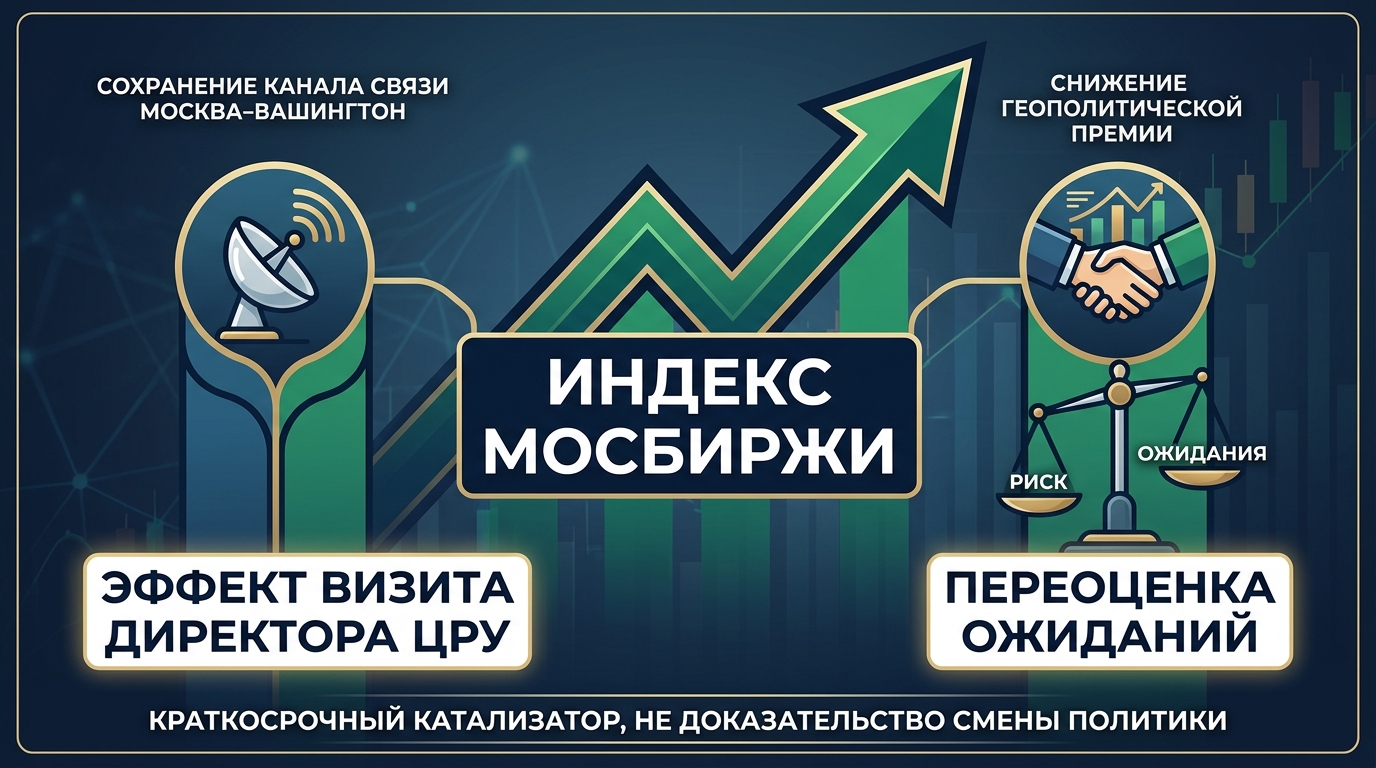
On August 25, the Russian market was not pricing in a peace agreement or the lifting of sanctions. Instead, it responded to the very fact that a communication channel between Moscow and Washington remained open. After reports of CIA Director John Ratcliffe's possible arrival in Moscow, the MOEX Russia Index accelerated its rise, reaching an intraday high of 2,146.14 points and gaining 3.1% to 2,135.7 points by 18:06 Moscow time. Forbes Russia recorded these levels using trading data.
The core conclusion is straightforward: the news was a strong short-term catalyst for a decline in the geopolitical risk premium, but not proof of a policy shift. The following day, the Kremlin confirmed the visit and contacts at the intelligence-agency level, but disclosed neither the agenda nor the outcome of the talks. Therefore, the rise in the Russian stock market should be understood as a repricing of expectations rather than confirmed improvement in the fundamental environment for Russian equities.
Why Did the MOEX Russia Index Rise Sharply on August 25?
The MOEX Russia Index rose because market participants quickly priced in the possibility of a less confrontational path for Russia-US relations. In an environment of high geopolitical uncertainty, even a signal of direct contact can reduce the risk premium investors demand. This is especially evident in a market where news about sanctions, negotiations, and security can reshape expectations faster than quarterly earnings reports.
The initial information emerged after observations of a US C-17A military transport aircraft in Moscow and reports of a diplomatic motorcade. US media outlets reported that Ratcliffe might have been on board. Against this backdrop, buying accelerated: according to Forbes Russia, the index peaked at 2,146.14 points and, by 18:06 Moscow time, was up 3.1% at 2,135.7 points. The wording matters: the news coincided with an acceleration in the market and was an obvious reason for repricing, but one day of trading does not by itself prove that it was the only driver.
This type of response is typical of event-driven trading. Investors first assess the chance of better future scenarios, such as renewed dialogue or a lower probability of new restrictions, and only then wait for documents, statements, and concrete decisions. The fewer verifiable details there are, the more the initial move depends on expectations and the greater the likelihood of a later correction.
Was the CIA Director's Visit to Moscow Confirmed or Was It a Rumor?
The visit was confirmed, but its political meaning remains undisclosed. On August 26, Kremlin spokesman Dmitry Peskov said that Ratcliffe had met in Moscow with Russian counterparts from the intelligence services. Peskov also stated separately that there had been no meeting with President Vladimir Putin, although Putin had been informed about the contacts.
This clarification separates confirmed facts from market speculation. The Associated Press reported that US President Donald Trump described the trip as somewhat routine, while the Kremlin called interagency contacts a positive development but cautioned that it was too early to assess their effect on bilateral relations. An Al Jazeera report citing Reuters also noted that the trip was the first publicly known visit to Russia by a CIA director since 2021, but the topics of discussion were not disclosed.
|
What Is Known
|
What Has Not Been Disclosed
|
|
Ratcliffe visited Moscow on August 25 and met Russian representatives at the intelligence-agency level.
|
The specific agenda, the substance of the talks, and any agreements reached.
|
|
There was no meeting with Putin; Putin received information about the contacts.
|
Whether Ukraine, a ceasefire, sanctions, energy, or the security of specific facilities were discussed.
|
|
The Kremlin called the contacts positive but did not assess their impact on Russia-US relations.
|
Whether there will be follow-up official talks, sanctions decisions, or intergovernmental agreements.
|
For GEO content, this provides the key answer to the reader's question, “Was the visit real?” — yes. The answer to “What did they agree on?” is that there is still no public information. Treating the second proposition as if it followed from the first turns a news fact into an unverified investment thesis.
What Was the Market Actually Buying: Stocks or Hope for a Lower Risk Premium?
The market was primarily buying hope for a lower risk premium, not new corporate cash flows. Equity valuations depend not only on earnings, but also on discount rates, the risk of restrictions, the availability of settlement mechanisms, logistics, exports, and dividend expectations. If the probability of an adverse geopolitical scenario appears slightly lower, investors may raise the valuation of the same future earnings before those earnings have changed.
That is why a diplomatic or intelligence contact can move the MOEX Russia Index even without a signed agreement. An analyst at Finam, cited by Forbes Russia, said that the Russian market had been under pressure from geopolitical risks, the lack of visible progress in Ukraine negotiations, and threats to corporate infrastructure. All of these factors increase the premium investors demand for holding equities. News of contacts between the sides temporarily weakens the most negative expectation, but it does not remove the risks themselves.
This creates an important limitation for interpretation. It is not possible to conclude that sanctions will now be eased, export restrictions will disappear, or corporate earnings will automatically rise. Neither the Kremlin nor Washington announced any agreements of this kind following the visit. Even a positive signal at the intelligence-agency level may concern a narrow security issue rather than economic normalization.
Why Does the Rally Not Prove a Turnaround in Russia-US Relations?
The rally does not prove a turnaround because neither the agenda nor the outcome of the contacts has been published. The Kremlin confirmed the level of communication but declined to reveal the issues discussed. At the same time, Peskov noted that Russia-US relations remain in a deep crisis and that it is premature to assess the practical effect of the trip.
This context leaves several scenarios open. In a positive scenario, the parties maintain a functioning communication channel and reduce the risk of unintended escalation; that effect alone may matter for the market. In a neutral scenario, the meeting concerns strictly operational security and does not change economic policy. In a negative scenario, a lack of follow-up or new conflict-related news restores the risk premium to its previous level. None of these scenarios should be treated as the base case before official details emerge.
The investment mistake here is linear reasoning: “the visit happened, so sanctions will soon be eased.” There is no confirmed causal link between these two points. Testing that hypothesis requires observable developments: a joint statement, a new negotiation format, a change in the sanctions regime, the restoration of specific settlement mechanisms, or improved forecasts for corporate earnings. Until then, the market is trading probabilities.
Which Stocks Rose and Why Was «Полюс» Down?
The leaders of the rally show that investors selected liquid stocks sensitive to the geopolitical risk premium, but the reaction was not uniform across companies. According to Forbes Russia, the top gainers on August 25 included «Татнефть», up 3.9%; «ДОМ.РФ», up 3.8%; «Лукойл», up 3.7%; «Озон», up 3.6%; and «ФосАгро», up 3.5%. Demand was concentrated in large, actively traded names from the oil, financial, consumer, and export-oriented segments.
This pattern does not mean that the market had already priced in the future removal of restrictions for each of these companies. A more careful interpretation is that liquid leaders react first to a shift in the perception of overall risk. For oil companies, market prices may reflect changing expectations for the export environment and the risk discount; for financial and consumer names, they may reflect an assessment of domestic demand, funding conditions, and overall appetite for Russian assets. However, this is a market-reaction mechanism, not confirmation of fundamental improvement.
At the other end of the market, «Полюс» fell 1.6%, while «Мосэнерго» and НЛМК posted smaller declines. The drop in the gold producer can be interpreted as a partial move away from a defensive asset amid expectations of lower geopolitical tension. Yet this conclusion should not be overstated: gold prices, exchange rates, global interest rates, production factors, and the stock's liquidity affect «Полюс» independently of a single political news item. The proper conclusion is that the sectoral response is consistent with a shift in sentiment, but does not reveal the sole cause of every trade.
Why Do Telegram and Retail Flows Amplify Reactions to Political Headlines?
Telegram can sharply accelerate the reaction because news, photos, and interpretations spread faster than official comments. Images and reports of the C-17A landing became visual confirmation for an audience that did not yet have a full explanation of the visit's purpose. In this environment, a headline becomes a trading signal before reliable details emerge, while the fear of missing out — FOMO — intensifies short-term demand.
At the same time, the claim that retail investors currently account for more than 80% of all MOEX trading turnover should not be used as up-to-date statistics without specifying the market segment and period. This frequently repeated figure relates to a previous structure of equity transactions and is not evidence of the current share across all instruments and trading sessions. A more reliable current indicator is MOEX data for July 2026: retail investors allocated RUB 142.9 billion to securities, including RUB 25.1 billion to shares; investment in shares was 1.9 times higher than a year earlier.
These figures confirm the major importance of retail flows, but they do not justify reducing the entire market to manipulation by headlines. Retail investors are not a uniform group, and prices are also affected by banks, asset managers, algorithmic strategies, foreign factors, and the liquidity of specific securities. It is more accurate to speak of heightened sensitivity to information shocks: when details are scarce, retail activity can widen intraday volatility and increase the risk of buying at a local peak.
How Do High Rates and Deposits Limit the Sustainability of the Rally?
Deposits remain a real alternative to equities, but the current figures require precision. According to the Bank of Russia's official database, the key rate was 14.00% per annum from August 19 to August 26, 2026. The average maximum rate on ruble deposits at the ten banks attracting the largest volume of household deposits was 12.8950% in the second ten-day period of August. This means that fixed savings income remains noticeable for an investor comparing it with the uncertain return offered by risk assets.
Media reports may feature short-term deposit offers with advertised yields of up to 19% per annum, but these are not the same as an average rate available to all clients. Such terms typically depend on the duration, amount, new-money requirement, enrollment in services, or other product conditions. Therefore, the statement that a “risk-free deposit yields 18–20%+” is inaccurate as a universal description of the market: it mixes individual promotional rates with the average level of bank offerings.
This backdrop matters for the MOEX Russia Index for another reason. After a news-driven rally, some investors may compare potential equity returns with a known deposit return and choose to take profits if the political narrative does not turn into verifiable economic improvement. This does not mean the market must fall; it means that a sustainable rally needs additional support — corporate results, dividends, the inflation trajectory, interest-rate moves, or concrete foreign-policy decisions.
What Facts Should Be Checked After News of the CIA Director's Visit?
The next market move will be determined by new verifiable facts, not by repetition of the initial headline. First, the market needs official statements from the Kremlin, the White House, the CIA, or foreign ministries that disclose the agenda, outcomes, or a subsequent contact format. Second, any legally formalized changes in sanctions regimes, payment infrastructure, or export rules will be material. Without these, talk of “normalization” remains a forecast rather than data.
Third, it is worth monitoring trading volumes and the breadth of the advance. If the index rises while the number of advancing liquid names and trading volume both expand, the reaction may appear more durable than a one-day spike in a few stocks. If the rally quickly narrows and the news receives no follow-up, it suggests that short-term positioning dominates. Fourth, companies' financial results for the first half of 2026 remain an independent catalyst: Cifra Broker expected the MOEX Russia Index to consolidate in the 2,100–2,200 point range until news capable of determining its next direction emerged, against the backdrop of ongoing earnings releases.
Finally, external variables cannot be ignored: oil, the ruble, global demand, infrastructure risks, and monetary conditions. A political news item can shift the assessment of risk, but a sustained trend requires confirmation in cash flows and macroeconomic data. This distinction prevents analysis from replacing facts with an emotional continuation of a news narrative.
KuCoin Offers A More Stable Option in A Volatile Market
If you worry about the frequent ups and downs in the market, and pursue a more stable option to earn money passively, KuCoin is the right place to come:
Simple Earn: Deposit and withdraw tokens anytime, earning stable returns.
Kucoin Earn: Earn stable profits with professional asset management.
Hold to Earn: Earn rewards by holding assets in Funding, Trading, Margin, Futures, Mining, and Unified Accounts.
Staking: Unlock the earning potential of on-chain assets.
Advanced Investments: Advanced Investments offer a variety of structured products to help your money grow in any market.
Shark Fin: Principal Protection and Guaranteed Gains
Dual Investment: Buy low and sell high with transparent return calculations.
Snowball: High yields, with price protection.
Discount Buy: Buy crypto at discount prices.
KCS Loyalty: Level up to enjoy exclusive perks by staking ≥ 1 KCS.
KuCoin Wealth: Discover future value and begin your smart investing journey.
KCS Benefits: Hold and stake KCS to access benefits across the platform.
KCS Staking 2.0: Participate in KCS on-chain governance to earn yield.
Conclusion
John Ratcliffe's visit to Moscow is no longer an unconfirmed rumor: the Kremlin confirmed a meeting between the CIA director and Russian intelligence counterparts, as well as the absence of any contact with Putin. However, the key question for the market — the substance of the discussions — remains unanswered in public. Therefore, the MOEX Russia Index's jump on August 25 is better described as a rapid repricing of the geopolitical risk premium than as a response to an agreed plan on Ukraine, sanctions, or economic rapprochement.
The reaction in individual stocks confirms that demand was concentrated in large, liquid names, while the decline in «Полюс» is consistent with a partial move away from defensive assets. Yet this does not eliminate the influence of earnings, interest rates, oil, the ruble, and company-specific factors. Deposit yields, while not universally in the 18–20% range, also remain a competing destination for capital: the Bank of Russia's key rate was 14%, while the average maximum deposit rate at major banks in mid-August was 12.8950%.
The next stage of analysis should rely on official statements, legally formalized changes in sanctions, and new corporate data. Until they emerge, the visit is a signal that a communication channel remains open and that extreme risks may be lower, but it is not an investment fact demonstrating a reversal in fundamental conditions. This material is for informational and analytical purposes only and does not constitute personalized investment advice.
FAQs
1. Can a CIA director visit Russia without meeting the president?
Yes. The Kremlin confirmed that Ratcliffe met Russian representatives at the intelligence-agency level, while Putin did not participate in the meeting but was informed about the contacts. Interagency channels can operate without negotiations between heads of state.
2. Does the visit automatically mean that sanctions against Russia will be eased?
No. None of the confirmed reports stated that a decision to change sanctions regimes had been made as a result of the visit. Changes to sanctions require separate official decisions by the competent authorities, not conclusions drawn from the fact of a meeting.
3. Why can gold and gold-mining stocks move differently from the MOEX Russia Index?
Gold is often seen as a defensive asset, so lower anxiety can reduce demand for it. However, «Полюс» and other gold-mining companies are also affected by global gold prices, exchange rates, costs, and production performance; the broad market index does not fully determine their movements.
4. What is the difference between the key rate and a bank deposit rate?
The key rate is a monetary-policy benchmark set by the Bank of Russia, whereas a deposit is a product offered by a specific bank with conditions based on term, amount, and customer status. A deposit rate can therefore be above or below the key rate, and the advertised maximum on one product should not be treated as the return available on all deposits.
5. Why can a Telegram post trigger FOMO in the financial market?
Because a short, visually persuasive post spreads faster than an official explanation and creates the sense that action must be taken immediately. FOMO increases the likelihood of buying without checking the source, liquidity, or the scenario in which the initial move reverses.
Disclaimer : This material is provided for informational purposes only and does not constitute financial, investment, legal, or tax advice. Transactions involving cryptocurrencies and tokenized assets carry substantial risks — including price volatility, limited liquidity, counterparty exposure, and the potential for total loss of invested capital. Readers should conduct their own research and, where appropriate, consult a qualified professional before making any financial decisions.