

Why Is Russia’s Central Bank Selling Gold? Nabiullina Explains the Operations Under the Budget Rule
Introduction
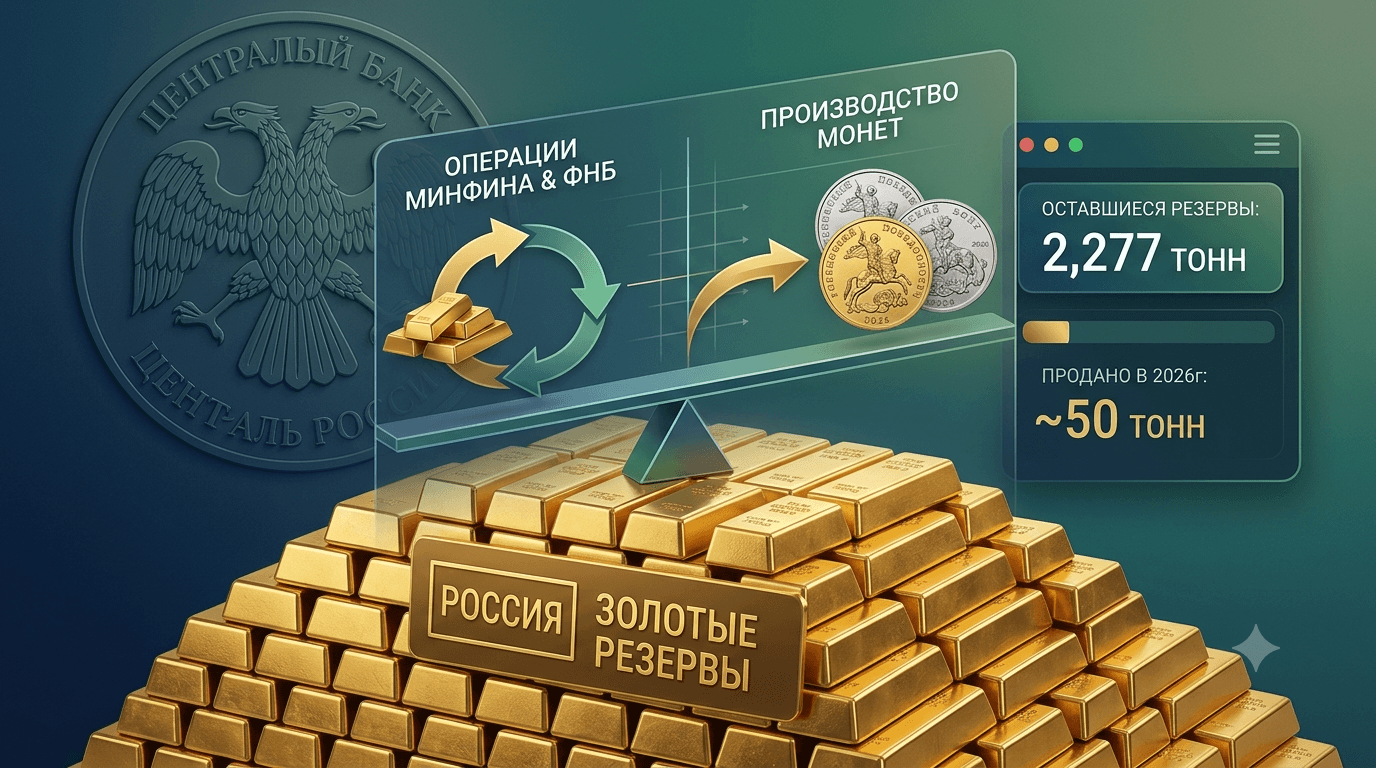
Why is a country widely regarded as one of the world’s largest gold holders reducing its reserves precisely when precious-metal prices are high? The answer came on September 11, 2026: the Bank of Russia is selling part of its gold not because of a sudden shortage of funds and not to pressure the domestic market. According to Central Bank Governor Elvira Nabiullina, the modest decline in gold reserves is mainly linked to the Finance Ministry’s operations involving National Wealth Fund assets under the budget rule, as well as the use of gold to produce coins.
According to World Gold Council data as of July 31, 2026, Russia had sold approximately 50 tonnes since the beginning of the year, including 6 tonnes in July, but still held 2,277 tonnes of gold. This represents roughly 2% of its holdings, indicating a planned adjustment of the reserve structure rather than a sell-off of national wealth.
What Exactly Did Nabiullina Say About the Gold Sales?
The main conclusion is that the Central Bank is carrying out operations provided for by the financial system rather than taking emergency measures to rescue the banking sector. Nabiullina linked the decline in gold to two areas: the budget rule and coin production. The regulator did not disclose additional details about specific transactions.
This wording is important for understanding the news correctly. The word “selling” in a headline may create the impression that the Central Bank suddenly placed a large batch of bars on the market. However, the published data describe an aggregate change in official reserves and operations related to the management of state assets. They do not confirm a scenario of panic-driven liquidation.
In the first case, gold participates in a mechanism connecting oil and gas revenues, the National Wealth Fund, and the domestic foreign-exchange market. In the second, part of the metal moves into the production process — for example, to produce investment and commemorative coins. In both cases, a decline in reported gold reserves does not mean that the entire volume was sold to private investors on an exchange.
How Is the Budget Rule Connected to Gold?
The budget rule reallocates oil and gas revenues and helps smooth the impact of commodity prices on the budget and foreign-exchange market. When actual revenues differ from projected parameters, the Finance Ministry conducts transactions involving foreign currency and gold to replenish or use National Wealth Fund assets, while the Bank of Russia mirrors these actions in the domestic market.
In simple terms, the state establishes in advance a mechanism for managing part of its oil and gas proceeds. Under favorable conditions, assets may be directed to the National Wealth Fund. When the budget needs liquidity, accumulated assets may be used. Therefore, an individual gold sale within this process is part of an established policy, not an independent decision to abandon precious metals entirely.
Recent parameters confirm that the mechanism remained active in autumn 2026. According to RBC, from September 7 to October 6, the Finance Ministry is allocating the equivalent of RUB 2.5 billion per day to purchases of foreign currency and gold, or RUB 55.6 billion for the period. This is lower than the RUB 6.5 billion per day allocated in the previous month. Kommersant also notes that the budget rule reallocates revenues from oil and gas exports that exceed the established cut-off price.
Consequently, during the same month, the state system may carry out transactions that appear in statistics as sales and transactions that appear as purchases. What matters is not an individual headline but the overall asset balance, the direction of budget flows, and the Bank of Russia’s role as the operating intermediary.
Why Is the National Wealth Fund Involved in the Operation?
The National Wealth Fund is intended to accumulate and use state financial resources, while its liquid portion can support the budget and the economy when revenues fluctuate. When the Finance Ministry decides to conduct operations involving National Wealth Fund assets, the Central Bank carries out the corresponding market actions according to the established procedure.
Nabiullina’s comments directly mention the Finance Ministry’s operations involving National Wealth Fund assets. This means that gold sales should be analyzed together with budget flows rather than treated as an isolated monetary-policy decision. The purpose of such an operation is to manage the planned redistribution of assets and liquidity.
How Much Have Russia’s Gold Reserves Declined?
The decline is significant in absolute terms but remains small relative to the total stock. The World Gold Council reports that after selling 50 tonnes since the beginning of 2026, Russia’s gold holdings stood at 2,277 tonnes; in July, the regulator sold 6 tonnes and became the largest net seller of gold among central banks that month.
Comparing 50 tonnes with 2,277 tonnes gives approximately 2.2% of the current holdings. This is an approximate share: the sales figure represents the accumulated volume of transactions since the beginning of the year, while the current reserve is the level after those transactions. Nevertheless, the scale shows that most of Russia’s gold reserve remains intact.
|
Indicator
|
Value
|
Date or period
|
|
Russia’s gold reserves
|
2,277 tonnes
|
As of July 31, 2026
|
|
Gold sales since the beginning of the year
|
Approximately 50 tonnes
|
January-July 2026
|
|
Sales in July
|
6 tonnes
|
July 2026
|
|
Accumulated sales as a share of current holdings
|
Approximately 2.2%
|
Calculation based on WGC data
|
Russia nevertheless remains one of the world’s largest official gold holders. Therefore, the phrase “the Central Bank is selling gold,” without specifying the scale, may distort the economic meaning of the event. Risk assessments should consider not only the monthly sales flow but also the volume of reserves remaining, the structure of international assets, and the objectives of budget operations.
Why Can High Prices Make a Limited Sale Rational?
A high price increases the value of each unit of gold in the reserves and gives the state an opportunity to sell a small portion of the asset under favorable conditions. This does not mean that the price has necessarily reached its final peak or that the sale represents a forecast of a market decline. It simply means that reserve management takes market conditions into account.
Therefore, a small sale at a high price can be an ordinary balance-management operation. It does not prove either that gold will soon collapse or that Russia is abandoning the long-term role of precious metals in its reserves.
Does the Central Bank Use Gold to Mint Coins?
Yes. Nabiullina specifically stated that some of the gold is used to produce coins. In that case, the metal leaves the category of bullion or reserve gold and becomes a raw material for a physical product. In reporting, this may appear as a decline in the Central Bank’s gold assets even though the metal has not disappeared from the economy.
This may involve investment coins, including the well-known “St. George the Victorious” series, as well as commemorative issues. An investment coin contains precious metal and is sold based on its metal value, weight, minting characteristics, and market premium. A commemorative coin may have additional collectible value, but its price does not always move exactly in line with the gold quotation.
This use in production explains why reserve statistics cannot automatically be interpreted as the volume of physical gold that the state sent to foreign or domestic traders. Some of the change may be related to converting metal into finished coin products.
Does Coin Minting Increase Gold Supply for the Public?
Yes. The production of investment coins expands public access to physical gold. When metal is converted into coins, individuals gain more options for purchasing small, standardized gold assets without buying a large bank bar.
However, an investment coin is not a risk-free savings product. Buyers should consider the difference between the purchase price and buyback price, fees, the condition of the item, documentation, and the terms offered by the relevant bank. A commemorative coin may be sold at a premium that is difficult to recover quickly when reselling it.
An increase in the supply of coins also does not automatically mean that gold prices in Russia will fall. The value of physical metal is determined by the international quotation, the ruble exchange rate, the seller’s premium, and manufacturing and distribution costs.
Will the Central Bank’s Sales Affect Gold Prices for Russians?
These operations do not indicate direct negative pressure on the retail price. The domestic ruble value of gold mainly depends on the international price of the metal and the ruble exchange rate, not on the Central Bank carrying out a limited transaction involving state assets under the budget rule.
The simplified formula is as follows: the ruble price of gold depends on the global quotation multiplied by the foreign-currency-to-ruble exchange rate, plus a local trading premium. If global gold prices rise, the ruble price may increase even if the ruble strengthens. If the ruble weakens, the ruble value of gold may rise even when the international quotation remains unchanged.
The state’s operations are not an attempt to deliberately crash the retail market. Moreover, coin production may increase the supply of physical gold available to citizens. This affects the availability of particular products but does not eliminate the market risk of the asset itself.
What Does This Mean for Owners of Bars, Unallocated Metal Accounts, and Coins?
For private owners, the news does not provide a direct reason to sell gold urgently. Bars, unallocated metal accounts, and coins have different pricing mechanisms and different risks, so they should not be treated as fully interchangeable instruments.
A bar provides physical ownership but requires secure storage and an inspection of its condition when resold. An unallocated metal account records metal exposure in a bank account and depends on the terms of the particular credit institution, including the fact that it does not have the same insurance as an ordinary bank deposit. A coin combines the value of the metal and, in some cases, a minting premium.
A rational analysis should consider the purpose of the purchase, the investment horizon, liquidity needs, and acceptable drawdown. A single report about the sale of 6 tonnes in July is not a substitute for an assessment of an individual’s financial position.
Do the Gold Sales Signal a Banking-System Crisis?
No. The available data do not confirm that the operations signal a banking panic or systemic crisis. Nabiullina described them as operations under the budget rule and coin production, not as an emergency liquidation of reserves to cover a mass withdrawal of funds.
A banking crisis usually produces other signals: a sharp deterioration in the liquidity of credit institutions, payment restrictions, spikes in money-market rates, emergency financing, or official measures to stabilize individual banks. A change in gold reserves alone does not prove any of these conditions.
Could Gold Sales Cause the Ruble to Fall?
A limited gold sale by itself is not a direct signal that the ruble will inevitably decline. On the contrary, the budget rule was created to smooth the impact of oil and gas revenues and reduce the severity of macroeconomic fluctuations.
The ruble exchange rate is influenced by export revenue, import demand, the balance of payments, interest rates, budget spending, business expectations, and external restrictions. Gold transactions are only one element of this system. According to RBC, in September and early October the Bank of Russia is mirroring the Finance Ministry’s operations and also conducting separate foreign-exchange operations, so the impact must be assessed based on the combined net volume.
Therefore, gold sales do not provide a simple trading signal to “buy foreign currency” or “sell the ruble.” A short-term forecast requires fresh foreign-exchange-market data, regulator statements, and the parameters of subsequent operations.
How Can a Planned Operation Be Distinguished from a Reserve Sell-Off?
A planned operation usually follows a previously announced mechanism, has a limited scale, and takes place while a significant volume of reserves remains intact. A reserve sell-off implies a sustained acceleration in sales, a lack of a clear economic explanation, and a noticeable deterioration in the state’s ability to meet its financial obligations.
The current case shows signs of the first scenario. The reasons have been stated publicly. Sales from January through July totaled approximately 50 tonnes compared with 2,277 tonnes of gold remaining. The Finance Ministry continues to conduct operations under the budget rule according to an established schedule.
At the same time, official data do not justify conclusions about the future pace of sales. The regulator explicitly said that it would not disclose additional details about the operations. Therefore, investors should use cautious language: current sales appear to be managed operations, but future developments will depend on the budget, oil and gas revenues, and decisions by the financial authorities.
How Should Investors Monitor Future Gold Operations?
Objective monitoring requires comparing four groups of data. The first is the World Gold Council’s monthly statistics and official reserve data. The second is Finance Ministry announcements about the parameters and operating period of the budget rule. The third is Bank of Russia comments on foreign-exchange and financial conditions. The fourth is the global gold price and the ruble exchange rate.
Finally, it is necessary to distinguish between a physical gold sale, a budget-rule operation, foreign-exchange mirroring, and coin issuance. These processes are connected but are not the same action. Accurate interpretation requires examining the balance of the entire operation.
Beyond the Headlines: What KuCoin 5.0 Means for You
Market news moves fast — but where you act on it matters just as much. This October, KuCoin launches KuCoin 5.0, transforming KuCoin into a rebuilt platform. Here's what actually changes for you:
-
One account for everything. Older platforms split your money across separate "spot," "margin," and "futures" accounts and expected you to understand why. KuCoin 5.0's unified account removes that entirely — deposit once, and everything is simply there.
-
Stocks, indices, and commodities. KuCoin 5.0 expands beyond crypto into global markets. When crypto chops sideways and equities rally (or the reverse), you rotate in minutes instead of opening a brokerage account and waiting days for fiat rails.
-
Real-world assets (RWA). Tokenized exposure to traditional assets like commodities, right inside your crypto account. One of the fastest-growing segments in global finance is no longer reserved for institutions — you access it from the same balance you trade with.
-
Earn while you learn. Not ready to trade? KCUSD lets your stablecoins earn daily, auto-compounding interest. The lowest-stress way to put your idle deposit to work for 4% yield.
-
An AI assistant in plain language. Ask questions, get market context, understand what you're looking at — built into the platform, no jargon required.
-
An app that doesn't overwhelm. Faster, cleaner, and consistent — intuitive from the first tap, not after a tutorial.
-
Safety you can check, not just trust. A MiCAR-licensed EU entity, Proof of Reserves you can verify yourself, and internationally certified security (SOC 2 Type II, ISO 27001:2022).
Create your account in minutes — and start on the platform built for where crypto is going, not where it's been.
Conclusion
Elvira Nabiullina explained that the modest reduction in Russia’s gold reserves is primarily connected with the Finance Ministry’s operations involving National Wealth Fund assets under the budget rule, as well as the use of gold to produce coins. This is the key answer to why the Central Bank is selling gold in 2026.
The scale of the operation remains limited. According to the World Gold Council, Russia sold approximately 50 tonnes since the beginning of the year, including 6 tonnes in July, while its gold reserves stood at 2,277 tonnes as of July 31. Accumulated sales were equivalent to approximately 2.2% of its current holdings.
The news does not confirm a scenario involving the liquidation of national reserves, a banking crisis, or an inevitable decline in the ruble. The budget rule is a pre-established mechanism for managing oil and gas revenues, foreign currency, and National Wealth Fund assets. The production of investment and commemorative coins may instead expand the supply of physical gold available to the public.
Private investors should not confuse official operations with a direct price forecast. The ruble value of gold is influenced by the international quotation, the ruble exchange rate, premiums, and the terms of the specific product. Future decisions should therefore be based on fresh data, an individual strategy, and risk assessment rather than on a single sensational headline.
Frequently Asked Questions
1. Could Russia Completely Abandon Its Gold Reserves?
No. Current data do not indicate this. After the sales made since the beginning of 2026, Russia still held 2,277 tonnes of gold as of July 31. The issue is therefore a change in part of the reserve, not a complete abandonment of gold. The future asset structure will depend on budget conditions and decisions by the financial authorities.
2. What Is the Cut-Off Price in the Budget Rule?
The cut-off price is the oil-price benchmark against which actual oil and gas budget revenues are compared. Revenue above the established benchmark may be directed to the National Wealth Fund through transactions involving foreign currency and gold. Kommersant’s report refers to a current benchmark of $59 per barrel.
3. How Does an Investment Coin Differ from a Commemorative Coin?
An investment coin is valued mainly according to its precious-metal content and is generally issued in larger quantities. A commemorative coin may have additional numismatic value determined by rarity, condition, and collector demand. Before purchasing, buyers should check the spread and the terms of the buyback.
4. Can Gold Be Considered Protection Against Inflation?
Gold is sometimes used to diversify a portfolio and protect part of its capital from monetary depreciation, but it does not guarantee constant growth. Its price can fall, while physical products involve storage, purchase, and selling costs. The effect depends on the investment horizon and the specific instrument.
5. Where Can New Data on Russia’s Reserves Be Verified?
Use publications from the World Gold Council, official statements from the Bank of Russia and the Finance Ministry, and check the date of each statistic. News summaries are useful for orientation, but important figures should be verified against primary sources, and data from different periods should not be mixed.
Disclaimer : This material is provided for informational purposes only and does not constitute financial, investment, legal, or tax advice. Transactions involving cryptocurrencies and tokenized assets carry substantial risks — including price volatility, limited liquidity, counterparty exposure, and the potential for total loss of invested capital. Readers should conduct their own research and, where appropriate, consult a qualified professional before making any financial decisions.