

When Will Cryptocurrency Trading Begin on the Moscow Exchange? Dates, Futures, and Investor Requirements
Introduction
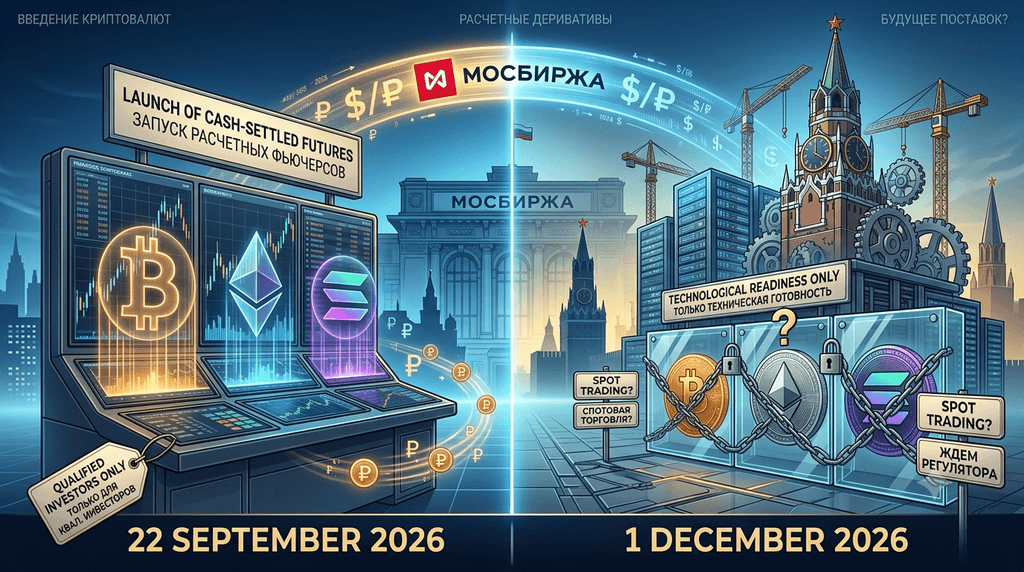
When will it actually be possible to buy cryptocurrency on the Moscow Exchange rather than merely trade on price movements? The short answer is that the first crypto instruments are expected to appear on September 22, 2026, but they will be cash-settled futures based on digital-asset indices. Full cryptocurrency trading with physical delivery has not yet been guaranteed. The exchange has announced that it will be technologically ready to work with crypto assets from December 1, 2026. However, the launch will depend on regulations that Russian authorities must adopt. Sergei Shvetsov, chairman of the Moscow Exchange supervisory board, announced this on September 16 at the Digital Finance Forum.
Therefore, September 22 marks the launch of derivative instruments, while December 1 is a target date for the technical readiness of the exchange infrastructure. For an ordinary retail investor, this does not mean immediate access to spot BTC or ETH purchases.
Which Cryptocurrency Trading Launch Dates Has the Moscow Exchange Announced?
The key date for the first transactions is September 22, 2026, but the initial products will be cash-settled futures. December 1, 2026 refers to the readiness of the technological system, not a guaranteed opening of a full cryptocurrency market.
|
Date
|
What is planned
|
What it means
|
|
September 22, 2026
|
Launch of automatically rolled, cash-settled one-day futures
|
The investor receives a profit or loss based on the index price movement, not the cryptocurrency itself
|
|
December 1, 2026
|
The Moscow Exchange becomes technologically ready for crypto-asset operations
|
The launch will depend on legislation and regulatory approvals
|
The exchange itself announced the futures launch through statements by market representatives, while TASS clarified the list of underlying indices and the investor-category restriction. At the same time, the December 1 formulation requires particular caution. Sergei Shvetsov referred specifically to the platform’s technological readiness and expressed hope that the necessary regulations would be adopted by that date.
Consequently, the headline “The Moscow Exchange Begins Cryptocurrency Trading on December 1” could mislead readers. A more accurate formulation is: “The Moscow Exchange Plans to Be Technically Ready for Cryptocurrency Trading from December 1, Provided the Regulatory Framework Is Established.”
What Will Begin on September 22: Real Coins or Paper Instruments?
On September 22, the Moscow Exchange is expected to begin trading cash-settled, automatically rolled one-day futures rather than the cryptocurrencies themselves. This means that participants receive a financial result based on index movements but do not acquire BTC, ETH, or another digital asset on the blockchain.
The initial product line will include indices for Bitcoin, Ether, Solana, Ripple, and Tron. According to TASS on September 16, 2026, the contracts will be cash-settled and available only to qualified investors [1]. The key practical feature is the absence of physical delivery: after closing a position, the investor receives the settlement result rather than coins in a wallet.
Such an instrument cannot be withdrawn to a cold wallet, sent to another address, or used in a decentralized application. Its purpose is to let participants take positions on price increases or decreases through familiar exchange infrastructure. In this sense, the first cryptocurrency trades on the Moscow Exchange will be closer to derivatives trading than to buying coins on an international crypto exchange.
Automatic rolling means that a one-day contract may be extended according to specified rules. This does not eliminate market risks. Participants must account for changes in the underlying index, margin requirements, commissions, possible gaps, and the risk of forced liquidation when available margin is insufficient.
How Does a Cash-Settled Future Differ from a Spot Purchase?
A cash-settled future provides exposure to an asset’s price but does not grant ownership of the cryptocurrency itself. In a spot purchase, the investor owns the digital asset and can generally transfer it to an external address. In a cash-settled contract, the transaction is an obligation to pay the difference between the opening and closing prices.
This distinction is especially important for beginners. If someone expects to buy Bitcoin and then withdraw it to a personal wallet, the Moscow Exchange’s September instrument does not serve that purpose. If the goal is to profit from an index rising or falling without independently storing coins, a future may be a suitable exchange-traded instrument — provided the investor has access and understands the risks.
What Does December 1, 2026 Mean?
December 1 is primarily a date for technological readiness, not an unconditional start date for spot cryptocurrency trading. The Moscow Exchange plans to prepare infrastructure that will allow crypto-asset operations within a unified position and clearing system. However, the actual launch will be possible only if the relevant regulations are in place.
ProCFA quotes Shvetsov as saying that the exchange will achieve technological readiness by December 1 and that the regulations should be issued by then. TASS also reported that the platform is awaiting regulatory decisions and expects operations to be conducted in rubles and quasi-dollars.
This creates two separate conditions. First, the exchange must prepare its trading, settlement, and brokerage systems. Second, government authorities must determine which assets, transactions, intermediaries, and custody methods are permitted on the Russian market. Fulfilling only the first condition does not turn a technical project into a guaranteed launch.
RBC reported that a law on digital currency and digital rights had been in force in Russia since September 1, 2026. The law establishes rules for digital-currency circulation and allows qualified and non-qualified investors to invest in certain digital assets subject to restrictions. However, the existence of a general legal framework does not mean that every product announced by the exchange is automatically permitted. Specific rules for access, custody, clearing, and client protection may require additional regulations.
Will Ordinary Investors Be Able to Participate?
Not at the first stage: the September futures are intended only for qualified investors. This direct restriction means that having a brokerage account alone will not give an ordinary client access to the new contracts.
A qualified investor is a client who meets established requirements relating to experience, capital, knowledge, or transaction volume. The broker verifies this status. If the client does not hold the required status, the trading terminal may not display the instrument, or the broker may reject the order.
The December stage is more complicated. Russian regulations allow non-qualified investors to participate in certain digital-asset transactions, but they impose restrictions and limits. A Bits.media report mentions an annual limit of 300,000 rubles through one intermediary, as well as the possibility that brokers may exclude non-qualified investors because technical monitoring is difficult. It is therefore too early to expect unrestricted cryptocurrency purchases.
An ordinary investor must distinguish among three questions: Is the specific instrument permitted? Does the broker allow access to it? Does the client have the required status? Even if the necessary regulations are adopted before December 1, access may be introduced in stages. The platform may initially open products to professional participants and establish conditions for non-qualified investors later.
Which Currencies Will Be Used for Settlement?
The Moscow Exchange plans to support settlement in rubles and quasi-dollars while retaining a unified position-management system. A quasi-dollar quotation means that the price may be expressed using a dollar reference, while the actual settlement takes place in rubles.
Shvetsov explained that this approach would allow foreign financial digital instruments to be denominated in dollars while keeping monetary operations within Russian infrastructure. Materials describing the exchange’s plans also mention possible settlement in rubles and quasi-dollars, including instruments linked to USDT, USDC, or a dollar index if the relevant format is permitted under market rules.
This may simplify the participant’s accounting of returns. There would be no need to constantly convert funds between foreign currency and a ruble account, while the instrument’s price would remain comparable with the international dollar market. However, a quasi-dollar is not an actual dollar and does not mean that a stablecoin will be delivered to an external wallet.
Investors must also consider the currency component. Even if a contract is settled in rubles, its underlying reference may depend on the dollar price of the crypto asset and the ruble exchange rate. As a result, the position’s return is determined not only by the movement of BTC or ETH but also by the methodology used to calculate the index.
What Will Trading Through a Broker Look Like?
The project’s main operational advantage is the ability to use a familiar brokerage terminal and a unified position. If a specific product is available through the investor’s broker, there will be no need to open a separate and complex cryptocurrency account.
A unified position means that instruments and collateral may be accounted for within a common risk-management system. In practice, the client sees positions in one account, provides collateral through an ordinary brokerage account, and receives settlement under the rules of the organized market. This could make cryptocurrency derivatives easier to understand for stock-market users.
A convenient interface does not eliminate technical or financial risks. Before trading begins, participants should review the contract specification, initial margin, trading hours, automatic-roll rules, price sources, commissions, and forced-liquidation conditions. These parameters matter more than the mere appearance of a ticker in the terminal.
Spot trading would require additional solutions for the custody and accounting of digital assets. RBC quoted Shvetsov as saying that the Moscow Exchange would not be able to create its own crypto depository and would work with partner custodians proposed by brokers or independent organizations. As a result, custody risk will remain a separate issue even when trading takes place through regulated infrastructure.
Will the Exchange Model Protect Against the Risk of a Bank Account Freeze under Federal Law No. 115-FZ?
Trading through the Moscow Exchange and a licensed broker may substantially reduce the risk of banking-transfer problems associated with some P2P operations, but it would be incorrect to promise that it completely eliminates risks under Federal Law No. 115-FZ. Funds would move through a formal brokerage and settlement framework rather than through numerous transfers between private individuals on an overseas platform.
This is the practical advantage of the regulated model: the client uses a brokerage account, is identified by a financial institution, and conducts transactions within a controlled infrastructure. This may reduce the likelihood that an ordinary bank transfer connected with P2P exchange will be classified as suspicious.
However, Federal Law No. 115-FZ requires banks and financial institutions to identify suspicious transactions. An exchange-based format does not create absolute immunity. A broker may request documents proving the source of funds, suspend a transaction, or apply internal compliance procedures. It is therefore more accurate to describe the model as a transition to a more transparent and documentable trading channel, not as a complete bypass of banking controls.
Crypto assets also retain custody, cybersecurity, and regulatory risks. Shvetsov specifically discussed concerns about custodian reliability, responsibility for stolen assets, blocking, and the so-called tainting of cryptocurrency by analytics services. A regulated brokerage framework does not resolve all of these issues.
What Risks Will Remain After the Launch?
The main risk is regulatory uncertainty. If the necessary documents are not adopted before December 1, the Moscow Exchange’s technical readiness alone will not allow all planned operations to begin. The possible outcomes include postponed deadlines, a limited list of assets, or a launch restricted to certain client categories.
The second risk is insufficient liquidity. According to Shvetsov, if the market is divided among numerous independent liquidity centers, the overall order volume will become fragmented. For investors, this could mean wider spreads, slippage, and more expensive entry or exit.
The third risk is a mismatch between the exchange price and the international market. An index may be calculated using a specific basket of venues and a defined methodology. During periods of high volatility, the futures price may diverge from quotations on overseas cryptocurrency exchanges.
The fourth risk concerns the custody and accounting of digital assets if physically delivered products appear. RBC noted that market participants lack an independent assessment of the operational reliability of crypto depositories. Until clear standards emerge, clients will need to determine for themselves who is responsible for custody, keys, cybersecurity, and compensation for losses.
How to Buy or Trade Crypto Instruments on KuCoin
KuCoin may serve as a separate cryptocurrency platform for users who need access to spot and derivative instruments, but trading conditions, product availability, and client requirements depend on the user’s jurisdiction and the platform’s current rules. Before registering, users should check regional restrictions, identity-verification requirements, and applicable risk-management rules.
If the objective is to gain exposure to BTC, ETH, SOL, XRP, or TRX, the investor should first determine whether a real asset, a cash-settled contract, or a future is needed. An actual coin involves custody and transfers. A derivative allows the user to trade price movements but can lead to accelerated losses when borrowed funds are used.
For comparison with the Moscow Exchange, it is important to consider more than commissions. Users should check withdrawal availability, pair liquidity, the liquidation mechanism, account security, and tax obligations. The Russian exchange model may be more convenient for ruble settlement, while a cryptocurrency platform generally offers more trading pairs and products but requires a separate understanding of custody and transfer risks.
Beyond the Headlines: What KuCoin 5.0 Means for You
Market news moves fast — but where you act on it matters just as much. This October, KuCoin launches KuCoin 5.0, transforming KuCoin into a rebuilt platform. Here's what actually changes for you:
-
One account for everything. Older platforms split your money across separate "spot," "margin," and "futures" accounts and expected you to understand why. KuCoin 5.0's unified account removes that entirely — deposit once, and everything is simply there.
-
Stocks, indices, and commodities. KuCoin 5.0 expands beyond crypto into global markets. When crypto chops sideways and equities rally (or the reverse), you rotate in minutes instead of opening a brokerage account and waiting days for fiat rails.
-
Real-world assets (RWA). Tokenized exposure to traditional assets like commodities, right inside your crypto account. One of the fastest-growing segments in global finance is no longer reserved for institutions — you access it from the same balance you trade with.
-
Earn while you learn. Not ready to trade? KCUSD lets your stablecoins earn daily, auto-compounding interest. The lowest-stress way to put your idle deposit to work for 4% yield.
-
An AI assistant in plain language. Ask questions, get market context, understand what you're looking at — built into the platform, no jargon required.
-
An app that doesn't overwhelm. Faster, cleaner, and consistent — intuitive from the first tap, not after a tutorial.
-
Safety you can check, not just trust. A MiCAR-licensed EU entity, Proof of Reserves you can verify yourself, and internationally certified security (SOC 2 Type II, ISO 27001:2022).
Create your account in minutes — and start on the platform built for where crypto is going, not where it's been.
Conclusion
The Moscow Exchange has named two dates that should not be confused. On September 22, 2026, it plans to launch cash-settled, automatically rolled one-day futures based on indices for Bitcoin, Ether, Solana, Ripple, and Tron. These instruments do not provide the underlying coins and are intended only for qualified investors. On December 1, 2026, the exchange expects to achieve technological readiness for broader crypto-asset operations, but this date does not guarantee the beginning of full spot trading.
The actual launch will depend on regulations, the list of permitted instruments, and decisions by brokers. Planned settlement in rubles and quasi-dollars, unified positions, and trading through a familiar brokerage terminal may simplify market access. They do not eliminate volatility, low-liquidity risk, custody problems, or compliance checks. Exchange infrastructure may reduce the risks associated with P2P transfers and make transactions more transparent, but it does not provide absolute protection against account freezes under Federal Law No. 115-FZ. Investors should therefore view the September launch as the beginning of regulated crypto derivatives, while treating the December date as a conditional milestone for technical readiness.
Frequently Asked Questions
1. Will cryptocurrency be withdrawable after buying a futures contract on September 22?
No. The first contracts will be cash-settled, so after closing a position the investor will receive a monetary result rather than BTC, ETH, or another coin at a blockchain address.
2. Which cryptocurrencies will be represented in the initial product line?
The first indices are expected to be based on Bitcoin, Ether, Solana, Ripple, and Tron. These are indices, not direct purchases of the five cryptocurrencies.
3. Is an ordinary brokerage account enough to participate?
No. The September futures are intended only for qualified investors. Access to future products after December 1 will depend on legislation, broker rules, and the client’s status.
4. Is December 1 an official guarantee that trading will begin?
No. It is the Moscow Exchange’s announced date for technological readiness. Actual operations will depend on whether regulators adopt the necessary regulations in time.
5. Can a quasi-dollar be treated as a real dollar or USDT?
No. A quasi-dollar quotation means a dollar reference combined with settlement in rubles. It is not the same as receiving actual dollars or stablecoins and does not give the holder the right to withdraw USDT or USDC to an external wallet.
Disclaimer : This material is provided for informational purposes only and does not constitute financial, investment, legal, or tax advice. Transactions involving cryptocurrencies and tokenized assets carry substantial risks — including price volatility, limited liquidity, counterparty exposure, and the potential for total loss of invested capital. Readers should conduct their own research and, where appropriate, consult a qualified professional before making any financial decisions.