

What Crypto Operations Are Permitted in Russia From September 1, 2026? Rules for Investors, Businesses, and Overseas Transfers
2026/08/24 14:29:00
Introduction
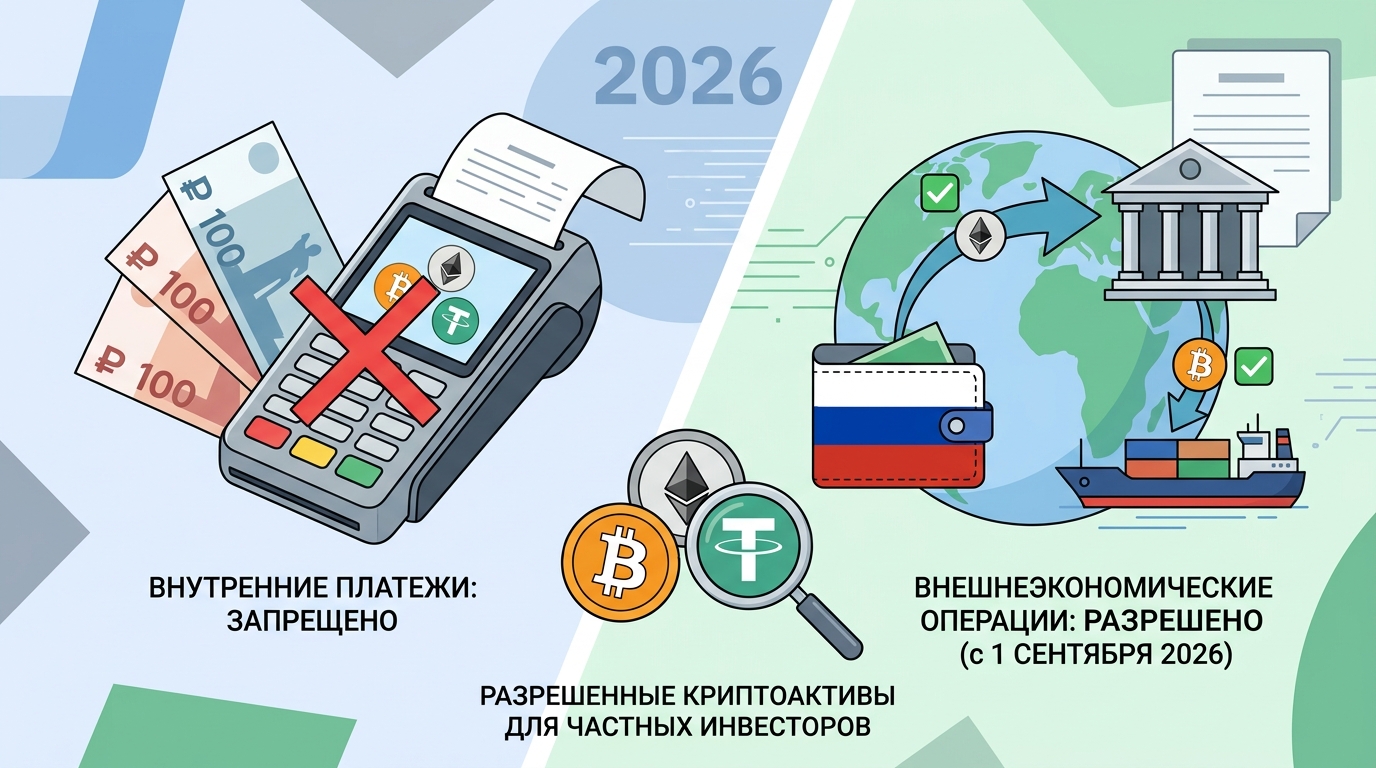
From September 1, 2026, cryptocurrency in Russia will have a clearer legal framework, but it will not become a substitute for the ruble. The main answer is simple: Russian citizens, sole proprietors, and companies will be able to buy permitted assets and use cryptocurrency in lawful foreign economic transactions, including transfers to their own overseas wallets and payments for goods or services to non-residents. However, paying with Bitcoin for purchases, apartment rent, or services within Russia will remain prohibited. The law on digital currencies takes effect on September 1 and establishes their status as property rather than an internal means of payment.
The new rules matter not only to traders. They define which coins are available to non-qualified investors, who controls an overseas transfer, why the 300,000-ruble limit should not be treated as a universal prohibition, and why a direct exchange of cryptocurrency for shares remains impermissible.
What Exactly Changes on September 1, 2026?
From September 1, cryptocurrency becomes regulated property subject to rules on purchase, custody, transfers, and judicial protection of the owner’s rights. Federal Law No. 282-FZ creates a comprehensive framework for the circulation of digital currencies and digital rights, with its main provisions taking effect on September 1, 2026. The practical significance of the change is not that cryptocurrency can now be used to pay everywhere, but that the state is establishing controlled infrastructure for crypto operations.
The Bank of Russia receives authority to admit, regulate, and supervise professional market participants. This framework includes exchanges, brokers, crypto exchangers, asset managers, and digital depositories. As a result, a lawful operation will be assessed not only by the asset itself, but also by the participants involved, the purpose of the transfer, customer identification, and compliance with financial-control requirements.
For a digital-asset holder, this means a clearer legal trail. Cryptocurrency may be the subject of transactions and property rights, but operations do not become anonymous by default. According to RIA Novosti on August 23, 2026, banks will be able to see the payment purpose and reject an operation that does not comply with the law.
Why Does September 1 Not Mean Full Freedom for Crypto Operations?
The law’s start date does not remove existing restrictions or make every crypto transfer permissible. The law distinguishes operations by their purpose, the customer’s status, and the infrastructure used. Domestic crypto settlements are prohibited, while foreign economic operations are allowed subject to specific requirements.
In addition, certain technical and organizational rules may be introduced in stages. For example, on August 11, the Bank of Russia published a draft directive for public consultation on cryptocurrency purchases by non-qualified investors. This matters when assessing any attention-grabbing headline: a draft regulation, an enacted law, and an individual intermediary’s decision are not the same document.
Can You Pay With Cryptocurrency for Goods, Rent, and Services Within Russia?
No. In Russia, cryptocurrency cannot be used to pay for goods, works, services, or residential rent because the ruble remains the country’s lawful means of payment for domestic transactions. The law does not make digital currency a means of payment within the country; even after September 1, you cannot buy goods in a Russian store or transfer cryptocurrency to a Russian landlord as rent.
This rule applies to both personal and commercial settlements. It does not matter whether a transfer is called a “payment,” “compensation,” “deposit,” or a “settlement between acquaintances”: if its economic substance is payment in cryptocurrency for goods, works, or services in Russia, it violates the prohibition. Renaming the payment does not change its nature.
The prohibition also means that a seller should not advertise the acceptance of cryptocurrency as a method of payment within the country. Parties may first enter into a contract denominated in rubles, but directly transferring a digital asset instead of making a ruble payment does not become permitted because of wording in correspondence or the existence of a foreign wallet.
|
Situation from September 1, 2026
|
Basic status
|
Key consideration
|
|
Paying for a purchase or rent in Russia with BTC, ETH, or USDT
|
Prohibited
|
Domestic settlements must be made in rubles.
|
|
Buying an available cryptocurrency through a regulated framework
|
Permitted subject to requirements
|
Investor category, testing, and intermediary controls are required.
|
|
Transferring cryptocurrency to your own overseas wallet
|
Permitted subject to requirements
|
The purpose and route may be reviewed by the bank and market infrastructure.
|
|
Paying a foreign seller or non-resident supplier
|
Permitted as a foreign economic transaction subject to requirements
|
Currency-control and AML/CFT procedures apply.
|
|
Directly exchanging cryptocurrency for securities
|
Not permitted
|
The bill directly prohibits offering such an exchange.
|
Can You Transfer Cryptocurrency Abroad and Shop at Foreign Stores?
Yes. Subject to foreign-economic-activity requirements, cryptocurrency may be transferred to your own wallet abroad or sent to a non-resident as payment for foreign goods and services. The Bank of Russia has clarified that both qualified and non-qualified investors may use this option if they meet the established requirements.
The distinction between the domestic and foreign spheres is fundamental. If a citizen pays for a foreign subscription, consulting service, software, or purchase from an overseas store, the operation is not treated in the same way as payment for an equivalent service to a Russian seller. The same logic applies to foreign-trade contracts for sole proprietors and legal entities: settlements in digital currencies and stablecoins may be used in foreign economic activity.
Who Can Conduct a Foreign Economic Transaction Using Digital Currency?
Foreign economic transactions involving cryptocurrency are available to individuals, sole proprietors, and legal entities, but this access does not exempt them from transaction reviews. According to an explanation published by RIA Novosti on August 23, 2026, the rule concerns foreign economic activity specifically, not permission to make crypto payments within Russia.
For an individual, this may mean a transfer to their own overseas wallet or payment to a non-resident. For a business, it may mean settlement under a foreign-trade contract with an overseas counterparty. In both cases, the participant must be prepared to confirm the economic purpose of the operation and provide information about the recipient. The Bank of Russia states that such settlements will be subject to standard currency-control and anti-money-laundering procedures.
Why Can a Bank or Intermediary Reject a Transfer?
A bank or regulated participant may refuse to process an operation that does not comply with the law or fails the necessary reviews. This is not a harmless technical delay, but part of the new control regime: banks assess the purpose of the payment, while a Russian crypto service provider may also request the purpose of a withdrawal.
For this reason, documents explaining the purpose of an operation should be prepared before a transfer is made. For a foreign-trade payment, these may include a contract, invoice, description of the goods or service, and the counterparty’s details. For a transfer to your own wallet, it is important that the address, transaction trail, and source of funds do not create inconsistencies during a review. This approach does not guarantee automatic approval, but it reduces the risk that an operation will be stopped because of incomplete information.
Which Cryptocurrencies Can a Non-Qualified Investor Buy?
At the launch of public circulation, Bitcoin, Ethereum, and Tether USDT are available to non-qualified investors subject to the established requirements. The Bank of Russia included these three assets in the list based on market-capitalization criteria, average daily trading volume, and at least five years of pricing history on foreign platforms.
This list does not mean that BTC, ETH, and USDT are risk-free. The regulator explained that limited access is intended to protect non-qualified investors from sharp and unpredictable price swings. Even the most liquid coins can lose value quickly, while a stablecoin carries its own issuer, liquidity, regulatory, and counterparty risks.
Is Testing Required Before Buying Cryptocurrency?
Yes. Before entering into a transaction, all investors, regardless of status, must complete testing and familiarize themselves with the risks of investing in crypto assets. This follows directly from the Bank of Russia’s notice of August 11, 2026.
Testing is not a forecast of returns and does not replace a personal risk assessment. Its purpose is to verify that a customer understands the basic characteristics of digital assets, including volatility, custody features, the risk of losing access, and the absence of guaranteed returns. Passing the test also does not give a customer the right to disregard platform, bank, or currency-control requirements.
What Is Available to a Qualified Investor?
A qualified investor gains access to a broader range of digital currencies without a monetary cap, but this access is not permission to buy any token anywhere. The Bank of Russia has stated that this category will be able to purchase cryptocurrencies traded on exchange and over-the-counter markets without amount limits.
There may nevertheless be exceptions for assets that the regulator or a Russian platform does not admit to circulation. In particular, an expert comment for RIA Novosti mentions a possible ban on privacy coins on Russian platforms. Therefore, qualified-investor status removes some investment restrictions, but it does not override prohibitions on a specific asset, source-of-funds checks, or a market participant’s internal rules.
Is It True That There Is a General Annual Limit of 300,000 Rubles for Buying Cryptocurrency?
No. It is incorrect to interpret 300,000 rubles as a single final limit on all cryptocurrency purchases for every Russian resident. Two different contexts are being conflated here: a rule on digital rights for an investor who has not completed testing, and a separate Bank of Russia draft directive on cryptocurrencies. This confusion has produced the simplified claim that there is a universal annual prohibition.
The Bank of Russia did state on August 11, 2026, that under a draft directive published for consultation, a non-qualified investor would be able to purchase crypto assets worth up to 300,000 rubles per year from each intermediary — a broker, crypto exchanger, or asset manager. This wording is important for two reasons. First, it concerns a draft directive rather than a simple universal figure that can be applied without reading the document. Second, the limit is described in relation to each intermediary, not as a single lifetime or market-wide balance across all services.
In a comment on August 23, expert Alexey Korolenko separately stated that the 300,000 rubles mentioned in the law relates to digital rights when testing has not been completed, while the specific limit for non-qualified cryptocurrency buyers must be set by a separate Bank of Russia act. Therefore, it is more accurate to follow the final version of the Bank of Russia’s act and the terms of a particular intermediary rather than treat a social-media retelling as a complete rule.
No. You may not offer a direct exchange of cryptocurrency for securities. An explanation given to RIA Novosti notes that the bill contains an explicit prohibition on offering an exchange of cryptocurrency for securities. This restriction separates the circulation of digital currencies from transactions that disguise the purchase of shares, bonds, or other instruments through a crypto exchange.
In practice, it is important to distinguish an independent sale of a crypto asset from a direct barter arrangement. Selling cryptocurrency through a permitted framework and then conducting a separate lawful transaction in rubles is not the same as offering a counterparty tokens directly in exchange for shares. The latter falls under the prohibition on offering a direct exchange.
Digital currency and digital rights should not be viewed as interchangeable terms either. The new framework regulates both objects, but different requirements, tests, and limits may apply to them. This confusion of concepts is one reason why the 300,000-ruble figure has been interpreted incorrectly.
How Should You Prepare for a Lawful Cryptocurrency Operation?
A lawful operation begins with checking its purpose, the participant’s status, and the selected infrastructure — not by sending coins to the first address you find. Before buying or transferring cryptocurrency, determine whether the action is an investment, a domestic payment, or a foreign economic settlement. If it is a payment within Russia, the crypto operation cannot be carried out. If it is for a foreign-trade purpose, prepare supporting documents in advance.
Next, verify your investor category and the intermediary’s requirements. A non-qualified investor should rely on the available list of BTC, ETH, and USDT, complete the required testing, and consider the current version of applicable limits. A qualified investor will also need testing and compliance with platform rules, even though the selection of assets and limits may be broader.
Finally, assess not only the asset’s price, but also the risks associated with the transfer route. Confirm the network fee, recipient address, blocking rules, source-of-funds verification requirements, and whether the transaction can be reversed. Blockchain transactions are generally irreversible: an error in the address, network, or stated purpose can result in a loss of funds or an extended review.
How to Buy BTC, ETH, or USDT on KuCoin Under the New Rules?
Buying cryptocurrency on KuCoin first requires confirming that your chosen funding method, trading pair, and services are available in your jurisdiction and do not conflict with Russian requirements. KuCoin does not replace a check of the law, currency-control rules, or bank requirements: the platform is a trading tool, while the legality of a particular operation depends on its purpose, the customer’s status, and the payment route used.
Start by registering an account and completing the identity verification required by the platform. Then enable two-factor authentication, create a unique password, and set up anti-phishing protection in advance. Do not transfer funds through links in messages, and always verify the domain, network, and wallet address.
For an initial trade, it is prudent to use a small amount consistent with your risk plan and choose the spot market rather than borrowed instruments. If you are a non-qualified investor, consider Russian requirements concerning testing, the available asset list, and applicable limits. When planning an overseas withdrawal, make sure that the operation is genuinely connected with a permitted foreign economic purpose and that the required documents are ready for a possible review.
KuCoin provides tools to buy, exchange, and hold digital assets, but it does not guarantee returns or eliminate market risk. Before trading, review the platform’s current notices and the Bank of Russia’s official guidance. Cryptocurrencies are volatile, so a decision to buy should be based on your own understanding of the risks, not on expectations of rapid price appreciation.
KuCoin Offers A More Stable Option in A Volatile Market
If you worry about the frequent ups and downs in the market, and pursue a more stable option to earn money passively, KuCoin is the right place to come:
Simple Earn: Deposit and withdraw tokens anytime, earning stable returns.
Kucoin Earn: Earn stable profits with professional asset management.
Hold to Earn: Earn rewards by holding assets in Funding, Trading, Margin, Futures, Mining, and Unified Accounts.
Staking: Unlock the earning potential of on-chain assets.
Advanced Investments: Advanced Investments offer a variety of structured products to help your money grow in any market.
Shark Fin: Principal Protection and Guaranteed Gains
Dual Investment: Buy low and sell high with transparent return calculations.
Snowball: High yields, with price protection.
Discount Buy: Buy crypto at discount prices.
KCS Loyalty: Level up to enjoy exclusive perks by staking ≥ 1 KCS.
KuCoin Wealth: Discover future value and begin your smart investing journey.
KCS Benefits: Hold and stake KCS to access benefits across the platform.
KCS Staking 2.0: Participate in KCS on-chain governance to earn yield.
Conclusion
From September 1, 2026, Russian residents will have clearer rules for using cryptocurrency, but not the right to use it for payments within the country. The central boundary remains unchanged: goods, rent, and services in Russia must be paid for in rubles. At the same time, individuals, sole proprietors, and companies will be able to use digital assets in foreign economic operations, including transfers to their own overseas wallets and payments to non-residents, subject to control requirements and confirmation of the operation’s purpose.
For non-qualified investors, Bitcoin, Ethereum, and Tether USDT are the key reference assets, and testing is required before a transaction. The 300,000-ruble figure should not be viewed as a simple, unconditional ceiling for all operations: it is important to distinguish the rule on digital rights, the Bank of Russia’s draft directive, and the limit applicable to each intermediary. Qualified investors receive broader access, but they must also consider platform requirements, potential restrictions on assets, and financial controls.
A prudent approach is to first identify the purpose of the transaction, select the appropriate infrastructure, and prepare supporting documents. The new regulation makes the crypto market more transparent, but it does not eliminate volatility, technical risks, or the obligation to follow the rules.
Frequently Asked Questions
1. Can I send USDT to a Russian friend after September 1 as payment for their services?
No. If the transfer is payment for a service provided within Russia, cryptocurrency cannot be used, regardless of whether the recipient is an acquaintance, a sole proprietor, or a company. Domestic settlements must be made in rubles.
2. Is it permitted to hold Bitcoin in my own overseas wallet?
Transferring cryptocurrency to your own wallet abroad is permitted if the established requirements are met. A bank, intermediary, or market infrastructure provider may request information about the purpose of the transfer, the address, and the source of funds.
3. Why is USDT on the list if it is a stablecoin?
The Bank of Russia selected Bitcoin, Ethereum, and Tether USDT according to capitalization criteria, average daily trading volume, and at least five years of pricing history on foreign platforms. Inclusion on the list does not eliminate USDT’s issuer and liquidity risks.
4. Can I buy another cryptocurrency if I am not a qualified investor?
For public circulation, the Bank of Russia identified BTC, ETH, and USDT as available to non-qualified investors. The purchase of other assets depends on final regulatory rules, the investor’s status, and whether the asset is permitted on the selected platform.
5. What should I do if a bank requests documents for an overseas crypto transfer?
Provide truthful evidence of the transaction’s economic purpose, such as a contract, invoice, description of the goods or service, and the counterparty’s details. Standard currency-control and AML/CFT procedures apply to foreign economic settlements.
Disclaimer : This material is provided for informational purposes only and does not constitute financial, investment, legal, or tax advice. Transactions involving cryptocurrencies and tokenized assets carry substantial risks — including price volatility, limited liquidity, counterparty exposure, and the potential for total loss of invested capital. Readers should conduct their own research and, where appropriate, consult a qualified professional before making any financial decisions.