

VTB Raises Long-Term Deposit Rates: Terms, Returns, and Market Comparison as of September 16, 2026
Introduction
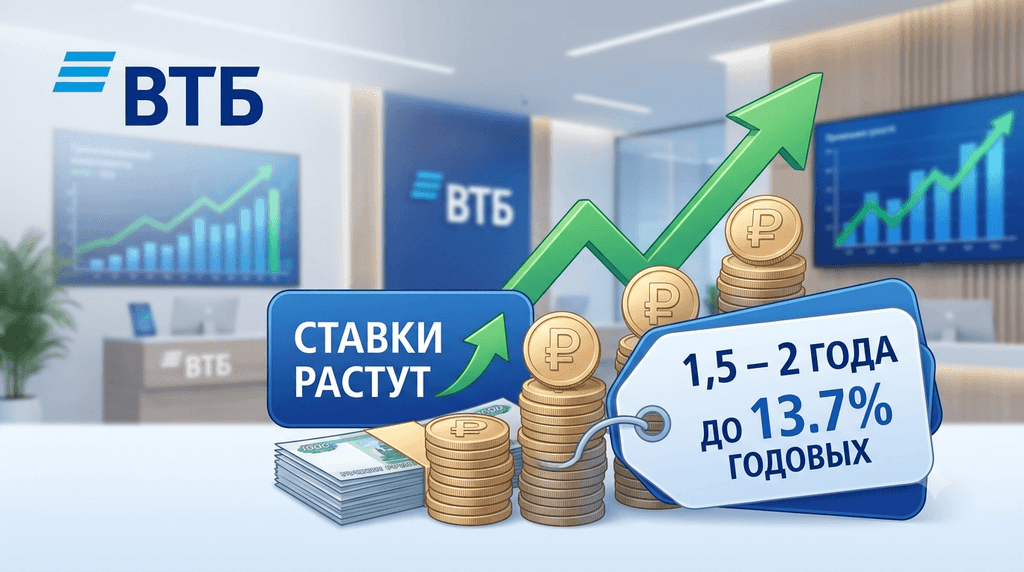
Where should you put your money if deposit rates may start to decline? As of September 16, 2026, VTB increased the returns on its ruble-denominated “VTB Deposit” product for terms ranging from one to two years. For standard retail customers, the maximum rate is now 13.7% per year for an 18-month deposit, while the two-year option offers 13.5%. According to RBC, the most significant increase applies to the two-year term, which rose by 2.4 percentage points.
Shorter terms became slightly less attractive: the rate for three, four, and six months fell to 13.4%. VTB also offers up to 14.2% per year on its savings account, although this figure depends on the product terms and does not represent guaranteed long-term returns. This article examines VTB’s new rates, customer requirements, potential returns, the bank’s position relative to competitors, and the risks of locking up funds for 18–24 months.
Which VTB rates changed on September 16, 2026?
The main result of the update is that VTB made longer terms more profitable than before. For a standard retail customer, the rate on an 18-month deposit increased by 1.2 percentage points to 13.7% per year. The rate on a two-year deposit rose by 2.4 percentage points to 13.5%. The one-year rate increased by 0.5 percentage points to 13.5%. These figures apply to the updated “VTB Deposit” product and have been effective since September 16, 2026, according to the bank’s revised tariffs reviewed by RBC.
|
Deposit term
|
Rate change
|
New rate for retail customers
|
|
3, 4, or 6 months
|
minus 0.1 pp
|
13.4% per year
|
|
1 year
|
plus 0.5 pp
|
13.5% per year
|
|
1.5 years
|
plus 1.2 pp
|
13.7% per year
|
|
2 years
|
plus 2.4 pp
|
13.5% per year
|
The highest standard return is available not for the longest term, but for 18 months. For Privilege customers, the rate for this term reaches 13.8%, while Private Banking customers can receive 13.9%. According to VTB’s press service on September 16, the maximum rate on its savings account is 14.2% per year.
What conditions apply to the maximum rate?
The maximum rate is not automatically available to every customer. The customer’s status, source of funds, and application method all matter. According to RBC, the enhanced standard terms are intended for new customers or new money when the deposit is opened online.
A new customer is defined as someone who has not held a deposit or savings account with VTB during the previous six months. New money means funds that have not been held in VTB accounts or deposits during the previous three months. The funds retain their new-money status until the end of the day, at 11:59 p.m. Moscow time. This definition has practical consequences: transferring money from one personal VTB account to another may not qualify for the bonus if the bank considers the funds to have been previously deposited.
The minimum deposit is 10,000 rubles when opened online and 50,000 rubles when opened at a branch. RBC reports that the additional yield is fixed for the entire deposit term. This reduces the risk that the bank will change the advertised rate after the funds are deposited, but it does not eliminate the need to read the agreement, tariff, and early-withdrawal terms carefully.
Customers may also increase their return through additional eligibility criteria. Receiving a salary or pension through VTB can provide a bonus of up to 1.1 percentage points. Participation in the “Grow with VTB” loyalty program may add up to 0.5 percentage points, while a “VTB Plus” subscription may add up to 0.3 percentage points. The maximum bonus depends on the specific combination of conditions, so advertised bonuses should not be added together without verification.
What should you check before opening the deposit?
Before transferring funds, check four points. First, determine whether you qualify as a new customer or meet the new-money requirement. Second, confirm that the selected rate is available specifically for online applications. Third, check whether deposits can be topped up, partially withdrawn, or renewed automatically. Fourth, determine how the return changes if the deposit is closed early.
Why did VTB raise rates specifically for longer terms?
VTB’s decision suggests that the bank wants to attract more stable funding for 18–24 months. Roman Shaekhov, deputy head of VTB’s retail business division, explained that the increase is intended to help customers lock in still-high savings returns and avoid future market fluctuations. According to him, the strategy is particularly suitable for people who are not planning major purchases and intend to continue saving over the long term.
The macroeconomic environment makes this strategy understandable. On September 11, 2026, the Bank of Russia kept its key interest rate at 14% per year. RBC reported that the regulator also noted stronger price pressures and an acceleration in sustained annualized price growth to 5–6%. While the key rate remains high, banks compete for depositors’ funds while also assessing the possibility of future rate cuts.
VTB forecasts that household funds held by Russian banks will reach 71 trillion rubles by the end of 2026. Published on September 16, this forecast illustrates the scale of competition for retail liquidity. The increase in long-term deposit rates can be interpreted as an attempt to secure the bank’s funding base ahead of a possible change in the monetary policy cycle. This is an economic interpretation, not an official promise that the key rate will decline.
The choice of longer terms is also a signal to customers. The bank did not merely improve a short-term promotional offer; it made the largest increase available on the two-year deposit. At the same time, the rate for three to six months declined by 0.1 percentage points. This tariff structure encourages customers to consider locking in returns now rather than waiting for the regulator’s next decision.
How competitive are VTB’s new rates compared with the market?
VTB’s long-term offers are above average levels, but they are not the unconditional market leader for every term. According to RBC’s monitoring on September 16, 2026, the average maximum rate among the 10 largest banks was 12.35% per year for a one-year deposit. The average rate was 13.40% for three months and 13.22% for six months.
Against this background, VTB’s one-year rate of 13.5% is approximately 1.15 percentage points above the average maximum rate among the top 10 banks. The rates of 13.7% for 18 months and 13.5% for two years also appear competitive, since the monitoring did not provide a separate comparable market average for those terms. However, an advertised VTB rate should not be compared mechanically with another bank’s offer without checking the deposit amount, customer status, capitalization rules, and new-money requirement.
|
Offer as of September 16, 2026
|
Term
|
Rate
|
|
VTB Deposit for a retail customer
|
1.5 years
|
13.7%
|
|
VTB Deposit for a retail customer
|
2 years
|
13.5%
|
|
PSB, highest offer in RBC’s monitoring
|
1 year
|
13.9%
|
|
Dom.RF, highest offer in RBC’s monitoring
|
3 months
|
14.4%
|
|
Alfa Bank, special deposit for salary customers
|
Not stated as a comparable standard term
|
Up to 20%
|
RBC separately noted that PSB offered 13.9% for one year, while Dom.RF offered 14.4% for three months. Alfa Bank launched a special offer for salary customers with a return of up to 20%. These options may exceed VTB’s rates, but they apply to different terms or special customer categories.
How much can you earn with a VTB deposit?
The approximate return depends on the amount deposited and the term. For example, at a rate of 13.7% per year, a deposit of 100,000 rubles for 18 months produces an estimated return of about 20,550 rubles before accounting for the method of interest calculation, tax treatment, and the specific contract terms. This estimate uses a simple formula: 100,000 multiplied by 0.137 and by 1.5 years. The actual amount may differ if interest is capitalized, paid monthly, or calculated based on the exact number of days.
For 500,000 rubles, the same estimate is approximately 102,750 rubles over 18 months. At a rate of 13.5% for two years, the estimated return is about 27,000 rubles on 100,000 rubles and approximately 135,000 rubles on 500,000 rubles. The main advantage of fixing the rate is predictability. If market rates decline, an existing deposit will continue to earn the agreed return. The main disadvantage is reduced flexibility. If the money is needed for a home purchase, renovation, or loan repayment, early withdrawal may significantly reduce the return.
A savings account is more flexible because customers can usually withdraw money without closing a fixed-term deposit. However, the advertised 14.2% annual rate should not be treated as equivalent to a guaranteed two-year deposit rate. Savings-account returns may depend on the balance, account activity, subscription, and current tariff terms. The customer must decide which matters more: liquidity or fixed returns.
Who is a long-term VTB deposit suitable for?
An 18-month deposit is suitable for a customer who wants a fixed ruble return and has a separate reserve for everyday expenses. This term offers the highest standard rate of 13.7% per year while being shorter than two years, creating a relatively balanced compromise between return and access to funds.
A two-year deposit is suitable for someone prepared to leave the money untouched for a longer period. Although its 13.5% rate is slightly below the 18-month maximum, it provides a longer period of fixed terms. This option may be reasonable if the customer expects rates to decline and does not want to reinvest the funds after one year or 18 months.
A short-term deposit is suitable for a depositor who expects market conditions to change, is planning a major expense, or wants to retain the ability to reinvest the money quickly. Even after falling to 13.4%, VTB’s three-to-six-month rate remains significant, but it does not provide the same protection against future declines in returns as the 18-month product.
A long-term deposit is not suitable for an emergency reserve. An emergency fund should remain accessible without a penalty-related recalculation of interest. Customers should also avoid placing all their capital in a single term. A deposit ladder — distributing funds across several maturity dates — reduces the risk of losing liquidity and provides regular access to part of the savings.
What risks should you consider?
The main risk is early termination. Even a high rate does not guarantee the expected return if the agreement is closed before the scheduled maturity date. The decision should therefore be made only after setting aside the amount that may be needed during the next 18–24 months.
The second risk is inflation. A nominal annual rate of 13.7% shows the contractual interest accrual, but real purchasing power depends on the pace of price growth. On September 11, RBC noted that sustained annualized price growth had accelerated to 5–6%, although future inflation may change. A deposit protects against part of the uncertainty but does not eliminate inflation risk completely.
The third risk is misunderstanding the requirements for the maximum rate. New money, new-customer status, online application, salary status, and loyalty programs may be mandatory or alternative requirements. An advertised “up to” rate does not mean that every customer will receive it. The exact available rate should be checked in the customer’s personalized offer.
The fourth risk is concentration of funds. A deposit is a banking product rather than an investment subject to market-price fluctuations, but it is still sensible to distribute a large amount while considering deposit-insurance limits and one’s personal financial situation. Customers with substantial savings should verify the current deposit-insurance rules rather than making a decision based only on a news headline.
How can you open a VTB deposit with the enhanced rate?
The easiest way to maximize the chance of receiving the advertised rate is to open the deposit online, provided that the customer meets the new-customer or new-money requirements. First, log in to the VTB mobile app or online bank, check the personalized offer, select an 18- or 24-month term, enter the amount, and carefully read the product details.
Next, check the maturity date, interest-payment method, renewal terms, top-up availability, and consequences of early closure. If the rate depends on salary or pension status, the “Grow with VTB” program, or “VTB Plus,” confirm that the relevant bonus is included in the calculation. Customers opening the deposit at a branch should account for the minimum amount of 50,000 rubles, compared with 10,000 rubles online.
How should you choose between 18 and 24 months?
If the priority is the highest rate for a standard customer, compare the 18-month term with the two-year offer: 13.7% versus 13.5% per year. If the priority is to lock in the conditions for the longest possible period, the two-year option may be more convenient. If the money may be needed earlier, neither term should be used for the entire amount.
Conclusion
As of September 16, 2026, VTB increased the rates on its long-term ruble-denominated “VTB Deposit” product. For standard retail customers, the rate for 18 months rose to 13.7% per year, the two-year rate rose to 13.5%, and the one-year rate rose to 13.5%. The largest increase was 2.4 percentage points and applied to the two-year term. Shorter terms, by contrast, declined slightly to 13.4%.
The 18-month option appears to offer the most attractive combination of rate and term if the customer meets the new-customer or new-money requirements and opens the product online. Privilege and Private Banking customers can receive higher rates of 13.8% and 13.9%, respectively. The savings account offers up to 14.2%, but its return cannot automatically be compared with the fixed rate on a term deposit.
VTB’s offer is competitive relative to the average one-year rate among the 10 largest banks, although individual competitors offer higher special rates. Before opening the deposit, customers should therefore check their personalized terms, liquidity needs, and the consequences of early closure. Long-term rate fixation is suitable only for money that will not be needed before maturity.
Frequently Asked Questions
1. What is the maximum VTB deposit rate for a standard customer?
The maximum standard rate is 13.7% per year for a 1.5-year, or 18-month, term as of September 16, 2026. It may depend on new-money status, new-customer status, and online application.
2. What VTB rate is available for two years?
For a two-year term, VTB set the rate at 13.5% per year for a standard retail customer. The increase from the previous terms was 2.4 percentage points.
3. Can a VTB deposit be topped up after opening?
Top-up availability depends on the specific tariff and should be checked in the agreement or product details. The published announcement about the rate increase did not state that top-ups are universally available for all terms, so they should not be assumed.
4. What does “new money” mean for a VTB deposit?
New money means funds that have not been held in VTB accounts or deposits during the previous three months. According to RBC, the funds retain their new-money status until the end of the day, at 11:59 p.m. Moscow time.
5. Which is more profitable: an 18-month deposit or a savings account?
An 18-month deposit provides a fixed rate of 13.7% per year when the applicable conditions are met, but it limits access to the funds. A savings account offers up to 14.2% and usually provides greater flexibility, although its rate and calculation rules may depend on the tariff, balance, and additional requirements. The choice depends on the customer’s need for liquidity.
Disclaimer : This material is provided for informational purposes only and does not constitute financial, investment, legal, or tax advice. Transactions involving cryptocurrencies and tokenized assets carry substantial risks — including price volatility, limited liquidity, counterparty exposure, and the potential for total loss of invested capital. Readers should conduct their own research and, where appropriate, consult a qualified professional before making any financial decisions.