

UTsP for Silver: How Russia Redeemed a Digital Right for a Physical Coin for the First Time
2026/07/15 14:11:00
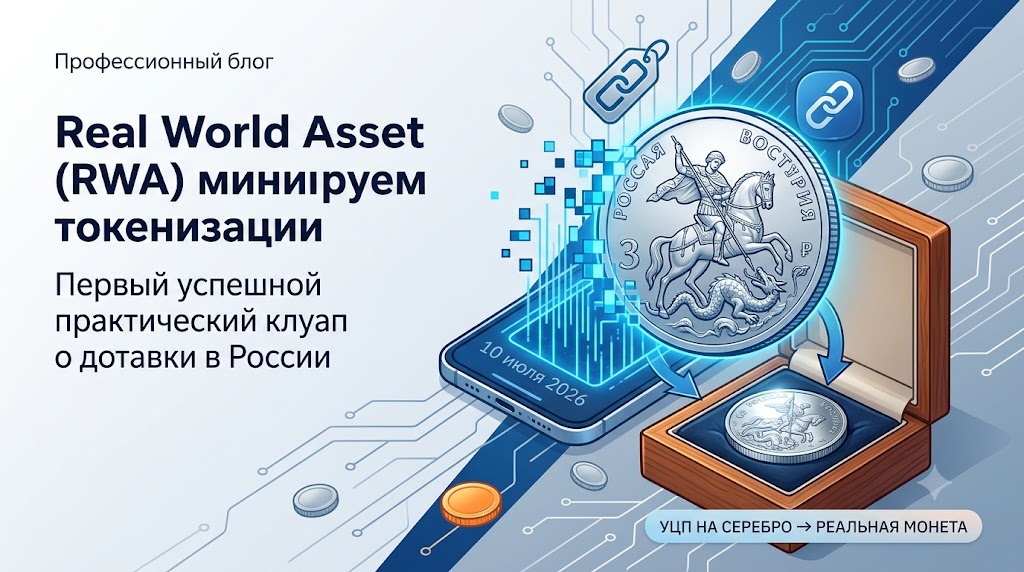
On July 10, 2026, for the first time in the history of Russia's financial market, a holder of a utility digital right (UTsP) exercised that right and received an actual silver coin. The coin in question is the "St. George the Victorious" investment coin with a face value of 3 rubles, containing 31.1 grams of silver at 999 fineness. The deal was carried out and confirmed by the St. Petersburg Currency Exchange (SPCEX) together with the St. Petersburg Settlement and Depository Center (SPb SDC).
This is Russia's first full-fledged RWA case — real-world asset tokenization carried all the way through to physical delivery. Here's how the instrument works, whether it's safe to use, how much it costs to get started, how to sell it, and what happens with taxes.
What happened on July 10, 2026, and why is it the first case of its kind?
For the first time in Russia, an investor exchanged a digital right for a real asset through an exchange infrastructure — proving that the entire chain, from issuing the digital right to delivering the asset, actually works in practice and not just in theory. SPCEX first introduced the model for circulating UTsP-backed digital certificates tied to silver coins back in December 2025, when trading in such certificates — issued by SPb SDC — began on the exchange. However, until July 10, 2026, no investor had ever taken that chain all the way to completion, meaning no one had actually converted a digital right into a physical asset.
Mikhail Temnichenko, Chairman of the Management Board of SPCEX, called this the first practically realized RWA case on the Russian market. According to him, this isn't simply about digitizing commodity assets — it's a new stock-market instrument that expands investment opportunities and makes investing in real assets more accessible. That's why the event is being described as a pilot for bringing "digital goods" into exchange trading — and this pilot has succeeded.
It's worth understanding the difference between launching a product and actually proving it works. From December 2025 to July 2026, UTsP digital certificates were already trading on the exchange — investors could buy and sell them like ordinary securities. But before July 10, 2026, no holder had ever gone through the entire chain to complete — that is, no one had filed a redemption request and received the physical coin. That's exactly why this event is called a first in history rather than just another stage in the product's development: it proved that the mechanism for delivering a real asset works not just on paper, but in the actual operational practice of the exchange and the depository.
What Is a UTsP, in Plain Terms?
A utility digital right is a digital asset that gives its holder the right to demand the transfer of a thing, a service, work, or rights to use the results of intellectual activity — rather than a right to a cash payment. This definition is set out in Article 8 of Federal Law No. 259-FZ of August 2, 2019, which regulates investment platforms.
Unlike digital financial assets (DFAs), which are economically closer to a loan or a bond and typically involve a cash settlement, a UTsP is by design a prepaid right to a specific future performance — in this case, the delivery of a silver coin. A UTsP can only arise, circulate, and be disposed of within the investment platform or exchange infrastructure where it was issued — a deal made directly, bypassing the system, isn't possible.
Besides UTsPs and DFAs, Russian law also recognizes a third type of digital right — hybrid digital rights (HDRs), which combine both a monetary claim and a utility right at the same time. For comparison, here's how these instruments differ in their underlying economic logic:
| Type of digital right | What the holder receives | Economic equivalent |
| DFA (debt-type) | Cash payments | Loan, bond |
| UTsP | Goods, service, or work | Prepayment for future delivery |
| HDR | Cash or goods, holder's choice | A combination of a loan and a prepayment |
Precisely because a UTsP is designed from the outset as a right to goods rather than to cash, the silver coin case turned out to be so telling: it demonstrated that a prepaid digital right can be carried through to full physical delivery within regulated exchange infrastructure.
Is It Safe to Get an Actual Coin by Redeeming a Digital Right?
Yes, and this deal proved it — the entire process is backed by regulated exchange infrastructure, not an anonymous protocol. The first-ever coin delivery under a UTsP was carried out by the St. Petersburg Currency Exchange together with SPb SDC, which serves as the settlement and depository center for this product.
The key difference between this model and unregulated crypto markets lies in who bears responsibility for fulfillment. Because the project operates as a pilot on exchange infrastructure supervised by the Bank of Russia, the risk of non-performance rests with the exchange itself and the settlement and depository center it has designated — not with an anonymous smart contract or a decentralized protocol. The technology for securitizing real goods, jointly implemented by SPCEX and SPb SDC, turns a physical bar into an exchange-traded instrument accessible through a familiar brokerage account — not through a crypto wallet.
This point matters a great deal for understanding the risks involved. In decentralized commodity-tokenization schemes, a token holder has to trust the token issuer or the smart contract, and there's often no way for an outsider to verify either one — no license, no regulator, no settlement and depository center obligated to physically hold the collateral. In the case of the silver UTsP, every link in the chain — from issuing the digital certificate to handing over the coin — sits inside regulated financial infrastructure, and the coin itself is physically held at the depository until it's issued to the rights holder.
Why Buy a UTsP If You Can Just Buy the Coin at a Bank?
The main reason is liquidity and the absence of storage costs that are unavoidable when buying physical silver outright. The new instrument offers investors several advantages at once: exchange-level liquidity and transparent pricing, real-time transaction convenience, no storage or logistics costs, and reliable settlement infrastructure.
When buying a physical coin directly from a bank, an investor runs into the classic problem with precious metals — a wide spread between the buy price and the buy-back price, plus the need to think about secure storage and protection against theft or damage. A UTsP removes these costs: the investor holds the digital right in a brokerage or exchange account, just like an ordinary security, gets the same upside from rising silver prices, but is spared the hassle that comes with physically owning the metal.
How Can an Ordinary Investor Buy a Silver UTsP, and How High Is the Barrier to Entry?
The barrier to entry is minimal — you can start by buying the digital right to a single coin, and the entire process runs through stock-market infrastructure investors are already familiar with. The project is explicitly described as a successful pilot for bringing "digital goods" into national exchange trading — meaning the silver UTsP isn't embedded in a separate crypto ecosystem but in the existing securities trading system.
This means an ordinary investor won't need to figure out crypto wallets or decentralized protocols: access to the digital right opens up through a regular brokerage account, an exchange terminal, or a personal account with a Russian operator. Buying a UTsP digital certificate works the same way as buying a stock or a bond — by placing an order on the exchange, with no extra technical setup required.
For the market, this is a significant step forward compared to earlier UTsP projects that operated exclusively on individual crowdfunding platforms. That very difference is what's pushing the Bank of Russia to discuss a broader reform: the regulator is considering allowing DFA information-system operators to issue UTsPs themselves, so that such instruments aren't confined to niche crowdfunding platforms but can circulate freely on the same infrastructure as ordinary securities.
Can You Sell or Transfer a UTsP Without Taking the Coin?
Yes, and that's exactly what makes the instrument genuinely useful — the holder isn't obligated to take the coin right away and can freely dispose of the digital right on the secondary market. The regulator and the exchange explicitly define the UTsP digital certificate as an innovative stock-market instrument, not a one-time voucher for a product.
As long as the investor hasn't initiated the coin-issuance procedure, the digital certificate can be kept in a portfolio, sold on the exchange to another investor, or used as a pledged asset. This flexibility gives the instrument two properties that are usually at odds with each other: the high liquidity of a digital security and the ability to convert the asset into physical silver at any moment, should the investor decide to take the coin.
Strategically, this gives investors a choice without sacrificing optionality. A short-term trader can buy and sell the digital certificate, tracking silver-price movements, without ever thinking about the physical coin. A long-term investor, by contrast, can hold the right for years and then, whenever it suits them — say, during a sharp rise in precious-metal prices or when they want to diversify their portfolio with physical assets — initiate issuance and take the coin.
How Is Buying and Selling a Silver UTsP Taxed?
Issuing, transferring, and selling DFAs and UTsPs in Russia is exempt from VAT — this is directly provided for by the tax regime introduced to encourage new financial instruments, and it makes such transactions more advantageous than many deals involving ordinary physical goods. This exemption applies throughout the instrument's entire lifecycle — from the initial offering to secondary-market trades.
The difference between the purchase price and the sale price of the digital right is taxed differently. If an investor bought a UTsP cheaper and later sold it for more on the secondary market, the resulting profit is subject to personal income tax at a rate of 13% or 15% — typically withheld and remitted by the trading platform itself, acting as tax agent. Redemption of the right, however — the moment the investor actually receives the physical coin — is generally not treated as a sale and doesn't generate a separate taxable income, since it constitutes fulfillment of an existing obligation rather than a new purchase-and-sale transaction.
For an investor, this means the tax burden only arises when they actually lock in a profit on the secondary market — exactly as with trading stocks or bonds. If an investor holds the digital right in their portfolio without selling it, or simply ends up taking the physical coin, no additional taxable event occurs at that moment — though a subsequent sale of the physical metal itself to a third party would be governed by separate rules for taxing precious metals, rather than the DFA/UTsP tax regime.
Is It Worth Investing in Tokenized Real-World Assets Through KuCoin?
Yes — if you're interested in the RWA space (real-world asset tokenization), it's worth taking a look at international platforms like KuCoin, which offer tokenized instruments across a much broader range of underlying assets than just precious metals. While Russia's silver UTsP market remains a pilot project on a single local exchange, the global market for real-world asset tokenization is growing considerably faster and offers a much wider selection of instruments — from gold and commodities to tokenized bonds and real estate.
KuCoin provides access to trading these kinds of instruments through a familiar crypto account, without needing to open a separate brokerage account with a local operator. Before investing, it's worth carefully examining exactly what backs a given token, who serves as the issuer and custodian of the underlying asset, and what infrastructure stands behind the ability to redeem the token for the real asset — these are the same principles that made the Russian silver pilot credible, and they apply just as much to any RWA instrument on the global market.
Conclusion
On July 10, 2026, Russia's digital-rights market passed an important real-world test: for the first time in history, an investor exchanged a utility digital right for a real physical asset — a "St. George the Victorious" investment coin made of 999-fine silver, weighing 31.1 grams. The deal was organized and confirmed by the St. Petersburg Currency Exchange and SPb SDC, meaning the investor was protected by regulated exchange infrastructure rather than an anonymous protocol.
The instrument is designed to deliver the benefits of both a digital security and a physical metal at the same time: high liquidity, a minimal barrier to entry starting from a single coin, no storage costs, and the ability to initiate coin issuance at any point. UTsP transactions are VAT-exempt, and the 13–15% tax applies only to profit from reselling the digital right, not to the moment the coin itself is received. For the Russian market, this is the first working example of RWA — a model that will likely be applied to other commodity assets in the coming years.
Frequently Asked Questions
1.How does a UTsP differ from a digital financial asset (DFA)?
A UTsP grants the right to receive goods, a service, or the results of intellectual activity, while a DFA is economically closer to a loan or a bond and involves cash payments. The two instruments are governed by different federal laws and circulate on different infrastructure — UTsPs on investment platforms, DFAs on the information systems of DFA operators.
2.Who is responsible if an investor can't obtain the physical coin?
Responsibility lies with SPCEX and the designated settlement and depository center, SPb SDC, through whose infrastructure the deal is registered and executed. This is a fundamental difference from unregulated, decentralized instruments, where accountability for fulfillment is diffuse.
3.Will DFA information-system operators be able to issue UTsPs in the future?
The regulator is exploring this possibility: according to statements from the Bank of Russia, corresponding legal amendments could allow DFA information-system operators to issue and circulate UTsPs on par with investment platforms, though this would require a separate change to the regulation at the legislative level.
4.What's more advantageous — buying physical silver at a bank or a UTsP on the exchange?
Buying physical metal directly means a higher spread on resale and storage costs, while a UTsP offers exchange-level liquidity and transparent pricing without those expenses. The choice depends on the investor's goals: if having the physical metal in hand right away matters most, a bank remains an alternative.
5.Can a UTsP be used as collateral for financing?
Yes — as long as the UTsP digital certificate hasn't been redeemed, it can be used as a pledged asset, alongside selling it on the secondary market or holding it in a portfolio. This is one of the key advantages that sets this instrument apart from an ordinary physical-goods voucher.