

Short-Term Deposits in Russia Have Grown More Expensive: Why Banks Raised Rates by 1.5–2.5% and Where It Is Most Profitable to Place Money Now
Introduction: Why Rates on Short-Term Deposits Are Rising
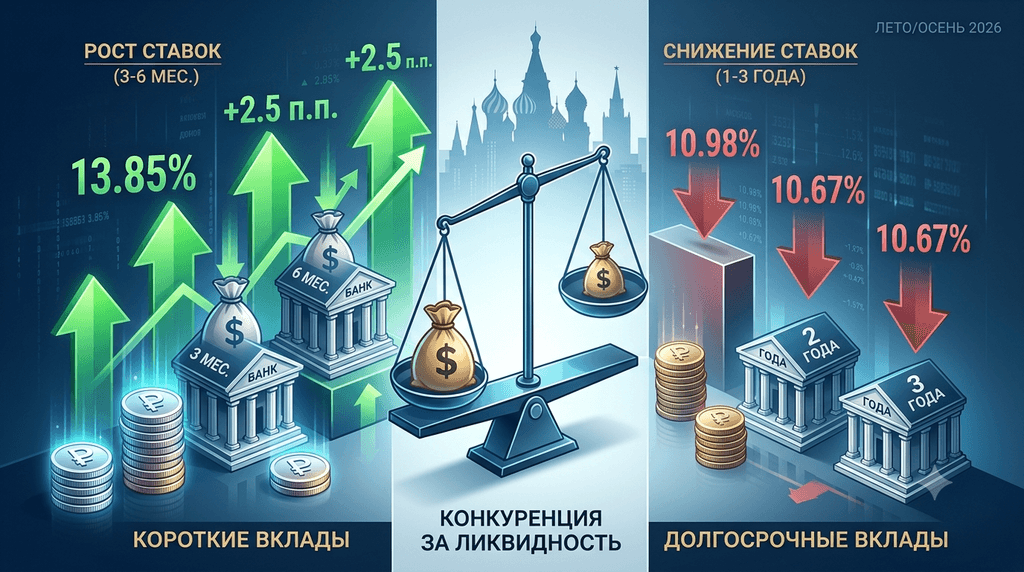
Major Russian banks have indeed begun noticeably increasing yields on short-term deposits — but this does not mean the market has returned to sustained growth in deposit rates across all terms. According to Finuslugi data, in the summer of 2026, 12 out of the top 20 banks modified conditions for three-month deposits, and the average rate rose to 13.85% per annum. At individual banks, the increase for short-term products reached 1.5–2.5 percentage points; however, the highest values are often available only to new clients, for "new money," or upon meeting additional conditions.
The main takeaway for depositors is simple: banks are currently competing primarily for short-term liquidity. Therefore, a three-month deposit may look more attractive than a one-year deposit, but one should compare actual total returns, conditions for top-ups and early withdrawals, and the status of funds the bank classifies as new, rather than just the promotional rate.
What Happened to Deposit Rates in August and Early September 2026?
Short-term deposits grew more expensive, whereas long-term products on average continued to drop in price. According to Finuslugi data published by Gazeta.Ru, the average rate on three-month deposits increased by 0.52 percentage points over the summer, reaching 13.85% per annum. The average yield on six-month deposits stood at 13.18%, one-year at 12.37%, and 1.5-year deposits at 11.45%.
This dynamics looks unusual only at first glance. If a bank expects high money costs to persist for several months, it benefits from attracting funds for a short period while retaining the ability to revise terms after the deposit matures. Conversely, committing to pay a high rate for two or three years becomes less comfortable for a bank if credit and monetary rates begin to fall.
As a result, the gap between the short and long ends of the deposit yield curve widened. The average rate on two-year deposits decreased to 10.98%, and on three-year deposits to 10.67%; the spread between three-month and three-year terms reached 3.18 percentage points. This is an important signal: banks are not merely mechanically raising yields, but selectively buying the funding term they need most.
| Deposit Term | Average Rate (Finuslugi Data) | Direction of Change (Summer 2026) |
| 3 months | 13.85% | Growth by 0.52 p.p. |
| 6 months | 13.18% | Growth by 0.21 p.p. |
| 1 year | 12.37% | Growth by 0.04 p.p. |
| 1.5 years | 11.45% | Growth by 0.27 p.p. |
| 2 years | 10.98% | Decrease |
| 3 years | 10.67% | Decrease |
Why Are Banks Raising Rates Specifically on Short-Term Deposits?
Banks are raising short-term rates due to the need to attract more stable retail money for the coming months, not necessarily because they face a general deficit of funds. The market is experiencing a structural shortage of long-term funding: loans and other assets have one maturity term, while a portion of liabilities matures quickly or can leave to a competitor.
In this situation, a bank is willing to pay more for a three-month or six-month deposit if it helps close immediate liquidity gaps, comply with regulatory ratios, and reduce reliance on more expensive sources. Market publications attribute selective rate hikes to liquidity deficits and limited flexibility in monetary policy. This is not equivalent to claiming an individual bank is insolvent: it is about balance sheet structure and the cost of attracting money at a specific moment.
The second reason is the expectation that high rates will persist longer than previously assumed. On the Bank of Russia website, the key rate for September 1–7, 2026, is listed at 14% per annum. At the same time, RUONIA stood at 13.97% on September 3, with transaction volume under this indicator reaching 713.34 billion rubles. For banks, this means that the cost of short-term ruble liquidity remains high, and a rate reduction cannot be considered immediate or guaranteed.
The third reason is competition for clients. Depositors can easily compare three-month offers on financial marketplaces, allowing a bank to temporarily raise its rate for a limited period without altering the terms of its entire deposit lineup. This tactic helps generate an influx of money now, after which the product can return to standard yield levels once the promotional campaign ends.
Is the Maximum Rate Really Available to Every Depositor?
No, the maximum rate is most often intended for new money, new clients, or holders of a specific service package. Terms must be verified before opening a deposit, as promotional yields may consist of a base rate plus a bonus that is awarded only if several requirements are met.
By "new money," banks usually mean funds that were not present on the client's accounts or deposits during a specific reference period. Practical offers often include restrictions covering 30 to 90 days: if funds were recently held in the same bank, transferring them from one account to another may not qualify them as new. For existing clients, this means closing an old deposit and immediately opening a new one does not guarantee the maximum yield.
An additional condition may involve a paid subscription or premium service package (for example, services like SberPrime or Alfa-Check). Before signing up, check whether a specific subscription applies at the chosen bank on the date the deposit is opened. Subscription fees reduce net income, especially for smaller deposit amounts or shorter terms. Therefore, one should compare actual net yields after accounting for package costs, mandatory spending, and potential restrictions, rather than relying on nominal 15–16.5% annual rates.
Before finalizing, it is useful to check five points: what exactly the bank considers new money, how the bonus is calculated, whether a minimum balance must be maintained, how much the subscription costs, and what happens to the rate if a condition is breached. If any of these lack clarity, the advertised rate cannot be considered a guaranteed yield.
Which Term to Choose: Three Months, Six Months, or a Year?
In the current market configuration, a three-month deposit looks like the most flexible compromise between yield and fund lock-up duration. The average rate stood at 13.85% per annum, compared to 13.18% for six-month and 12.37% for one-year deposits. Given persistent high key rates, a shorter term allows for faster reallocation without locking money in during a period when market conditions might change.
A three-month term is particularly suitable for money that will definitely not be needed before maturity but might be required afterward. The depositor secures a pre-determined return and can choose a new deposit, money market fund, or another instrument after a quarter. However, this advantage disappears if the bank offers a high rate only with automatic renewal at a significantly lower standard tariff.
A six-month deposit makes sense for those who prefer to rebalance less frequently and are willing to accept market change risks. The gap between 13.85% and 13.18% may seem small, but on larger sums over the full term, it becomes noticeable. A one-year deposit is justified when the main goal is to lock in yield and eliminate the need to look for a new offer in three months, rather than maximizing current short-term rates.
Longer terms currently require extra caution. Average rates on two- and three-year products are lower than short-term ones, meaning long-term capital lock-ups carry no obvious premium. If a bank offers a long-term deposit significantly above market rates, check whether the rate is stepped, conditional, or effective only during the initial months.
Is It Worth Closing an Old Deposit for a New Rate?
In most cases, closing an old deposit prematurely is unprofitable. Upon early termination, the bank may recalculate interest at the demand deposit rate (sometimes close to 0.01% per annum), causing the depositor to lose accrued interest.
The decision depends on three variables: the deposit amount, time remaining until maturity, and the spread between the old and new rates. If the old deposit was opened recently and carries a very low yield, switching to a new offer may offset the loss. If little time remains and interest has accumulated over several months, a 1.5–2.5 percentage point boost rarely offsets lost earnings.
Calculations should be made in monetary terms (rubles) rather than comparing percentages alone. For example, on a 1 million ruble deposit, a 2 percentage point difference over three months yields approximately 5,000 rubles before taxes and product fees. If closing the old deposit forfeits 20,000 rubles in accrued interest, the switch is clearly disadvantageous. Since this is a simplified example, request an exact payout calculation from the bank before taking action.
A practical alternative is to wait for the old deposit to mature and place new funds into a short-term deposit. This preserves already earned interest and builds a maturity ladder where deposits mature at staggered intervals rather than all at once.
What Is Better for Free Capital: A Deposit, LQDT, or OFZ-PK?
Short-term deposits win on guaranteed returns, while money market funds and floating-rate bonds win on liquidity. There is no universal winner; choice depends on whether the investor might need access to capital before maturity.
A three-month deposit offers a fixed outcome but locks up money. Early withdrawal risks losing nearly all accrued interest. Promo deposits from certain banks may advertise 15–16.5% per annum, but such figures should be evaluated only after verifying new-money terms, promo validity, and paid services.
A money market fund, such as LQDT, aims to track short-term ruble interest rates and can be more convenient for reserves that need to be accessed quickly. With RUONIA at 13.97% as of September 3 (per Bank of Russia data), money market fund returns directly mirror changes in this benchmark. If rates drop, fund yields decrease, but investors are not locked into a fixed maturity.
OFZ-PK bonds also feature floating coupons, making them attractive for exposure to money market rates. However, this is not a bank deposit: bond prices fluctuate, broker commissions apply, and early sale outcomes depend on market conditions. Deposit guarantees and exchange risks should not be conflated.
| Instrument | Primary Advantage | Main Limitation |
| Short-term Deposit | Fixed return over the term | Loss of interest upon early withdrawal |
| Money Market Fund (LQDT) | High liquidity, closely tracks short-term rates | Yield varies with the market; subject to exchange risks |
| OFZ-PK | Floating coupon, sovereign issuer | Price volatility; requires a brokerage account |
How Do Rising Rates Affect Russian Stocks and Corporate Bonds?
High rates on risk-free short-term instruments exert near-term pressure on demand for MOEX equities and corporate bonds. When depositors can earn around 14% per annum with a guaranteed outcome, they require a higher potential risk premium to allocate capital to market assets.
For stocks, this translates to a higher discount rate and increased competition for retail liquidity. Capital that might otherwise flow into equities remains parked in deposits. High-debt companies with weak cash flows are especially vulnerable: future profits face heavier discounting, and refinancing costs escalate.
For corporate bonds, the effect is twofold. New issuances must offer a distinct spread over bank deposits; otherwise, investors lack compensation for credit risk, illiquidity, and potential repricing. Consequently, issuers face greater difficulty placing debt under previous terms. Floating-rate bonds are more resilient to high rates but do not eliminate individual corporate credit risks.
This does not mean the stock or bond market is destined to fall. Rate increases may be temporary, and strong companies can offset rising borrowing costs through earnings growth. However, a short-term capital rotation toward deposits remains a logical outcome while the gap between guaranteed bank yields and expected risk premiums stays narrow.
Does Rising Deposit Rates Signal Another Key Rate Hike?
No, the increase in deposit rates points to a pause in the rate-cutting cycle rather than an imminent key rate hike. Banks may have priced in a scenario where money costs remain elevated longer due to inflation expectations, fuel price trends, and limited liquidity supply.
The Bank of Russia's key rate stood at 14% as of September 7, 2026. RUONIA closely tracked the key rate, confirming the high cost of overnight funding. However, a specific bank's deposit rate reflects more than Central Bank policy expectations—it is also driven by fundraising targets, liability maturity profiles, competitive pressure, and internal liquidity ratios.
Therefore, one should not draw the reverse conclusion that a bank raising three-month deposit rates implies an impending policy tightening by the Central Bank. A more accurate interpretation is that banks are securing short-term stability while the market remains uncertain about the pace of future rate cuts.
How to Buy or Open a Short-Term Deposit on KuCoin?
KuCoin is not a Russian bank and does not offer ruble bank deposits. Short-term deposits must be opened directly with a licensed Russian credit institution or through an authorized financial marketplace. KuCoin users should separate bank savings from cryptocurrency holdings and avoid mistaking promotional deposit rates for digital asset yields.
If the goal is to place a ruble reserve, compare bank offers based on total net yield and verify early withdrawal conditions. If trading cryptocurrency on KuCoin, use only funds you can afford to risk: bank deposit yields do not shield against crypto volatility, and transferring funds across platforms carries distinct operational and regulatory risks.
A prudent sequence is to first establish an emergency fund, then select a bank deposit term for money that will not be needed, and only then evaluate higher-risk assets. Avoid borrowing or liquidating emergency reserves to chase higher market returns.
KuCoin Offers A More Stable Option in A Volatile Market
If you worry about the frequent ups and downs in the market, and pursue a more stable option to earn money passively, KuCoin is the right place to come:
Simple Earn: Deposit and withdraw tokens anytime, earning stable returns.
Kucoin Earn: Earn stable profits with professional asset management.
Hold to Earn: Earn rewards by holding assets in Funding, Trading, Margin, Futures, Mining, and Unified Accounts.
Staking: Unlock the earning potential of on-chain assets.
Advanced Investments: Advanced Investments offer a variety of structured products to help your money grow in any market.
Shark Fin: Principal Protection and Guaranteed Gains
Dual Investment: Buy low and sell high with transparent return calculations.
Snowball: High yields, with price protection.
Discount Buy: Buy crypto at discount prices.
KCS Loyalty: Level up to enjoy exclusive perks by staking ≥ 1 KCS.
KuCoin Wealth: Discover future value and begin your smart investing journey.
KCS Benefits: Hold and stake KCS to access benefits across the platform.
KCS Staking 2.0: Participate in KCS on-chain governance to earn yield.

Conclusion
Russian banks raised rates primarily on short-term deposits to secure short-term retail liquidity amid persistently high borrowing costs. In summer 2026, the average three-month deposit rate reached 13.85%, while two- and three-year yields fell to 10.98% and 10.67%, respectively. This divergence reflects market expectations of a pause in rate cuts and selective bank competition for new capital rather than broad-based rate hikes.
For average depositors, eligibility rules matter more than promotional headline rates. Check new-money criteria, reference periods, mandatory subscriptions, auto-renewal clauses, and early termination penalties. Currently, three-month deposits offer an effective balance of high yield and flexibility, whereas unreserved liquid cash is better compared against money market funds. OFZ-PK bonds and LQDT serve different investment purposes and do not replace bank deposit guarantees.
While rising deposit yields create headwind for the MOEX index and corporate bonds, they do not inherently signal a market collapse. They reflect competition for capital and the high price of liquidity. Decisions should be guided by time horizon, risk tolerance, and liquidity needs rather than promotional headline figures alone.
Frequently Asked Questions
1. Can a bank change the interest rate after a fixed-term deposit is opened?
For a fixed-term deposit, the bank generally cannot alter the agreed rate prior to maturity, though bonus conditions may vary. Review the contract: certain bonus top-ups apply only if minimum balance, connected service, or new-money requirements are continuously met.
2. Is tax payable on interest earned from ruble deposits?
Taxation depends on total annual interest income across all accounts relative to the tax-free threshold set by Russian law. Tax authorities or banks may apply rules automatically, but depositors should factor potential tax liabilities into net yield calculations rather than focusing solely on pre-tax rates.
3. What happens if I deposit additional money after opening a deposit?
It depends on the product type. Top-up deposits accept additional funds, though additions may be subject to a different rate or time restriction. Non-replenishable deposits do not allow adding funds, so top-up terms should be confirmed before opening the account.
4. Are all funds in a bank deposit equally protected?
Deposit insurance covers funds up to the legally established limit per depositor per bank, subject to statutory exceptions. Large sums should be distributed across multiple banks after verifying their participation in the deposit insurance system and reviewing specific product terms.
5. Can a money market fund completely replace a short-term deposit?
No. Money market funds offer greater liquidity, but their yields fluctuate with market rates, and investment returns are not equivalent to a fixed bank deposit guarantee. The choice depends on whether securing a guaranteed sum at a specific maturity date or maintaining immediate penalty-free access to funds is the priority.
Disclaimer : This material is provided for informational purposes only and does not constitute financial, investment, legal, or tax advice. Transactions involving cryptocurrencies and tokenized assets carry substantial risks — including price volatility, limited liquidity, counterparty exposure, and the potential for total loss of invested capital. Readers should conduct their own research and, where appropriate, consult a qualified professional before making any financial decisions.