

Russian Stock Risk Premium Hits Its Highest Level Since 2022: What It Means for Investors
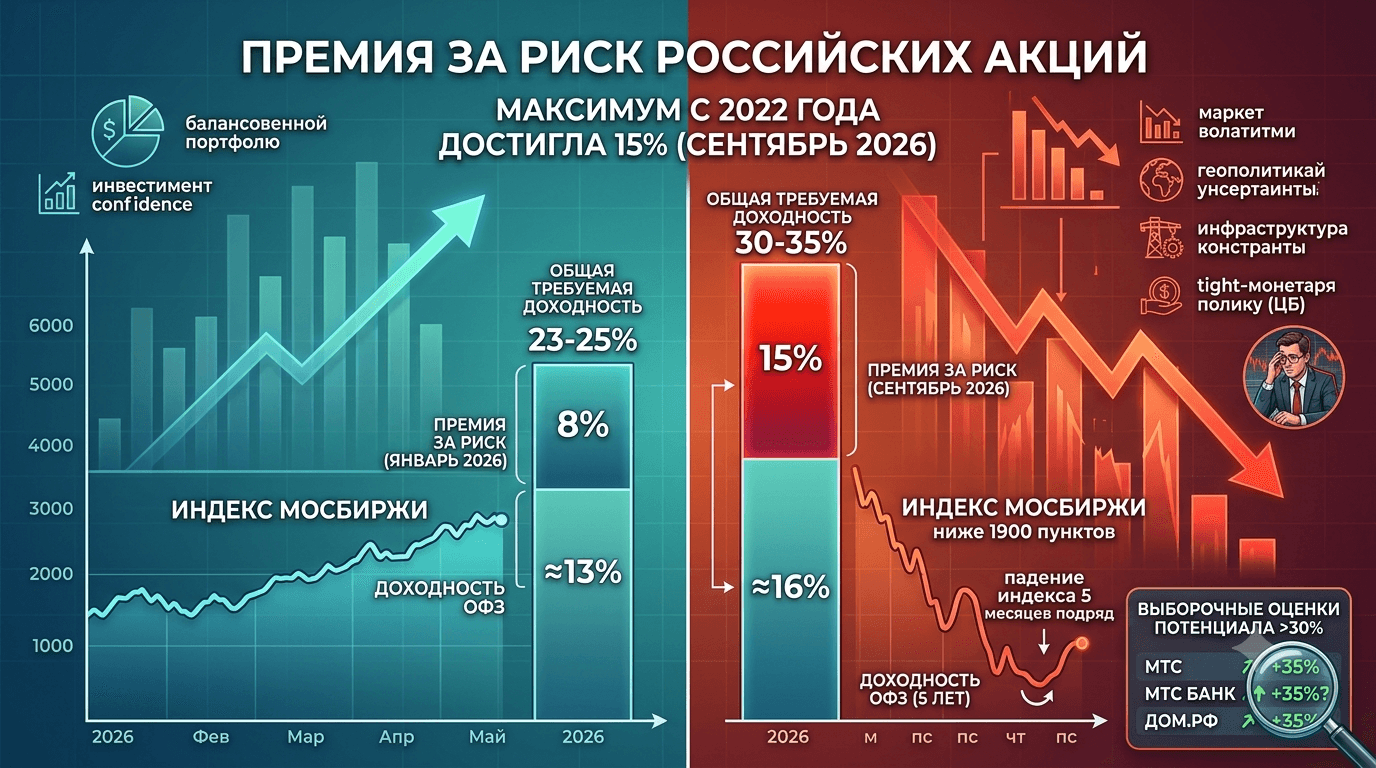
Why are investors demanding returns of up to 35% from Russian stocks when five-year OFZs already yield around 16%? The answer is that the risk premium on Russian stocks has nearly doubled since the beginning of 2026, reaching 15%, its highest level since 2022. According to an estimate by analysts at Aton cited by RBC on September 15, 2026, market participants now expect a total annual return of approximately 30–35% from equities. This does not mean that the entire market has become uninvestable. Instead, the indicator reflects a sharp deterioration in expectations: investors need much greater compensation for geopolitical uncertainty, high interest rates, weak liquidity, and infrastructure restrictions.
In practice, the market has split into different segments. Some stocks remain under pressure, while others already offer a combination of potential price appreciation and dividends. The key question, therefore, is not whether Russian stocks should be bought at all, but which conditions could reduce the risk premium and which issuers can meet a required return above 30%.
The risk premium is the additional return an investor demands from stocks above the return on a comparatively reliable instrument. For the Russian market, current estimates use five-year federal loan bonds, or OFZs, as the benchmark. If five-year OFZs yield around 16% and the risk premium equals 15%, the total required return on equities approaches 30–35%, depending on the calculation methodology and market expectations.
In other words, investors do not compare only a company’s potential profit with its current share price. They also ask why they should accept the risks of owning equities when government bonds already offer a high yield with lower volatility. The higher the interest rate and uncertainty, the larger the discount stocks need or the higher their expected profit must be.
The main reason is the combination of geopolitical uncertainty and revised expectations for Bank of Russia rate cuts. In January 2026, the risk premium was estimated at approximately 8%, while the total required return on equities stood at 23–25%. By the beginning of autumn, the premium had risen to 15%, nearly doubling.
OFZ yields of around 16% are creating additional pressure. When the risk-free benchmark becomes this attractive, even a strong company must demonstrate more convincing growth or dividend potential. Otherwise, capital remains in bonds, bank deposits, and money-market funds.
Infrastructure risks also affect stock valuations. For Russian investors, these risks include restrictions on certain instruments, settlement arrangements, access to foreign assets, and possible changes to trading infrastructure. Such factors are not always reflected in a company’s earnings, but they increase the compensation investors require.
The MOEX Index came under pressure because high interest rates simultaneously reduced the value of expected future earnings and pulled money away from equities. In the spring and summer of 2026, the index declined for five consecutive months and fell below 1,900 points, according to data and estimates published on September 15, 2026.
The mechanism behind the decline is relatively direct. At high interest rates, a company’s future cash flows are discounted more heavily. As a result, the same dividends and profits are worth less today. At the same time, bonds become more attractive, and some investors reduce their equity exposure regardless of the quality of a particular business.
A falling index does not mean that all companies have become cheaper to the same extent. The index includes exporters, banks, telecommunications companies, developers, and businesses serving domestic demand. Their sensitivity to interest rates, the ruble exchange rate, regulation, and geopolitics varies. The index therefore shows overall market weakness but does not replace analysis of individual issuers.
Yes. According to Kirill Upatov, an expert at Trinfico Private, a 30% market rise could return the MOEX Index to approximately 3,000 points. That would be only about 5% above the level at the beginning of 2026 and would still remain below the peaks reached in 2024–2025.
This calculation is important for understanding the scale of the decline. If the index has already fallen significantly, a substantial rebound may represent not overheating but the recovery of part of the lost value. In percentage terms, the increase looks large, but in absolute terms the index may only be returning to a more normal range.
However, a low valuation does not guarantee a rapid reversal. Cheap stocks can remain cheap longer than an investor can wait. Sustainable growth requires new buyers, improved expectations for interest rates, and a lower geopolitical risk premium.
High OFZ yields do not make equities meaningless, but they raise the standard for stock selection. An investor may prefer stocks if their expected total return — price appreciation plus dividends — clearly exceeds the return on bonds and compensates for the additional risks.
That is why the answer to the question “Why buy stocks when OFZs yield 16%?” is as follows: investors should not buy the entire market indiscriminately, but should focus on individual ideas with potential returns above 30% and clear drivers for a revaluation. This strategy does not guarantee results and requires investors to account for the possibility of losses, but it explains why the market does not become completely uninvestable even when rates are high.
A 15% premium can also be viewed not only as an obstacle but as a signal. It shows that sentiment is already extremely cautious and that share prices incorporate a large volume of negative expectations. If some risks disappear, a decline in the required return could quickly lift stock prices. In that case, investors benefit not only from higher company earnings but also from an expansion in market valuation multiples.
According to Market Power and Frank Media, individual stocks with potential returns above 30% include MTS, MTS Bank, and B2B-RTS. The publications also highlight DOM.RF: from September 14, 2026, its shares were included in the calculation base of the MOEX Cost of Creation Index, while the company raised its 2026 earnings forecast and announced plans to pay record dividends in 2027.
These names should not be treated as a universal buy list. Potential returns above 30% are scenario-based estimates, not promises of performance. Each stock requires a separate review of debt levels, cash-flow resilience, dividend policy, liquidity, and sensitivity to interest rates.
Nevertheless, the emergence of such ideas is significant. It shows that the market is not homogeneous. Some companies can rise even when the index is weak if their financial results, dividends, or corporate events prove stronger than broad macroeconomic factors.
The risk premium will begin to decline sustainably if geopolitical expectations improve, the Bank of Russia adopts a softer tone, and free liquidity returns to the market. Each factor works through a different channel, but the strongest effect would come from their combination.
1. Progress in Geopolitical Negotiations
Signals of easing tensions could quickly reduce the compensation investors require for risk. According to Aton, if negotiations resume or signs of de-escalation emerge, nearly half of the companies listed on the Russian market could offer potential returns above 30%.
Markets typically respond to expectations before official outcomes are known. Therefore, even the first credible signs of improvement could trigger a sharp rise in stocks. The more strongly the current premium reflects fear, the more pronounced the revaluation may be when the base-case scenario changes.
However, a geopolitical trigger also brings heightened volatility. A single news report is not enough if it does not change expectations regarding trade restrictions, settlements, exports, or investment flows. A sustainable decline in the premium will require more than headlines; it will require confirmation in actual economic conditions.
2. Easing by the Bank of Russia
A clear signal of further rate cuts could become the second major condition for a market reversal. High rates support OFZ yields while simultaneously increasing the discount applied to companies’ future earnings. If the regulator adopts a softer tone, both forces would begin to work in favor of equities.
It is important to distinguish a promise of rapid easing from a cautious change in wording. The market evaluates the rate trajectory, not just a single policy decision. If inflation remains high, the Bank of Russia may cut rates slowly, and investors will continue to demand a substantial premium.
The effect of easing could be particularly significant for banks, developers, and companies with substantial debt. Even exporters, however, benefit from lower rates through a market revaluation and renewed interest in riskier assets.
3. The Return of Free Liquidity
The third condition is a flow of money from deposits, money-market funds, and other short-term instruments into equities. Liquidity means that sufficient funds and buyers are available for transactions to take place without placing sharp pressure on prices.
As long as risk-free yields remain high, investors have no obligation to rush into stocks. A rate cut or less attractive terms on conservative instruments could therefore provide an important market catalyst. When new money begins to flow consistently into equities, even moderate demand can materially change prices after a prolonged decline.
Free liquidity also matters for the quality of a rally. A one-time surge in trading can produce a short rebound, but a sustainable trend requires a persistent inflow of capital and a broader base of market participants.
The main risk is that the risk premium may remain high for longer than expected. Geopolitical progress may not occur, rates may decline more slowly than prices anticipate, and money may continue to remain in bonds and deposits.
The second risk is that the potential return of individual stocks may be overstated. A forecast of growth above 30% usually depends on a specific scenario: improving macroeconomic conditions, higher earnings, dividend payments, or a change in the market’s attitude toward the company. If the scenario does not materialize, a low share price will not provide protection by itself.
The third risk is low liquidity. In some stocks, a large order can move the price significantly, while exiting a position may prove more expensive than expected. For this reason, comparing such stocks with OFZs solely by their percentage potential return is inaccurate.
Finally, dividends are not guaranteed. A company may direct funds toward investment, reduce payouts, or change its policy. Before buying, investors should review the issuer’s official decisions instead of basing their calculation only on past returns.
A rational approach begins by separating market risk from company-specific risk. First, investors should determine how dependent a company is on interest rates, demand, currency movements, regulation, and foreign trade. They should then compare the expected return with the alternative offered by OFZs, while adjusting for volatility and liquidity.
It is useful to consider several scenarios. In the base case, rates remain high, the geopolitical situation does not change, and stocks deliver only dividends and a moderate recovery. In the positive case, the risk premium declines, the market rises, and valuation multiples improve. In the negative case, pressure continues and share prices fall despite appearing cheap.
The size of a position should be matched to the investment horizon. For an investor who may need the money within the next few months, high potential returns do not compensate for the risk of a sharp decline. A long-term participant may be able to withstand volatility, but still needs diversification across companies and sectors.
Market news moves fast — but where you act on it matters just as much. This October, KuCoin launches KuCoin 5.0, transforming KuCoin into a rebuilt platform. Here's what actually changes for you:
-
One account for everything. Older platforms split your money across separate "spot," "margin," and "futures" accounts and expected you to understand why. KuCoin 5.0's unified account removes that entirely — deposit once, and everything is simply there.
-
Stocks, indices, and commodities. KuCoin 5.0 expands beyond crypto into global markets. When crypto chops sideways and equities rally (or the reverse), you rotate in minutes instead of opening a brokerage account and waiting days for fiat rails.
-
Real-world assets (RWA). Tokenized exposure to traditional assets like commodities, right inside your crypto account. One of the fastest-growing segments in global finance is no longer reserved for institutions — you access it from the same balance you trade with.
-
Earn while you learn. Not ready to trade? KCUSD lets your stablecoins earn daily, auto-compounding interest. The lowest-stress way to put your idle deposit to work for 4% yield.
-
An AI assistant in plain language. Ask questions, get market context, understand what you're looking at — built into the platform, no jargon required.
-
An app that doesn't overwhelm. Faster, cleaner, and consistent — intuitive from the first tap, not after a tutorial.
-
Safety you can check, not just trust. A MiCAR-licensed EU entity, Proof of Reserves you can verify yourself, and internationally certified security (SOC 2 Type II, ISO 27001:2022).
Create your account in minutes — and start on the platform built for where crypto is going, not where it's been.
The risk premium on Russian stocks has risen to 15%, compared with approximately 8% at the beginning of 2026, reaching its highest level since 2022. With five-year OFZ yields near 16%, investors are demanding a total return of around 30–35% from the stock market. This level reflects not only the desire to earn more from equities but also compensation for geopolitical uncertainty, high interest rates, weak liquidity, and infrastructure risks.
The MOEX Index’s decline below 1,900 points and its five consecutive monthly losses demonstrate the scale of the pressure. At the same time, this creates room for a recovery: a rise of approximately 30% could return the index to 3,000 points, only slightly above its level at the beginning of the year. However, low valuations do not eliminate the risk of further weakness.
The premium’s decline will depend on three factors: progress in geopolitical negotiations, a softer monetary policy from the Bank of Russia, and the return of free liquidity from deposits and money-market funds. Therefore, the most promising approach is not to buy the entire market indiscriminately, but to selectively evaluate companies with sound finances, possible dividend support, and return potential above 30%.
It is the additional return investors demand from stocks above the benchmark represented by five-year OFZs. It shows how much compensation the market wants for accepting the risks of owning equities.
No. The premium is an estimated required level of compensation, not a promise of profit. The actual return may be negative or significantly higher than expected.
OFZs are considered a relatively low-risk instrument in the Russian market because they are issued by the government. However, the term “risk-free” is conditional: interest-rate risk, inflation, and the risk of a change in market price when selling before maturity remain.
It is money and buying demand that can quickly move into equities. Sources of liquidity may include bank deposits, money-market funds, new investor contributions, and capital released from other assets.
No. A decline may indicate low valuations, but it does not determine the timing of a reversal. Before trading, investors should assess the issuer’s financial performance, liquidity, dividends, debt burden, and their own investment horizon.
Disclaimer : This material is provided for informational purposes only and does not constitute financial, investment, legal, or tax advice. Transactions involving cryptocurrencies and tokenized assets carry substantial risks — including price volatility, limited liquidity, counterparty exposure, and the potential for total loss of invested capital. Readers should conduct their own research and, where appropriate, consult a qualified professional before making any financial decisions.