

Russian Issuers Raise More Than RUB 4.4 Trillion Through DFA: The Short-Term Financing Market Reaches a New Level
Introduction
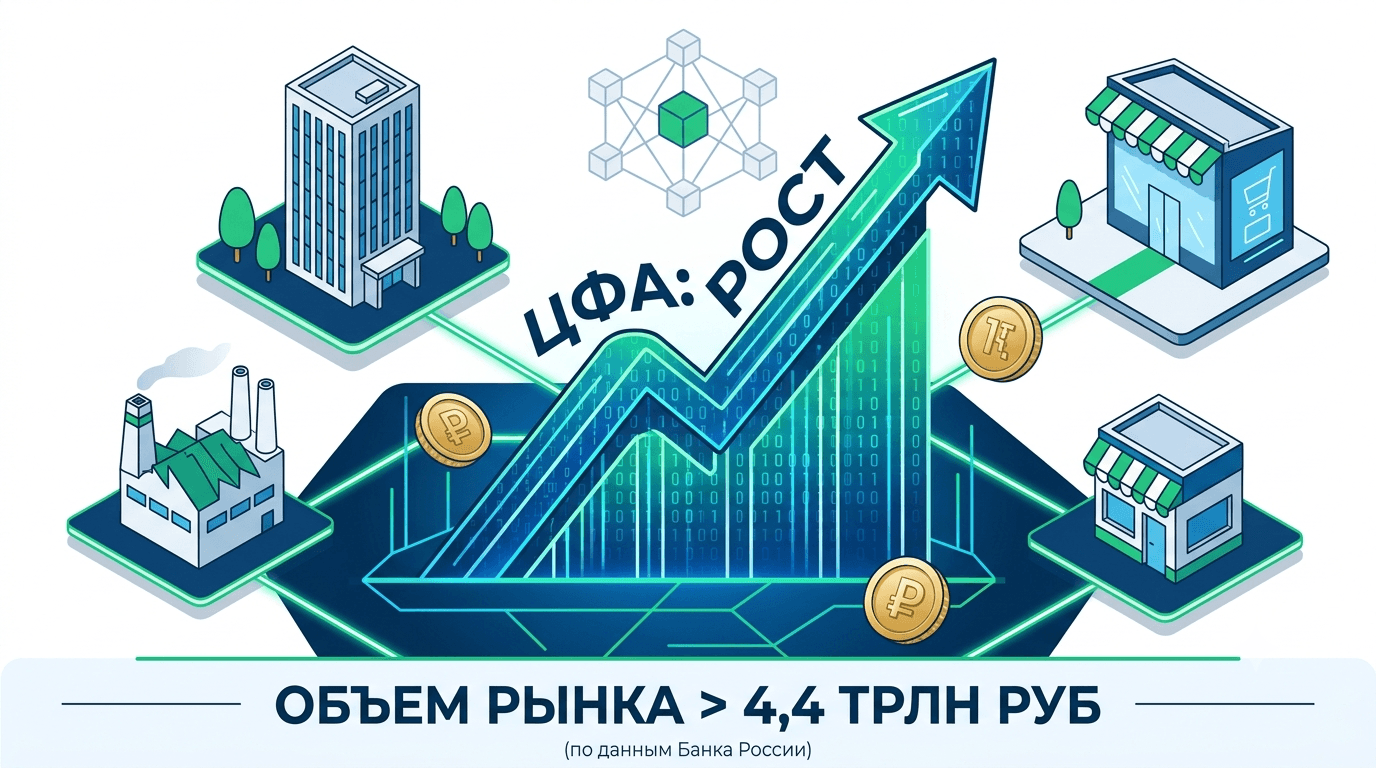
Can an instrument that appeared on the Russian financial market only a few years ago compete with traditional bonds? Yes — digital financial assets have already become a notable channel for raising capital. According to data from the Bank of Russia published in September 2026 in its draft Guidelines for the Development of the Financial Market for 2027–2029, Russian issuers have raised more than RUB 4.4 trillion through DFAs over the entire period of the market’s existence.
The market grew particularly quickly in 2026. According to the regulator, the value of DFA issues placed through information system operators during the first half of 2026 reached RUB 2.1 trillion — 26% more than during the whole of 2025. At the same time, the instrument is still used primarily for short-term debt financing: approximately 87% of issued DFAs are economically equivalent to short-term debt obligations. This article examines what this growth means for companies, investors, and the Russian capital market.
Why Has the DFA Market Exceeded RUB 4.4 Trillion?
The main conclusion is that DFA market growth is driven not by isolated experiments but by sustained business demand for alternative financing. According to Bank of Russia data from September 2026, the total amount raised through DFAs over the market’s entire operating period exceeded RUB 4.4 trillion.
DFAs allow a digital right to be issued on the platform of an information system operator. Depending on the issue terms, an investor may receive a cash flow linked to the issuer’s obligations, the value of an asset, or another legally permitted underlying basis. For businesses, the key advantages include faster deal structuring, digital document management, and the ability to approach investors without fully repeating the traditional securities issuance process.
However, RUB 4.4 trillion cannot automatically be treated as the volume of secondary-market turnover or the net amount of funds currently held by companies. It represents the aggregate value of issues placed and funds raised during the instrument’s period of operation. Some issues may already have been redeemed, while certain transactions may have been short-term in nature. The figure is therefore best understood as a measure of how extensively this financing channel has been used, rather than as the size of a single DFA portfolio.
How Quickly Is the Digital Financial Asset Market Growing?
The market is growing at an explosive pace: placements reached RUB 2.1 trillion in the first six months of 2026 alone. According to the Bank of Russia’s draft Guidelines for the Development of the Financial Market, published in September 2026, this was 26% more than the value of issues placed during the whole of 2025.
This comparison shows that the trend is not limited to a gradual increase in the number of transactions. During half of 2026, issuers placed DFAs worth more than the full-year result of the previous year. This may indicate that companies already view the digital format as a practical component of financial planning rather than as a test technology.
The institutional scale is also important. As of the beginning of September 2026, 25 information system operators through which DFAs are issued had been included in the Bank of Russia’s register. The greater the number of legal platforms operating in the market, the wider the potential choice of terms for issuers and investors. However, the number of operators alone does not guarantee an identical level of liquidity, reliability, or convenience: each platform and specific issue must be assessed separately.
The regulator characterizes the first years, 2022–2023, as the market’s formation stage. In 2026, the situation changed: interest in DFAs came not only from large financial and industrial companies but also from small and medium-sized enterprises. The expanding issuer base indicates that the digital format is gradually moving from a technological experiment to a corporate financing tool.
Are DFAs Replacing Traditional Bonds?
DFAs are already partially replacing traditional bonds in the short-term debt segment, but they are not yet a complete universal substitute. The Bank of Russia states that issuers primarily view DFAs as a short-term financing instrument, while approximately 87% of issued assets are economically identical to short-term debt obligations.
This means that a company receives funds for a defined period and assumes an obligation to fulfill the issue terms. Its economic function is similar to that of a short-term loan or debt instrument, even though its legal and technological structure differs from that of a bond.
Why Do Businesses Choose Short-Term DFAs?
The short-term format is convenient when a company needs to quickly cover a cash-flow gap, finance a purchase, accelerate working-capital turnover, or raise money for a specific transaction. A digital platform can reduce the number of paper-based operations and simplify interaction between the issuer and investors.
Speed is not the only consideration for an issuer. DFAs allow the terms of an offering to be customized more precisely: maturity, yield, redemption procedure, and additional conditions can be structured around a company’s specific needs. This is particularly relevant for businesses that do not fit the standard structure of a public bond issue.
Why Are DFAs Not Fully Displacing Bonds?
Traditional bonds remain a more mature instrument with established infrastructure, familiar record-keeping channels, and a more developed secondary market. Bonds also have a longer track record across different market cycles, while many institutional investors already have established procedures for analyzing and purchasing them.
DFAs still depend on the rules of the information system operator, the terms of the specific transaction, and the level of development of digital-rights trading. It is therefore more accurate to describe the relationship as competition and complementarity rather than a complete replacement of bonds. For some tasks, a traditional debt instrument may be more suitable; for others, a digital issue with a more flexible structure and shorter maturity may be preferable.
Who Issues DFAs, and Why Do SMEs Need Them?
DFAs are used by large financial and industrial companies as well as small and medium-sized enterprises. The emergence of SMEs among interested issuers shows that the digital instrument is becoming an alternative to traditional borrowing not only for the largest corporations.
For small and medium-sized businesses, access to the bond market may be limited by document-preparation costs, disclosure requirements, the required issue size, and the need to maintain relationships with a broad group of participants. DFAs can offer a more targeted model: a company raises funds for a clearly defined purpose and interacts with investors through a specialized platform.
The digital format does not eliminate credit risk, however. SMEs often have smaller liquidity buffers, so investors should examine the issuer’s financial condition, sources of repayment, and dependence on individual customers or suppliers. The technological nature of an issue is not proof of a company’s ability to pay.
Reputation also matters for the issuer. Successful redemption of digital issues can help establish a track record with investors and enable the company to raise funds on more favorable terms in the future. A payment delay, by contrast, may increase the cost of future financing.
Can Retail Investors Buy DFAs and Sell Them on the Secondary Market?
Yes, the 2026 regulatory framework creates conditions for broader retail-investor participation, but actual liquidity depends on the specific issue and the development of trading infrastructure. The Bank of Russia has announced measures aimed at enabling digital rights to trade on organized markets and allowing traditional financial intermediaries to enter the segment.
Previously, the main concern for retail investors was uncertainty about how to exit a position. If an asset could not be sold quickly before maturity, the investor had to plan to hold it until the end of its term. The lack of a familiar brokerage channel also made access and comparison of offerings more difficult.
What Changed in 2026?
In 2026, digital rights were permitted to circulate on organized markets — that is, regulated trading infrastructure. At the same time, traditional financial intermediaries, including brokers and banks, were allowed to participate in this segment.
The Bank of Russia stated the purpose of these measures directly: to provide retail investors with broader access to digital instruments and expand issuers’ ability to attract investment. In the future, this means investors may be able to use a more familiar financial interface and potentially buy or sell DFAs through established infrastructure.
However, permission to trade on organized markets does not equal guaranteed liquidity. An active market requires a sufficient number of buyers and sellers, transparent information, an acceptable spread, and regular demand. If an issue is small or its terms are unattractive to the market, a sale may take time or require the seller to accept a lower price.
Before buying, a retail investor should check whether a secondary market exists for the specific issue, who acts as the operator, what fees apply, and whether the asset can be sold early. The investor should also study the default procedure, redemption terms, and restrictions applicable to the relevant investor category.
Is the DFA Market Really Experiencing a Boom Rather Than a Speculative Wave?
Available indicators point to a genuine boom in the use of the instrument, although they do not eliminate market risks. Placements totaled RUB 2.1 trillion in the first half of 2026, exceeding the result for all of 2025 by 26%. At the same time, the number of information system operators in the Bank of Russia’s register reached 25 at the beginning of September 2026.
These figures confirm an inflow of issuers and capital. Importantly, growth is visible not only in the prices or turnover of already issued assets but also in the volume of new placements. Companies are genuinely using DFAs to raise funds, while investors are participating in the financing of these transactions.
Nevertheless, the term “boom” should not be turned into a promise of guaranteed returns. Rapid growth of a young infrastructure may be accompanied by differences in platform quality, limited historical data, and varying levels of issuer transparency. Market participants may also overestimate the convenience of the digital format and underestimate the ordinary risk of non-repayment.
The market’s maturity should therefore be assessed using several indicators: the share of issues redeemed without violations, the stability of repeat placements, the quality of disclosure, the functioning of secondary-market turnover, and issuer diversity. The RUB 4.4 trillion figure is a strong measure of scale, but it is not by itself a guarantee of the reliability of every DFA.
What Risks Do Issuers and Investors Face?
The main risks relate to issuer creditworthiness, liquidity, platform terms, and the difficulty of evaluating a new instrument. Investors should not focus only on the stated yield or the reputation of the information system operator.
Credit risk is the possibility that a company will fail to fulfill its obligation in full or on time. Since a significant share of DFAs is economically equivalent to short-term debt, the issuer’s financial position is of primary importance. Investors should analyze revenue, cash flow, debt burden, and the source of repayment.
Liquidity risk is the possibility that an asset cannot be sold quickly at a fair price. Even after digital rights are admitted to organized markets, a particular issue may attract few bids. If an investor expects to exit early, the rules governing circulation should be checked in advance.
Operational risk is connected with platform performance, access to the digital wallet, identification, and the execution of technological procedures. Investors need to understand where the right is recorded, how ownership is confirmed, and where to turn in the event of a disputed transaction.
Finally, there are regulatory and tax risks. The rules governing the DFA market continue to develop, so it is important to study current requirements, investor status, and tax consequences before entering a transaction. This informational material is not an individual investment recommendation.
How Will DFAs Change the Russian Capital Market?
DFAs will most likely expand the short-term financing market and gradually connect digital platforms with traditional financial infrastructure. For issuers, this means more ways to raise funds; for investors, it means an additional class of instruments with different trading and settlement terms.
Integration with organized markets and traditional intermediaries will be the key factor. If brokers and banks provide convenient access and trading venues establish sustainable demand, DFAs could move from predominantly primary placements to a complete life cycle — issuance, circulation, and redemption.
At the same time, the market should not develop solely through quantitative growth. Its quality will be determined by transparency, clear disclosure standards, investor protection, and the comparability of terms across issues. The easier it is for a participant to compare yield, maturity, risk, and liquidity, the more sustainable demand will be.
For companies, DFAs will be particularly useful where short-term and precisely structured financing is required. For long-term infrastructure projects or broad public investment, traditional bonds and bank loans may remain more suitable. The likely result is not the disappearance of existing instruments but a more specialized financial ecosystem.
Beyond the Headlines: What KuCoin 5.0 Means for You
Market news moves fast — but where you act on it matters just as much. This October, KuCoin launches KuCoin 5.0, transforming KuCoin into a rebuilt platform. Here's what actually changes for you:
-
One account for everything. Older platforms split your money across separate "spot," "margin," and "futures" accounts and expected you to understand why. KuCoin 5.0's unified account removes that entirely — deposit once, and everything is simply there.
-
Stocks, indices, and commodities. KuCoin 5.0 expands beyond crypto into global markets. When crypto chops sideways and equities rally (or the reverse), you rotate in minutes instead of opening a brokerage account and waiting days for fiat rails.
-
Real-world assets (RWA). Tokenized exposure to traditional assets like commodities, right inside your crypto account. One of the fastest-growing segments in global finance is no longer reserved for institutions — you access it from the same balance you trade with.
-
Earn while you learn. Not ready to trade? KCUSD lets your stablecoins earn daily, auto-compounding interest. The lowest-stress way to put your idle deposit to work for 4% yield.
-
An AI assistant in plain language. Ask questions, get market context, understand what you're looking at — built into the platform, no jargon required.
-
An app that doesn't overwhelm. Faster, cleaner, and consistent — intuitive from the first tap, not after a tutorial.
-
Safety you can check, not just trust. A MiCAR-licensed EU entity, Proof of Reserves you can verify yourself, and internationally certified security (SOC 2 Type II, ISO 27001:2022).
Create your account in minutes — and start on the platform built for where crypto is going, not where it's been.
Conclusion
The Russian DFA market has reached an important milestone: the total amount raised by issuers over the entire period of its operation has exceeded RUB 4.4 trillion. According to the Bank of Russia, placements totaled RUB 2.1 trillion in the first half of 2026 — 26% more than during the whole of 2025. The number of information system operators in the regulator’s register reached 25 at the beginning of September 2026.
The main practical role of DFAs today is short-term financing. Approximately 87% of issues are economically equivalent to short-term debt obligations, meaning that the digital format is already partially competing with traditional loans and bonds. Both large companies and SMEs are showing interest in the instrument.
The next stage concerns liquidity. The measures introduced in 2026 open the way for digital rights to trade on organized markets and allow traditional financial intermediaries to participate, which may broaden retail-investor involvement. But the ability to trade does not guarantee a quick sale. Each issue must still be assessed separately in terms of the issuer, terms, platform, and risks.
Frequently Asked Questions
1. Do I need to qualify as an investor to buy DFAs?
Requirements depend on the specific issue, operator, and applicable regulations. Before entering a transaction, check the access conditions, testing requirements, and restrictions for your investor category.
2. How Do DFAs Differ From Cryptocurrencies?
DFAs represent digital rights issued under a regulated Russian framework, whereas cryptocurrencies generally do not represent a claim against a specific issuer. Their legal status, return mechanism, and risks differ.
3. Can I Earn Income From a DFA Before Its Maturity Date?
It depends on the issue terms. Income may be paid periodically, at redemption, or through the sale price on the secondary market. The applicable arrangement must be confirmed in the documentation for the specific DFA.
4. What Happens if an Information System Operator Stops Operating?
The procedure is determined by legislation, the operator’s rules, and the issue documents. Investors should check in advance how rights are recorded, who is responsible for servicing them, and whether a mechanism exists for transferring the data to another operator.
5. Why Can DFA Yields Be Higher Than Bank Deposit Rates?
A higher yield usually compensates for additional risks — issuer credit risk, lower liquidity, and more complex infrastructure. DFAs should be compared with deposits not only by their interest rate but also by the probability of loss and the conditions for early exit.
Disclaimer : This material is provided for informational purposes only and does not constitute financial, investment, legal, or tax advice. Transactions involving cryptocurrencies and tokenized assets carry substantial risks — including price volatility, limited liquidity, counterparty exposure, and the potential for total loss of invested capital. Readers should conduct their own research and, where appropriate, consult a qualified professional before making any financial decisions.