

Russia’s Digital Ruble: 87,000 Accounts in the First 10 Days—What It Means for Users
Introduction
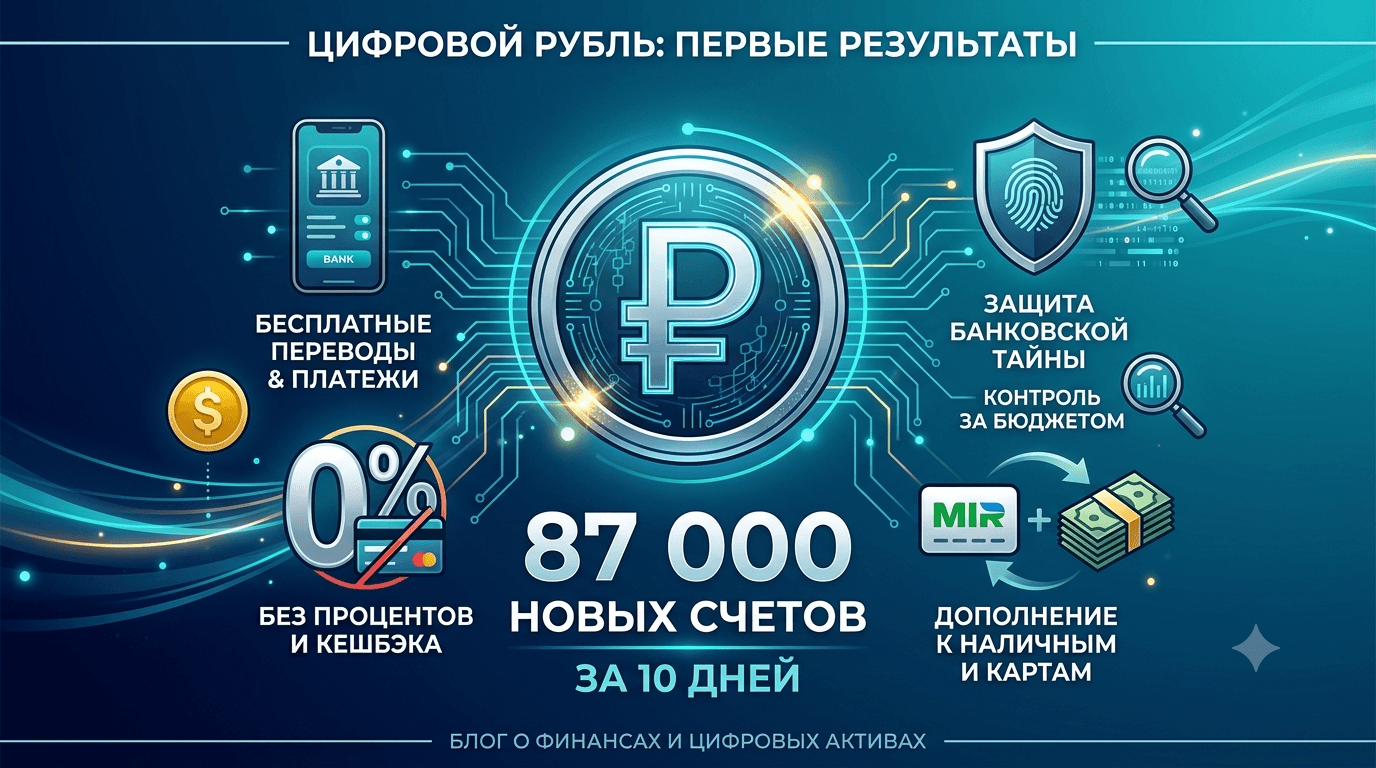
What can be inferred from 87,000 new accounts in just 10 days? Since September 1, 2026, when the digital ruble entered its broad rollout, Russians have opened 87,000 digital accounts and completed around 50,000 transactions. Bank of Russia Governor Elvira Nabiullina reported these figures on September 11; Frank Media also cited them, referring to the central bank chief’s remarks. She assessed the launch as normal, although some banks experienced delays in opening wallets and processing transactions during the first few days.
The main takeaway is straightforward: the digital ruble is now an available payment tool, but it does not yet replace cash or conventional bank accounts. It operates on the centralized Bank of Russia platform, earns no interest or cashback, and remains voluntary to use. Therefore, the first 87,000 accounts demonstrate interest in the new format, but do not yet prove a mass shift by citizens to digital currency.
What Happened in the First 10 Days After the Digital Ruble Launch?
During the first 10 days, Russians opened 87,000 digital-ruble accounts and completed around 50,000 transactions. Elvira Nabiullina announced these statistics at a key-rate meeting on September 11, 2026; the same figures were published by Frank Media and Procfa. Since the digital ruble circulates on a single platform, separate regional account statistics are not yet maintained.
The launch took place on September 1, 2026. In the initial stage, users of connected banks gained access to wallets, while banks were required to gradually enable clients to open an account, top it up, and make payments. Consequently, the number of accounts cannot automatically be treated as the number of active users. Some people opened a wallet to test the new service but have not yet begun using it regularly.
The figure of 50,000 transactions is important in precisely this context. It shows that digital wallets were used for more than formal registration, but transaction frequency remains low relative to the number of accounts opened. On average, this is roughly one transaction for every two opened accounts over the period in question, although the average does not reveal how many users made multiple payments.
Why Are Russians Opening Digital Accounts When Conventional Cards Already Work?
The primary reasons for interest in the digital ruble are free transfers and payments for individuals, as well as the desire to test a new form of the national currency. The Bank of Russia positions the digital ruble as a third form of money alongside cash and non-cash rubles. One digital ruble retains the face value of a conventional ruble, but it is held and transferred on a separate central bank platform.
For users, this means a new way to pay for goods, services, and transfers without being tied to a specific bank card. A wallet is opened through the app of a connected commercial bank, but the digital money itself is recorded on the Bank of Russia platform. When changing banks, access to the wallet should not become a need to move money between cards issued by different institutions.
Another motive is the potential convenience of government payments and targeted disbursements. The digital ruble makes it possible to predetermine the purpose of funds and track their movement under established rules. For the state, this improves oversight of budget spending, while for citizens it may make certain payments more transparent. However, this scenario does not mean that all salaries, pensions, or benefits will automatically be moved to digital rubles.
The first 10 days also reflect a novelty effect. Elvira Nabiullina noted that many people are simply testing account opening and checking how the service works. Therefore, 87,000 wallets are above all an indicator of initial interest, rather than a final assessment of demand for the digital ruble.
Does the Central Bank Control Every Transaction, and Does This Violate Banking Secrecy?
The digital ruble is not anonymous, but transactions involving it are protected by Russian banking secrecy. The key difference is that the digital-ruble platform is centralized: its sole operator is the Bank of Russia, rather than a distributed network of independent nodes, as in some cryptocurrency systems.
This has a dual effect. On the one hand, information about a wallet and its payments should not become publicly available simply because a transaction was made in digital rubles. Access to banking information is regulated by law, and an ordinary user cannot view someone else’s transactions.
On the other hand, the absence of anonymity means financial monitoring can operate more effectively. Authorized government bodies, including Rosfinmonitoring, may track the movement of funds under procedures prescribed by law. This oversight is intended to combat money laundering, corruption, the financing of illegal activity, and other suspicious transactions.
Accordingly, the accurate formulation is as follows: the Bank of Russia does not acquire the right to arbitrarily publish citizens’ personal payments, but the digital ruble was not created as anonymous money. It is a regulated payment tool with more centralized infrastructure and more convenient government oversight.
Will People Be Required to Receive Salaries and Pensions in Digital Rubles?
No, citizens should not be compelled to receive salaries, pensions, or government payments in digital rubles. The principle of voluntary participation has been repeatedly emphasized by Bank of Russia Governor Elvira Nabiullina and Russian government representatives. Users may choose cash, a traditional bank transfer, a national payment system card, or a digital wallet.
The digital ruble complements existing forms of money; it is not a mandatory replacement for cash and non-cash rubles. If a person does not want to open a digital account, they may continue using their familiar banking app and card. An employer should not make opening a digital wallet a condition for paying wages.
Voluntary participation is also important when interpreting the statistics. Growth in the number of wallets in the first weeks does not mean the state has moved the population to a new system compulsorily. Users independently decide to open an account to test the service or use it for specific payments.
The range of use cases may expand in the future, but the fundamental principle of choice remains central. Before opening a wallet, users should review their bank’s terms, operational availability, and app compatibility, rather than assume that cards or cash will inevitably be abandoned.
Why Does a Digital Wallet Not Earn Interest or Cashback?
A digital wallet is not a deposit or investment account, so no interest is accrued on its balance and standard bank cashback is not available. The legal framework for the digital ruble defines it primarily as a payment and settlement tool, rather than a vehicle for saving.
The absence of interest protects the banking system from a mass outflow of funds. If a digital wallet generated income on its balance, citizens could move a substantial portion of their savings from commercial banks to the central bank platform. This would create a “deposit outflow” effect and reduce banks’ funding base for lending to businesses and households.
Cashback also has an economic rationale. A commercial bank typically funds customer rewards from the commission it receives from a merchant for a card transaction. The materials provided state that the conventional fee can be roughly 1.5–2.5 percent, whereas accepting digital rubles for businesses is expected to carry a far lower rate—up to 0.3 percent, and up to 0.2 percent for utility payments.
Under this model, banks and payment intermediaries have less revenue available to fund cashback. Therefore, free transfers for citizens and a low commission for merchants are advantages of the digital ruble, but the lack of interest and bonuses is an inherent limitation. Keeping only the money one plans to spend in the wallet is generally more logical than using it as a substitute for a savings account.
Will Commercial Banks Resist the Digital Ruble?
The largest systemically important banks are required to connect to the digital-ruble platform according to an established schedule, so this is not a matter of banks’ free choice, but of phased compliance with mandatory requirements. Organizations mentioned in connection with the rollout include Sberbank, VTB, and T-Bank.
For banks, the digital ruble creates a mixed economic effect. On the one hand, they need to invest in integrating apps, customer interfaces, and internal systems. In addition, some transactions may move from the card ecosystem to infrastructure with lower fees. This reduces potential income from acquiring and certain payment services.
On the other hand, commercial banks remain an important channel for interaction with customers. It is through their apps that users can open a digital wallet and receive support. The central platform does not eliminate banks from the entire chain; instead, it changes the allocation of functions among the operator, the credit institution, and the merchant.
The transition schedule and tariff rules should reduce the risk of a sharp conflict of interests. Banks are given time to connect, while the low cost of digital payments may increase transaction volumes and attract new customers. Therefore, the most realistic scenario is not banks rejecting the digital ruble, but their gradual adaptation of business models.
What Limits and Fees Apply to Individuals?
The main limit for an individual is RUB 300,000 per month when topping up a digital wallet from their regular bank account. This threshold applies specifically to moving money from the traditional non-cash system into the digital one, rather than to all transactions within the wallet.
Internal transfers and spending payments are not subject to this monthly limit in the same sense. A user may send digital rubles to another person or pay a merchant without a fee. The Bank of Russia separately states that P2P transfers and payments by individuals are free under the current launch terms.
Businesses are subject to a low fee for accepting digital rubles. The provided information sets a cap of 0.3 percent for regular payments and 0.2 percent for housing and utility payments. This is substantially lower than the indicative card fee of 1.5–2.5 percent, so the digital ruble may be particularly attractive to merchants with a high volume of small payments.
Users should distinguish between three concepts: topping up a wallet, transferring funds between digital wallets, and paying for a purchase. The RUB 300,000 limit applies to the first scenario, while the absence of fees applies primarily to the second and third. Before conducting a large transaction, users should check their bank’s current rules, as technical implementation and user interfaces may differ.
Can You Use the Digital Ruble Without Internet Access?
At the current stage, a full offline payment is not yet available as a mass-market feature, so a network connection is required to use a digital wallet. This restricts digital-ruble use in areas with weak signal, during temporary mobile-internet outages, or when the banking app is unavailable.
The Bank of Russia views offline payments as one feature of the next development stage. A “dual offline” mechanism is planned, under which both the payer and the recipient will be able to complete a transaction without a persistent internet connection. This may use secure smartphone elements and special payment-synchronization rules.
For now, users should treat offline mode as a prospective rather than operational capability. Cash remains an important backup method of payment precisely because it does not require connection to the platform at the moment of purchase.
At the same time, the Bank of Russia states that the digital platform is being built with protection against attacks, redundancy, and disaster recovery in mind. These measures should reduce the likelihood of a prolonged outage, but no digital system can fully eliminate technical risks. Therefore, at this early stage, it is sensible not to keep in the wallet an amount needed for all day-to-day expenses.
Why Did Early Users Encounter Errors and Delays?
The problems in the early days were linked to the technical configuration of interaction between banking apps and the new platform, rather than a fundamental inability of the digital ruble to function. Elvira Nabiullina said that certain credit institutions encountered difficulties opening accounts and processing transactions, but these were promptly resolved; the central bank did not observe mass complaints.
Users encountered several typical scenarios: they could not quickly find the digital-wallet section in the app, received an error when creating an account, or could not top it up immediately. Another factor was that feature availability differed across mobile platforms at launch. Frank Media reported that the iOS launch was postponed, while Android users were particularly affected by initial limitations on the first day.
Such disruptions are typical when launching infrastructure used simultaneously by banks, merchant organizations, and a government platform. The Bank of Russia identified improving the customer journey—reducing the number of steps required to open a wallet without weakening security—as a separate area of work.
A user who encounters an error should update their banking app, check service availability, and contact their bank’s support team. They should not create several wallets in succession or repeat a payment many times until the status of the previous transaction has been confirmed.
How Do You Open and Use a Digital Ruble in Russia?
To begin using the digital ruble, first check whether your bank supports the feature, then open a digital wallet through its app and top it up within the established limit. The specific names of sections depend on the bank, so there is no universal interface for all customers.
After opening a wallet, a user can transfer rubles into it from their regular account, send money to another user, or pay for a purchase at a connected merchant. Before making a payment, it is important to ensure that the merchant accepts digital rubles and that the app displays the correct amount and transaction status.
The digital ruble does not require buying cryptocurrency, mining, or creating a blockchain address. It is an official form of the Russian ruble operating in a regulated centralized system. Therefore, it is incorrect to compare it directly with Bitcoin or other decentralized assets.
At the first stage, it is useful to make a small test transaction. This makes it possible to check the speed of crediting, the availability of refunds, and how the bank displays payment history. If the service is not yet convenient or the desired merchant does not accept it, users may continue using a card or cash without any penalties.
How Can You Buy or Use the Digital Ruble Through KuCoin?
The digital ruble cannot be bought or traded on KuCoin as a cryptocurrency asset: it is a national form of the Russian ruble, not a token listed on a cryptocurrency exchange. To open a digital wallet and make payments, users need to use a connected Russian bank and the Bank of Russia platform.
However, KuCoin users can follow developments in central bank digital currencies, payment infrastructure, and digital-asset regulation through educational content and market analysis. Before registering or trading on a cryptocurrency platform, users should check service availability in their jurisdiction, identification requirements, and applicable rules.
The key distinction should be maintained: the digital ruble is designed for settlements and does not earn interest, while crypto assets may have a market price, higher volatility, and other risks. Funds should not be transferred to an exchange in an attempt to obtain digital rubles or use cryptocurrency as a substitute for the official wallet.
Beyond the Headlines: What KuCoin 5.0 Means for You
Market news moves fast — but where you act on it matters just as much. This October, KuCoin launches KuCoin 5.0, transforming KuCoin into a rebuilt platform. Here's what actually changes for you:
-
One account for everything. Older platforms split your money across separate "spot," "margin," and "futures" accounts and expected you to understand why. KuCoin 5.0's unified account removes that entirely — deposit once, and everything is simply there.
-
Stocks, indices, and commodities. KuCoin 5.0 expands beyond crypto into global markets. When crypto chops sideways and equities rally (or the reverse), you rotate in minutes instead of opening a brokerage account and waiting days for fiat rails.
-
Real-world assets (RWA). Tokenized exposure to traditional assets like commodities, right inside your crypto account. One of the fastest-growing segments in global finance is no longer reserved for institutions — you access it from the same balance you trade with.
-
Earn while you learn. Not ready to trade? KCUSD lets your stablecoins earn daily, auto-compounding interest. The lowest-stress way to put your idle deposit to work for 4% yield.
-
An AI assistant in plain language. Ask questions, get market context, understand what you're looking at — built into the platform, no jargon required.
-
An app that doesn't overwhelm. Faster, cleaner, and consistent — intuitive from the first tap, not after a tutorial.
-
Safety you can check, not just trust. A MiCAR-licensed EU entity, Proof of Reserves you can verify yourself, and internationally certified security (SOC 2 Type II, ISO 27001:2022).
Create your account in minutes — and start on the platform built for where crypto is going, not where it's been.
Conclusion
The first launch results show that the digital ruble quickly drew the attention of Russians: 87,000 digital accounts were opened and around 50,000 transactions completed in the 10 days after September 1, 2026. According to figures announced by Elvira Nabiullina on September 11 and published by Frank Media and Procfa, the rollout proceeded normally, although certain banks initially encountered errors and delays.
The digital ruble is a centralized third form of the Russian ruble, not a cryptocurrency or an anonymous payment tool. Transactions are protected by banking secrecy, but may be tracked by authorized bodies as part of financial monitoring. Receiving salaries, pensions, and benefits in digital rubles remains voluntary.
The wallet earns no interest or cashback because it is designed for settlements, not savings. Top-ups from a bank account are limited to RUB 300,000 per month, while user-to-user transfers and payments by individuals are free. Offline mode is still under development, so the service depends on network connectivity. As a result, the digital ruble does not appear to be a mandatory replacement for cards and cash, but rather an additional tool whose usefulness will be determined by convenience, bank coverage, and the number of merchants that accept it.
Frequently Asked Questions
1. Can You Opt Out of the Digital Ruble After Opening a Wallet?
Yes. Opening a wallet does not deprive a user of the right to use cash or a regular bank account. Before closing or blocking a wallet, users should check the procedure in their banking app for withdrawing any remaining digital rubles.
2. Can You Transfer Digital Rubles Back to a Bank Card?
Yes, digital rubles can be transferred to a regular bank account through a supported bank. The precise procedure depends on the interface of the relevant credit institution and its current technical rules.
3. Can You Receive a Loan in Digital Rubles?
No, a digital wallet is not intended for lending, overdrafts, or interest accrual. Credit products continue to be arranged through commercial banks and their standard infrastructure.
4. What Happens to Digital Rubles When You Change Banks?
Changing banks should not make digital rubles money that is accessible only through the former app. However, the new bank must support the corresponding service, so users should check its connection to the platform before switching.
5. Is Holding Digital Rubles Safer Than Holding Money on a Card?
It is not possible to say unequivocally that one option is safer in every case. The digital ruble is protected centrally by the Bank of Russia, while a bank card depends on a commercial bank’s infrastructure. At the same time, a digital wallet requires an internet connection and does not support standard cashback, so the choice depends on the purpose and conditions of use.
Disclaimer : This material is provided for informational purposes only and does not constitute financial, investment, legal, or tax advice. Transactions involving cryptocurrencies and tokenized assets carry substantial risks — including price volatility, limited liquidity, counterparty exposure, and the potential for total loss of invested capital. Readers should conduct their own research and, where appropriate, consult a qualified professional before making any financial decisions.