

Prison Time for Cryptocurrency in Russia: What Happens for Illegal Digital Money Exchange
2026/07/09 16:14:00
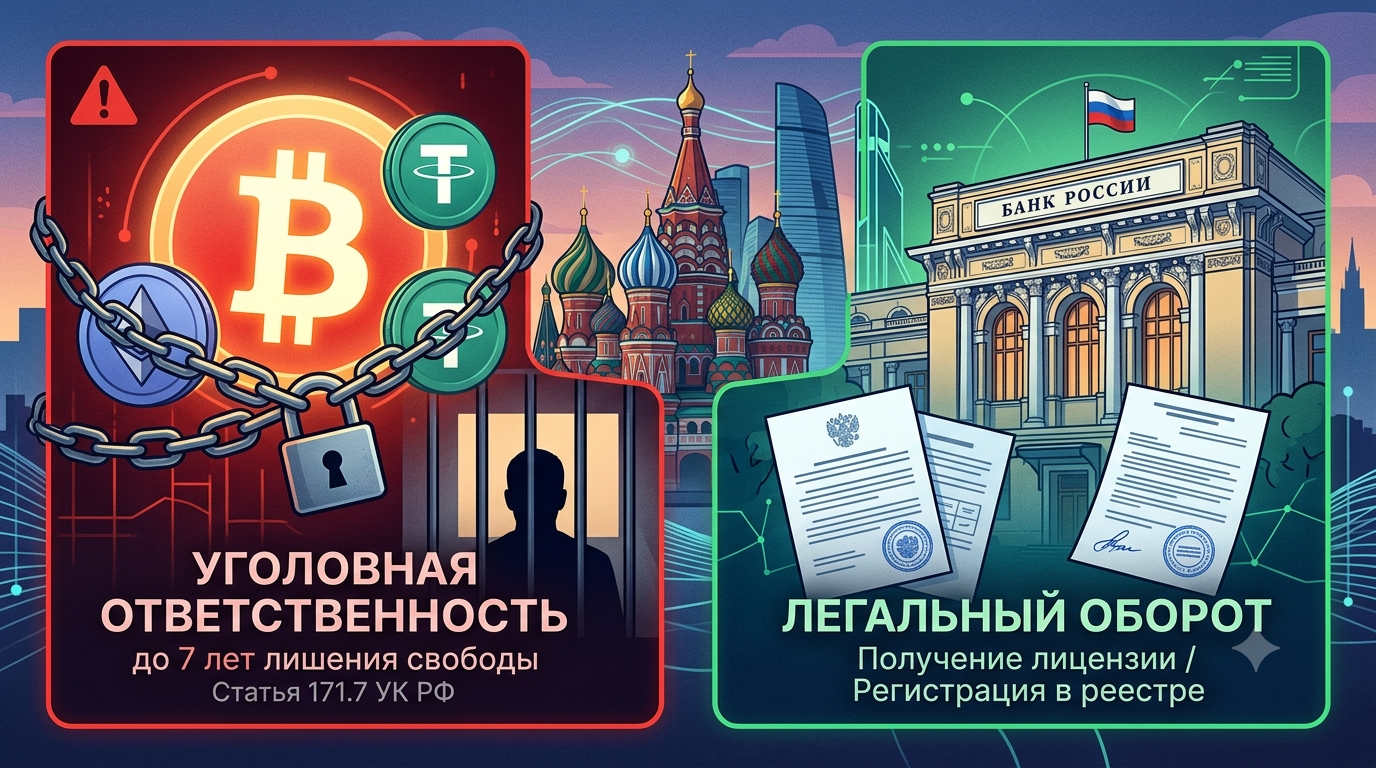
On July 8, 2026, the State Duma passed in its first reading a government bill introducing criminal liability for illegally organizing digital currency circulation in Russia — the maximum penalty under the new provision will be up to seven years in prison. This is not about owning cryptocurrency itself, but about organizing illegal exchange operations — operating without registration or a Bank of Russia license in cases where income or damages exceed an established threshold.
The rule primarily targets organizers of illegal exchange platforms, underground "obmenniki" (exchange points), and large OTC dealers operating without Central Bank authorization. The changes are set to take effect on July 1, 2027 — giving the market a transition period to bring operations into compliance with the new requirements.
Why a New Article of the Criminal Code Was Needed
The main reason is the rapid growth of the illegal exchange sector, which the state could not control under existing rules. Before the amendments, the activities of underground exchangers and unregistered OTC dealers formally fell under general statutes on illegal banking activity or fraud, creating legal uncertainty and complicating law enforcement.
Alongside the criminal statute, the government submitted a package of three interconnected documents to the State Duma: the main law "On Digital Currency and Digital Rights," amendments to the Administrative Offenses Code establishing liability for exchangers, and a separate draft of the new Article 171.7 of the Criminal Code. This comprehensive approach is meant to close the legal vacuum at three levels simultaneously — from legal circulation infrastructure to criminal prosecution of organizers of gray-market schemes.
The chairman of the relevant State Duma committee on financial markets stated his intention to pass the entire package during the spring session by the end of July 2026, underscoring the priority given to this issue by lawmakers.
Who Is Affected by the New Criminal Liability for Cryptocurrency
Criminal prosecution threatens organizers of illegal exchange schemes — not ordinary holders of digital assets. According to the explanatory note to the bill, liability arises for organizing digital currency circulation without the registration or special permit required for such activity.
Three categories are at risk:
-
operators of crypto platforms working without a Bank of Russia license;
-
organizers of underground exchange points (obmenniki);
-
professional OTC dealers conducting operations at industrial scale without registration.
An ordinary purchase or sale of cryptocurrency by a private individual for personal use is not "organizing circulation" and does not fall under this statute. The offense requires organized, systematic activity with the hallmarks of a business: a client base, regular income from intermediary operations, and infrastructure for processing multiple transactions.
The Role of the Investigative Committee and FSB
Investigators from the Investigative Committee of Russia and the FSB will handle these cases — corresponding amendments are simultaneously being introduced into the Criminal Procedure Code. This cements the division of authority between agencies and signals the seriousness of the state's intentions: cases under Article 171.7 will be handled by the same agencies that investigate economic crimes and illegal-activity financing cases.
What Amounts Turn a Violation into a Criminal Offense
Criminal liability only arises when income or damages exceed a set threshold — without this element, no offense exists. The rule operates on two tiers, and a mandatory element of the offense is precisely the socially dangerous consequence in the form of damage or income of a certain size.
| Threshold | Amount | Maximum Penalty |
| Large scale | over 3.5 million rubles (~$38,000) | up to 4 years in prison or a fine of 100,000–300,000 rubles |
| Especially large scale / organized group | over 13.5 million rubles (~$150,000) | up to 7 years in prison with a fine of up to 1 million rubles |
For offenses at the large scale, the penalty is a fine of 100,000 to 300,000 rubles or an amount equal to the convicted person's income over a period of one to two years, or alternatively — forced labor or imprisonment for up to four years. If the act is committed by an organized group or involves especially large income, the penalty is increased to forced labor for five years or imprisonment for up to seven years with a fine of up to 1 million rubles.
Possibility of Release from Liability
The bill provides a mechanism for mitigating consequences for those who voluntarily remedy the violation. By analogy with the parallel bill on illegal mining, the document allows for the possibility of releasing from criminal liability persons guilty of organizing illegal circulation, in the event of full compensation for the damage caused. This gives organizations an incentive to settle claims before a case goes to trial.
Are Ordinary P2P Users at Risk of a Criminal Case
Small, one-off P2P exchanges by private individuals do not constitute "organizing" circulation and do not fall under the criminal statute. The key condition for liability is systematic, organized activity generating income above 3.5 million rubles — not a single transaction between two users.
Administrative sanctions are being prepared in parallel: for an illegal transaction by an exchange organization with a Russian non-qualified investor, a fine is provided for officials — from 30,000 to 50,000 rubles with possible disqualification for 1–2 years, and for legal entities — from 700,000 to 1 million rubles. These Administrative Offenses Code provisions also take effect on July 1, 2027, and target exchange companies, not private traders.
Thus, the regulation is targeted: administrative and criminal liability falls specifically on organizations and professional intermediaries operating without a license or in violation of rules regarding non-qualified clients. A private user conducting one-off transactions for personal needs need not worry about the new statute.
What Distinguishes "Organizing Circulation" from an Ordinary Transaction
In practice, the line runs through several factors: regularity of operations, advertising of exchange services to third parties, use of infrastructure to accept payments from an unlimited circle of clients, and extraction of profit specifically from an intermediary margin rather than from the appreciation of an asset. An investor who buys cryptocurrency and later sells it at a higher price acts differently from an operator profiting from the spread between buy and sell rates across many clients.
How the State Is Steering Retail Investors Toward CFAs
The Bank of Russia is consistently promoting digital financial assets (CFAs) as a regulated alternative to decentralized cryptocurrencies for retail investors. These are tokens issued by licensed banks — such as Sberbank and T-Bank — and backed by gold or corporate assets.
For non-centralized instruments like bitcoin and USDT, the logic is different: retail investors may eventually need to pass a financial test and obtain qualified investor status in order to legally trade them on Russian licensed platforms. Under the package's discussed parameters, an annual purchase limit for non-qualified participants of up to 300,000 rubles was also considered — the specific test parameters and limits will be finalized as the legislative package is refined ahead of the second reading.
Which Assets Will Be Allowed on Licensed Exchanges
The discussed criteria for admitting assets to organized trading are fairly strict: average market capitalization of over 5 trillion rubles over two years, average daily trading volume of at least 1 trillion rubles over the same period, and a trading history of at least five years. The largest global assets — bitcoin, Ethereum, and a number of other coins with a long history and high liquidity — already meet these parameters. Smaller-cap and younger tokens will not make it onto Russia's regulated platforms under the law's current configuration.
This is part of a three-tier regulatory system: legal circulation infrastructure, administrative sanctions for violating trading rules, and criminal prosecution for organized illegal activity. Each tier addresses its own task — from protecting inexperienced investors to suppressing large gray-market schemes.
Why Russia Is Running a Cross-Border Crypto Settlement Experiment
Russia is simultaneously easing rules for foreign trade settlements, creating a controlled channel for business's international payments. Under the experimental legal regime (ELR), companies are permitted to use cryptocurrency to pay for imports and exports within a special regulatory "sandbox."
The regulator's logic is bipolar. For state-owned banks and large export-import companies, a green corridor is open — using cryptocurrency is encouraged as a tool for countering Western sanctions and sustaining foreign trade settlements. For private capital, capital-flight schemes, money laundering, and gray exchange infrastructure, the opposite approach applies — up to seven years in prison. In this way, the state seeks to prevent the outflow of already-limited foreign currency liquidity through uncontrolled channels.
Who Has Access to the Experimental Regime
Participation in the ELR is limited to companies included in a special Bank of Russia registry and does not extend to individuals or unaccredited organizations. This is a fundamental distinction from the retail market: where business is given a channel for crypto settlements to support trade, individuals simultaneously face tightening requirements for qualified investor status.
What the Changes Mean for Exchangers and OTC Platforms
Companies providing digital currency exchange services will have to operate through the Bank of Russia's registry or leave the market. As of July 1, 2026, legally buying and selling cryptocurrency in Russia is only possible through licensed intermediaries — brokers, exchange operators, and managers included in the Central Bank's registry.
A separate statute on criminal liability for illegal mining is being developed — with the same large-scale threshold of 3.5 million rubles and a prison term of up to five years. According to the Federal Tax Service, around 50,000 entities in Russia potentially engage in cryptocurrency mining, yet only about 1,489 are included in the official registry — the regulator cites this as one argument in favor of tightening liability. Representatives of the relevant State Duma committee have pointed out that illegal mining has already become a systemic problem: unregistered farms overload power grids, cause substation failures, and lead to power outages for law-abiding consumers.
International Platforms Outside the Russian Registry
For international platforms that have no physical presence or license in Russia and work with clients through standard identification procedures, the new rules create a different legal contour — they do not fall under the requirements for local registration with the Bank of Russia, since they do not organize circulation on Russian territory within the meaning of the law. This makes such platforms a separate category, regulated according to the rules of the jurisdiction where they are licensed.
Is It Worth Trading Cryptocurrency on KuCoin
For those who want to trade global crypto assets without going through Russia's investor qualification procedure, an international platform like KuCoin remains a viable option. KuCoin offers a secure peer-to-peer (P2P) channel and multi-currency channels for deposits and withdrawals, and access to the platform requires only standard international KYC — identity verification — without additional local qualification tests.
KuCoin offers thousands of assets — from major coins like bitcoin and Ethereum to smaller-cap tokens — providing a wider selection than the limited list of assets permitted for trading on Russian licensed platforms. Before starting to trade, it's worth assessing one's own risk tolerance: cryptocurrency remains a highly volatile asset class, and each investor makes their own decision about the nature and scale of their operations, taking into account the legal requirements of their jurisdiction.
Conclusion
The new Article 171.7 of the Criminal Code introduces criminal liability of up to seven years in prison for organizing illegal cryptocurrency circulation — but it targets organizers of illegal exchange schemes and underground platforms, not private holders of digital assets. Criminal liability begins at income or damages exceeding 3.5 million rubles, and the especially large scale — over 13.5 million rubles — giving the system clear quantitative criteria for enforcement.
Alongside the crackdown on illegal intermediaries, the state is building legal infrastructure: a registry of licensed operators, digital financial assets as a regulated alternative, and an experimental cross-border settlement regime for business. The changes take effect on July 1, 2027, leaving the market a transition period to adapt, and cases will be investigated by the Investigative Committee and the FSB.
For private investors, the key takeaway is simple — occasional small transactions do not constitute a crime, while organizing commercial exchange activity without a license carries serious risks, including actual prison time. International platforms with transparent KYC procedures remain an alternative for those who prefer not to go through local investor qualification tests and want to retain access to a broad range of global crypto assets.
Frequently Asked Questions
When does criminal liability for illegal cryptocurrency circulation take effect?
The changes take effect on July 1, 2027 — the bill has only passed its first reading so far and will be refined ahead of the second reading.
Can I legally own bitcoin or USDT in Russia after the law is passed?
Yes, the law does not prohibit private individuals from owning cryptocurrency or conducting one-off transactions — criminal liability applies to organizing an illegal exchange business without a Central Bank license.
What happens if the volume of illegal exchange activity is less than 3.5 million rubles?
Criminal liability under Article 171.7 does not apply in this case — the offense requires exceeding the large-scale threshold. Only administrative liability for violating organizations may apply.
Are retail investors required to pass a qualification test to trade cryptocurrency?
The testing requirement and a potential purchase limit are being discussed for operations conducted through Russian licensed platforms; the specific test parameters will be finalized as the legislative package is refined.
How do digital financial assets (CFAs) differ from cryptocurrencies like bitcoin?
CFAs are issued by licensed banks and backed by real assets — gold or corporate obligations — whereas bitcoin and similar coins remain decentralized assets with no single issuer and are not tied to a specific issuing bank.