

New Macro-prudential Add-ons by the Central Bank on Securitization: A Complete Guide to Changes from September 4, 2026
2026/08/04 17:32:00
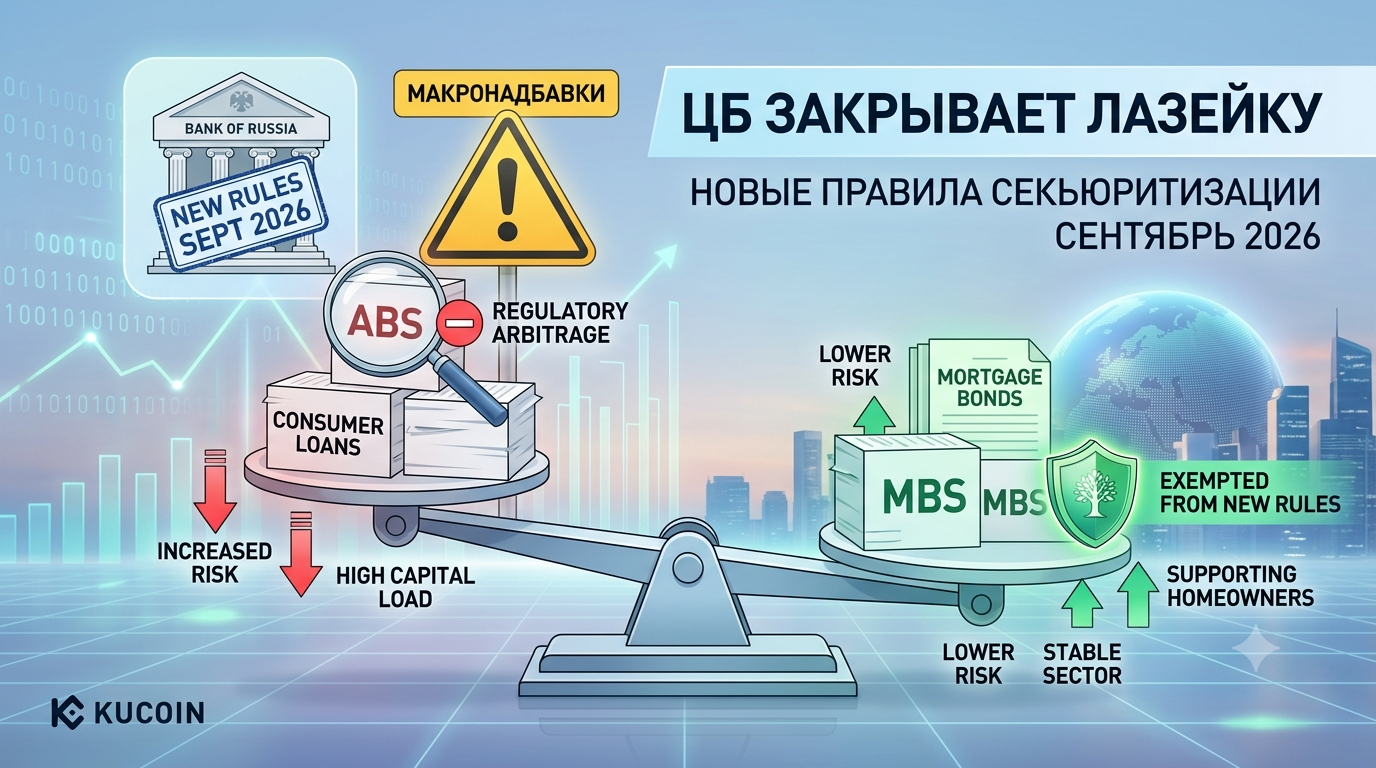
The Bank of Russia is officially closing a "loophole" for regulatory arbitrage by introducing macro-prudential add-ons from September 4, 2026, on banks' investments in bonds secured by consumer loans. According to Instruction No. 7375-U, the new requirements aim to equalize regulatory conditions for various types of credit risks, preventing the practice of "hidden" reduction of capital burden through packaging risky assets into securities. The main goal of the regulator is to ensure financial stability against the backdrop of record trading volumes on the Moscow Exchange, which reached an all-time high of 210.5 trillion rubles in July 2026. It is important to note that the innovations do not affect the mortgage-backed securities (MBS) market, maintaining support for the housing sector. This measure is a technical supervisory tool, not a signal of a systemic crisis, which is critically important for understanding consumer loan securitization in the current macroeconomic conditions.
Why is the Central Bank introducing add-ons on securitized bonds from September 2026?
The Central Bank of the Russian Federation is introducing macro-prudential add-ons to eliminate regulatory arbitrage, where banks artificially understated capital requirements by transferring risky loan portfolios to each other in the form of bonds. Previously, direct retention of consumer loans on the balance sheet required significant reserves and capital from banks due to high add-ons imposed to cool down the overheated retail lending market. However, by packaging the same loans into asset-backed securities (ABS), purchasing banks could account for them with a much lower risk weight, allowing the banking system as a whole to circumvent strict Central Bank limits and create an illusion of excess liquidity. According to the regulator's data for August 2026, the activity in issuing such securities significantly increased, which necessitated prompt intervention to prevent the accumulation of systemic risks that could destabilize the financial sector in the event of a sharp increase in consumer loan defaults.
Eliminating this practice will allow the regulator to see the real picture of risk distribution in the financial system and prevent the formation of "bubbles" in the unsecured debt segment. In June 2026, the Central Bank already noted that banks began to actively "exchange" portfolios, which created a false sense of high capital adequacy while the actual level of household debt remained at critical levels. The introduction of add-ons makes cross-bank investments in ABS economically unfeasible, forcing credit organizations to take a more responsible approach to assessing asset quality and forming a safety cushion. This decision is synchronized with the general trend towards tightening monetary policy, given that the official dollar exchange rate on August 4, 2026, was 80.0687 rubles, and inflationary pressures require maximum concentration of resources from the banking system to maintain national currency stability.
Which assets will be subject to the new macro-prudential add-ons?
The new rules apply to banks' investments in securitized debt securities backed by unsecured consumer loans and car loans that do not have mortgage collateral. The regulator is introducing special asset codes that will allow these instruments to be separated in reporting and to apply appropriate risk coefficients depending on the credit rating and quality of collateral. This means that any bond based on cash loans or car loans will now require the holding bank to allocate a larger amount of its own capital, which reduces the overall profitability of such investments for credit organizations. The segregation will affect both originating banks that retain "junior tranches" (the riskiest part of the portfolio, absorbing the first losses) and investors who purchase "senior tranches," which were previously considered almost risk-free from the regulator's perspective.
Differentiation of approaches will allow the Central Bank to precisely target the most overheated segments of the credit market without affecting socially significant areas. While industrial production in the Russian Federation showed a moderate growth of 0.6% in June 2026, the consumer lending sector continued to demonstrate high dynamics, fueled by aggressive marketing and expectations of further price increases. The introduction of add-ons on car loans is particularly relevant against the backdrop of slowing car sales growth, which in July 2026 amounted to a symbolic 0.2%. The regulator fears that with a decrease in sales rates, the quality of new car loans may deteriorate, and their packaging into bonds will only mask the problem without solving it fundamentally. Thus, the new asset codes will become a tool for "surgical" intervention, cooling banks' ardor in niches where the risk does not correspond to the potential benefit for the economy.
It is important to emphasize that the add-ons will be applied progressively: the higher the risk of the underlying loan portfolio, the higher the capital burden on the investor bank. This will create a natural market incentive to improve underwriting quality. Originators wishing to securitize their portfolios will be forced to conduct a more thorough selection of borrowers so that their bonds remain attractive to buyers under the new regulatory restrictions. In the long term, this will lead to the cleansing of the market from "junk" assets and an increase in the overall credit quality of instruments available on the Russian debt market, which is a positive signal for institutional investors focused on conservative strategies.
Why did mortgage-backed securities (MBS) receive immunity from the new rules?
Mortgage-backed securities (MBS) were completely excluded from the scope of the new add-ons, as the Bank of Russia recognizes the strategic importance of the housing sector for maintaining social stability and economic growth. According to statistics for July 1, 2026, the total household mortgage debt, including the securitized portion, reached 24.5 trillion rubles, making this segment the largest in the retail lending market. At the same time, 22.4 trillion rubles are on banks' balance sheets, and the remaining part is successfully circulating in the market in the form of bonds, mainly through single-tranche issues of DOM.RF. Maintaining a preferential regime for mortgages allows for supporting housing affordability for millions of citizens and ensures a stable inflow of liquidity into the construction industry, which generates a significant multiplier effect for related sectors of the economy.
The exemption of MBS from add-ons is also due to the fundamentally higher quality of collateral compared to all types of consumer loans. Unlike unsecured loans, mortgages are backed by real collateral – real estate, the value of which tends to grow in the long term, and the delinquency rate on mortgage portfolios in Russia traditionally remains at a record low level (less than 1%). The regulator understands that any tightening in this segment could lead to a sharp reduction in issuances, a drop in demand in the primary market, and, as a consequence, stagnation in the development business. Even after the "artificial surge" in June 2026, when banks issued 106 thousand loans for 486 billion rubles in anticipation of reforms, the market remains stable, and mortgage bonds continue to play the role of a reliable foundation for the financial system.
Furthermore, mortgage securitization is a key tool for implementing state programs, such as "Family Mortgage" and programs to support young professionals. Without the ability to effectively "de-load" balance sheets through bond issuance, banks would be forced to sharply limit participation in these programs due to capital shortages. The Central Bank of the Russian Federation, acting in close conjunction with the government, deliberately exempts MBS to prevent disruptions in social support mechanisms. This creates a unique situation in the market where mortgage securities become not only the most reliable but also the most regulatorily advantageous instrument for the banking sector, which predetermines their dominant position in the investment portfolios of credit organizations for the coming years.
How will the new requirements affect private investors?
For ordinary citizens and retail investors, the direct impact of the new rules will be practically imperceptible, as complex structured ABS-based products are traditionally aimed at professional market participants. The main volume of bonds backed by consumer loans is purchased by banks as part of liquidity management, and individuals rarely encounter these instruments directly. Nevertheless, an indirect effect may manifest itself in a gradual increase in interest rates on new consumer loans and car loans. Banks, facing increased costs of maintaining capital, will be forced to pass on some of these costs to borrowers to maintain the profitability of their business at an acceptable level.
From the perspective of savings security, the new measures of the Central Bank are an unequivocally positive factor for depositors and bondholders, as they increase the overall stability of the banking system. "Closing loopholes" for regulatory arbitrage means that banks will have more real, rather than "drawn," capital, which is critically important during periods of economic turbulence. Private investors holding units of mutual funds or mortgage-backed bonds can be absolutely calm: their assets are protected both by the quality of collateral and by regulatory immunity. In a situation where the share of non-residents in the OFZ market has decreased to a historical minimum of 3% (about 980 billion rubles at the end of July 2026), the domestic investor becomes the main pillar of the country's financial sovereignty, and the regulator's actions are primarily aimed at protecting their long-term interests.
For those looking for ways to protect capital from inflation and currency risks, the current situation is a signal for more active diversification. Although Russian bonds remain an important component of the portfolio, the introduction of new add-ons may temporarily reduce their profitability relative to risks in certain segments. In this context, the use of global trading platforms, such as KuCoin, allows private investors to gain access to assets that are not dependent on local regulatory changes. The combination of reliable domestic instruments, such as MBS, with dynamic digital assets allows for the creation of a balanced strategy capable of withstanding any changes in the rules of the game in the traditional financial market.
What awaits the banking sector and bond issuers?
The banking sector will enter a period of deep transformation of capital management models, as traditional methods of "optimization" through securitization will become unprofitable. For banks with a universal license, for which the Central Bank plans to raise the minimum capital threshold to 3 billion rubles, the efficiency of resource allocation will become a matter of survival. Major players, such as Sberbank, which carried out a series of large-scale consumer loan securitization deals between 2024 and early 2026, will be forced either to seek new sources of capital replenishment or to significantly slow down the pace of retail lending. This may lead to a temporary decrease in liquidity in the secondary market for non-mortgage bonds, as purchasing banks will demand a higher premium for risk.
Issuers of non-mortgage ABS, in turn, will face the need to revise the parameters of their issues to attract investors under the new conditions. When the cost of capital for a purchasing bank increases due to macro add-ons, it inevitably demands a higher coupon yield from the bond itself. This means that for originators – banks and microfinance organizations – attracting financing through the bond market will become more expensive. As a result, we may see a reduction in the number of new placements in the consumer ABS segment and a shift by issuers to simpler forms of borrowing or to holding loans on their balance sheets until maturity, which, in turn, may limit their ability to issue new loans.
On the other hand, tightening rules can become a catalyst for the development of the "green" and social securitization market if the regulator decides to introduce additional benefits for such instruments. In a situation where bank capital adequacy (ratios N1.1 and N20.1) becomes the main constraint on growth, financial institutions will be forced to seek innovative ways to attract funds. This may include the use of digital financial assets (DFAs) to package loan portfolios, which opens new horizons for the technological development of the financial sector. Thus, current restrictions can stimulate a transition from simple schemes of circumventing rules to creating truly high-tech and transparent financial products.
How to trade bonds on KuCoin under the new Central Bank restrictions?
In the context of tightening regulation in the traditional Russian bond market, investors should pay attention to alternative instruments available on global platforms such as KuCoin. While the Central Bank of the Russian Federation limits opportunities for banking arbitrage, the crypto sphere offers transparent mechanisms for staking and lending through stablecoins, which are not subject to direct regulatory add-ons from the Russian regulator. Diversifying a portfolio with digital assets allows not only to protect against inflationary risks of the ruble but also to gain access to yields that often exceed offers on classical corporate bonds, even considering increased risk premiums.
Trading on KuCoin provides investors with unprecedented flexibility: you can use USDT or other stablecoins as an analogue of protective assets when there is uncertainty in the local debt market due to new Central Bank rules. Registration on the platform opens access to a wide range of instruments, from spot trading to advanced futures, which allows hedging risks of interest rate changes and exchange rates. In an era when macro-prudential add-ons of the Central Bank are changing the landscape of traditional finance, the transition to decentralized and global solutions becomes a logical step to ensure the safety and growth of your capital. Start trading on KuCoin today to take advantage of the global market and stay one step ahead of local regulatory changes.
Join KuCoin 9th Anniversary Trading Campaign
KuCoin is celebrating its 9th anniversary with a special platform campaign filled with exclusive rewards, trading activities, and limited-time offers. Don’t miss the chance to participate and enjoy the benefits as the exchange marks nine years of growth and innovation. Visit the official campaign page now:

Conclusion
The decision of the Bank of Russia to introduce macro-prudential add-ons from September 4, 2026, is a key step towards increasing the transparency and stability of the Russian financial system. These measures are aimed at eliminating regulatory arbitrage, which allowed banks to artificially reduce capital requirements through the securitization of consumer loans. Although this will require adaptation from banks and issuers, and possibly increase costs, in the long term it will ensure a healthier and more predictable market. The exclusion of mortgage bonds from the scope of the new rules emphasizes their strategic importance. Private investors are advised to diversify their portfolios, including digital assets, to protect and multiply capital in a changing regulatory environment.
Frequently Asked Questions (FAQs)
1. Will the new rule affect my investments in DOM.RF mortgage bonds?
No, the new macro-prudential add-ons do not apply to mortgage-backed securities (MBS). Your investments in instruments backed by mortgage loans remain subject to the previous, softer regulatory rules, as the Central Bank of the Russian Federation has identified this segment as strategically important and less risky.
2. Why did the Central Bank decide to introduce these measures now, in September 2026?
The decision was prompted by a sharp increase in banks' activity in consumer loan securitization in the first half of 2026. The regulator recorded the use of this mechanism to circumvent capital requirements and decided to curb the practice of regulatory arbitrage before it created critical systemic risks for the entire banking system.
3. Will consumer loans become more expensive for ordinary borrowers due to these measures?
Yes, there is a high probability of a moderate increase in interest rates on new consumer loans and car loans. Banks will factor in the increased costs of maintaining capital into the cost of loans to compensate for the decrease in profitability from securitizing their portfolios.
4. What is "regulatory arbitrage" in simple terms and why is it dangerous?
It is the use of differences in regulatory rules to gain an advantage without changing the essence of the risk. In this case, banks sold each other bonds that required less capital than the loans themselves, "hiding" real risks. This is dangerous because in the event of a crisis, banks may not have enough real capital to cover losses.
5. What alternatives to bonds with add-ons exist for a private investor in 2026?
In addition to mortgage bonds and OFZ, investors should consider corporate bonds of real sector companies with a high rating. Digital assets on platforms like KuCoin are also an excellent alternative, where stablecoin staking instruments can offer yields comparable to or exceeding those of traditional bonds with greater portfolio management flexibility.
Disclaimer : This material is provided for informational purposes only and does not constitute financial, investment, legal, or tax advice. Transactions involving cryptocurrencies and tokenized assets carry substantial risks — including price volatility, limited liquidity, counterparty exposure, and the potential for total loss of invested capital. Readers should conduct their own research and, where appropriate, consult a qualified professional before making any financial decisions.