

Moscow Exchange to Launch 20 Perpetual Futures on US Stocks: Dates, List, and Risks for Investors
Introduction
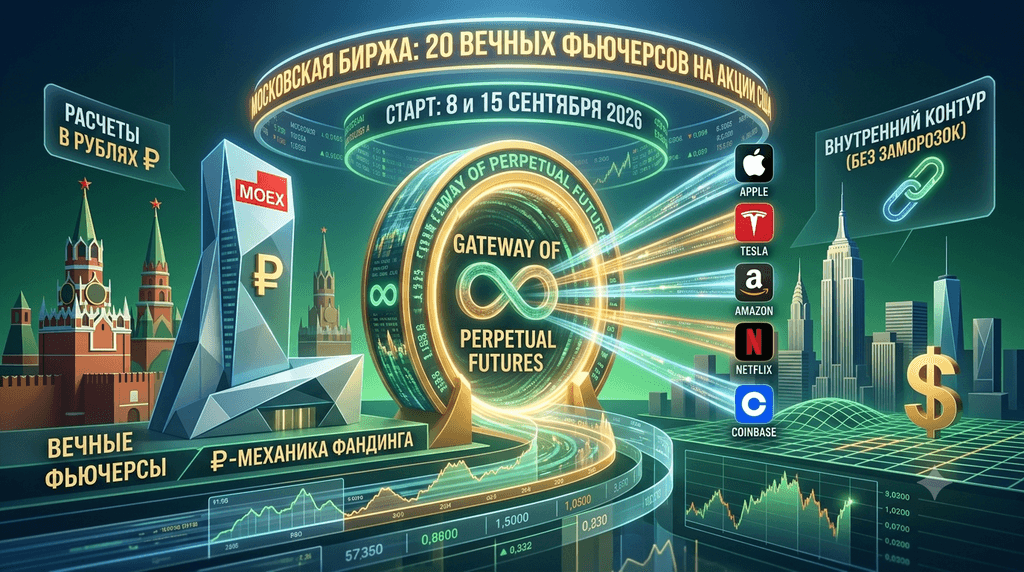
How can investors gain exposure to the price movements of Apple, Tesla, or Coinbase without purchasing the underlying shares through foreign infrastructure? The Moscow Exchange (MOEX) is preparing an answer: in September 2026, it will launch 20 perpetual futures on US stocks. Trading will begin in two stages—on September 8 and September 15—with ten contracts on each date. Quotations will reflect MOEX fixings in US dollars, while settlements will be conducted in Russian rubles.
These are neither new shares nor a way to acquire a stake in an American company. They are cash-settled derivative instruments with daily automatic rollover. Their goal is to provide Russian market participants with a local tool to trade global corporate price movements while keeping all settlements within the Russian exchange infrastructure.
Why Is the Moscow Exchange Launching Futures on US Stocks?
The primary reason for the launch is the shortage of available investment tools for US equities following the suspension of US stock trading on SPB Exchange. SPB Exchange halted these trades on November 2, 2023, after being added to the OFAC sanctions list, leaving a portion of investors' assets frozen. In August 2026, the venue reported that it was considering derivatives on frozen securities, given that direct transactions in them suffer from low liquidity and substantial discounts.
As a result, Russian investors lost their usual local gateway to popular US companies, particularly in the tech sector. Even when an economic premise remains clear—such as growing demand for artificial intelligence or shifting interest rate expectations—executing it through physical stock purchases can be difficult due to restrictions on settlements, custody services, and cross-border transfers.
MOEX is attempting to solve this issue by "derivatizing" access to global assets. Instead of a foreign security, the investor receives a contract whose value is tied to a calculated benchmark—the fixing of a specific stock. Consequently, this new line of products simultaneously expands trading strategy options and reduces dependence on foreign brokers, foreign depositories, and external settlement chains.
However, local infrastructure does not eliminate market risks. The price of the futures contract still depends on the underlying US stock, foreign market trading hours, the USD exchange rate, liquidity, and clearing parameters. The "Russian circuit" changes the infrastructural mechanism of access, but it does not turn a volatile asset into a conservative investment.
What Exactly Is MOEX Launching?
MOEX is launching 20 one-day cash-settled contracts with automatic position rollover to the next trading day. According to an official exchange announcement from September 3, 2026, the underlying assets are fixings of foreign securities calculated by the Moscow Exchange itself.
A major difference from a standard deliverable trade is the absence of physical share delivery. Upon closing a position, the participant receives or pays the net cash difference based on the change in settlement value. The contract grants no ownership rights in Apple, Amazon, Tesla, or any other company, does not provide shareholder dividends, and creates no direct claims against the issuer.
This model does not touch foreign depository infrastructure in terms of physical delivery of the underlying asset. In other words, executing the trade does not require transferring US shares through Euroclear, Clearstream, or any other foreign depository circuit. Cash settlement occurs entirely within the Russian system, whereas the price benchmark is formed based on a fixing linked to the foreign security.
This represents the internal logic of the product: the price tracks an external asset, but the contract trades on the Russian derivatives market. That said, this structure should not be viewed as absolute protection against asset freezes. Participants still bear the risks of the exchange, broker, clearing organization, regulatory changes, and potential liquidity declines.
How Does Automatic Rollover Work?
A perpetual futures contract has no pre-set expiration date in the traditional sense. Formally, each contract is a one-day contract, but at the end of the trading day, its tenure is automatically extended to the next day. This allows a position to be held longer than a single day without manually rolling over into a new monthly or quarterly contract.
Auto-rollover is convenient for traders seeking to maintain a directional position, but it does not mean free perpetual holding. Every day, the settlement price, margin requirements, and funding rate adjustments change. Maintaining a long-term position requires regular monitoring, even if the trader places no new orders.
Which US Stocks Will Be Included in the List?
The list is split into two equal groups. On the first stage, September 8, 2026, trading will begin for contracts on ten companies; on the second stage, September 15, ten more instruments will be introduced.
| Launch Date | Companies and Tickers | Futures Codes |
| September 8, 2026 | AMD, Tesla, Apple, Sandisk, Coherent, Nebius, Robinhood, Amazon, Netflix, Lumentum | AMDF, TSLAF, APPF, SNDKF, COHRF, NBISF, HOODF, AMZNF, NFLXF, LITEF |
| September 15, 2026 | Coinbase, Carvana, CrowdStrike, DoorDash, Palo Alto Networks, Super Micro Computer, Uber, Boston Scientific, Chipotle Mexican Grill, Lululemon | COINF, CVNAF, CRWDF, DASHF, PANWF, SMCIF, UBERF, BSXF, CMGF, LULUF |
The first stage features several of the most recognizable tech and consumer brands. It includes chipmakers like AMD, server equipment and data center software providers, as well as major internet platforms. Tesla and Netflix add stocks that are sensitive to consumer demand and growth expectations.
The second ten make the lineup more thematic. Coinbase offers exposure to crypto infrastructure, CrowdStrike and Palo Alto Networks to cybersecurity, while DoorDash, Uber, Chipotle, and Lululemon cover the consumer sector. This list may appeal to traders building pair trades, hedging sector risk, or capitalizing on short-term expectations for individual companies.
COINF warrants special attention. According to the official MOEX announcement, this contract is available exclusively to qualified investors. Therefore, the presence of a ticker on the exchange list does not guarantee equal access for all clients.
Why Is the Launch Taking Place in Two Stages?
The two dates allow the exchange to roll out the product incrementally rather than all at once. The first stage serves to test liquidity, market maker operations, fixing accuracy, and clearing system stability on a limited subset of securities. If certain instruments show wide spreads or insufficient interest, the exchange and brokers gain time to fine-tune parameters before expanding the offering.
The second stage broadens coverage, adding ten more underlying assets following the initial verification. This approach reduces operational launch risk: technical errors, abnormal price swings, or quote shortages can be identified earlier than if the entire product line were introduced at once.
However, two rollout dates do not guarantee equal liquidity across all securities. Apple, Amazon, and Tesla potentially command a wider audience, whereas individual companies from the second group may trade less frequently. In practice, execution quality will depend on order book depth, market maker activity, and bid-ask spreads.
This scaling comes against the backdrop of growing interest in existing perpetual contracts. According to MOEX data, as of September 3, 2026, the exchange traded 11 such instruments, with open interest exceeding 450 billion rubles—up 36% from August 2025 levels. Monthly, over 60,000 clients executed trades in perpetual contracts. These figures demonstrate demand for the format, but do not guarantee that every new contract will become immediately liquid.
How Are Prices and Settlements Calculated for These Futures?
Quotations for the new contracts reflect MOEX fixings in US dollars, while final settlements are made in Russian rubles. The calculation of foreign security fixings began on July 27, 2026; thus, the price of the instrument is built not on physical stock transfers, but on an exchange-calculated indicator serving as the derivative's underlying benchmark.
This creates a dual driver of returns. First, the USD price of the corresponding US stock fluctuates. Second, the USD/RUB exchange rate changes. If the stock remains flat in US dollars while the ruble weakens, the ruble-denominated return can shift positively. Conversely, if the US stock rises but the ruble strengthens significantly, the currency effect could diminish the return for a ruble investor.
In simplified terms, the calculated ruble value depends on the USD fixing and the conversion rate applied by the exchange. The exact rate, determination procedure, contract size, margin requirement, and clearing schedule should be verified in the specific instrument's specifications and with the broker prior to trading. Parameters from one futures contract should not be automatically assumed for another.
This structure differs fundamentally from purchasing a stock with dollars. When buying shares, an investor owns a physical asset; here, they open an obligation subject to daily mark-to-market revaluation. As a result, ruble fluctuations can impact returns even when a trader is purely analyzing the US target company.
What Is Funding and Why Does It Matter?
Funding is a mechanism designed to keep the perpetual futures price close to its underlying benchmark. Because the contract has no fixed expiration date, periodic payments between parties offset deviations between the futures price and the base indicator. This payment can increase the holding cost of a long or short position depending on the direction and current rate.
In the new contracts' specifications, MOEX set parameters K1 at 0% and K2 at 0.35%. While these parameters factor into the funding calculation, they do not guarantee daily yield or a fixed fee. The exact payment depends on the formula in the specification, position direction, and calculated benchmark values on a given date.
The primary takeaway for a long-term trader is that holding a position can gradually become more expensive even if the underlying stock trades sideways. If funding payments are regularly debited, overall performance will decline regardless of the stock price forecast. Therefore, before holding a position long-term, one must evaluate not only potential stock movements but also accumulated funding costs, commissions, spreads, and potential margin requirement changes.
Funding also helps explain why perpetual contract prices can temporarily diverge from expected fixing values. In volatile markets, participants are willing to pay a premium to maintain positions, and shifts in supply/demand dynamics can flip payment directions.
What Restrictions and Risks Should Be Considered?
The primary risk of perpetual futures is the potential for rapid loss of margin due to leverage. Contracts allow traders to control positions significantly larger than the deposited collateral. Thus, a minor shift in stock price or exchange rate can trigger a substantial move relative to the trader's capital.
If losses push the collateral below required maintenance levels, the broker may issue a margin call. If funds are not replenished, the position may be forcibly closed. In volatile market conditions, forced liquidation occurs at available market prices, which can be far worse than expected. During extreme market moves, losses can approach or exceed initial margin depending on account terms and broker policies.
A second risk is currency-related. Although quoted in USD, the final result is settled in RUB. Currency fluctuations can amplify both profits and losses. A third risk stems from potential divergence between the fixing and the real-time US exchange stock price, as the fixing is a calculated indicator rather than a live physical trade execution.
A fourth risk is liquidity. Low order volume can widen bid-ask spreads, making position exits more costly. A fifth risk is infrastructural: while local settlement reduces reliance on foreign depositories, it does not eliminate trading halts, clearing rule modifications, technical outages, or regulatory shifts.
Access also hinges on investor status and individual broker requirements. Certain instruments may require qualified investor status, while trading derivatives generally may require passing a knowledge test. Official MOEX documentation explicitly restricts COINF to qualified investors. Before opening a position, clients should review the contract specification card, availability within their broker app, and applicable Russian regulatory rules.
How to Use These New Tools in a Trading Strategy?
Perpetual futures on US stocks can be utilized for short-term directional trading, hedging, and relative-value strategies. For instance, a trader might open a short position ahead of an earnings release or hedge broader tech sector exposure via an opposing trade in a related asset.
However, futures do not replace long-term stock ownership. They confer no corporate voting rights, dividend entitlements, or equity ownership. Their value depends on margin, funding rates, ruble exchange rates, and clearing terms. Consequently, the trade horizon must match the objective: short-term tactical ideas and multi-month holds require vastly different cost-benefit calculations.
Before trading, it is prudent to establish maximum loss limits, position sizing, and forced-liquidation triggers in advance. Trading schedules, specifications, margin requirements, tick size, commissions, and parameter rule changes should all be reviewed. Maxing out available leverage increases margin call probability, meaning even an accurate stock prediction might fail to yield a successful trade.
KuCoin Offers A More Stable Option in A Volatile Market
If you worry about the frequent ups and downs in the market, and pursue a more stable option to earn money passively, KuCoin is the right place to come:
Simple Earn: Deposit and withdraw tokens anytime, earning stable returns.
Kucoin Earn: Earn stable profits with professional asset management.
Hold to Earn: Earn rewards by holding assets in Funding, Trading, Margin, Futures, Mining, and Unified Accounts.
Staking: Unlock the earning potential of on-chain assets.
Advanced Investments: Advanced Investments offer a variety of structured products to help your money grow in any market.
Shark Fin: Principal Protection and Guaranteed Gains
Dual Investment: Buy low and sell high with transparent return calculations.
Snowball: High yields, with price protection.
Discount Buy: Buy crypto at discount prices.
KCS Loyalty: Level up to enjoy exclusive perks by staking ≥ 1 KCS.
KuCoin Wealth: Discover future value and begin your smart investing journey.
KCS Benefits: Hold and stake KCS to access benefits across the platform.
KCS Staking 2.0: Participate in KCS on-chain governance to earn yield.
Conclusion
The Moscow Exchange plans to launch 20 perpetual futures on US stocks in two stages—on September 8 and September 15, 2026. The first wave includes AMD, Tesla, Apple, Amazon, Netflix, Nebius, Robinhood, among others, while the second brings Coinbase, Uber, CrowdStrike, Palo Alto Networks, Lululemon, and additional global brands.
These new instruments are one-day cash-settled contracts with automatic rollover. They do not involve physical delivery of US shares or operations via foreign depository infrastructure. Prices are tied to MOEX US dollar fixings, but settlements are conducted in rubles, meaning overall returns depend on both underlying stock performance and FX exchange rate shifts.
The perpetual format removes fixed expiration dates but does not eliminate holding costs. Funding rates, commissions, spreads, and margin adjustments can significantly impact returns over extended holding periods. Leverage amplifies both potential profits and the risk of margin calls or forced liquidations.
While this launch expands local toolsets, it does not convert derivative contracts into direct stock ownership, nor does it guarantee immunity from all infrastructure or regulatory risks. Prior to trading, investors should thoroughly review contract specifications, access prerequisites, broker rules, and their own capacity to manage sharp price volatility.
Frequently Asked Questions
No. These are cash-settled derivative instruments with no physical delivery of underlying shares. Participants receive or pay cash differences based on settlement price movements without gaining ownership in Apple, Tesla, or any other company.
2. In which currency should performance be evaluated?
Quotations are tied to USD fixings, but settlements occur in Russian rubles. Performance must be evaluated in rubles taking the USD exchange rate into account, even if the underlying trade hypothesis focuses on US stock price movements.
3. Do perpetual futures have an expiration date?
There is no fixed expiration date. Formally, contracts are one-day instruments that automatically roll over to the next trading day. However, daily auto-rollover comes with daily mark-to-market revaluations, funding payments, and potential changes to margin requirements.
4. Are all 20 contracts available to non-qualified investors?
No. Access depends on the specific instrument and individual broker policies. MOEX explicitly designated COINF as restricted to qualified investors. For other contracts, investors must check requirements in the instrument's specifications and with their broker.
5. Can funding turn a profitable trade into a loss?
Yes. If a position is held over a long period, cumulative funding payments, commissions, and bid-ask spreads can exceed gains from minor moves in the underlying asset. Always evaluate trades based on net performance after all expenses rather than purely on price direction.
Disclaimer : This material is provided for informational purposes only and does not constitute financial, investment, legal, or tax advice. Transactions involving cryptocurrencies and tokenized assets carry substantial risks — including price volatility, limited liquidity, counterparty exposure, and the potential for total loss of invested capital. Readers should conduct their own research and, where appropriate, consult a qualified professional before making any financial decisions.