

Moscow Exchange Launches Perpetual Futures on BTC, ETH, SOL, XRP, and TRX: Trading Terms and Investor Access
Introduction
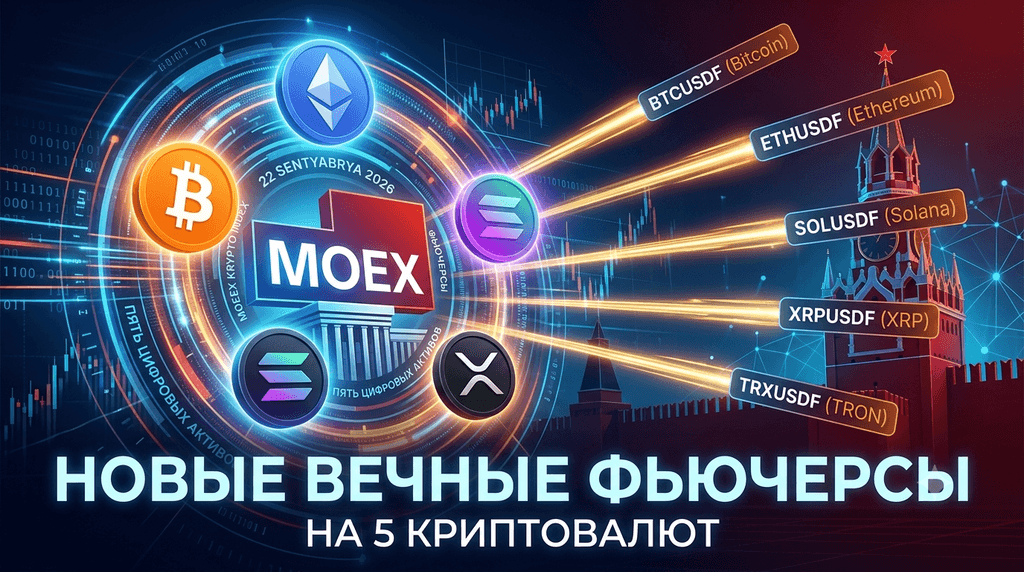
Can investors gain exposure to cryptocurrency price movements through Russia's exchange infrastructure without buying tokens or using a crypto wallet? Starting September 22, 2026, Moscow Exchange will launch cash-settled one-day futures with automatic rollover on the indices of five digital assets. The list includes Bitcoin, Ethereum, Solana, XRP, and TRON. However, this does not open crypto trading to everyone: the new contracts will be available only to qualified investors. According to Moscow Exchange's official announcement, prices will be quoted in U.S. dollars, while collateral, variation margin, and settlement will be handled in Russian rubles.
The instruments allow investors to take positions on both rising and falling index prices, but they do not provide delivery of cryptocurrency. Investors therefore cannot withdraw BTC, ETH, or another asset to a personal wallet. This article explains which contracts are being launched, how daily rollover works, what the funding rate means, and why the new product differs from perpetual futures on international crypto exchanges.
When Will Moscow Exchange Launch Perpetual Crypto Futures?
Trading in the five new contracts will begin on September 22, 2026. Moscow Exchange announced the launch parameters on September 16, while its official release clarified that these are not physically delivered perpetual contracts but cash-settled one-day futures with automatic rollover.
The term “perpetual” describes the instrument's economic logic: the position has no conventional expiration date on which it must be closed or moved into the next quarterly contract. Legally and technically, the position exists within a one-day futures contract. At the end of the trading day, it is automatically carried into the next day if the participant still has an open position.
Moscow Exchange already uses this mechanism for other asset classes. According to the exchange's official announcement dated September 16, 2026, its perpetual futures range includes 31 contracts on currency pairs, equity and bond indices, precious metals, and Russian and foreign securities. Cryptocurrency instruments will become a new segment of this model.
The launch also expands the digital-asset derivatives range introduced by Moscow Exchange in summer 2025. According to exchange data, more than 72,000 qualified investors had traded these contracts by September 16, 2026, while total turnover exceeded RUB 600 billion. This figure refers to the previously launched range of crypto derivatives, not to the five new contracts, which have not yet begun trading.
Which Cryptocurrencies Are Included in the New Range?
The first range includes five widely followed digital assets: Bitcoin, Ethereum, Solana, XRP, and TRON. The instruments will not be futures on the coins themselves but futures linked to the corresponding Moscow Exchange indices. The contract codes and underlying indices are as follows.
|
Contract Code
|
Underlying Index
|
Digital Asset
|
|
BTCUSDF
|
MOEXBTC
|
Bitcoin
|
|
ETHUSDF
|
MOEXETH
|
Ethereum
|
|
SOLUSDF
|
MOEXSOL
|
Solana
|
|
XRPUSDF
|
MOEXXRP
|
XRP
|
|
TRXUSDF
|
MOEXTRX
|
TRON
|
The names, codes, and underlying indices come from Moscow Exchange's official press release dated September 16, 2026.
Bitcoin and Ethereum provide exposure to the two most widely recognized cryptocurrencies. Solana adds an asset with its own decentralized application ecosystem. XRP enables trading based on the performance of an asset associated with cross-border payment infrastructure. TRON completes the first group and expands the choice beyond the market's most obvious leaders.
TON and USDT are not included in the initial list. This means that investors will not be able to open a Moscow Exchange position directly linked to these assets through the new perpetual futures. The range may change in the future, but as of the launch date, only the five announced indices are officially included.
The index-based structure is important for understanding the product. A contract buyer does not acquire the coin, become its owner, or obtain the right to demand delivery of the underlying asset. The result of the trade depends on the change in the index's settlement value and the terms of the specific futures contract.
Can Ordinary Investors Trade These Futures?
No. An ordinary non-qualified investor will not be able to trade the new contracts directly. Access is limited to investors who have qualified-investor status, including eligible individuals and organizations.
The restriction is not related to the technical difficulty of connecting to a trading terminal. It follows from the regulatory regime governing crypto-related instruments in Russia. A broker must do more than open a client account and accept an order. The broker must also verify the client's category and confirm that the client is allowed to use products intended for professional market participants.
Qualified-investor status does not provide automatic protection against losses. It only confirms that the client meets requirements related to experience, assets, transactions, or other criteria established by Russian regulations. The specific process for confirming status depends on the broker and the rules in force.
Accordingly, the launch should not be interpreted as an announcement that cryptocurrency can be freely purchased on Moscow Exchange. Access will remain closed to most retail clients. A non-qualified investor cannot bypass the restriction simply by choosing another tariff plan or applying through a standard brokerage account.
How Are Moscow Exchange Perpetual Futures Settled?
The new contracts are cash-settled and operate through daily automatic rollover. A participant opens a position for one trading day, and the system carries it into the next day without requiring the participant to close and reopen it manually.
The key result of a trade is determined by the change in the index's settlement price. If a long position rises with the index, the investor receives a positive financial result before commissions, margin requirements, and other costs are deducted. If the index falls, the long position produces a loss. The relationship is reversed for a short position.
Automatic rollover removes the need to select a new expiration date manually. With a conventional monthly or quarterly futures contract, a trader plans in advance how to move from one contract to another. Under the new structure, this manual position transfer is not required. However, holding a position is not free: daily adjustments related to funding, margin, and the movement of the underlying index still apply.
An open position also does not guarantee that the required collateral will remain unchanged. If the market moves unfavorably, the broker may require additional funds. If available margin is insufficient, the position may be forcibly reduced or closed under the rules of the broker and the exchange.
The word “perpetual” should not be understood as a promise that a position can remain open indefinitely under all circumstances. The instrument depends on the trading schedule, liquidity, risk-management rules, broker actions, and contract specifications. Before opening a trade, a qualified investor should check the collateral requirement, tick size, commission, and conditions for forced closure.
Why Are Prices Quoted in Dollars While Settlement Is in Rubles?
The contract price is displayed as the value of the relevant cryptocurrency index in U.S. dollars, but all financial settlement is carried out in Russian rubles. This separates the price reference from the currency used to fulfill the actual obligations.
For example, the BTC index value shown in a trading terminal may be expressed in dollars. However, the payment of collateral, daily crediting of profit or loss, and final cash settlement all take place in rubles. Bitcoin delivery and conversion of the ruble result into coins are not provided.
This structure gives investors access to digital-asset price movements without using USDT, a crypto wallet, or an account on an overseas crypto exchange. Deposits and withdrawals are processed through a brokerage account and Russia's banking infrastructure. At the same time, ruble settlement creates an additional risk factor: the final financial result may depend not only on the movement of the crypto index but also on the currency dynamics incorporated into the calculation model.
It is important to distinguish the quotation currency from the payment currency. If an investor sees a dollar value for BTCUSDF, this does not mean that the investor deposits or receives dollars. The operational cash flow for the new range remains denominated in rubles.
What Is the Funding Rate and How Do K1 and K2 Work?
The funding rate is designed to keep the price of a perpetual futures contract linked to the corresponding index because this type of instrument has no natural expiration date. According to Moscow Exchange's official parameters, K1 is set at 0% and K2 at 0.35% for the new contracts.
Funding is not guaranteed income and is not a fixed commission charged on every trade. It is a mechanism that can affect the cost of holding a long or short position. Depending on the calculated value and the direction of the position, one side of the market may transfer funds to the other side or incur a corresponding adjustment.
Daily rollover and funding serve different purposes. Automatic rollover carries the position into the next trading day. Funding helps adjust the difference between the futures price and the index reference. Together, these mechanisms replace the conventional expiration process, but they do not eliminate the costs and risks of holding a position for an extended period.
K1 and K2 should be treated as components of the formula specified in the contract documentation, not as a promise that the rate will always equal 0.35%. The actual calculation depends on the methodology used, the index price, market conditions, and the direction of the position. Before trading, investors should read the complete specifications for BTCUSDF, ETHUSDF, SOLUSDF, XRPUSDF, or TRXUSDF provided by the broker and the exchange.
How Does the New Product Differ From Buying Cryptocurrency?
The main difference is that the investor does not acquire ownership of any tokens. A perpetual futures contract provides financial exposure to changes in an index, but it does not allow the investor to receive cryptocurrency, transfer it to an external address, or use it in a blockchain application.
When buying BTC on a spot platform, an investor normally acquires the asset and becomes responsible for key storage, wallet selection, and address security. When trading a Moscow Exchange futures contract, the investor is dealing with a derivative. The responsibilities are different: the investor must monitor margin, position size, liquidation risk, funding, and commissions.
The new product also differs from overseas perpetual futures in the way it is settled. On international crypto exchanges, collateral often consists of stablecoins or cryptocurrencies, and profit and loss may be credited in digital assets. Under the Russian structure, settlement is carried out in rubles, while access is controlled through a broker and qualified-investor status.
Another difference concerns the infrastructure. Trading takes place within a traditional exchange and brokerage framework rather than through an anonymous or pseudonymous crypto wallet. This increases the formal transparency of transactions, but it also requires compliance with Russian identification, reporting, and client-admission requirements.
Taxes, Banks, and Settlement Security
For investors, an important advantage of the exchange-based model is that transactions pass through a Russian broker and bank account rather than an informal peer-to-peer exchange. Under this structure, the broker acts as a tax agent and generally calculates and withholds tax on the client's taxable result under applicable tax rules. The launch terms provided for this product indicate a personal income tax rate of 13% to 15%, depending on the tax base and the client's status.
Automatic tax withholding reduces the need to collect documents for every individual transaction. However, it does not eliminate all tax obligations. Investors should request a report on financial results and withheld tax from their broker, check the rate applied, and clarify the filing procedure applicable to their circumstances.
Ruble deposits and withdrawals through a regulated broker also reduce dependence on peer-to-peer transactions. In a direct exchange between individuals, a bank may request proof of the source of funds or suspend a transaction under anti-money-laundering procedures, including requirements under Federal Law No. 115-FZ. The exchange route does not eliminate banking controls or guarantee that no review will occur, but it places transactions within a more formal financial framework.
A tax agent does not protect an investor from market losses. Automatic tax calculation cannot compensate for an unsuccessful trade, and regulated infrastructure does not eliminate the possibility of sharp price gaps, insufficient liquidity, or requests for additional collateral.
What Risks Should Investors Assess Before Opening a Position?
The first risk is the high volatility of the crypto indices themselves. The prices of Bitcoin, Ethereum, Solana, XRP, and TRON can change rapidly because of liquidity conditions, macroeconomic decisions, news, and market sentiment. Leverage increases not only potential profits but also potential losses.
The second risk is margin risk. Opening a position requires only part of its notional value, but daily losses are deducted from the collateral. If the market moves against the trader, available margin decreases. An inability to fund the account quickly may result in forced closure.
The third risk is the cost of holding the position. Automatic rollover is convenient, but a long-term position is subject to repeated funding adjustments. Even if the index moves in the expected direction, these costs may reduce the final result.
The fourth risk is basis risk. The futures contract tracks a Moscow Exchange index rather than one specific quotation on a particular overseas exchange. Differences between the index and the price on another venue may arise from the calculation methodology, update times, and the composition of the data sources.
The fifth risk is regulatory and operational. Access rules, contract specifications, trading hours, collateral requirements, and settlement procedures may change. Investors should therefore verify the current exchange and broker documentation before trading instead of relying only on a news headline.
Beyond the Headlines: What KuCoin 5.0 Means for You
Market news moves fast — but where you act on it matters just as much. This October, KuCoin launches KuCoin 5.0, transforming KuCoin into a rebuilt platform. Here's what actually changes for you:
-
One account for everything. Older platforms split your money across separate "spot," "margin," and "futures" accounts and expected you to understand why. KuCoin 5.0's unified account removes that entirely — deposit once, and everything is simply there.
-
Stocks, indices, and commodities. KuCoin 5.0 expands beyond crypto into global markets. When crypto chops sideways and equities rally (or the reverse), you rotate in minutes instead of opening a brokerage account and waiting days for fiat rails.
-
Real-world assets (RWA). Tokenized exposure to traditional assets like commodities, right inside your crypto account. One of the fastest-growing segments in global finance is no longer reserved for institutions — you access it from the same balance you trade with.
-
Earn while you learn. Not ready to trade? KCUSD lets your stablecoins earn daily, auto-compounding interest. The lowest-stress way to put your idle deposit to work for 4% yield.
-
An AI assistant in plain language. Ask questions, get market context, understand what you're looking at — built into the platform, no jargon required.
-
An app that doesn't overwhelm. Faster, cleaner, and consistent — intuitive from the first tap, not after a tutorial.
-
Safety you can check, not just trust. A MiCAR-licensed EU entity, Proof of Reserves you can verify yourself, and internationally certified security (SOC 2 Type II, ISO 27001:2022).
Create your account in minutes — and start on the platform built for where crypto is going, not where it's been.
Conclusion
Moscow Exchange will begin trading perpetual futures on Bitcoin, Ethereum, Solana, XRP, and TRON indices on September 22, 2026. The BTCUSDF, ETHUSDF, SOLUSDF, XRPUSDF, and TRXUSDF contracts will be cash-settled: investors will gain or lose money based on index movements but will not receive the underlying digital assets.
The structure is based on a one-day position with automatic rollover. Prices are displayed in dollars, while collateral, daily financial results, and settlement are handled in rubles. Funding is calculated under a special methodology with K1 set at 0% and K2 at 0.35%. These parameters help maintain the connection between the contract price and the index, but they do not make trading risk-free.
The most important access restriction is that only qualified investors will be allowed to trade. Ordinary retail clients will not be able to buy these futures directly. The exchange model reduces the need for peer-to-peer transactions and crypto wallets, while the broker may act as a tax agent and withhold personal income tax at the applicable rate of 13% to 15%. However, volatility, margin requirements, funding costs, and regulatory changes remain. The new product should therefore be viewed as a complex derivative for experienced participants, not as a simple way to buy cryptocurrency.
Frequently Asked Questions
1. Can purchased futures be converted into Bitcoin or another cryptocurrency?
No. The contracts are cash-settled and do not provide delivery of the underlying asset. The financial result is paid in Russian rubles through the brokerage infrastructure.
2. Will TON and USDT be included in the first launch?
No. The officially announced initial range includes only Bitcoin, Ethereum, Solana, XRP, and TRON. TON and USDT are not listed among the five launch indices.
3. Do investors need to buy dollars to trade these futures?
No. Although the index value and quotation are expressed in U.S. dollars, collateral and settlement are carried out in Russian rubles. Buying dollars to execute the contract is not required.
4. Does automatic rollover mean that there are no commissions?
No. Automatic rollover eliminates the need to transfer a position manually between expiration dates, but it does not eliminate brokerage commissions, exchange fees, margin requirements, or possible funding adjustments.
5. Can investors trade the contracts without qualified-investor status?
No. As of the launch date, access is limited to qualified investors. An ordinary non-qualified investor cannot obtain direct access to these contracts through a standard brokerage account.
Disclaimer : This material is provided for informational purposes only and does not constitute financial, investment, legal, or tax advice. Transactions involving cryptocurrencies and tokenized assets carry substantial risks — including price volatility, limited liquidity, counterparty exposure, and the potential for total loss of invested capital. Readers should conduct their own research and, where appropriate, consult a qualified professional before making any financial decisions.