

Digital Ruble in Russia: Why Users Faced Problems Opening a Wallet
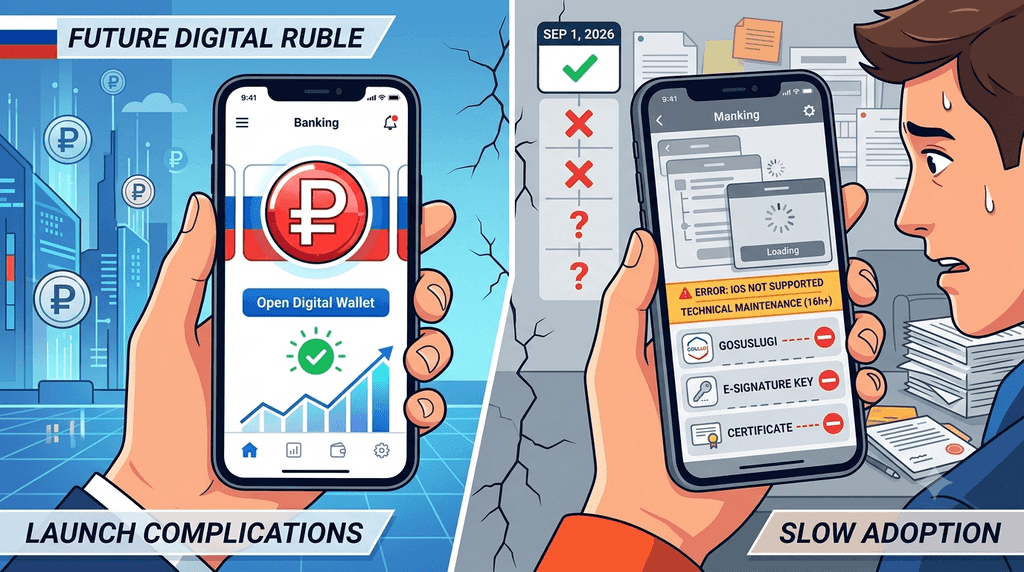
The digital ruble was supposed to become more accessible to individuals and businesses starting September 1, 2026, but the first days of the launch showed the opposite: not every bank could open a wallet, and the process itself could take hours. Why did this new form of money turn out to be more complicated than familiar card payments and transfers? According to Frank Media on September 1, users encountered delays, incompatible app versions, hard-to-find sections, and technical failures. RIA Novosti confirmed the same day that many banks were still not ready to provide full access to the digital ruble.
The digital ruble is the third form of Russia's national currency, alongside cash and non-cash rubles. Unlike ordinary money held in a bank account, digital rubles are stored on the Bank of Russia's platform. At launch, however, users still needed an intermediary bank whose app could be used to open a digital wallet and conduct transactions.
What Happened to the Digital Ruble After the September 1 Launch?
The main launch problem was that the formal availability of the digital ruble did not mean that banking channels were actually ready. Banks and major retail chains were expected to support transactions in the new form of money starting September 1, 2026, but access was opened gradually and unevenly.
The situation differed depending on the bank, operating system, and app version. For some Android users, the required feature was missing even after an update. iPhone owners faced a stricter limitation: the digital ruble launch for iOS had been postponed, so users could not open a wallet through an iPhone at the time of publication.
RIA Novosti reported that the button for opening a wallet in SberBank Online appeared only for Android users, while VTB linked access to a phased rollout and a specific app version. T-Bank also identified Android version 8.2 as a necessary condition. This means that the problem was not simply whether a customer wanted to use the digital ruble. Successful activation simultaneously required a compatible operating system, a current app build, and the feature being enabled on the bank's side.
|
Problem
|
How it appeared
|
What it meant for the customer
|
|
iOS restriction
|
The digital ruble launch was postponed for iPhone
|
Users could not open a wallet through the iOS app
|
|
Unsynchronized versions
|
Different versions of banking apps were available in app stores
|
An update might not include the required feature
|
|
Phased activation
|
The bank did not grant access to all customers at the same time
|
Even a compatible app version did not guarantee success
|
|
Technical work
|
Operations at Ozon Bank were temporarily unavailable for more than 16 hours
|
Wallet opening and transactions depended on infrastructure readiness
|
Why Was Opening a Digital Wallet So Difficult?
The main reason for the difficulties was that the digital ruble required more than a single app update. It required a chain of confirmations and technical conditions. The experience of Sber customers was particularly telling: opening a wallet required consent through Gosuslugi, the generation of an electronic-signature verification key, an application for a security certificate for that key, and a wait for a readiness notification.
This process is significantly different from opening a conventional banking product. A customer normally expects to find a button, confirm the action, and receive immediate access. With the digital ruble, the customer must complete identification through an external government system and wait for a certificate linked to the key to be issued. Every additional step creates a separate point of failure, from an authorization error to a delay on the platform side.
Industry expert Andrey Chirkov described the customer journey at Sber as “hellish.” This was not merely an emotional assessment of the interface. After registering through Gosuslugi, a Frank Media correspondent waited eight hours, but the account still had not appeared in the app by the time of publication. Thus, even completing the entire sequence of actions did not guarantee an immediate result.
Another barrier is that the digital ruble is being introduced on top of an already complex banking ecosystem. The app must exchange data with Gosuslugi, the electronic-signature system, the certificate infrastructure, and the Central Bank platform. If even one element responds slowly, the customer sees an incomplete account-opening process without always understanding where the problem occurred.
What Role Did App Stores Play?
App stores became a separate restriction, especially for VTB and T-Bank customers. Frank Media found that a version of VTB Online with digital-ruble functionality could be available through NashStore or RuMarket, while the newer build had not yet appeared in the more popular RuStore. Users were advised to delete the old app, install an additional app store, and ignore system warnings about possible cybersecurity threats.
Even after installing the required version, the feature might not appear immediately. According to Frank Media, users had to log in several times, after which the digital-ruble window appeared at the bottom of the product list, immediately after Troika and Parking in Russia. This scenario turned a basic payment feature into a search for a hidden menu.
T-Bank faced a similar problem. Support stated that the wallet was available in Android version 8.2, but three users still could not find the digital ruble after updating. At the same time, version 8.0 remained available in RuStore, while T-Bank's app was absent from NashStore. The gap between support's recommendation and the app build actually available undermines confidence in the bank's instructions.
Which Banks Could Not Provide the Digital Ruble Immediately?
At launch, several major banks encountered problems, although the symptoms differed. At VTB, the feature was missing for some customers even after they updated the app. Support explained the situation as a phased rollout and told one customer that no access timeline had yet been determined. Andrey Chirkov said that his request had been registered and was promised a resolution by October 1.
At Sber, opening a wallet was relatively easier in terms of feature availability: the app updated automatically and the relevant section appeared. However, the registration process and subsequent waiting became critical obstacles. In addition, some customers could not top up digital accounts that had already been opened.
Sber support acknowledged that top-up difficulties could occur because the digital ruble was being launched on a large scale and all at once. In correspondence cited by Frank Media, an operator attributed the problems to the Central Bank platform. This is important: a failure does not necessarily indicate a user error or a malfunction in a particular mobile app. It may originate in central infrastructure to which multiple banks are connected.
At Alfa-Bank, the feature appeared automatically, but opening a wallet also required registration through Gosuslugi. Sovcombank stated that it had implemented the functionality in full, provided that customers used the latest Android app. RIA Novosti also reported that Alfa-Bank, Sovcombank, Rosselkhozbank, and Tsifra Bank had confirmed that customers could open a wallet.
The example of Ozon Bank was especially notable. When users attempted to open a digital account, the app displayed a technical-work message and stated that operations were temporarily unavailable. According to Frank Media, the work continued for more than 16 hours, while support did not provide an end time.
Why Was the Digital Ruble Button Hidden in Banking Apps?
Customers had to search for the digital ruble in account-opening sections because the largest banks did not place the feature on the app home screen. These banks were Sber, VTB, and Alfa-Bank. The feature could technically exist, but users were not given an obvious route to it.
This approach differed from the expectations of the Bank of Russia. Earlier, Alla Bakina, head of the Central Bank's payments department, said that bright-red digital-ruble logos should appear on app home screens from September 1. Within the Central Bank, the shade was reportedly called “dopamine red.” In practice, the banks chose less prominent placement.
From a user-experience perspective, a hidden entry point has two consequences. First, many customers may conclude that their bank does not yet support the digital ruble. Second, low visibility reduces the number of voluntary wallet openings. When a bank says that a product is available but places it three menu levels deep, the customer receives a contradictory signal.
Are Banks and Customers Interested in the Digital Ruble?
Early market comments indicate that interest in the digital ruble currently comes largely from the regulator rather than from users and commercial banks. Sber CFO Taras Skvortsov said that he did not see clear interest in the instrument from market participants, individual or corporate customers, or financial organizations.
This admission helps explain why the launch was accompanied more by minimum compliance than by active promotion. For customers, the digital ruble does not look like an obvious replacement for cash or non-cash money: familiar cards, instant transfers, and banking apps already handle most everyday needs.
This raises the central question: why use the digital ruble if existing payment methods work? At this stage, ordinary customers do not have a universal answer that outweighs the complexity of connecting. If a new form of money requires Gosuslugi, a certificate, a separate wallet, and a waiting period, it must offer clear additional value. So far, the first days of the launch have primarily revealed infrastructure and interface costs.
The lack of interest from banks is also connected to the product's architecture. Digital rubles are stored on the Central Bank platform, while a commercial bank provides the customer interface and access to transactions. The bank must therefore integrate the system, train support staff, and ensure app compatibility, but it does not automatically gain obvious demand for its conventional banking services.
What Changes for Businesses and Retail Chains?
For businesses, the digital ruble means a gradual expansion of payment acceptance channels rather than an immediate transition of the entire retail sector to a new system. RIA Novosti reported that, from September 2026, major retail chains with annual revenue above 120 million rubles would be required to accept digital-ruble payments; the requirement would later extend to smaller sellers.
However, a retailer's obligation to accept the new form of money does not automatically solve the customer's access problem. If a buyer cannot open a wallet, find the feature in the app, or top up the account, a QR code at the checkout does not create a complete payment scenario.
For merchants, settlement stability, clear cash-register integration, and predictable support are essential. For customers, the priorities are fast wallet opening and the ability to transfer funds into the wallet without unnecessary steps. The expansion of the digital ruble therefore depends not only on formal deadlines, but also on how quickly banks close the gap between regulatory readiness and the real user experience.
|
Participant
|
Main expectation
|
Actual launch obstacle
|
|
Customer
|
Quickly open and top up a wallet
|
Gosuslugi, electronic signatures, waiting, and top-up failures
|
|
Bank
|
Connect customers to the Central Bank platform
|
Unsynchronized versions, hidden sections, and pressure on support
|
|
Retail chain
|
Accept digital rubles at checkout
|
Insufficient wallet availability among buyers
|
|
Central Bank
|
Mass adoption of a third form of money
|
Low market interest and uneven channel readiness
|
How Can Users Open a Digital Ruble Wallet at Launch?
In practice, customers should first check whether their bank supports the feature and which app version is required. This is particularly important for Android users: RIA Novosti cited VTB version 20.16 or later and T-Bank version 8.2, but the availability of an update could differ between app stores.
Next, users need to find the digital-wallet opening section rather than looking among ordinary accounts and cards. At Sber and Alfa-Bank, customers must complete confirmation through Gosuslugi and wait for the process to finish, including the issuance of a security certificate for the key. If the wallet does not appear immediately, resubmitting the application may make diagnosis more difficult. It is more reasonable to check notifications, the app version, and the bank's official support channel first.
Finally, users should remember that the feature may be temporarily unavailable for technical reasons. The experience at Ozon Bank, the eight-hour wait at Sber, and reports of top-up failures show that a delay is not necessarily caused by incorrect customer actions. When using app stores, users should also be cautious and avoid disabling security warnings without understanding the source of the installation file.
KuCoin Offers A More Stable Option in A Volatile Market
If you worry about the frequent ups and downs in the market, and pursue a more stable option to earn money passively, KuCoin is the right place to come:
Simple Earn: Deposit and withdraw tokens anytime, earning stable returns.
Kucoin Earn: Earn stable profits with professional asset management.
Hold to Earn: Earn rewards by holding assets in Funding, Trading, Margin, Futures, Mining, and Unified Accounts.
Staking: Unlock the earning potential of on-chain assets.
Advanced Investments: Advanced Investments offer a variety of structured products to help your money grow in any market.
Shark Fin: Principal Protection and Guaranteed Gains
Dual Investment: Buy low and sell high with transparent return calculations.
Snowball: High yields, with price protection.
Discount Buy: Buy crypto at discount prices.
KCS Loyalty: Level up to enjoy exclusive perks by staking ≥ 1 KCS.
KuCoin Wealth: Discover future value and begin your smart investing journey.
KCS Benefits: Hold and stake KCS to access benefits across the platform.
KCS Staking 2.0: Participate in KCS on-chain governance to earn yield.
Conclusion
The first days of the digital ruble's mass rollout showed that a regulatory launch is not the same as a finished user product. Starting September 1, 2026, access was supposed to expand through the apps of major banks, but iPhone owners faced a postponed launch while Android users encountered different app versions and phased activation.
The most serious obstacles were complex identification through Gosuslugi, generation of an electronic-signature key, issuance of a security certificate, and long waits for account opening. Hidden sections in apps, unsynchronized updates in app stores, technical work at Ozon Bank, and top-up failures at Sber created additional problems.
Banks also remain cautious. Taras Skvortsov's comments about weak market interest help explain why the feature is not always promoted prominently and why access is being opened gradually. Further implementation will require not only connecting more banks and retail chains, but also reducing the customer journey to several clear steps. For now, the digital ruble is less a day-to-day alternative to cards than an infrastructure system still being rolled out, whose reliability and convenience have yet to be proven.
Frequently Asked Questions
1. Can a user open more than one digital wallet?
No. According to explanations published by RIA Novosti, each citizen will be able to open only one digital-ruble wallet. When changing banks, users should therefore consider where the wallet has already been created and which bank provides access to it.
2. Can digital rubles be held in an ordinary bank account?
No. Digital rubles are held on the Bank of Russia's platform, not in a standard account at a commercial bank. The banking app serves as the interface for opening the wallet and conducting transactions.
3. Can users pay with digital rubles without a smartphone?
The materials reviewed do not establish this. The launch scenario described in the reports assumes the use of a banking app, so customers should clarify any smartphone-free payment options with their bank and the retailer.
4. Are digital-ruble transactions subject to fees?
The sources provided do not contain a complete, universal list of fees. Conditions may depend on the type of transaction and the rules of the specific bank, so users should check the applicable tariffs in the official app or with support before transferring or spending funds.
5. Can a digital-ruble payment be canceled or refunded?
The refund process depends on the type of payment, the merchant, and the platform's rules. The sources used for this article do not confirm a single mechanism for all transactions. Before paying, users should clarify the refund procedure with the retailer and the bank.
Disclaimer : This material is provided for informational purposes only and does not constitute financial, investment, legal, or tax advice. Transactions involving cryptocurrencies and tokenized assets carry substantial risks — including price volatility, limited liquidity, counterparty exposure, and the potential for total loss of invested capital. Readers should conduct their own research and, where appropriate, consult a qualified professional before making any financial decisions.