

Crypto Market Regulation in Russia Starting September 1: What Will Change for Investors and Businesses?
2026/08/31 15:11:00
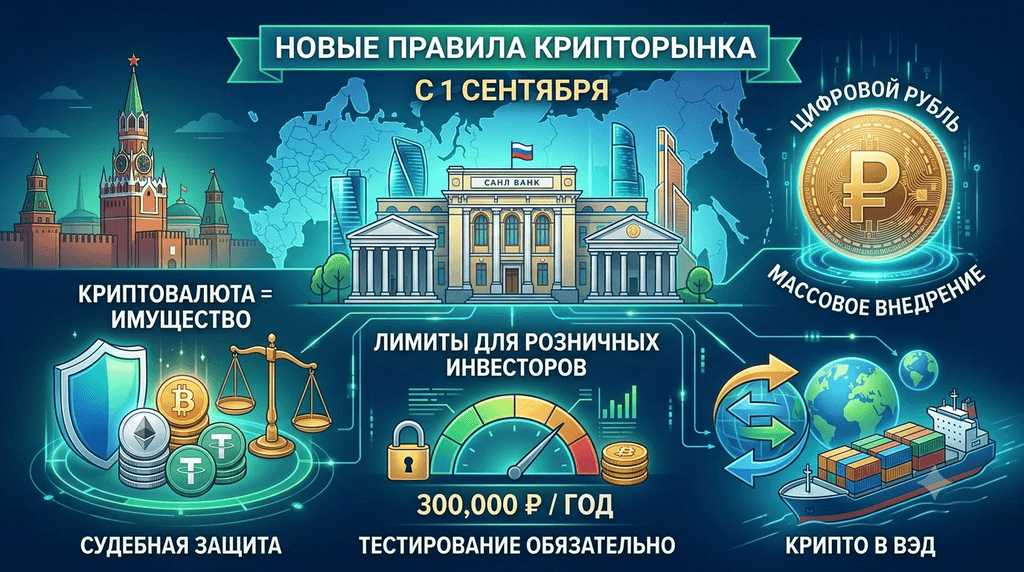
On September 1, a comprehensive legislative reform comes into force in Russia, defining the legal status of digital currencies, investor limits, and new rules for business. The primary change is the official recognition of cryptocurrency as property, guaranteeing judicial protection of owners' rights in the event of disputes or theft. Non-qualified retail investors gain the ability to purchase liquid assets (Bitcoin, Ethereum, USDT) through licensed intermediaries with a limit of up to 300,000 rubles per year per agent. For businesses, lawmakers are opening legal cryptocurrency settlements for foreign trade contracts (FEA) to bypass international restrictions, while maintaining a strict ban on domestic payments. Concurrently, the mass rollout of the digital ruble begins: major banks are required to provide access to digital wallets in their apps, and retailers with revenues exceeding 120 million rubles must set up acceptance for the new payment method.
How Will the Legal Status of Cryptocurrency and Infrastructure Change in Russia Starting September 1?
Establishing the legal status of property for cryptocurrency fully legalizes the ownership of digital assets within the Russian Federation. Under the revised legislation, citizens and legal entities receive full legal protection for their digital property. This means that in cases of fraud, hacks, or property disputes, courts and law enforcement agencies are obligated to accept claims and protect asset owners' interests on par with traditional real estate or securities.
Legalizing ownership does not change the general status of digital currency as an object with a special operational regime. Basic ownership and storage of cryptocurrency on personal wallets do not require registration or special permits. However, any purchase and sale transactions within national jurisdiction are now strictly tied to regulated infrastructure.
Formation of Institutional Infrastructure by Banks and Exchanges
The country's largest financial institutions are launching official services for custodial storage and cryptocurrency trading starting September 1. According to financial sector analytical reports, giants such as Sberbank, VTB, and the Moscow Exchange have completed preparations for their own cryptographic services, custodial vaults, and specialized wallets.
Creating a state-regulated infrastructure aims to reduce counterparty risks and integrate digital assets into the traditional banking system. Licensed brokers and management companies are becoming key interaction nodes between private investors and the crypto market. Institutional depositories will ensure secure key storage and segregated client asset accounting, eliminating the risks of freezes on international platforms.
What Limits Are Being Introduced for Retail and Qualified Investors?
The Bank of Russia is introducing a strict annual limit of 300,000 rubles on cryptocurrency purchases for non-qualified retail investors through each individual intermediary. According to clarifications from the Central Bank of Russia, this restriction applies to the most liquid digital assets, including Bitcoin (BTC), Ethereum (ETH), and Tether (USDT). The primary goal of this regulation is to protect novice investors' capital from heightened volatility and the risk of total devaluation in high-risk assets.
Digital Asset Purchase Rules for Non-Qualified Investors
Access to purchasing cryptocurrency through a licensed broker or crypto exchange is granted only after successfully passing a specialized test. According to the regulator, the test is designed to verify the investor's understanding of blockchain specifics, price formation mechanisms, and the risks of capital loss.
Acquiring assets without passing the test is legally prohibited. If an investor passes the test, a limit of 300,000 rubles per year is unlocked with the chosen intermediary. An important feature of the regulatory framework is the ability to use this limit concurrently across multiple brokers, which increases the overall available investment volume.
Opportunities and Requirements for Qualified Market Participants
Qualified investors receive unlimited access to purchase all types of cryptocurrencies and stablecoins without a maximum transaction cap. Under the existing law "On the Securities Market," qualified investor status is granted to individuals meeting requirements regarding asset volume, annual income, work experience in financial organizations, or relevant professional education.
Qualified market participants can conduct transactions through Russian infrastructure within investment portfolios of any volume. Complex financial instruments also become available to them, including digital financial assets (DFAs) and derivative contracts based on cryptocurrencies.
| Investor Category | Annual Purchase Limit | Available Assets | Mandatory Testing |
| Non-Qualified | Up to 300,000 ₽ per intermediary | Top liquid coins (BTC, ETH, USDT) | Yes, before the first transaction |
| Qualified | Unlimited amount | All types of cryptocurrencies and stablecoins | Not required (upon obtaining status) |
How Can Businesses Use Cryptocurrency in Foreign Economic Activity (FEA) Despite the Internal Payment Ban?
The use of cryptocurrency and digital rights is officially permitted for settlements under foreign trade contracts for the import and export of goods and services. Based on adopted amendments to currency regulation legislation, Russian companies gain a legal tool to overcome international payment barriers and secondary sanctions. The new rules entitle businesses to settle with foreign counterparties in any digital currency and stablecoins.
Maintaining Red Lines: Absolute Ban on Internal Payments
Using cryptocurrency as a payment method for goods, work, or services within the Russian Federation remains under a strict state prohibition. According to the provisions of the law, the ruble remains the sole legal tender inside the country.
Attempts by commercial organizations to accept cryptocurrency from citizens or domestic counterparties carry administrative and criminal liability. Any transactions within the country must be conducted exclusively in national rubles—whether in cash, non-cash, or digital form.
Financial Monitoring of Large-Scale Operations Over 10 Million Rubles
All foreign trade transactions using cryptocurrencies exceeding 10 million rubles are subject to mandatory state financial control. According to regulations from Rosfinmonitoring and the Central Bank of the Russian Federation, companies are required to provide comprehensive data on the origin of funds, participants' wallets, and transaction finalization.
Conducting large-scale payments requires disclosing information about beneficial owners and the subject of the foreign trade contract. This ensures transparency in cross-border financial flows and prevents the use of digital assets in illegal money-laundering schemes.
How Will Cryptocurrency Tax Be Calculated and Paid in Russia?
Personal income from the sale of cryptocurrency is subject to Personal Income Tax (PIT/NDFL) under a two-tier progressive scale with rates of 13% and 15%. According to clarifications from the Ministry of Finance of the Russian Federation, the 13% rate applies to total annual income from crypto sales up to 2.4 million rubles.
If realized income for a calendar year exceeds the 2.4 million ruble threshold, the amount exceeding it is taxed at an increased rate of 15%. This model is fully synchronized with the general taxation system for personal income derived from transactions with securities and other property rights.
Calculation of the Tax Base and Accounting for Documented Expenses
The taxable base arises exclusively at the moment of actual digital asset realization—that is, upon converting into fiat currency. Based on the provisions of the Tax Code of the Russian Federation, the mere act of acquiring, transferring between wallets, or long-term holding of cryptocurrency (HODL) does not create tax obligations.
Tax is calculated on net profit, defined as the difference between sales revenue and documented purchase expenses. The formula for calculating the taxable base is as follows:
Taxable Base = Sales Revenue - Purchase Expenses (including fees)
If documents confirming purchase costs are absent, tax is calculated on the total sales revenue. Investors are required to independently file a 3-NDFL tax return at the end of the reporting year and pay the calculated tax within the deadlines established by law.
What Citizens and Businesses Need to Know About the Mass Rollout of the Digital Ruble Starting September 1?
The country's largest systemically important banks are required to provide their clients with full functionality for working with the digital ruble through familiar mobile applications. According to the Bank of Russia, the digital ruble represents the third official form of the national currency, existing alongside cash and non-cash money. The primary benefit for citizens is that all digital ruble transfers between individuals are completely free of charge, with no fees applied.
Obligations of Major Banks and Free Transfers for Individuals
Opening a digital wallet is carried out by citizens strictly on a voluntary basis through commercial bank applications. The digital money itself is stored directly on the isolated platform of the Central Bank of the Russian Federation, while credit institutions act as technological intermediaries.
The maximum monthly limit for replenishing a digital wallet from a bank account is 300,000 rubles. At the same time, digital ruble balances do not earn interest on deposits or bank cashback, underscoring the purely payment nature of the instrument.
Requirements for Retail and Service Enterprises with Revenue Over 120 Million Rubles
Large retail chains and service enterprises with annual revenues exceeding 120 million rubles are required to integrate digital ruble payment acceptance starting September 1. According to the regulator, digital ruble acquiring is implemented using a universal QR code, similar to Faster Payments System (FPS/SBP) technologies.
For businesses, acquiring fees for accepting payments from individuals are set at a minimum level of 0.3% of the transaction amount, capped at 1,500 rubles per operation. This significantly reduces merchant costs compared to traditional payment card acquiring.
| Characteristic | Cryptocurrency (BTC, ETH, USDT) | Digital Ruble (CBDC) |
| Issuer | Decentralized networks / Private companies | Central Bank of the Russian Federation |
| Legal Status | Property | Third form of national currency |
| Domestic Payments | Strictly prohibited | Allowed and mandatory for large businesses |
| FEA Settlements | Officially permitted | Developing under bilateral agreements |
Why Does Trading Cryptocurrency on KuCoin Remain a Profitable Solution for Investors?
The international cryptocurrency exchange KuCoin provides Russian investors and traders with access to deep liquidity and a wide selection of assets, regardless of local intermediary limits. Over 800 cryptocurrencies and trading pairs are available on the KuCoin platform, including major spot assets, stablecoins, and promising Web3 sector tokens. Investors can freely build diversified portfolios without artificial cheque limits and without the need to prove qualified status.
For businesses and participants in foreign economic activity (FEA), KuCoin offers a reliable P2P trading infrastructure and institutional transaction processing tools. The platform supports fast exchange of traditional funds into USDT and Bitcoin with guaranteed transaction security via an escrow service. Low trading fees, high asset protection standards, and 24/7 Russian-language support make KuCoin an optimal platform for effective trading amidst evolving legislation.
Register on KuCoin right now to receive welcome bonuses, participate in Earn promotions, and utilize advanced tools to manage your digital assets.
KuCoin Offers A More Stable Option in A Volatile Market
If you worry about the frequent ups and downs in the market, and pursue a more stable option to earn money passively, KuCoin is the right place to come:
Simple Earn: Deposit and withdraw tokens anytime, earning stable returns.
Kucoin Earn: Earn stable profits with professional asset management.
Hold to Earn: Earn rewards by holding assets in Funding, Trading, Margin, Futures, Mining, and Unified Accounts.
Staking: Unlock the earning potential of on-chain assets.
Advanced Investments: Advanced Investments offer a variety of structured products to help your money grow in any market.
Shark Fin: Principal Protection and Guaranteed Gains
Dual Investment: Buy low and sell high with transparent return calculations.
Snowball: High yields, with price protection.
Discount Buy: Buy crypto at discount prices.
KCS Loyalty: Level up to enjoy exclusive perks by staking ≥ 1 KCS.
KuCoin Wealth: Discover future value and begin your smart investing journey.
KCS Benefits: Hold and stake KCS to access benefits across the platform.
KCS Staking 2.0: Participate in KCS on-chain governance to earn yield.
Conclusion
The entry into force of new legislative norms on September 1 marks a turning point in the history of Russia's financial market. Official recognition of cryptocurrency as property provides owners with long-awaited judicial protection and creates a transparent legal environment for banking infrastructure integration. Introducing a 300,000-ruble annual limit for non-qualified investors mitigates risks for newcomers, while legalizing cryptocurrency in FEA opens legitimate cross-border settlement channels for businesses.
Delineating the functions of cryptocurrencies and the digital ruble establishes a clear system of coordinates. The digital ruble becomes an efficient tool for internal everyday settlements with zero fees for citizens, while cryptocurrency solidifies its position as an investment asset and foreign trade instrument. For traders and investors seeking to maximize returns and flexibility, global platforms such as KuCoin continue to serve as indispensable partners, ensuring seamless access to the global digital asset market.
Frequently Asked Questions (FAQs)
1. Is it legal to store cryptocurrency on a hardware or software wallet?
Yes, storing cryptocurrency on any private wallet is completely legal and unrestricted in amount. Legislation regulates the procedure for purchasing assets through intermediaries but does not ban self-custodial, secure key storage.
2. Do I need to pay tax if I just hold cryptocurrency and do not sell it for rubles?
No, personal income tax is paid only upon actual asset realization and fixing profits in fiat currency. Until the moment of sale, no taxable base arises regardless of price increases.
3. How do I report to tax authorities if cryptocurrency was purchased several years ago?
To account for expenses when calculating tax, you must provide bank statements or P2P transaction history confirming the purchase cost. In the absence of purchase receipts, a tax of 13% or 15% is calculated on the entire sales amount.
4. Will the digital ruble completely replace cash and bank cards?
No, the digital ruble is introduced as a third complement to cash and non-cash money. The choice of payment and storage method remains with the citizen, and digital wallets are opened strictly on a voluntary basis.
5. Can legal entities buy cryptocurrency for import settlements via KuCoin?
Yes, Russian FEA participants have the legal right to use international platforms to purchase stablecoins to pay for import contracts. It is essential to comply with financial monitoring requirements for transactions over 10 million rubles and properly maintain accounting records of transactions.
Disclaimer : This material is provided for informational purposes only and does not constitute financial, investment, legal, or tax advice. Transactions involving cryptocurrencies and tokenized assets carry substantial risks — including price volatility, limited liquidity, counterparty exposure, and the potential for total loss of invested capital. Readers should conduct their own research and, where appropriate, consult a qualified professional before making any financial decisions.