

CBR Key Rate in September 2026: Why the Market Expects a Hold at 14% and What It Means for Deposits, Loans, and Assets
Introduction
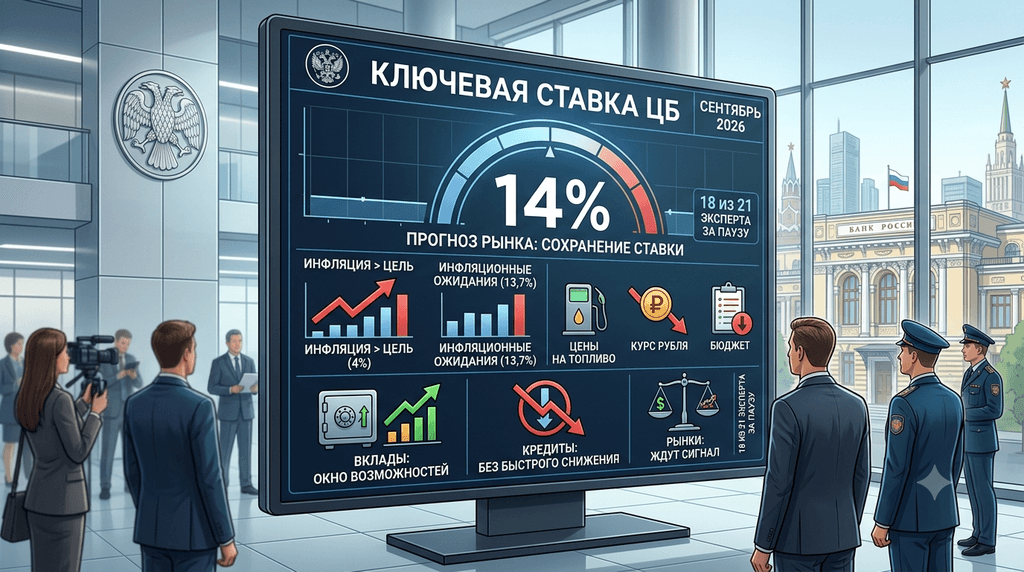
Can the Bank of Russia continue its rate-cutting cycle when inflation remains noticeably above target? Most analysts believe that at its meeting on September 11, 2026, the regulator will take a pause and keep the key rate at 14% per annum. In a survey published by Izvestia and recounted by Business Online, 18 out of 21 experts supported this scenario. The alternative remains a 0.25 percentage point cut to 13.75%, but this would require more convincing signs of slowing price growth, ruble stabilization, and an improved situation in the fuel market.
A pause does not mean abandoning further monetary policy easing. It shows that the Central Bank wants to test the sustainability of disinflation following the July cut and evaluate fiscal, currency, and inflationary risks. For depositors, this means an extension of high interest rates; for borrowers, a lack of swift relief; and for the stock and bond markets, dependence on the regulator's post-decision signaling.
Why the Market Expects the Key Rate to Remain at 14%
The main reason for the expected pause is that inflationary risks do not yet allow the CBR to cut rates quickly. According to the Bank of Russia's official announcement on July 24, the regulator reduced the rate by 25 basis points to 14%, but simultaneously pointed to the need for a more gradual future reduction. Therefore, the September decision is most likely to serve as a test: are prices slowing down quickly enough to continue easing without accelerating inflation again?
Inflation Remains Above Target
In its official decision on July 24, the Bank of Russia reported that annual inflation stood at 5.9% as of July 20, while the regulator's medium-term target is 4%. In its baseline scenario, the CBR expects inflation to be in the 6–7% range by the end of 2026. This means that even with further slowdowns, price pressures will remain above target, and a sharp rate cut could fuel excess demand.
An additional signal comes from current price growth estimates. According to CBR data, in the second quarter of 2026, the seasonally adjusted current rate of price growth averaged 5% annualized, down from 8.7% in the first quarter. However, the indicator accelerated again in June and July. Consequently, while overall dynamics have improved, they do not yet look sustainable enough for a confident transition to a softer policy stance.
Inflation Expectations Support Consumer Demand
High inflation expectations prevent rapid rate cuts because they prompt households to make purchases sooner and more aggressively. In August, population expectations—cited in the Business Online review—declined to 13.7%, but remained very high. When people anticipate new price increases, they are more likely to put savings aside in favor of current consumption, and companies pass cost increases into prices faster.
That is why the CBR's decision will depend not only on published inflation figures, but also on how expectations among households, businesses, and financial market participants evolve. The official Bank of Russia also noted that elevated expectations could hinder a sustainable slowdown in inflation.
Fuel, the Ruble, and the Budget Increase Uncertainty
Another factor favoring a pause is fuel market instability. Experts surveyed for the September forecast pointed to rising gasoline prices and disruptions capable of increasing corporate logistics costs. Fuel price hikes quickly trickle down into transportation, retail goods, and services, making it essential for the regulator to assess both direct and secondary effects.
Pressure is also mounting through the currency channel. Experts estimate that in the month leading up to the forecast, the ruble weakened by approximately 8%. A weaker ruble increases the cost of imports and components, thereby potentially slowing disinflation. Finally, a more expansionary fiscal policy and a potential rise in the deficit could boost domestic demand. The Bank of Russia explicitly warned: if the structural primary deficit turns out higher than in the current baseline scenario, monetary policy may require greater tightness.
What a Pause Means for the CBR's Future Path
Holding at 14% in September is likely a temporary stop rather than the start of a prolonged period of rate hikes. However, further rate cuts will become slower and more data-dependent. In the official baseline scenario, the average rate in 2026 is estimated at 14.5–14.6%, and in 2027 at 10.5–12.5%. These forecasts do not represent a fixed schedule: the CBR will adjust its trajectory as new data on inflation, the budget, demand, and the labor market emerges.
Is 13.75% Possible in September?
A cut to 13.75% remains a working option, albeit a less likely one. Its probability will rise if weekly price data demonstrates a sustained slowdown, the ruble stabilizes, and the fuel market stops adding inflationary pressure. In that scenario, a modest 25 basis point step would allow the CBR to continue normalizing conditions while maintaining caution.
Even with a cut, the market will closely analyze the accompanying statement. A dovish signal would indicate a readiness to keep cutting rates, whereas a cautious comment could neutralize any positive reaction to the cut itself. Thus, while the 13.75% figure is important, the regulator's guidance on the pace of future steps is equally critical.
Why October and Year-End Remain Key Milestones
According to estimates cited by Business Online, if the ruble stabilizes, the gasoline situation improves, and inflation slows down, a 0.25 percentage point cut could happen as early as October 23. The same article outlines a scenario in which the rate could fall to 13.5% by the end of the year. This is not a promise from the CBR, but a hypothetical analyst forecast.
In an opposing scenario, the rate could remain at 14% longer. If inflation persistently exceeds 7% or fiscal parameters prove significantly more expansionary, the room for easing will shrink. Therefore, investors should not interpret a September pause as an automatic signal for a rapid revaluation of all assets.
How Keeping 14% Will Affect Deposits and Savings
For depositors, maintaining a high key rate extends the window of opportunity, but does not guarantee that maximum yields will remain unchanged for the entire term. Banks may already adjust their offers in anticipation of future rate cuts, especially on long-term deposits. However, a September pause can support attractive conditions over short- and medium-term horizons.
A rational strategy depends on the term, liquidity needs, and the requirement for cash access. If funds are not needed in the coming months, locking in part of the yield for a term of one year or more can reduce the risk of falling rates after a new easing cycle begins. However, one should not place the entire reserve into a single product: early withdrawal often results in lost accrued interest.
Chinese analytical notes on this issue suggest locking in high yields for the long term while the benchmark rate remains in the 10–14% range. This is useful logic for managing interest rate risk, but specific bank offers—including 13–15% ranges—must be verified on the date of deposit opening. Deposit yields do not equal the key rate and depend on requirements regarding top-ups, insurance, capitalization, and early termination.
When Mortgages and Consumer Loans Will Become Cheaper
Expectations of a rapid reduction in borrowing costs following the September decision are unwarranted. Bank rates typically decline gradually because they factor in funding costs, credit risk, operational expenses, and a margin over the key rate. Even a 0.25 percentage point CBR cut will not necessarily translate into an immediate, equivalent drop in mortgage or consumer loan rates.
If 14% is maintained, borrowers will likely continue to face tight lending conditions. The official Bank of Russia characterizes non-price conditions for bank lending as tight, noting that corporate lending growth slowed in June, whereas the retail portfolio grew faster. This indicates that loan demand remains intact, but banks are simultaneously scrutinizing borrower creditworthiness more closely.
User inputs also highlight commercial and mortgage rates in the 16–18%+ range. While these numbers should not be taken as universal for all banks and products, they illustrate the gap between the key rate and the final cost of borrowing. For major purchases, decisions should be based on total overpayment rather than expectations of a single small step by the CBR.
What Will Happen to the Ruble, Stocks, and Bonds
Market reactions will depend on the divergence between the decision and market expectations. A hold at 14% is already largely priced in, so the decision alone may not trigger strong moves. The tone of the CBR statement will be far more consequential: a hawkish signal could support the ruble and bond yields, whereas a neutral or dovish tone would reinforce expectations of future rate cuts.
The Ruble and the Money Market
For the ruble, a pause could prove moderately supportive, as high rates enhance the attractiveness of ruble-denominated instruments. However, the interest rate factor does not operate in isolation. The exchange rate is influenced by export revenues, import demand, budget expenditures, geopolitical risks, and inflation expectations. Therefore, ruble appreciation cannot be guaranteed based on the CBR's decision alone.
The money market, by contrast, remains a natural beneficiary of high rates. Money market funds and short-term instruments can retain high current yields as long as the rate stays elevated. Their key advantages are liquidity and lower sensitivity to changes in long-term yields, though their ultimate return will decline alongside future rate cuts.
Stocks: Valuation Pressure and Flight to Quality
High risk-free yields heighten competition for capital and can cap equity valuation growth. It becomes easier for investors to secure significant interest income via deposits, money market funds, or short-term bonds, so stocks must offer a more compelling risk premium.
Companies with high debt loads, weak cash flow, and heavy reliance on refinancing are the most vulnerable. Conversely, businesses with resilient earnings, low net debt, and stable dividend payouts may perform relatively better. This does not imply an entire sector will automatically rise, but it explains potential further differentiation among issuers.
Bonds: Why Floaters Offer Better Protection
Fixed-rate federal loan bonds (OFZ-PD) usually receive a noticeable boost once the market confidently prices in rate cuts. Until such a signal emerges, their prices may remain under pressure from high yields. Long-duration issues remain more sensitive to changing expectations than short-dated ones.
Floating-rate OFZs (OFZ-PK) and money market funds align better with a protective scenario where rates remain high for longer. Their coupon or yield tracks monetary conditions, and their duration sensitivity is generally lower than that of long fixed-rate bonds. However, this does not render them risk-free: credit, market, and infrastructure risks persist, and yields will drop upon future rate reductions.
| Asset or Product | Possible Reaction to a 14% Pause | Main Risk |
| Fixed deposit | Yields may remain high, but new offers will be revised downward | Loss of interest upon early withdrawal |
| Consumer loan & mortgage | Rapid reduction in rates is unlikely | High total overpayment |
| Money market fund | Retains attractive current yield and liquidity | Yield will decline following rate cuts |
| OFZ-PD (Fixed-rate) | Upside potential limited until a clear rate-cut signal | Rising yields lower bond prices |
| OFZ-PK (Floating-rate) | Better adapted to high rates | Variable coupon and market risks |
| Stocks | Potential selectivity favoring quality issuers | Competition from risk-free yields |
Why a High Rate Remains Necessary for the Economy
The Bank of Russia maintains tight monetary conditions to curb inflation while preventing elevated inflation expectations from taking root. Pressures stem from labor shortages, wage growth outstripping productivity, fiscal stimulus, and fuel/logistics costs. The official CBR has also noted that pro-inflationary risks predominate over disinflationary ones over the medium term.
A high rate cools demand through borrowing costs, increases the incentive to save, and helps limit secondary cost pass-through into prices. The downside is slower investment activity and pressure on borrowers. Thus, the regulator is not choosing between a good and a bad scenario, but rather between the risk of a temporary economic slowdown and the risk of persistent inflation.
How to Read the CBR's Signal After the Meeting
The most vital outcome of the meeting may not just be the 14% figure itself, but the wording regarding future actions. A hawkish signal indicates that the CBR does not rule out holding rates high or even raising them if the inflation outlook deteriorates. A neutral signal would indicate data dependence. A dovish signal would increase the likelihood of rate cuts at upcoming meetings.
Investors should compare the statement against three key indicators: the inflation forecast, demand assessments, and fiscal risk descriptions. If the regulator reiterates the persistence of price pressures, the market may push back expectations toward a later rate cut. If the CBR notes sustained disinflation and easing demand, long-term bonds and rate-sensitive stocks will gain more support.
KuCoin Offers A More Stable Option in A Volatile Market
If you worry about the frequent ups and downs in the market, and pursue a more stable option to earn money passively, KuCoin is the right place to come:
Simple Earn: Deposit and withdraw tokens anytime, earning stable returns.
Kucoin Earn: Earn stable profits with professional asset management.
Hold to Earn: Earn rewards by holding assets in Funding, Trading, Margin, Futures, Mining, and Unified Accounts.
Staking: Unlock the earning potential of on-chain assets.
Advanced Investments: Advanced Investments offer a variety of structured products to help your money grow in any market.
Shark Fin: Principal Protection and Guaranteed Gains
Dual Investment: Buy low and sell high with transparent return calculations.
Snowball: High yields, with price protection.
Discount Buy: Buy crypto at discount prices.
KCS Loyalty: Level up to enjoy exclusive perks by staking ≥ 1 KCS.
KuCoin Wealth: Discover future value and begin your smart investing journey.
KCS Benefits: Hold and stake KCS to access benefits across the platform.
KCS Staking 2.0: Participate in KCS on-chain governance to earn yield.

Conclusion
The consensus heading into the Bank of Russia meeting on September 11, 2026, points to keeping the key rate at 14% per annum. Supported by 18 out of 21 surveyed analysts, the primary arguments for this scenario remain above-target inflation, high household expectations, ruble weakening, fuel risks, and uncertainty surrounding fiscal spending. However, a pause does not close the door to future cuts: the CBR's official forecast projects an average rate of 14.5–14.6% in 2026 and 10.5–12.5% in 2027.
For depositors, this means the period of high yields may continue for a while longer, though terms should be verified before locking in funds. Borrowers should not count on a quick drop in mortgage and consumer loan rates. Markets have largely priced in a pause, making the regulator's subsequent signaling the deciding factor. Money market funds and floating-rate instruments may serve as defensive plays while rates remain high, whereas long-term bonds and highly valued stocks depend heavily on a future pivot in policy. Any investment plan must account for the fact that the September decision had not yet been made at the time of writing this article.
Frequently Asked Questions
1. Will the CBR keep the rate at 14% on September 11, 2026?
With high probability, yes: 18 out of 21 surveyed experts expect a pause at 14%, but the final decision rests with the Bank of Russia and had not yet been made at the time of writing.
2. Could the rate drop to 13.75%?
Yes, such a scenario is possible if fresh data confirms a sustained slowdown in inflation, ruble stabilization, and easing fuel price pressure. However, this is the less likely consensus scenario.
3. Is it worth locking in a high deposit rate now?
Locking in a portion of funds can protect against future deposit rate declines if the money is not needed early. Before opening a deposit, you should compare the full yield, early termination terms, and deposit insurance coverage.
4. Why doesn't a high key rate immediately make loans cheap when cut?
A loan rate reflects not only the key rate, but also the bank's funding costs, client risk, operational expenses, and margin. Therefore, even a CBR rate cut is passed on to borrowers gradually and not always in full.
5. Which assets typically handle a prolonged pause best?
During periods of high interest rates, liquid money market instruments and floating-rate bonds tend to demonstrate relative resilience, whereas long-term fixed-rate bonds and heavily indebted companies are more vulnerable to expensive financing. This is a general market principle, not individual investment advice.
Disclaimer : This material is provided for informational purposes only and does not constitute financial, investment, legal, or tax advice. Transactions involving cryptocurrencies and tokenized assets carry substantial risks — including price volatility, limited liquidity, counterparty exposure, and the potential for total loss of invested capital. Readers should conduct their own research and, where appropriate, consult a qualified professional before making any financial decisions.