

Banks Keep Rates Unchanged After the Central Bank Pause: What Will Happen to Deposits, Loans, and Bonds in 2026
Introduction
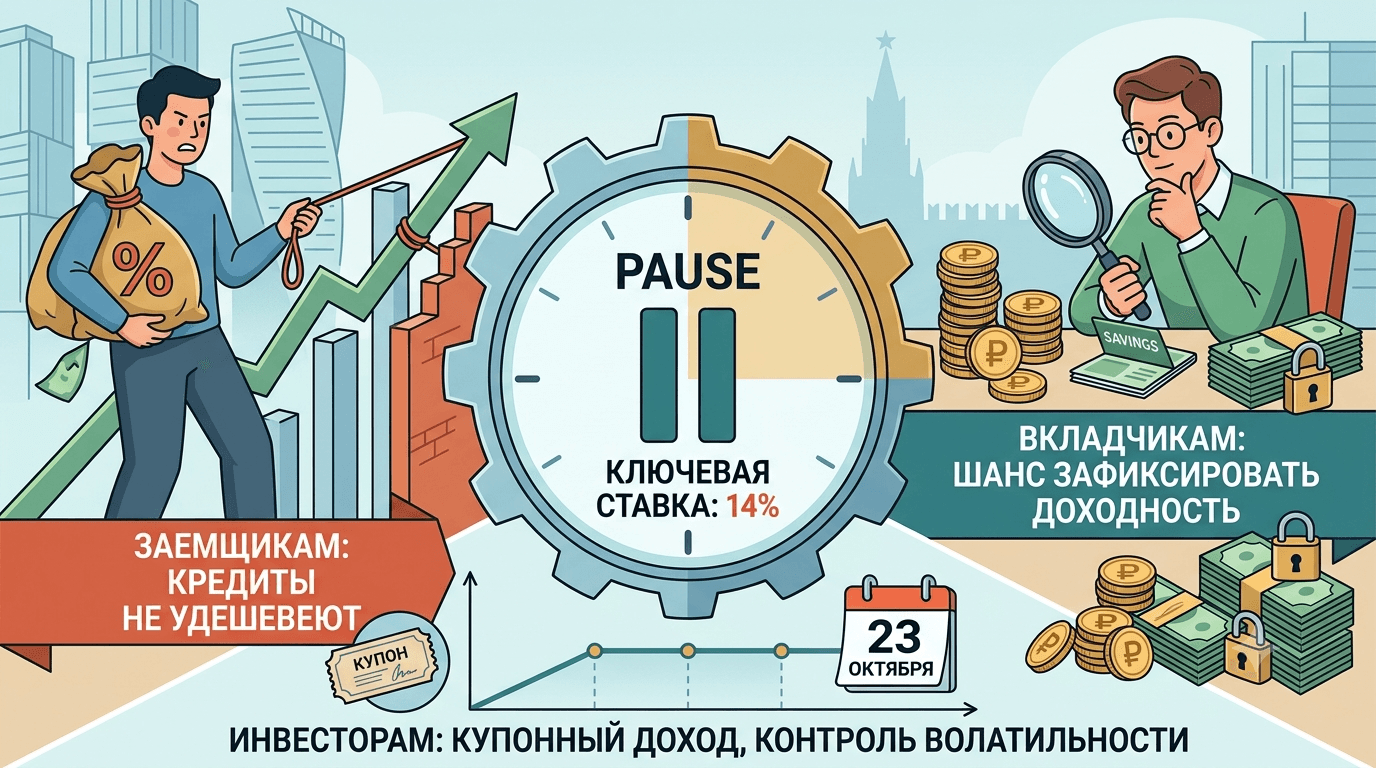
Why did banks refrain from sharply changing their rates after the Bank of Russia's decision? On September 11, 2026, the regulator kept its key rate at 14% per year for the first time after ten consecutive cuts. This means deposit rates will most likely remain high in the coming weeks, while consumer loans and market-based mortgages will not become noticeably cheaper before the next important meeting on October 23. According to the Bank of Russia, the annualized rate of persistent price growth accelerated to 5–6%, while inflation risks increased and now prevail over disinflationary risks. Therefore, the September pause is not a signal of an immediate reduction in the cost of money, but rather a period of waiting for new data. It gives depositors an opportunity to lock in attractive returns, advises borrowers not to count on rapid refinancing, and encourages investors to shift their focus from quick asset repricing to coupon income and risk control.
Why Did the Central Bank Keep the Key Rate at 14%?
The main reason for the pause was accelerating persistent inflation alongside still-elevated demand and lending activity. In its September 11 press release, the Bank of Russia reported that current price growth had intensified significantly during the summer, while persistent price growth reached 5–6% on an annualized basis. In July, seasonally adjusted current inflation stood at 11.6% annualized, compared with an average of 5.3% in the second quarter. The estimate of core inflation rose to 7% from 4.6% in the previous quarter.
The regulator also identified a risk of a new imbalance between supply and demand. Disruptions affecting some production capacity and rising motor fuel prices were among the contributing factors. The Bank of Russia considers these causes largely temporary, but it is concerned about secondary effects, whereby higher fuel prices begin to push up the prices of a broad range of goods and services.
The labor market and corporate lending are creating additional pressure. Wages are still growing faster than productivity, although the gap is gradually narrowing. According to Finam analysts, corporate lending growth in July was close to 14% year over year. This matters to the Central Bank because if companies continue to borrow actively, monetary conditions may not be tight enough to ensure a sustainable slowdown in demand.
The Central Bank Pause Is Hawkish, Not a Shift Toward Rate Hikes
The September decision can be described as a “hawkish pause”: the regulator did not raise the rate, but it adopted more cautious rhetoric. Elvira Nabiullina stressed that a key-rate cut does not happen automatically. According to Gazeta.Ru, the meeting substantively focused on keeping the rate unchanged, while a rate cut was effectively not considered.
This does not mean that the next move will necessarily be a rate hike. The Bank of Russia still allows for a renewed decline in persistent inflation if temporary supply constraints ease and aggregate demand remains contained. However, the regulator needs additional confirmation. Before October 23, it will assess September inflation, inflation expectations, corporate lending, and budget parameters.
Will High Deposit Rates Remain?
Yes, deposit rates should remain high and change gradually in the short term. Banks have not received a signal from the Central Bank to quickly reduce their funding costs, so they have no immediate reason to revise existing offers. According to data from Finuslugi cited by Gazeta.Ru, as of September 11, the average rate on three-month deposits reached 13.63%, while six-month deposits offered 13.15%, one-year deposits 12.37%, and deposits with a term of one and a half years 11.45%.
At the same time, longer maturities had already shown a slight decline. The average rate on two-year deposits fell to 10.98%, while the rate on three-year deposits declined to 10.67%. This difference is important: banks are pricing expectations of future monetary easing into long-term yields even while the current key rate remains unchanged.
The highest advertised rates should not be treated as market averages. As of September 11, the highest offer among the twenty largest banks was 19% per year on a three-month deposit, but it was available only to new customers. The minimum yield for a three-year term was 7%. Before opening a deposit, customers should check the requirements for the deposit amount, additional contributions, early withdrawal, interest payments, and the availability of new funds.
Is This a Good Time to Lock In Returns?
For a depositor with a one- to two-year horizon, the current period can be considered a convenient window to lock in part of their savings, but not a reason to place all capital in a single product. The 14% key rate remains significantly above the Bank of Russia's published estimate of 5–6% persistent inflation. In nominal terms, this creates a high positive real rate before taxes and the specific yield of the deposit are taken into account.
It is more practical to spread money across different maturities. Part of the funds can be placed in a short-term deposit to preserve liquidity and benefit if high rates are extended. Another portion can be locked in for one year or one and a half years if the funds will definitely not be needed. A two- or three-year deposit makes sense only for a clearly defined goal: it protects against falling rates but reduces the depositor's flexibility.
A sharp collapse in rates is not expected after the September decision. However, experts interviewed by Gazeta.Ru allowed for a decline in the average maximum rate at the largest banks to approximately 11.5–12% by the end of the year. Therefore, waiting for an “even better” offer could produce the opposite result if the easing cycle resumes.
|
Who may benefit from the decision
|
Rational approach
|
|
A depositor with an emergency reserve
|
Keep the liquid portion in a savings account or short-term deposit
|
|
A depositor with a one- to two-year horizon
|
Lock in part of the return through a fixed-rate deposit
|
|
A depositor planning a possible major purchase
|
Do not lock the entire amount into a long-term product
|
|
A customer seeking the maximum rate
|
Check the conditions for new funds, capitalization, and early withdrawal
|
When Will Loans and Mortgages Become Cheaper?
A noticeable decline in lending rates should not be expected in the coming weeks. After the key rate was left unchanged, banks continue to raise funds at a high cost, while credit risks and borrower requirements remain elevated. According to Gazeta.Ru, the average cost of consumer loans is around 30%, while market-based mortgage rates are approaching 19%.
Loans usually become cheaper more slowly than deposits. A bank must make sure that any decline in the key rate will be sustainable rather than a one-off move. In addition, the cost of a loan depends not only on the key rate, but also on the customer's risk profile, collateral, term, fees, insurance, and the bank's funding structure.
For market-based mortgages, experts expected rates of approximately 16–19% in the autumn, while unsecured consumer loans were expected to range from 28–35% and secured loans from 20–25%. These ranges are not a guarantee of an offer from any particular bank. They indicate the general level of rates and explain why borrowers should not build their budgets on the assumption that money will become cheaper quickly.
Should You Take a Loan Before the October 23 Meeting?
The decision should depend on necessity, not on an attempt to predict a single Central Bank meeting. If the purchase is optional, postponing the loan reduces the risk of overpayment. If the loan is needed for housing, medical treatment, or another essential expense, the borrower should minimize the amount, shorten the term, and check in advance whether partial early repayment is allowed.
The next meeting is scheduled for October 23, 2026. The Bank of Russia will receive new data on inflation, the budget, the fuel market, and corporate lending. However, even a rate cut at that meeting would not make mortgages or consumer loans cheap the next day. Banks would need time to change their products, reassess funding costs, and confirm that the trend is sustainable.
Potential refinancing in 2027 may become more realistic if inflation approaches the 4% target. This scenario is included in the Central Bank's baseline forecast, but it depends on several conditions being met. Therefore, a current loan should be considered affordable only if its payments can be supported by the borrower's present household or corporate budget.
What Does the Pause Mean for Bonds and Other Investments?
For investors, the pause shifts the focus from rapid price repricing toward locking in returns and managing volatility. If the rate remains close to 14% for an extended period, short-term bonds, money-market instruments, and floating-rate notes retain an attractive risk-return balance. This is the conclusion reported by Banki.ru, citing market experts.
Floating-rate notes are particularly sensitive to current interest-rate conditions: their coupons are usually linked to the money market or a benchmark rate, so they are less dependent on sharp price changes while maintaining high income. Short-term bonds limit interest-rate risk because their prices respond less to changes in long-term expectations.
Medium-term bonds can be viewed as a bet on the resumption of the rate-cutting cycle. If yields fall, previously purchased securities may rise in price. However, this potential is currently deferred. Finam noted that the repricing of medium- and long-term Russian government bonds may take place later, while reliable corporate bonds with fixed coupons and low duration are currently preferable.
Long-term Russian government bonds require greater caution. Their prices are sensitive to budget risks, inflation, and expectations for the rate path. If fiscal policy proves more expansionary than assumed in the Central Bank's baseline scenario, the regulator may keep monetary conditions tight for longer.
Equities received a neutral or moderately negative signal after the Central Bank's decision. According to Banki.ru, the MOEX Index had risen by almost 8% since the previous July meeting, while future performance will depend not only on interest rates but also on geopolitics, oil, the exchange rate, and corporate earnings. Therefore, the pause does not provide a universal “buy” or “sell” answer: investors must assess each company and their own risk tolerance.
|
Instrument
|
What supports it now
|
Main risk
|
|
Money-market instruments and short-term bonds
|
High current yield and low duration
|
Yield will decline when easing resumes
|
|
Floating-rate notes
|
Coupon adjusts to high interest rates
|
Income depends on the coupon formula and issuer credit quality
|
|
Medium-term Russian government bonds
|
Potential repricing if rates decline
|
Higher volatility before a policy turn
|
|
Long-term Russian government bonds
|
Significant price-growth potential during sustained easing
|
Fiscal and inflation risks
|
|
Equities
|
Earnings potential and geopolitical repricing
|
High dependence on external factors and commodity prices
|
How to Read the Bank of Russia's Next Signals
The key signal ahead of the October meeting will not be a single inflation figure, but the persistence of price growth. One temporary acceleration does not necessarily lead to a rate hike. However, several months of elevated price growth, rising expectations, and continued rapid corporate lending could force the Central Bank to maintain tight policy for longer.
The second indicator is the budget. The Bank of Russia said it would update its forecast after new budget projections become available. A higher structural deficit could require tighter policy than assumed in the baseline scenario.
The third indicator is the state of supply. If idled production capacity is restored and the fuel market stabilizes, the temporary inflation impulse will weaken. If the constraints persist, price pressure will last longer.
Thus, the pause does not cancel the scenario of gradual rate cuts, but it makes that scenario conditional. The market needs to see a sustained movement of inflation toward 4% in 2027, not merely a promise of future easing.
How to Buy Bonds and Manage Savings on KuCoin
KuCoin can be used as an additional platform for managing part of an investor's capital, but the product should match the user's objectives and risk tolerance. Before registering, users should check whether the required instrument is available in their region, as well as the fees, settlement currency, custody rules, and withdrawal procedures.
For the conservative portion of a portfolio, bank deposits and ruble money-market instruments are generally easier to understand than volatile digital assets. Money needed for mandatory payments and an emergency fund should not be allocated to assets with high price uncertainty. If an investor is considering cryptocurrency instruments, it is more prudent to start with a limited allocation, define the investment horizon in advance, and avoid using borrowed money.
Beyond the Headlines: What KuCoin 5.0 Means for You
Market news moves fast — but where you act on it matters just as much. This October, KuCoin launches KuCoin 5.0, transforming KuCoin into a rebuilt platform. Here's what actually changes for you:
-
One account for everything. Older platforms split your money across separate "spot," "margin," and "futures" accounts and expected you to understand why. KuCoin 5.0's unified account removes that entirely — deposit once, and everything is simply there.
-
Stocks, indices, and commodities. KuCoin 5.0 expands beyond crypto into global markets. When crypto chops sideways and equities rally (or the reverse), you rotate in minutes instead of opening a brokerage account and waiting days for fiat rails.
-
Real-world assets (RWA). Tokenized exposure to traditional assets like commodities, right inside your crypto account. One of the fastest-growing segments in global finance is no longer reserved for institutions — you access it from the same balance you trade with.
-
Earn while you learn. Not ready to trade? KCUSD lets your stablecoins earn daily, auto-compounding interest. The lowest-stress way to put your idle deposit to work for 4% yield.
-
An AI assistant in plain language. Ask questions, get market context, understand what you're looking at — built into the platform, no jargon required.
-
An app that doesn't overwhelm. Faster, cleaner, and consistent — intuitive from the first tap, not after a tutorial.
-
Safety you can check, not just trust. A MiCAR-licensed EU entity, Proof of Reserves you can verify yourself, and internationally certified security (SOC 2 Type II, ISO 27001:2022).
Create your account in minutes — and start on the platform built for where crypto is going, not where it's been.
Conclusion
Keeping the key rate at 14% means that banks are unlikely to sharply reduce deposit and lending rates for now. For depositors, this is a relatively favorable pause: average deposit yields remain high, and part of one's savings can be locked in for one or two years. However, the highest advertised rates require careful review of the terms and should not be treated as the market standard.
The situation remains difficult for borrowers. Market-based mortgages and consumer loans remain expensive, and meaningful relief is possible only after the rate-cutting cycle resumes sustainably. The next important Central Bank decision will take place on October 23, but even that meeting does not guarantee an immediate reduction in borrowing costs.
For investors, the pause suggests focusing on coupon income, short-term bonds, floating-rate notes, and issuer quality. Long-term securities retain potential if monetary policy eases in the future, but they carry higher volatility. Overall, the September decision should be interpreted as conditional waiting for new data: inflation, the budget, the fuel market, and corporate lending will determine whether the rate-cutting cycle returns by the end of 2026.
Frequently Asked Questions
1. Could the Central Bank Raise the Rate at the October 23 Meeting?
Yes, this is theoretically possible if inflation, inflation expectations, or fiscal risks intensify significantly. However, the September 11 decision itself was not a rate hike and did not mark a transition to a new tightening cycle.
2. Is Deposit Interest Protected When a Deposit Is Closed Early?
Usually not. When a deposit is withdrawn early, the bank recalculates the return according to the contract, often using an on-demand rate. The exact rules depend on the product, so they should be checked before opening the deposit.
3. Do You Have to Pay Tax on Deposit Income?
Tax liability depends on total annual interest income and the tax-free threshold calculated under Russian law. Before filing a tax return or placing a large amount of money, customers should check the current rules for the relevant tax year.
4. Why Is a Loan Rate Higher Than the Key Rate?
The key rate is a benchmark for the cost of money in the financial system, not a ready-made rate for the customer. A loan rate also includes default risk, the bank's operating expenses, the term, collateral, insurance, and its margin.
5. What Matters More for the Ruble: The Central Bank Rate or Oil?
Both factors matter under current conditions, but short-term ruble movements may depend more heavily on export revenues, oil prices, Finance Ministry operations, and geopolitics. Banki.ru noted that the currency's reaction after the September decision was limited.
Disclaimer : This material is provided for informational purposes only and does not constitute financial, investment, legal, or tax advice. Transactions involving cryptocurrencies and tokenized assets carry substantial risks — including price volatility, limited liquidity, counterparty exposure, and the potential for total loss of invested capital. Readers should conduct their own research and, where appropriate, consult a qualified professional before making any financial decisions.