

AOTsV Seeks Status as Russia’s First SRO for Crypto Exchanges: What Federal Law No. 282-FZ Will Change
Introduction
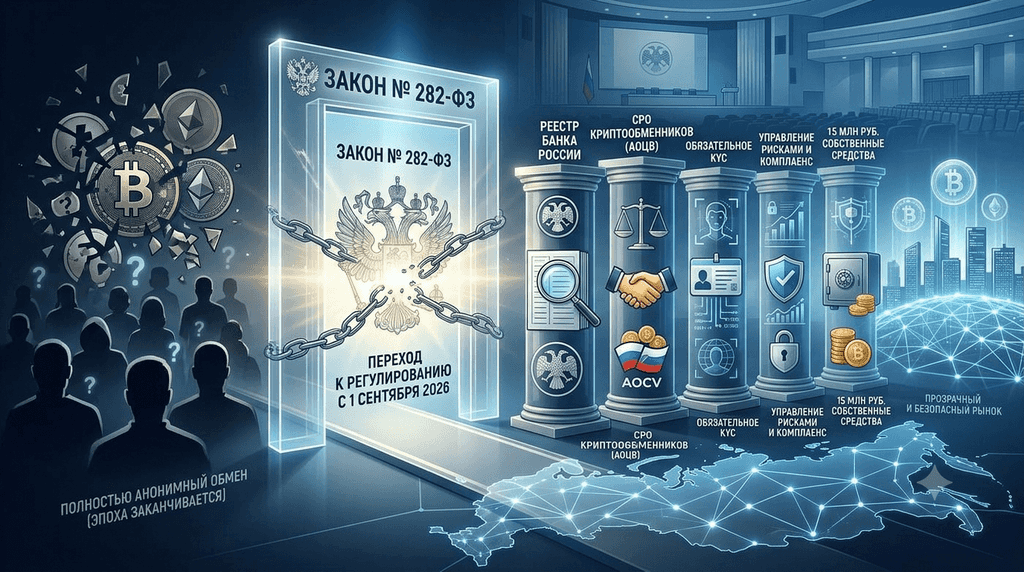
As of September 1, 2026, Russia’s crypto exchange market began moving from fragmented practices toward a formal system of authorization and oversight. The short answer is that organizations conducting systematic activity will have to enter a special register maintained by the Bank of Russia and join a specialized self-regulatory organization — an SRO. One of the first candidates for this role is the Association of Organizations Engaged in Digital Currency Exchange, known as AOTsV. According to RBC on September 1, 2026, representatives of more than 100 Russian crypto exchanges participated in its founding congress.
The creation of AOTsV does not mean that its SRO status has already been approved by the Bank of Russia. The association must still wait for the full set of subordinate regulations and submit its application for SRO status. Nevertheless, its establishment shows that the industry is preparing for mandatory KYC, transaction accounting, risk management, and disclosure of exchange terms. The era of fully anonymous digital currency exchange is coming to an end.
Why AOTsV Has Emerged as a Candidate for Russia’s First Crypto Exchange SRO
AOTsV aims to become a specialized SRO specifically for companies engaged in digital currency exchange, rather than for the entire financial market. Its founding congress took place in Moscow on September 1, 2026. More than 100 representatives of the crypto exchange industry, government bodies, the professional community, and companies connected with NAUFOR participated in the event.
The association’s stated objective is to unite the market and prepare common operating rules before the full authorization process for organizations begins. The main issues under discussion include customer identification standards, transaction accounting, internal controls, risk management, disclosure of exchange rates and fees, and procedures for handling complaints. This agenda matters because the future SRO will have to do more than represent business interests: it will need to turn the law’s general requirements into the day-to-day procedures used by crypto exchanges.
Andrey Tugarin, managing partner at GMT Legal, became the head of AOTsV. According to him, the association has been registered with the Ministry of Justice and intends to submit the required documents to the Bank of Russia once the regulatory framework is in place. For now, therefore, it is more accurate to describe AOTsV as a candidate for SRO status rather than as an operating self-regulatory organization.
Competition remains possible. NAUFOR has also announced plans to obtain SRO status for information system operators, digital depositories, and crypto exchanges, at least for some of these areas. At the same time, NAUFOR primarily focuses on professional securities-market participants and specialized depositories that are already part of its structure. As a result, the market may end up with several organizations serving different categories of participants rather than one universal SRO.
What SRO Status Means
An SRO is a nonprofit association of participants in a particular professional field that develops operating standards and monitors compliance within the powers established by law. Under the new model, the Bank of Russia sets the regulatory framework and maintains special registers, while the relevant SRO details many of the practical requirements for its members.
For a crypto exchange, SRO membership will not be a voluntary advantage comparable to an industry certificate. Article 18 of Federal Law No. 282-FZ links the right of a regulated exchange to operate in the market with inclusion in the Bank of Russia’s register and mandatory participation in a specialized SRO. The debate over which organization will become the first crypto exchange SRO therefore has practical as well as reputational importance: admission rules, oversight, and business costs will depend on the model ultimately selected.
How Federal Law No. 282-FZ Defines a Crypto Exchange
The law’s central criterion is the systematic nature of transactions. An organization engaged in digital currency exchange is defined as a person that regularly enters into digital currency purchase and sale transactions in its own name and at its own expense outside organized trading. Activity is considered systematic when two or more transactions are conducted during a month for a total amount exceeding RUB 3.5 million.
The law therefore focuses not only on a service’s name, website, or advertising, but also on the actual scale of its operations. A small business conducting one irregular transaction and a systematic exchange serving a steady flow of customers are not treated in the same way. Once the established threshold is reached, the company must prepare for the requirements of a regulated financial market.
An official crypto exchange must have at least RUB 15 million in equity capital. This amount, however, is not the full cost of legalizing the business. The calculation must also include expenses for the legal structure, personnel, compliance, information security, audits, software redundancy, and SRO membership. Experts quoted by RBC on August 27, 2026, emphasized that the actual burden could be significantly higher than the formal capital threshold.
|
Requirement
|
Practical meaning for the exchange
|
|
At least two transactions per month totaling more than RUB 3.5 million
|
The activity falls under the definition of systematic exchange
|
|
At least RUB 15 million in equity capital
|
The minimum financial threshold for an official organization
|
|
Inclusion in the Bank of Russia’s register
|
The right to operate under the regulated model
|
|
Membership in a specialized SRO
|
Mandatory compliance with industry standards
|
|
KYC, accounting, and internal controls
|
The end of a fully anonymous operating model
|
The law separately establishes requirements for managers and employees, transaction accounting, data storage, and software. In particular, primary and backup software systems must be located in Russia, increasing the demands placed on infrastructure and information security.
What Will Change for Anonymity and KYC
Fully anonymous exchange is no longer compatible with the legal sector’s new model. A regulated crypto exchange will have to identify customers, record transactions, and apply risk-management procedures. This means that KYC will become a basic condition for operating, not an optional service.
Common KYC standards should define what information must be collected from a customer, when a transaction may be suspended, and how the decision must be documented. AML procedures help identify suspicious transactions and reduce the risk that exchanges will be used to launder proceeds.
Mandatory identification does not mean that all information will automatically be disclosed publicly. The law contains separate requirements concerning information confidentiality, the storage of transaction data, and interaction with authorized bodies. For customers, this creates a different balance between privacy and verifiability: data should not be published without a legal basis, but a lawful exchange can no longer be built around a promise of complete anonymity.
The future SRO will likely become a platform for standardizing questionnaires, risk-based procedures, and internal-control requirements. However, the specific document forms, verification checklists, and data-sharing procedures will depend on regulations issued by the Bank of Russia and on the organization’s internal standards. Until those documents are approved, individual statements by market participants should not be treated as final rules.
How the Transition Period Until 2027 Will Work
The transition period gives existing participants time to restructure, but it does not cancel the future obligation to become compliant. According to RBC on September 1, 2026, residents may systematically buy and sell digital currency for their own interests, in their own name and at their own expense, until June 30, 2027, while they remain outside the special register. Another RBC explanation refers to July 1, 2027 — this is the date when the transition phase ends, while June 30 is the last day of the transition regime.
The sequence of actions is also important. An exchange will need to complete the admission procedure and enter the Bank of Russia’s register, then join a specialized SRO within the prescribed period. According to RBC, exchanges will have 90 days to join an SRO, with the period linked to the emergence of the relevant SRO and the inclusion of the particular exchange in the register, rather than simply to the date on which the law entered into force.
The transition period should not be interpreted as permission to operate without preparation until the final day. Companies should already be assessing their equity capital, ownership structure, management qualifications, accounting systems, data storage, and banking infrastructure. The later restructuring begins, the greater the risk that the business will not pass the review and will be unable to replace informal processes with formal controls.
For exchanges operating offline and in the OTC format, the transition will be especially sensitive. Their businesses often rely on cash settlements, manual customer checks, and individualized quotations. The new model will require them to document transactions, disclose rates and fees, and establish rules for refunds and stalled transactions. This may change not only their legal documents but also the customer experience at the exchange point.
Why the Market May Become More Concentrated
The RUB 15 million threshold, audits, and ongoing compliance expenses could push a significant share of small gray-market exchanges out of the industry. The formal capital requirement may appear limited, but the total cost of compliance will include in-house lawyers and AML specialists, data-protection systems, transaction monitoring, redundancy, reporting, and regular interaction with an SRO.
According to an expert assessment cited by RBC on August 27, 2026, relatively few participants are currently ready for licensing. At the same time, a new group of services created by banks or companies linked to banking infrastructure may enter the market. This creates a mixed effect. On one hand, the number of accidental and opaque players will decline. On the other, competition could weaken if large participants capture most of the liquidity and customer flow.
Consolidation does not by itself prove that the market will deteriorate. A large company can finance reliable infrastructure and meet regulatory requirements more quickly. However, if access to an SRO and the cost of compliance become excessively high, part of the burden may be passed on to customers through spreads and fees. Their exact level will depend on SRO decisions, audit costs, reserve requirements, and competition among participants.
Will Regulation Reduce the Risk of Bank Card Freezes?
Inclusion in the Bank of Russia’s register and membership in an SRO may reduce uncertainty for banks, but they do not provide an automatic guarantee against account restrictions. Previously, crypto-related exchange transactions could appear to a bank as an opaque flow of funds, while customer and operator accounts could come under heightened scrutiny under anti-money-laundering legislation, including Federal Law No. 115-FZ.
An official exchange will have a legally defined status, standardized documents, and a clear transaction-accounting trail. This should make it easier to verify the source of funds and the purpose of payments. A bank will be able to see that the company operates within a legally established category, applies KYC and internal controls, and is not disguising its activity as a series of unrelated transfers.
SRO status, however, will not eliminate bank compliance procedures. A suspicious transaction, a mismatch with the customer’s profile, documentation errors, or a breach of requirements may still trigger inquiries and restrictive measures. It is therefore more accurate to speak of reducing the risk of unjustified uncertainty than of complete immunity from review.
For customers, this means choosing services based on verifiable indicators: inclusion in the Bank of Russia’s register after it launches, disclosed exchange terms, a clear identification procedure, and accessible complaint channels. An association logo or a promise of “official operations” alone does not prove that the service has obtained the required status.
What Tasks Will the Future SRO Have to Solve?
The SRO’s first task will be to develop common standards that are both feasible for businesses and understandable to customers. They should cover KYC procedures, risk levels, rules for storing assets and money, disclosure of rates and fees, limits, refunds, and liability for erroneous or stalled transactions.
The second task will be to represent the market’s consolidated position in dialogue with the Bank of Russia, the Ministry of Finance, and other authorities. For the regulator, this channel is more practical than receiving many separate requests. For businesses, it creates an opportunity to discuss operational problems collectively, such as how to confirm the origin of funds, handle technical failures, and apply requirements for backup software.
The third task will be participant oversight and discipline. If an SRO becomes only a lobbying platform, its value for customers will be limited. An effective organization should check compliance with standards, review complaints, and apply the measures provided for members that violate the rules.
Finally, an SRO may perform an educational and methodological role. NAUFOR already uses training and professional certification, and a similar approach may be needed in the crypto exchange sector.
What Are the Risks of the New Model for Customers and Businesses?
The main risk for businesses is the rise in fixed costs before the legal market reaches a sufficient scale. A small exchange may be unable to absorb the costs of equity capital, audits, security, and membership. For customers, the main risks are higher fees and less choice if the market quickly becomes concentrated among several large operators.
There is also regulatory risk: the law has established the basic structure, but the practical mechanisms are still being developed by the Bank of Russia. The regulator held a webinar on the admission procedure for organizations on August 28, 2026, and published the materials on its website.
A positive scenario is also realistic. Common rules may make rates and fees more comparable, reduce the number of opaque intermediaries, and simplify dispute resolution. If several SROs compete on the quality of their standards, complaint-handling speed, and transparency of oversight, businesses will have an incentive to comply in substance rather than merely on paper.
The outcome will depend on the division of responsibilities between the Bank of Russia and the SROs, the transparency of admission criteria, and whether customers can verify an exchange’s status.
How to Choose a Regulated Crypto Exchange After the Register Launches
Once the Bank of Russia’s register is established, customers should first verify a service’s legal status and only then compare its exchange rate. A reliable exchange should clearly disclose its legal entity, KYC conditions, fees, refund procedure, and complaint channels. If a service promises “complete anonymity” while claiming to operate legally under the regulated model, that is a strong reason to conduct additional checks.
Customers should compare the total cost of a transaction rather than the advertised rate alone: the final result depends on fees, network expenses, limits, processing speed, and the payment method. Customers should read the transaction terms before confirming the operation.
Finally, SRO membership is not a guarantee of profit and does not eliminate the market risk of digital currencies. It concerns the organization’s status and procedures. Asset prices, blockchain transfer speeds, and the possibility of technical delays remain separate factors that customers must assess independently.
KuCoin Offers A More Stable Option in A Volatile Market
If you worry about the frequent ups and downs in the market, and pursue a more stable option to earn money passively, KuCoin is the right place to come:
Simple Earn: Deposit and withdraw tokens anytime, earning stable returns.
Kucoin Earn: Earn stable profits with professional asset management.
Hold to Earn: Earn rewards by holding assets in Funding, Trading, Margin, Futures, Mining, and Unified Accounts.
Staking: Unlock the earning potential of on-chain assets.
Advanced Investments: Advanced Investments offer a variety of structured products to help your money grow in any market.
Shark Fin: Principal Protection and Guaranteed Gains
Dual Investment: Buy low and sell high with transparent return calculations.
Snowball: High yields, with price protection.
Discount Buy: Buy crypto at discount prices.
KCS Loyalty: Level up to enjoy exclusive perks by staking ≥ 1 KCS.
KuCoin Wealth: Discover future value and begin your smart investing journey.
KCS Benefits: Hold and stake KCS to access benefits across the platform.
KCS Staking 2.0: Participate in KCS on-chain governance to earn yield.
Conclusion
AOTsV has become one of the first prominent candidates for SRO status for crypto exchanges in Russia after Federal Law No. 282-FZ entered into force. Its founding congress, attended by representatives of more than 100 exchanges, showed that part of the industry is ready to move toward formal rules. However, the association’s status has not yet been approved by the Bank of Russia, and NAUFOR may compete for certain regulatory areas.
The new model is built around three elements: a special Bank of Russia register, mandatory membership in a specialized SRO, and requirements concerning capital, KYC, transaction accounting, internal controls, and risk management. Systematic exchange involving at least two transactions per month totaling more than RUB 3.5 million will fall under regulated activity, while the minimum equity requirement will be RUB 15 million.
The transition period until June 30, 2027 gives businesses time to prepare but does not cancel future legalization. For the market, this means consolidation, higher costs, and potentially higher fees. For customers, it means a gradual end to complete anonymity, clearer rules, and potentially less risk of opaque bank freezes. The final effect will be determined not by announcements about SRO creation, but by the quality of its standards, the transparency of the register, and its ability to protect both professional participants and customers.
Frequently Asked Questions
1. Will AOTsV Be the Only SRO for Crypto Exchanges?
No, this has not yet been established. AOTsV has announced its intention to obtain SRO status for organizations engaged in digital currency exchange, while NAUFOR is also considering status for certain areas. The final configuration will become clear after decisions by the Bank of Russia.
2. Will It Be Possible to Exchange Cryptocurrency Completely Anonymously?
Not through a legal regulated exchange. The organization will have to identify customers, maintain transaction records, and use internal-control and risk-management procedures. The scope and format of verification will depend on the law and approved standards.
3. Do Exchanges Need to Join an SRO on September 1, 2026?
The transition regime does not require all existing exchanges to stop operating immediately. According to RBC, the transition period runs through June 30, 2027, while the 90-day period for joining an SRO is linked to the emergence of the specialized organization and the inclusion of the particular exchange in the register. Preparation should not be postponed.
4. Is RUB 15 Million Enough to Open a Legal Crypto Exchange?
No. RUB 15 million is the minimum equity threshold, not the full launch budget. Additional expenses will include compliance, AML and KYC systems, audits, information security, personnel, accounting, backup software, and SRO membership.
5. Will SRO Status Protect Customers from Bank Card Freezes?
No, it does not provide complete protection. The Bank of Russia register and SRO membership may make the business easier for banks to understand and reduce the risk of freezes caused by unclear legal status. However, bank compliance teams will continue to assess specific transactions, documents, and customer risk profiles.
Disclaimer : This material is provided for informational purposes only and does not constitute financial, investment, legal, or tax advice. Transactions involving cryptocurrencies and tokenized assets carry substantial risks — including price volatility, limited liquidity, counterparty exposure, and the potential for total loss of invested capital. Readers should conduct their own research and, where appropriate, consult a qualified professional before making any financial decisions.