
What is Crypto Margin Trading?
This article provides an overview of margin trading on KuCoin EU, including how borrowing, leverage, risk metrics, and repayment work. It is intended solely for informational purposes and does not constitute investment advice, a recommendation, or a suitability assessment under MiCAR or MiFID. Margin trading involves significant risks, including the possibility of losses that may exceed the initial amount of collateral. Users should carefully review the mechanics and risks before engaging in margin trading.
Contents
1. Margin Trading Types: Cross Margin vs. Isolated Margin
2. Borrowing and Interest on KuCoin EU Margin Trading
3. Long and Short Strategies Explained
4. Monitoring Debt Ratio and Repayment
5. Benefits and Risks of Margin Trading
6. Is Margin Trading Right for You?
1. Margin Trading Types: Cross Margin vs. Isolated Margin
KuCoin EU supports two margin trading modes—Cross Margin and Isolated Margin. These modes operate differently and are suited to distinct trading strategies and risk management preferences.
1.1 Cross Margin
In Cross Margin mode:
- All assets held in the user’s margin account are used collectively as collateral.
- This mode helps optimize capital utilization and reduces the need to transfer specific tokens when borrowing assets.
- Cross Margin accounts are treated as one unified position with a shared debt ratio.
- Users benefit from flexibility in borrowing a wide range of supported tokens.
- Maximum leverage is capped at 5x.
Key Consideration: Cross Margin pools all risks within the account. In the event of adverse price movements, the risk impacts the entire account balance.
1.2 Isolated Margin
In Isolated Margin mode:
- Each trading pair operates through its own independent margin account.
- Trades, risks, and debt calculations are isolated for individual pairs.
- Only the two specific coins in the trading pair can be transferred, held, or borrowed within the account.
- Maximum leverage is capped at 10x, but this limit varies by trading pair.
Key Consideration: If a position is liquidated, only the assets in the isolated margin account are affected; other margin accounts remain unchanged.
Cross Margin vs. Isolated Margin
Cross margin involves a shared account and risk across all holdings, while isolated margin is account-specific and risk is contained to individual trading pairs.
| Feature | Cross Margin | Isolated Margin |
| Account | Single account for all trading pairs. | Separate accounts for each trading pair. |
| Margin | All assets are collectively used as collateral. | Only assets of the specific trading pair are used. |
| Debt Ratio | A single debt ratio is calculated based on all assets and liabilities under the cross margin account | The debt ratio of each isolated margin account is independent of the others. It is calculated based on the assets and liabilities in the specific isolated account. You must manually modify the different isolated accounts to adjust the debt ratio. |
| Risk | You will be automatically requested to increase the margin or close the position depending on the overall risk level of the cross margin account. Once liquidation is triggered, all assets under the account may be liquidated. | The risk for each isolated margin account is independent of one another. No other account will be affected, even when one account is at high risk of liquidation. |
2. Borrowing and Interest on KuCoin EU Margin Trading
2.1 Borrowing Principles
Borrowing allows users to increase their available funds using collateral. KuCoin EU provides two borrowing methods:
- Manual Borrow: Users borrow assets from the lending market before placing trades. Borrowing is initiated manually.
- Auto-Borrow: Once the desired leverage is configured, the system automatically borrows the required funds when the user places an order.
2.1.1 Borrowing Limits
Cross Margin: The borrower has a maximum leverage of 5x, and the maximum borrowable assets are 4x the total assets in the cross margin account. If a user holds 10 USDC in a cross margin account, they may borrow up to 40 USDC, increasing their available funds to 50 USDC.
Isolated Margin: Maximum leverage can reach 10x, depending on the trading pair. Using 10x leverage as an example, the maximum borrowable assets are 9x the total assets in the specific isolated margin account. If a user holds 10 USDC in a BTC/USDC isolated margin account, they may borrow up to 90 USDC, increasing their available funds to 100 USDC. This isolated margin account can only borrow BTC to go short or USDC to go long. It cannot be used to borrow other coins.
2.2 Interest
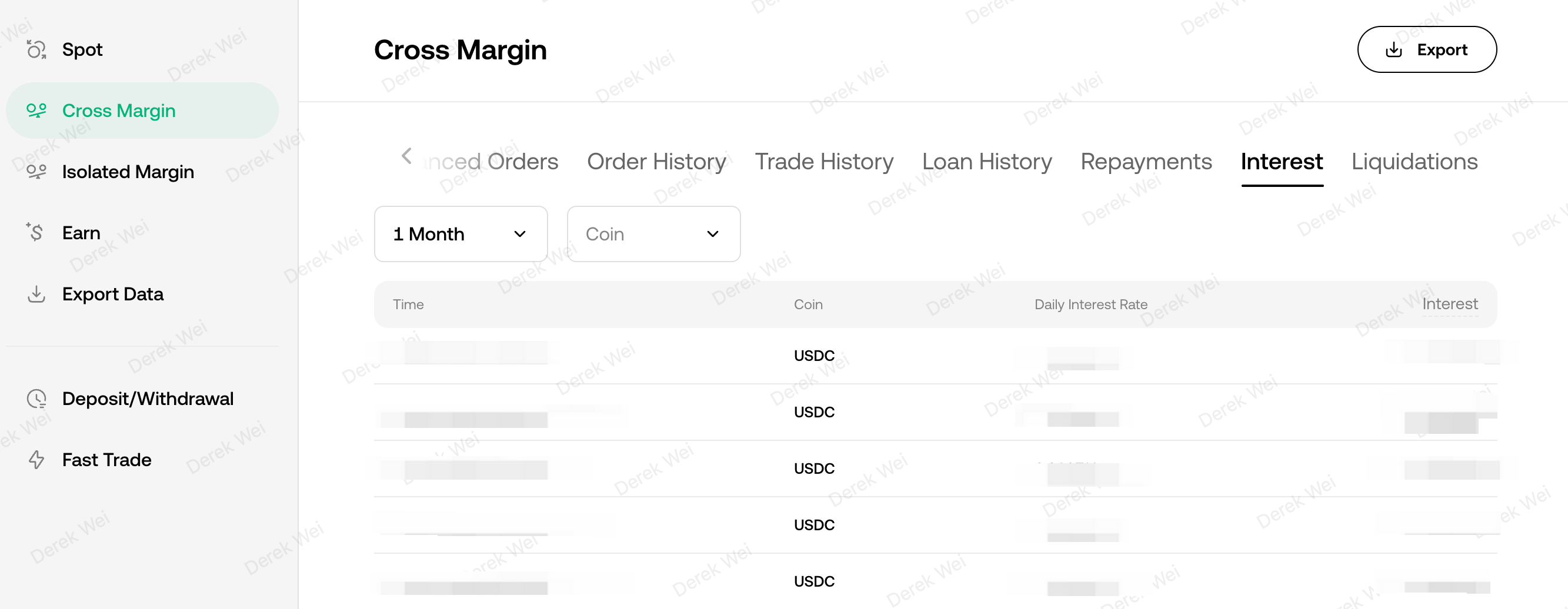
Interest is calculated based on principal, daily interest rate, and actual borrow time. You can check the Interest Records on the 'Orders' → 'Cross Margin/Isolated Margin Interest' page as shown below.
Interest Calculation Method
Interest is charged hourly based on dynamic borrowing rates influenced by supply and demand. For more details, please refer to Interest Calculation. At the same time, a more stable capital scale will be provided for Margin Borrowing, and the Margin Trading process will remain unchanged.
Interest repayment
Borrowers can repay manually or use the Auto-Repay function, which prioritizes loan repayment with assets received through trading.
Interest sharing
The platform will charge 5% of your accrued interest as fees and 10% as the insurance fund.
3. Long and Short Trading Strategies
Margin trading allows users to engage in both long and short positions:
-
Going Long: Buying low and selling high when a market is expected to rise. Example: Borrow USDC to buy BTC. If the price of BTC rises, the user sells their BTC for USDC, repaying the borrowed USDC and keeping the profit.
-
Going Short: Selling high and buying low when a market is expected to fall. Example: Borrow BTC to sell. If the price of BTC decreases, the user purchases BTC to repay the borrowed amount, keeping the profit.
4. Risk Management: Monitoring Debt Ratio and Repayment
4.1 Debt Ratio
If the user does not borrow any digital assets, the debt ratio is 0%. When the user borrows a number of digital assets, the system will calculate the debt ratio based on the user's principal, borrowed assets, and interest. The calculation is as follows:
Debt Ratio = Account liabilities/Account assets
Account liabilities = Borrowed assets + Accrued interest=sum(all borrowed assets * mark price) + sum(accrued interest for all borrowed assets * mark price)
Account assets = sum(all holding assets * mark price)
The Debt Ratio will be refreshed every second. When the user's debt ratio reaches 92%, the user's account will trigger a warning, and KuCoin EU will send an email warning to the user based on the security settings. When the debt ratio approaches 95%, the system triggers forced liquidation to repay the outstanding debt. Account holders are advised to monitor their debt ratio frequently and take actions to lower it as needed:
- Transfer additional assets to the margin account.
- Repay portions of outstanding debt.
| Margin Modes | Leverage Multiples | Initial Debt Ratio of Full Leverage (except interests) | Alert Issues When Debt Ratio Reaches | Debt Ratio of Forced Liquidation | Debt Ratio of Transfer-out |
| Cross Margin | 1-5 times | 80% | 92% | 95% | lower than 60% |
| Isolated Margin | 1-10 times | 90% | 92% | 95% | lower than 60% |
Low Risk: ≤60% debt ratio;
Medium Risk: 60%-85% debt ratio;
High Risk: >85% debt ratio.
Note: You can only transfer part of your funds from the margin account if the Debt Ratio is lower than 60%. The lower the debt ratio, the larger the transferable amount. If you'd like to transfer all your funds, kindly check the liabilities on your margin assets page and repay all the loans first.
4.2 Repayment Rules
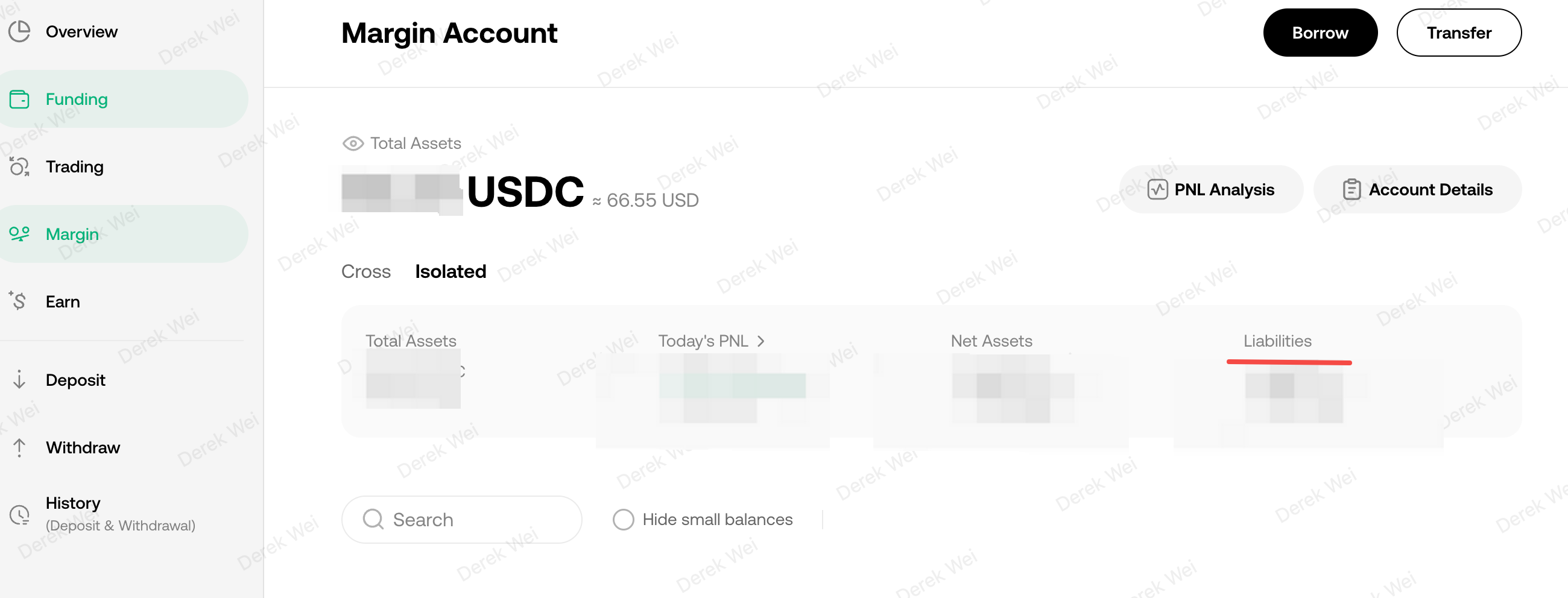
4.2.1 Viewing Liabilities
The tokens you borrow are the tokens you have to repay. You cannot use another token to repay a loan. For example, USDC liabilities must be repaid in USDC, while BTC liabilities must be repaid in BTC. When repaying a loan, ensure that the margin account has a sufficient amount of the corresponding tokens.
Liabilities payable = Borrowed assets + Accrued interest.
You can view Cross and Isolated liabilities through the Margin Account page.
4.2.2 Repayment Method
The borrower can choose to manually repay loans at any time before the due date. Interest is calculated on an hourly basis in accordance with the actual usage time.
Interest Calculation: Lending hourly interest rates are calculated dynamically each hour based on capital and liquidity conditions. Interest is also calculated and paid each hour.
Auto Repay: The auto-repay function is optimized so that once the user sells assets via the auto-repay function, the assets received will be used to repay the liabilities only if there are any corresponding liabilities.
5. Risks of Margin Trading
5.1 Forced Liquidation
Forced liquidation occurs when market movements cause the debt ratio to reach 95%:
- All holdings in the margin account will be liquidated to cover the debt.
- Any residual balance after liquidation will be returned to the user’s account minus liquidation fees (different coin assets and liabilities have different liquidation fee rates, please refer to the Liquidation Handling Fees Table).
Liquidation Notification
According to your account settings, you will receive an email notification and an in-app/on-site notification when the liquidation condition is triggered.
Operation Limitations
a. All margin trading pairs are not allowed to place orders (in any form);
b. All open orders in margin trading will be automatically canceled by the system;
c. No token can be transferred into the margin account while it is undergoing forced liquidation.
After the forced liquidation, the system will take over the positions to close and repay the debts. If there are residual balances, one small part of liquidation fees (different coin assets and liabilities have different liquidation fee rates, please refer to the Liquidation Handling Fees Table) will be charged to protect against the risks of negative balances; the others will be returned to users’ accounts in USDC or liquidated tokens.
5.2 Additional Risk Considerations
- Market volatility can amplify losses
- Losses may exceed initial collateral
- Liquidity gaps may affect execution
- Price movements may trigger liquidation rapidly
- Users must actively monitor positions and adjust as needed
Margin trading is not suitable for all users.
6. 6. Important Considerations Before Using Margin Trading
Users should carefully evaluate whether margin trading aligns with their financial situation, risk tolerance, and trading experience. Margin trading involves leverage and can lead to rapid changes in account equity. Independent financial advice should be considered where appropriate.
We hope this article has been helpful. Please reach out to our 24/7 customer support via online chat or submit a ticket if you have any other questions.