

Why Does My Exchange Need Recipient Details? Understanding the Crypto Travel Rule
When you transfer cryptocurrency from KuCoin Australia to another exchange or a self-hosted wallet, you may be asked for the recipient’s legal name, destination provider, wallet type and ownership information. These checks support applicable anti-money laundering and counter-terrorism financing obligations by connecting a pseudonymous wallet address with the people or organisations involved in the transfer. This guide explains Australia’s crypto Travel Rule, how it differs from KYC, how it affects external transfers and how your personal information is handled.
Why KuCoin Australia Requires Recipient Details Under the Crypto Travel Rule
If you use KuCoin in Australia, the platform is operated by Axis One Markets Pty Ltd. This is enrolled and registered with AUSTRAC as a virtual asset service provider. The information you may be asked to provide depends on your transfer and the instructions displayed on the platform.
Crypto Travel Rule Explained
The crypto Travel Rule is a payment-transparency standard established by the Financial Action Task Force (FATF). It requires regulated crypto providers, including virtual asset service providers, to obtain, retain and securely transmit prescribed information about the payer and recipient for applicable transfers. FATF updated Recommendation 16 in June 2025. However, each jurisdiction implements the standard through its own laws. Australian requirements, thresholds and procedures may therefore differ from those in the European Union, the United Kingdom, the United States or other markets. Always follow the instructions displayed in your account rather than assuming that a threshold or exemption described for another country applies to your transfer.
Why an Exchange Needs More Than a Wallet Address
A public wallet address tells the blockchain where cryptocurrency should be delivered. A blockchain explorer may show the asset, amount, wallet addresses, network, transaction hash, block number and confirmation status, but these technical details do not ordinarily reveal the legal identity of the person or organisation controlling the wallet. Understanding how crypto wallets and private keys work helps explain the difference. You can share a public address to receive cryptocurrency, while a private key authorises access to the wallet. Neither automatically proves whether the wallet belongs to you, another exchange, a business or someone else.
Connecting a transfer with the relevant payer and recipient can support:
-
Sanctions screening: Checking whether a person, organisation or wallet is subject to applicable financial sanctions.
-
Transaction monitoring: Identifying activity that may require further examination.
-
Transaction tracing: Connecting a transfer with its payer, recipient and destination.
-
Regulatory record-keeping: Maintaining evidence that applicable compliance checks were completed.
-
Legally authorised enquiries: Responding to valid requests from regulators or law-enforcement agencies.
These checks improve transparency within the regulated crypto ecosystem. However, they do not guarantee that a recipient is trustworthy, reverse an incorrect transfer or protect you from every crypto scam.
Australia’s Crypto Travel Rule Requirements in 2026
Australia’s crypto Travel Rule applies to domestic and international cryptocurrency transfers, including small withdrawals, because AUSTRAC sets no minimum transfer amount. Australia’s reformed AML/CTF framework commenced on 31 March 2026, with relevant obligations for certain newly regulated virtual-asset services generally applying from 1 July 2026. Specific exclusions and exemptions may still apply to your transfer.
Recipient Details Required for Crypto Transfers
For an applicable crypto transfer, you may need to provide your full legal name, an additional identifier such as your address, birth details or customer ID, and the recipient’s full name. You may also need to submit tracing information, including account numbers, wallet addresses, transaction references, memos or destination tags. Additional questions may cover the destination exchange, self-hosted wallet ownership, recipient type, your relationship with the recipient and the transfer’s purpose. These details support Travel Rule compliance, AML/CTF checks, sanctions screening and crypto fraud prevention.
KYC and the Crypto Travel Rule
KYC and the Travel Rule are connected but serve different purposes. KuCoin identity verification helps establish who controls your account and supports customer due diligence. The Travel Rule connects you with the recipient and wallet information for a particular transfer. Completing KYC does not remove the need to provide transfer-specific details. Your existing identity records establish who controls your account, but they do not automatically reveal who controls an external wallet. When transferring crypto to an account you own at another exchange, enter your full legal name as it appears on the receiving account. If you are paying someone else, use the recipient’s registered legal name rather than a nickname, username or social-media handle.
How the Travel Rule Affects KuCoin Transfers, Self-Hosted Wallets and Data Privacy
The Travel Rule process depends on whether you transfer crypto to another regulated provider or a self-hosted wallet. Your destination can affect what information is requested, whether the data must be sent to another provider and how long the transfer takes.
Exchange-to-Exchange Crypto Transfers Under the Travel Rule
When you transfer cryptocurrency from KuCoin Australia to another regulated exchange, the sending platform may act as the ordering institution, while the receiving exchange may act as the beneficiary institution. An applicable exchange-to-exchange transfer may involve the following steps:
-
You submit the destination wallet address and requested recipient information.
-
The sending provider determines whether the destination is controlled by another custodial provider or a self-hosted wallet.
-
When another provider is involved, the required payer, payee and tracing information is transmitted securely before or at approximately the same time as the blockchain transfer.
-
The receiving provider checks the information against its customer and deposit records.
-
The receiving provider reviews and credits the deposit according to its compliance and deposit policies.
Providers in different jurisdictions may follow different requirements or use different technical systems. You may therefore be asked for additional information by the receiving exchange even after completing every field requested by the sending platform.
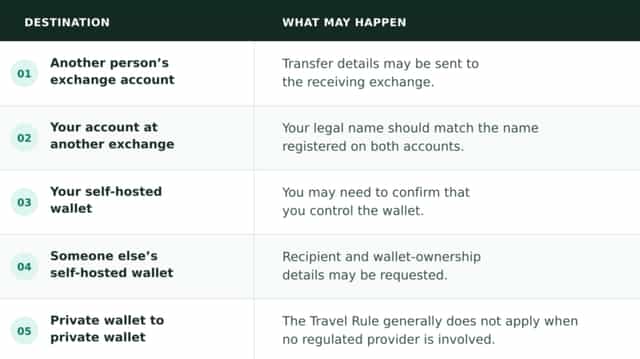
Travel Rule Requirements by Transfer Destination
Australia’s Travel Rule for Self-Hosted Wallets
A self-hosted wallet is controlled directly by an individual or organisation rather than by an exchange or custodian. Hardware wallets and many software wallets fall into this category. Australia’s Travel Rule does not prohibit self-custody. When you transfer crypto to a self-hosted wallet, there is no beneficiary institution to receive a provider-to-provider Travel Rule message. The requirement to send information to another business therefore generally does not apply. The sending provider must still collect and verify the required payer information and collect the relevant payee and tracing information. You should describe the wallet’s ownership accurately and provide any additional information requested through the platform.
Crypto Deposits From Self-Hosted Wallets
Before making a deposit from a self-hosted wallet available, KuCoin Australia may need to identify the payer, obtain the originating wallet address or other tracing information, determine the wallet type and assess the transaction for sanctions or financial-crime risks. Under Australia’s framework, a beneficiary institution receiving crypto from a self-hosted wallet must obtain the required payer and tracing information. It must also obtain the payee’s full name if it does not already hold that information. Separate reporting requirements for certain transfers involving unverified self-hosted wallets are scheduled to begin on 31 March 2029. This transitional date does not remove information-collection, customer-due-diligence or risk-management obligations that may already apply.
Travel Rule Data Privacy and Blockchain Records
Legal names and other Travel Rule identity details are not ordinarily written into the public blockchain transaction. Public blockchain records typically contain technical information such as wallet addresses, transaction amounts, network data and transaction hashes. When another regulated provider is involved, the required identity information is generally transmitted separately. Australian rules require providers to consider whether this information can be transmitted securely and kept confidential. Your information may be retained by the platform operator, another provider involved in the transfer, relevant affiliates or service providers, and government authorities when disclosure is legally required. Review the KuCoin AU Privacy Policy to understand how your personal information may be collected, protected, used and disclosed. Australian reporting entities are generally required to retain records demonstrating compliance with their Travel Rule obligations for seven years. The precise retention period can depend on the type of information and applicable legal requirements.
Common Reasons Your Crypto Transfer May Be Delayed or Rejected
Your crypto transfer may be delayed, reviewed or rejected for these reasons:
-
Recipient name mismatch: The legal name you provide does not match the name registered on the receiving account.
-
Incorrect destination details: You select the wrong exchange or incorrectly identify the wallet type or owner.
-
Missing Travel Rule information: You do not provide all required payer, recipient or self-hosted wallet details.
-
Technical transfer errors: You select an unsupported network or asset, enter an incorrect wallet address, or omit a required memo or destination tag.
Under the KuCoin AU Terms, your transaction may be delayed or prevented while compliance and fraud checks are completed. You may also be asked for additional information before your transfer can proceed.
Travel Rule Checks and Crypto Transaction Reversibility
Travel Rule checks do not make a crypto transfer reversible or guarantee that the recipient is trustworthy. Orders may be irrevocable once submitted, and confirmed blockchain transactions are generally irreversible. Before authorising a withdrawal, verify the recipient, crypto asset, wallet address and blockchain network. A legitimate compliance process should never require you to disclose your password, private key or recovery phrase. Access information requests only through the official KuCoin website or application, and use the available account-security tools. Treat any message claiming that you must provide a recovery phrase to release a transfer as suspicious. Fraudsters may imitate exchange support teams through smishing and other impersonation scams.
Frequently Asked Questions About Australia’s Crypto Travel Rule
1. Does the Travel Rule apply to transfers within the same exchange?
Internal transfers may not require provider-to-provider information sharing. The exchange may still request recipient details and perform compliance checks.
2. Can an exchange request source-of-funds documents?
Yes. Travel Rule information does not replace broader AML/CTF checks, so supporting records may still be requested.
3. What if the receiving exchange is not listed?
Do not select the wrong provider. Choose “Other” if accurate or contact official support for guidance.
4. Which name should I use for a business recipient?
Use the business’s registered legal name. Additional company or transfer-purpose details may also be required.
5. Does the Travel Rule apply to DeFi transfers?
It depends on the transfer. The sending platform may still request destination and wallet-control information for compliance checks.
6. Does the Travel Rule add transfer fees?
The Travel Rule does not establish a standard fee. Normal withdrawal and blockchain network fees may still apply.
Disclaimer: This article is for general information only and does not constitute legal advice. Travel Rule requirements and platform procedures may change.