

Russia’s Tax Service to Receive Device Data for Digital Ruble Transactions: What Will Change from July 1, 2027
Introduction: Will the Tax Service See Your Device When You Transfer Digital Rubles?
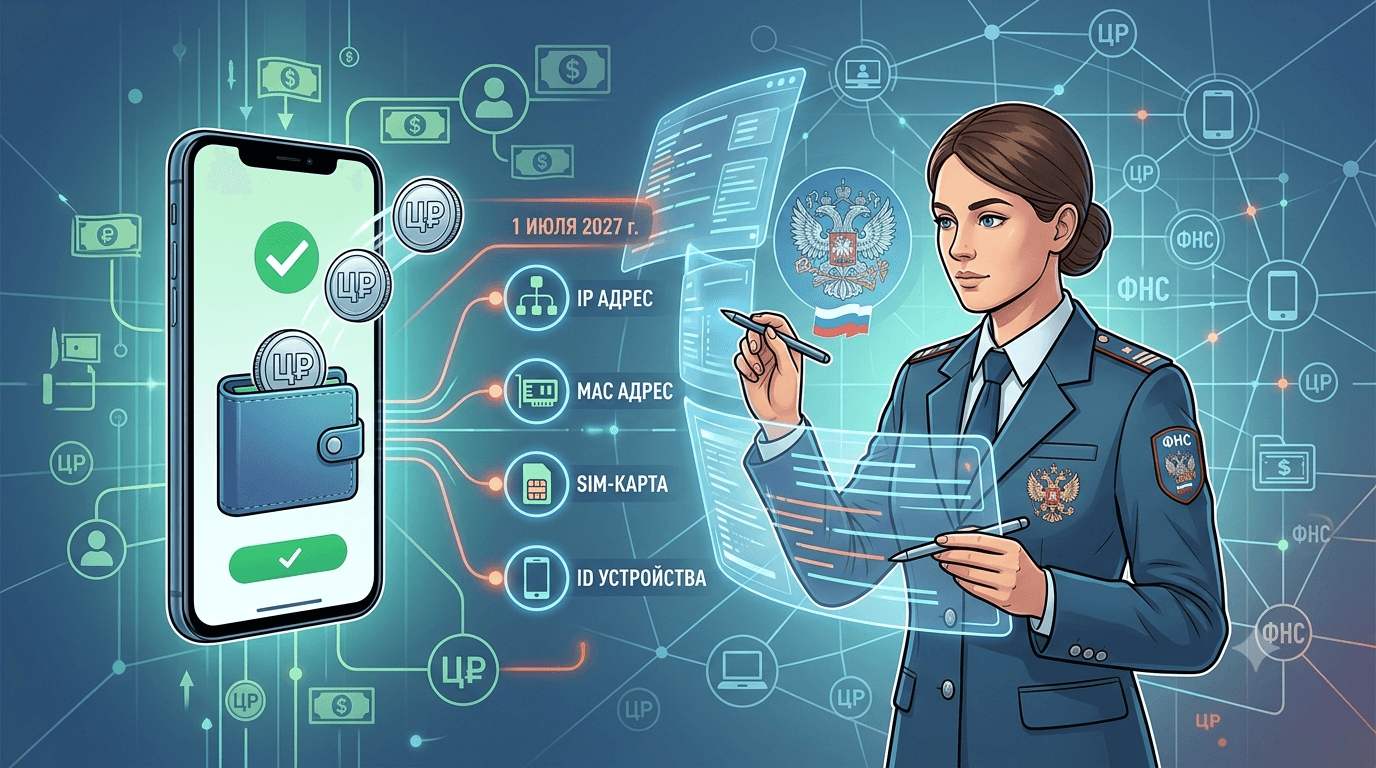
Starting July 1, 2027, Russia’s Federal Tax Service will be able to request expanded statements for digital ruble accounts, including the technical footprint of the device used for a transaction. This may include IP and MAC addresses, a phone number, SIM card data, and another device identifier, along with the payment amount, time, purpose, and sender and recipient details. Bits.media, Frank Media, and Vedomosti reported this on September 9, 2026, citing Federal Tax Service orders and a report by Izvestia.
This does not mean that the Tax Service will automatically tax every transfer between individuals or obtain permanent access to all wallets. The information will be requested in cases provided for by law, such as debt collection or a tax audit. The main purpose of the new measure is to compare financial transactions with device fingerprints in order to identify undeclared income, fictitious transactions, and accounts used by dropper networks.
What Data About the Digital Ruble Will the Tax Service Be Able to Obtain?
The Federal Tax Service will be able to request not only transaction details but also technical characteristics of the device used to make a transfer. According to Frank Media and Vedomosti, a statement may include the payment amount and time, its purpose, sender and recipient details, an IP address, a MAC address, a phone number, SIM card information, and another device identifier.
An IP address shows a network connection point but does not always identify a specific person. The same address may be used simultaneously by office employees, café visitors, or subscribers of one mobile operator. A MAC address is linked to a device’s network module and helps distinguish equipment within a network. A SIM card and phone number add mobile communication data to the technical footprint. If used by a particular system, a device identifier may serve as an additional identifier for a phone or another device.
|
Information category
|
What it shows
|
Why it matters for an audit
|
|
Amount, time, and purpose
|
Payment parameters
|
Helps compare incoming funds with income or expenses
|
|
Sender and recipient
|
The parties to the transfer
|
Makes it possible to analyze connections between accounts
|
|
IP address
|
The network connection point
|
Identifies recurring connections but does not by itself prove a person’s identity
|
|
MAC address and device identifier
|
The device’s technical identifier
|
Shows which wallets may have been managed using the same equipment
|
|
Phone number and SIM card
|
The mobile channel used for the transaction
|
Adds context when suspicious activity is investigated
|
It is important to distinguish the ability to request data from automatic access. According to the agency’s explanations, the Federal Tax Service will obtain a digital account statement under a procedure similar to the one used for ordinary bank accounts. Grounds for a request may include debt collection, an audit, or a request for documents approved by the head of a higher tax authority.
Why Are the Federal Tax Service and Bank of Russia Expanding Device Monitoring?
The main purpose of the new measure is not to tax everyday transfers but to identify hidden commercial activity and financial crimes. A technical footprint makes it possible to compare transactions across several formally independent wallets and determine whether they are controlled by the same person, device, or group of related individuals.
The problem of droppers is particularly important. A dropper, or “drop,” is a person who provides their banking details or opens an account for someone else’s transactions. In more complex schemes, criminal groups use several phones, SIM cards, and automated processes to move funds through hundreds of accounts while concealing their origin.
Traditional analysis of a bank payment often reveals the account holder’s name but not who actually controls the transaction. Comparing the device, SIM card, phone number, and IP address gives law enforcement and financial authorities an additional layer of analysis. If one phone is regularly used to transfer funds from wallets registered to different people, this may become a reason to examine the relationship between the accounts.
According to expert assessments cited by Bits.media and Frank Media, matching devices can help identify hidden income, fictitious transactions, the use of other people’s accounts, and artificial business fragmentation. However, a technical match remains an indirect indicator. It must be assessed together with contracts, primary documents, cash-register records, and explanations from the parties to the transactions.
Why Does the Digital Ruble Make End-to-End Transaction Analysis Easier?
The digital ruble is structured differently from ordinary non-cash money held in commercial bank accounts. The Bank of Russia issues digital rubles, and transactions take place on the Bank of Russia’s unified platform. Commercial banks act as intermediaries in this model, allowing citizens to open and use digital wallets through their applications.
This architecture creates a unified data environment. In an ordinary bank-card payment, information is distributed among the customer’s bank, the merchant’s bank, the payment system, and other participants. With the digital ruble, wallets are connected to the central bank’s common platform. As a result, it is technically easier to compare payment events, participants, and devices when an authorized authority submits an official request.
Supporters of stronger monitoring view this feature as an advantage. The unified platform is intended to provide security, fast settlements, and transparency in the movement of digital rubles. For the Federal Tax Service, it also creates an opportunity to analyze the life cycle of funds, from receipt to a subsequent transfer or payment.
However, “end-to-end analysis” does not mean that a tax inspector can see a citizen’s phone screen in real time. The system concerns data stored in an information system and provided under an established procedure. In addition, a single source of data does not eliminate the risk of misinterpretation: family members may use the same phone, while one IP address may belong to an entire office.
Will Transfers to Relatives and Friends Be Automatically Taxed?
No. A transfer between individuals does not become taxable income merely because it is made through a digital wallet. Under Article 217 of Russia’s Tax Code, monetary gifts between individuals and non-commercial transfers generally do not create an obligation to pay personal income tax. The Federal Tax Service has also explained that a transfer to a relative is not, by itself, grounds for a tax assessment.
This applies to helping parents, repaying a debt to a friend, sharing rent, splitting a restaurant bill, and other everyday situations. For example, if one person pays for a trip and several friends reimburse their shares, the use of the same device or a shared home IP address does not turn the reimbursement into business revenue.
The risk arises not from the form of the transfer but from its economic substance. Regularly receiving numerous payments from different customers, using unclear payment descriptions, receiving funds connected with the sale of goods or services, and showing a discrepancy between declared income and actual receipts may prompt the Federal Tax Service to request documents. In such a case, the technical footprint will be an additional basis for analysis, not an automatic formula for calculating tax.
Individuals should preserve evidence of the lawful nature of large or unusual transactions, such as a loan agreement, correspondence about repayment, receipts for a shared purchase, or gift documents. This does not mean that a document must be prepared for every everyday transfer. However, supporting records can help distinguish personal payments from commercial activity during a contested audit.
How Will the New Measure Affect Self-Employed People and Freelancers?
For self-employed people and freelancers, the main risk concerns undeclared business revenue rather than the use of the digital ruble itself. If one wallet regularly receives many small payments from different senders and the transactions resemble payments for services, an algorithm may flag the profile for additional analysis.
A self-employed person who properly reports income and pays tax under the applicable regime does not need to switch to cash or hide the use of the digital ruble. On the contrary, a transparent payment history may make it easier to confirm lawful activity. Payment descriptions should clearly identify the service, while receipts and contracts should be retained in accordance with general record-keeping rules.
The situation will be more difficult for people who accept money into a personal account while actually conducting regular trade or providing services without reporting the income. A device match with the wallets of suppliers, partners, or other recipients may strengthen suspicions of a unified scheme. However, the final conclusion must still be based on economic documents rather than on a single IP or MAC address.
What Will Change for Small and Medium-Sized Businesses?
Small and medium-sized businesses will find it more difficult to use personal wallets and related companies to artificially split turnover. If payments between several people consistently pass through the same device, have similar descriptions, and serve one commercial chain, the Federal Tax Service will be able to compare these indicators with tax returns and financial reporting.
This type of analysis is particularly relevant to gray schemes in which part of a company’s revenue is received in the accounts of employees or relatives. A connection between devices does not prove a violation, but it may lead to requests for contracts, cash-register documents, supply records, and explanations of the movement of funds.
For a compliant company, the practical conclusion is straightforward: separate personal and corporate transactions, use accurate payment descriptions, maintain primary records, and do not give outsiders access to a wallet. Accounting discipline becomes more important because a financial audit may consider not only the payment amount but also the context in which it was made.
Are IP Addresses and Device Data Protected by Tax Secrecy?
Information obtained by the Federal Tax Service within its legal authority should be protected under the tax-secrecy regime. Article 102 of Russia’s Tax Code restricts the disclosure of taxpayer information obtained by a tax authority unless it falls within exceptions established by law. Transfers through interagency electronic systems are expected to use organizational and technical safeguards.
Legal protection does not eliminate public concerns. Questions concern not only the formal status of the data but also the number of parties that may access it, retention periods, access logs, and liability for leaks. A device identifier may seem less sensitive than the content of a message, but when combined with a phone number, account, and payment history, it can describe a person’s behavior.
Trust in the digital ruble will therefore depend on transparent rules. Users need to understand who can request a statement and on what grounds, what information the Federal Tax Service receives, how erroneous matches are corrected, and how a citizen can challenge audit findings. Without such safeguards, the official idea of security may be perceived as excessive financial monitoring.
Will Transactions Made Before July 1, 2027 Be Reviewed?
The new technical rules do not make it possible to retrieve device data retroactively if that data was not recorded before the rules took effect. The stated effective date is July 1, 2027. If the relevant IP address, MAC address, or other technical identifier was not previously stored in the required format, the Federal Tax Service will not be able to request a historical record that does not exist.
This does not cancel the general limitation periods for tax violations. If there are grounds for an audit, financial documents and tax obligations may be assessed for the period established by law, which is three years for many tax matters. In other words, income history may become subject to review, but the new technical-statement mechanism does not become a universal archive of devices from previous years.
The date July 1, 2027 should not be understood as an amnesty for undeclared revenue. It marks the beginning of the new data format. Tax authorities could already analyze banking information when they had lawful grounds to do so.
Could Stronger Monitoring Reduce the Digital Ruble’s Popularity?
Yes. A heightened sense of surveillance could weaken citizens’ willingness to use the digital ruble, even if the actual risks for ordinary consumers remain limited. The official model offers security, convenience, and commission-free transfers, while the unified platform is intended to make payments predictable. However, users may view the same transparency as a loss of financial privacy.
Some funds could consequently move into cash, less formal arrangements, USDT, or other cryptoassets. This does not mean that cryptocurrency automatically provides anonymity or eliminates tax obligations. On the contrary, transactions involving digital assets may also create legal and compliance risks. Nevertheless, a shift away from the official payment system could become an unintended consequence if monitoring is perceived as disproportionate.
For ordinary consumers, the practical impact will probably remain limited: a legitimate transfer to a relative should not result in an automatic tax assessment. The psychological effect may be stronger than the practical one. The authorities should therefore explain that the mechanism targets droppers, fraud networks, and hidden commercial activity rather than everyday expenses.
How Can You Use the Digital Ruble Without Unnecessary Tax Risks?
The lawful way to reduce the risk of questions is to avoid concealing the economic purpose of payments and to retain documents confirming whether transactions are personal or business-related. For everyday transfers, it is useful to provide a clear payment description when the application allows it. Businesses need contracts, receipts, invoices, and separate records for personal and corporate funds.
Do not give your phone, SIM card, or access to a digital wallet to other people. Even if the registered owner is not formally involved in a scheme, their device may become associated with suspicious wallets. Other people’s payment details should not be used to accept money in order to conceal the actual seller or service provider.
When responding to a request from the Federal Tax Service, provide documents and a substantive explanation. A technical match may be explained by a shared office, a family phone, a SIM card replacement, or use of a public network if those circumstances can be supported. Most importantly, do not confuse the absence of tax on a personal transfer with the right not to declare actual payment for goods or services.
Beyond the Headlines: What KuCoin 5.0 Means for You
Market news moves fast — but where you act on it matters just as much. This October, KuCoin launches KuCoin 5.0, transforming KuCoin into a rebuilt platform. Here's what actually changes for you:
-
One account for everything. Older platforms split your money across separate "spot," "margin," and "futures" accounts and expected you to understand why. KuCoin 5.0's unified account removes that entirely — deposit once, and everything is simply there.
-
Stocks, indices, and commodities. KuCoin 5.0 expands beyond crypto into global markets. When crypto chops sideways and equities rally (or the reverse), you rotate in minutes instead of opening a brokerage account and waiting days for fiat rails.
-
Real-world assets (RWA). Tokenized exposure to traditional assets like commodities, right inside your crypto account. One of the fastest-growing segments in global finance is no longer reserved for institutions — you access it from the same balance you trade with.
-
Earn while you learn. Not ready to trade? KCUSD lets your stablecoins earn daily, auto-compounding interest. The lowest-stress way to put your idle deposit to work for 4% yield.
-
An AI assistant in plain language. Ask questions, get market context, understand what you're looking at — built into the platform, no jargon required.
-
An app that doesn't overwhelm. Faster, cleaner, and consistent — intuitive from the first tap, not after a tutorial.
-
Safety you can check, not just trust. A MiCAR-licensed EU entity, Proof of Reserves you can verify yourself, and internationally certified security (SOC 2 Type II, ISO 27001:2022).
Create your account in minutes — and start on the platform built for where crypto is going, not where it's been.
Conclusion
Starting July 1, 2027, the Federal Tax Service will be able to obtain expanded statements for digital ruble transactions through a lawful request. In addition to the payment amount, time, purpose, and participants, the statements may include IP and MAC addresses, a phone number, SIM card data, and another technical device identifier. The new measure will strengthen the ability to compare wallets that are effectively controlled using the same phone or network connection.
The main purpose of the mechanism is to identify hidden income, fictitious transactions, artificial business fragmentation, dropper networks, and fraud schemes. It does not create an automatic tax on transfers to relatives, debt repayments, or shared household expenses. A technical footprint is a signal for analysis, not independent proof of a violation. Conclusions must be supported by contracts, primary documents, and the actual substance of the transactions.
The digital ruble’s architecture on the Bank of Russia’s unified platform makes cross-system comparisons easier while increasing requirements for data protection and transparent access rules. Ordinary users mainly need to comply with tax rules and avoid giving their wallets to other people. Self-employed individuals and companies will need to separate personal and commercial payments more carefully because gray schemes will be harder to conceal behind formally independent accounts.
Frequently Asked Questions
1. Will the Federal Tax Service be able to see a phone screen during a digital ruble transfer?
No. The rules concern transaction information and technical device identifiers, not direct access to the phone’s screen, files, or messages. Access to the data must be arranged under the procedure established by law.
No. A shared IP address proves nothing by itself because dozens of people may use the same wireless network. Additional indicators and documents would be required to establish a connection between accounts.
3. Do I have to pay tax if friends regularly repay small amounts to me?
Not necessarily. If the payments are genuinely reimbursements for personal expenses or loan repayments rather than payment for goods or services, tax generally does not arise. If the amount is unusual or disputed, it is useful to have evidence of the transfers’ purpose.
4. Can I refuse to use the digital ruble because device data is collected?
The digital ruble is an additional form of money, not a replacement for cash and ordinary non-cash rubles. Users can choose among available payment instruments while taking into account the rules of banks, merchants, and applicable law.
5. Will switching to USDT help avoid tax monitoring?
No. USDT and other cryptoassets do not guarantee anonymity and do not cancel tax or compliance obligations. Any decision to move into cryptoassets should be assessed in light of their legal status, custody risks, and the availability of withdrawals.
Disclaimer : This material is provided for informational purposes only and does not constitute financial, investment, legal, or tax advice. Transactions involving cryptocurrencies and tokenized assets carry substantial risks — including price volatility, limited liquidity, counterparty exposure, and the potential for total loss of invested capital. Readers should conduct their own research and, where appropriate, consult a qualified professional before making any financial decisions.