

Digital Ruble in Alfa-Bank's API: How Businesses Are Automating Settlements — and What This Has to Do With Crypto
2026/07/16 14:17:00
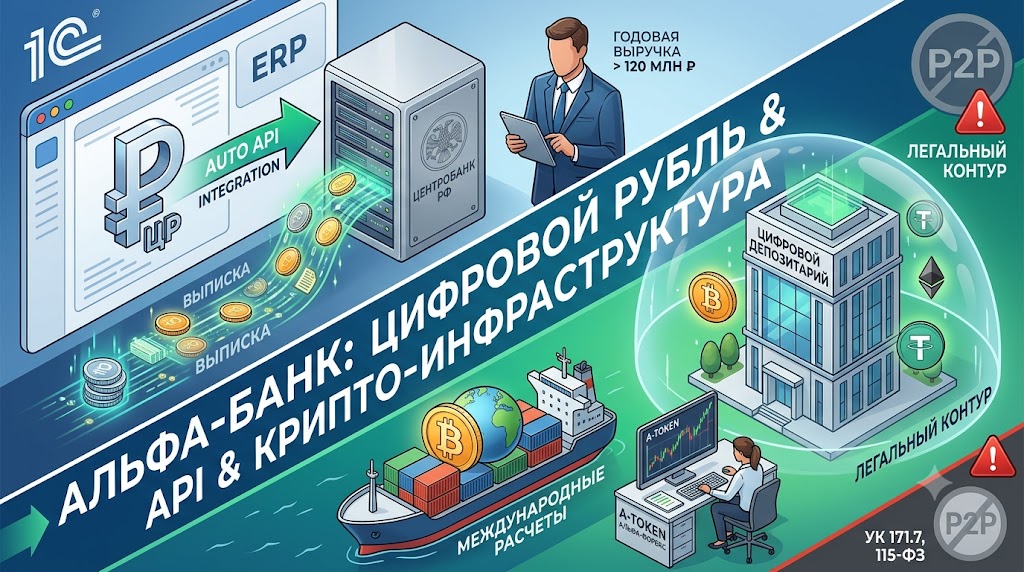
Alfa-Bank became the first player on the Russian market to embed a digital ruble account directly into an application programming interface (API) for corporate clients, completely eliminating manual management of the third form of the national currency. The solution targets companies with annual revenue from 120 million rubles — in other words, large business and part of the mid-size segment, for whom manual payment reconciliation has long been an operational headache. According to Alfa-Bank's official release, integration through Alfa API makes the digital ruble an equal participant in daily settlements alongside ordinary non-cash money.
At the same time, the bank is sharply expanding its presence in the crypto sphere: testing digital-asset trading, preparing its own depository, and launching cross-border crypto payments for business. Let's break down what problem the new API solves, what it means for tax oversight, and how the logic of a "legal window" into crypto is changing the rules of the game for Russian companies and private investors.
What Business Problem Does Digital-Ruble API Integration Solve?
Alfa API eliminates the main barrier to digital ruble adoption — the need to maintain double bookkeeping. Damir Battulin, Alfa-Bank's director of digital channel development, noted that the solution removes the main scaling barrier for the technology — implementation complexity — and that large businesses no longer need to maintain a dual accounting loop.
Before this new scenario launched, companies were forced to log into a separate terminal of the digital ruble platform to check balances and transactions — a process entirely disconnected from internal accounting systems like 1C. Accounting departments had to manually export data and transfer it into their ERP, which increased labor costs and the risk of reconciliation errors.
Now, the digital ruble account statement flows directly into the company's accounting system — just like with a regular settlement account. Transaction and balance data appears in internal ERP systems without manual file exports. This allows transactions to be processed in the familiar way and automates payment reconciliation and liquidity control, without creating a parallel process for the new form of money.
In effect, the digital ruble stops being an experimental instrument and becomes a full-fledged part of the payment landscape. The solution is universal and suits all business segments — from retail chains to industrial holdings working with large numbers of counterparties and high settlement frequency.
What This Means for Large Companies' Treasury Functions
For treasury departments, an automatic statement means being able to build a unified liquidity picture without manually consolidating data from different sources. Payments in digital rubles, non-cash rubles, and other instruments fall into a single financial loop, simplifying planning and reducing operational costs of servicing settlements.
For holding structures with multiple legal entities, Alfa API additionally unlocks treasury functions across subsidiaries — the parent structure can view digital ruble balances and movements across the entire group from a single interface, without requesting statements from each subsidiary separately. This matters especially for retail chains and industrial holdings where accounts are spread across dozens of legal entities, and the speed of data consolidation directly affects the quality of financial planning and the ability to respond quickly to cash gaps.
Notably, the Alfa API technology itself has already won a Runet Award in the "Digital Economy" category — according to bank representatives, the "multibank" approach lets clients handle all their financial tasks from one app or online bank, without switching between different systems for different forms of money.
Does Automating Settlements Mean Real-Time, End-to-End Tax Monitoring?
Yes, automation makes financial flows maximally transparent to the regulator, because the digital ruble's architecture is fundamentally different from classic banking money. The digital ruble is issued and recorded on a single platform operated by the Bank of Russia, while commercial banks, including Alfa-Bank, act merely as access points to that platform rather than independent account issuers.
This is fundamentally different from ordinary non-cash settlements, where fund-movement data is physically stored within individual banks' information systems. When a business shifts digital-ruble operations onto automated rails via the API, every transaction is recorded on the Central Bank's single platform, tied to a specific account and counterparty.
This architecture objectively expands the ability of tax authorities and financial-monitoring units to track settlements — this isn't so much additional surveillance as a built-in property of the third form of money. For law-abiding businesses that pay their taxes and operate legally, this simply means simpler reporting and fewer reasons for bank inquiries under Federal Law 115-FZ (anti-money-laundering law). For schemes involving artificial payment-splitting or tax evasion, the digital ruble's transparency sharply raises the risk of detection.
It's important to understand that the speed and completeness of data capture on the Bank of Russia's platform doesn't fundamentally depend on whether a company is connected via the API or still working through a separate terminal — the unified platform sees the operations either way. The difference is that automation through the API makes working with the digital ruble convenient and unobtrusive for day-to-day operations, removing the incentive to delay the transition to the new settlement form due to technical inconvenience. In other words, the bank is lowering implementation costs, while transparency for the regulator remains an unchanged characteristic of the instrument itself, not a side effect of integration.
Why Is the Bank Simultaneously Building Crypto Infrastructure?
Alfa-Bank is preparing a full lineup of crypto services in order to secure a position as a core infrastructure player in Russia's legalizing digital-asset market. Dmitry Vitman, chief operating officer of the bank's corporate and investment banking division, stated that the bank plans to offer the full range of digital-currency services once relevant legislation takes effect, and that its first priority is to create its own digital depository.
The bank is already testing crypto trading in its "Alfa-Investments" app among a limited circle of qualified investors; bitcoin, ether, Tether, Solana, and ZCash have been spotted among the listed instruments. This makes Alfa-Bank the fourth major Russian bank to publicly announce such plans — after T-Bank, VTB, and Sberbank.
The logic behind this race is clear: whoever first builds the storage and accounting infrastructure for digital assets will secure a key position in the new value chain. A depository isn't a nice-looking client app — it's about where assets physically reside and who is responsible for their safekeeping. T-Technologies is preparing a depository based on the "Atomyze" digital financial asset platform and plans to sell crypto through its "T-Investments" broker; VTB is building its own depository within the Russian perimeter; and Sberbank expects to launch a crypto wallet in its "Sberbank Online" and "SberInvestments" apps by December 1, 2026.
Bitcoin and Ether DFAs Through the A-Token Platform
The A-Token digital financial asset (DFA) platform has already issued products pegged to the value of bitcoin and ether — the market's first DFAs on two cryptocurrencies simultaneously. The instruments are built on foreign exchange-traded funds such as the iShares Bitcoin Trust and are available to qualified investors starting from a 1,000-ruble entry threshold. Returns on these DFAs directly track changes in the underlying asset's price, but the investor doesn't take direct ownership of the cryptocurrency itself — only a derivative financial instrument.
Bitcoin and Ether CFDs at "Alfa-Forex"
Forex dealer "Alfa-Forex" became the first player on the Russian market to launch contracts for difference (CFDs) on BTC/USD and ETH/USD pairs, with leverage of up to 1:10, available to qualified investors. A CFD doesn't involve buying the actual cryptocurrency — it's an over-the-counter instrument that lets traders profit from price movements without directly owning the asset.
Cross-Border Crypto Settlements for Business
Since early July, Alfa-Bank has offered companies engaged in foreign trade activity international settlements in cryptocurrency — funds are delivered to the counterparty in roughly two minutes, and the fee starts at 0.16% for the first two months, compared to the standard 0.3% charged by the current market leader, A7, which operates the ruble-pegged stablecoin A7A5. Starting September 1, Alfa-Bank's fee will also rise to 0.3%, effectively equalizing competitive terms with the already-established player. Experts point to CIS countries — Kyrgyzstan and Belarus in particular — as likely destinations for such settlements, given that the Bank of Russia has previously signaled willingness to continue legal crypto cooperation there.
For import-export companies, this means the emergence of a second legal settlement route with foreign suppliers and buyers alongside the already-familiar A7A5 — reducing dependence on a single operator and potentially leading to more favorable rates as competition between banks for this business segment intensifies.
What Does Tighter Regulation Mean for Those Operating in the Crypto Gray Zone?
The state is drawing not a ban on crypto as such, but a hard line between legal and shadow channels of circulation. The government's legislative commission has approved amendments to the Criminal Code introducing Article 171.7 for illegal organization of digital currency circulation. Large-scale damage or income will be defined as amounts starting from 3.5 million rubles, and especially large-scale as amounts exceeding 13.5 million rubles.
For a large-scale violation, the penalty is a fine of 100,000 to 300,000 rubles, forced labor, or imprisonment for up to four years. If the damage is especially large-scale or the crime was committed by an organized group, the penalty escalates to up to seven years in prison with a fine of up to 1 million rubles. Investigations under this new article will be handled by the Investigative Committee and the FSB.
At the same time, Federal Law 115-FZ on anti-money-laundering remains in force, under which banks block accounts and cards over suspicious transactions, including transfers through anonymous P2P channels and foreign platforms. Before the 3.5-million-ruble threshold was introduced, P2P market participants risked, at worst, having an account blocked (with the ability to withdraw funds for a fee) or facing additional personal income tax assessments; now the stakes have multiplied for those who continue working through messenger-app "cash changers" or engage in private P2P arbitrage.
For those who used offshore exchanges and exchangers without reporting to the Federal Tax Service, legal banking products — a digital depository, crypto DFAs, licensed CFDs, and regulated cross-border payments — are becoming a practical way to keep working with crypto assets without stepping outside the law. In essence, the state and major banks are building out a "legal loop" in which digital-ruble settlements, investments in bitcoin DFAs, and payments to foreign suppliers in cryptocurrency all take place under the regulator's watch, but fully within the law and with all taxes properly paid.
How to Trade Cryptocurrency on KuCoin Amid Changing Regulation
While Russia's banking infrastructure for cryptocurrency is still taking shape, and full access to depositories and DFAs remains limited to qualified investors, a global platform like KuCoin remains a way to get broad access to spot and derivatives trading across hundreds of assets without an investor-qualification threshold. KuCoin provides access to deep liquidity on major pairs, including BTC and ETH, along with risk-management tools and a straightforward verification system.
Before opening positions, it's worth soberly assessing market volatility and deciding what share of your portfolio it's reasonable to allocate to crypto assets. For users planning regular transactions, it's important to remember the need to declare income and to account for the current legal requirements of their jurisdiction — using a transparent platform with a clear transaction history makes this kind of reporting easier. You can start with a small deposit, get familiar with spot trading functionality, and then gradually move into more advanced instruments like futures once you've built confidence in your own strategy.
Conclusion
Alfa-Bank became the first to integrate the digital ruble directly into an API for large business, eliminating the need for manual account management and double bookkeeping. Companies with revenue from 120 million rubles now receive their digital ruble statement directly in their ERP systems, which automates payment reconciliation and liquidity control.
The flip side of this automation is increased transparency of settlements for tax authorities, since the digital ruble is inherently structured as a single Bank of Russia platform rather than a collection of separate banking systems. At the same time, the bank is actively building infrastructure for legal work with cryptocurrency: testing digital-asset trading, preparing its own depository, issuing bitcoin and ether DFAs, offering CFDs through "Alfa-Forex," and providing cross-border crypto settlements for business.
The tightening of criminal liability for illegal crypto circulation, with a threshold of 3.5 million rubles, shows that the state is fighting not cryptocurrency as a phenomenon, but opaque gray channels. For businesses and private investors, the logical strategy becomes combining legal Russian instruments with proven international platforms while fully complying with tax obligations.
Frequently Asked Questions
1.Which companies can connect the digital ruble to their accounting system via API?
The solution targets large businesses with annual revenue from 120 million rubles, as well as holding structures that need to automate treasury functions across a group of companies. Connection happens through Alfa API without needing to change the existing ERP system.
2.How does the digital ruble differ from an ordinary non-cash ruble for business?
In terms of settlements, the digital ruble has equal status with non-cash money and is used for the same payments to suppliers, partners, and the budget. The difference lies in the architecture: the digital ruble is recorded on the Bank of Russia's single platform rather than on an individual commercial bank's accounts, making the movement of funds more traceable.
3.Does a company need to change its accounting software to work with the digital ruble via API?
No system change is required. Alfa API integrates into the company's already-used ERP or accounting software, and the digital ruble account statement begins arriving in the same place where regular settlement account data appears.
4.Can a private investor already buy bitcoin through Alfa-Bank?
Direct cryptocurrency purchases are currently available only to a limited circle of qualified investors in test mode. Retail clients have access to derivative instruments — DFAs on the A-Token platform and CFDs at "Alfa-Forex" — which also require qualified-investor status.
5.What are the risks for a business settling payments through unofficial crypto exchangers after the law tightens?
If the damage or income threshold of 3.5 million rubles is exceeded, criminal liability under the new Article 171.7 of the Criminal Code may apply — ranging from a fine to imprisonment for up to four years, and up to seven years for especially large-scale or group violations. Banks may also block accounts under 115-FZ over suspicious transactions.