

Deposit Rates Rise in Russia: Why Are Funds Leaving Banks and What Should Depositors Do?
2026/08/06 15:29:00
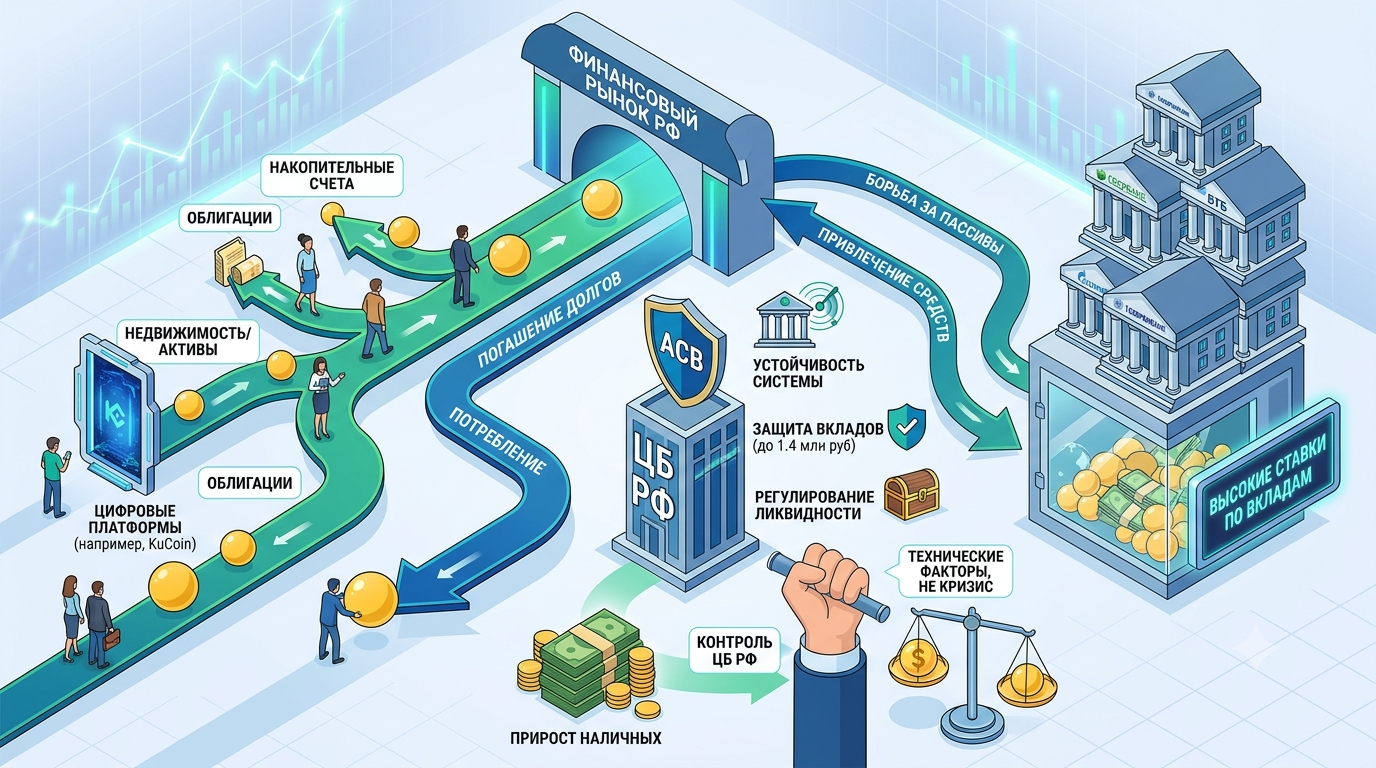
In recent months, the Russian financial sector has faced a unique and multi-layered macroeconomic situation: interest rates on bank deposits are showing a steady upward trend, despite an unprecedented outflow of liquidity from credit institutions. A natural and highly pressing question arises for millions of retail investors: why are commercial banks increasing deposit yields when citizens are actively withdrawing funds from their accounts, and does this trend pose a hidden threat to the stability of the entire country's financial system? According to official data from the Central Bank of the Russian Federation and analytical reviews by leading financial institutions, the banking system maintains absolute stability, and the observed capital outflow represents not a crisis-driven flight of depositors, but rather a rational and structural reorientation of household savings in response to tight monetary policy.
State of the Banking System and Deposit Safety: Dispelling Myths About a Systemic Crisis
The safety of the modern Russian banking system is at a historically high level, and the current volume of liquidity is fully controlled by the mega-regulator. The increase in interest rates on savings products by commercial banks bears absolutely no parallel to systemic crises or threats of large-scale defaults, which were observed in the economy in the 1990s. On the contrary, today's adjustment of deposit yields represents a pragmatic and balanced market response by major credit institutions—such as Sberbank, VTB, and other systemically important players—to a radical change in depositor behavior and the Central Bank's maintenance of the key interest rate at a high level.
The tight monetary policy implemented by the Bank of Russia to curb pro-inflationary risks is shaping entirely new rules of the game for the entire financial market. In this reality, commercial banks face the necessity of waging fierce competitive battles for the liquidity remaining within the system. Offering more profitable, and often unique, promo terms on deposits is becoming a key and virtually sole effective tool for retaining the existing customer base. Citizens, closely monitoring macroeconomic dynamics, strive to lock in maximum yields, while banks, for their part, are promptly restructuring their product lineups in an attempt to prevent a large-scale outflow of capital to competitors or alternative investment instruments.
A crucial stabilizing factor is the state mandatory deposit insurance system (DIA), which guarantees the full safety of private savings up to 1.4 million rubles in a single bank. This mechanism completely neutralizes any potential risks for the vast majority of retail depositors. Leading economists emphasize that any rumors circulating in the information space about supposedly existing liquidity problems at major banks have no real foundation, as the Bank of Russia possesses a colossal arsenal of refinancing tools and operational emergency liquidity provisions to smooth out any local imbalances.
Furthermore, amidst high volatility, commercial banks conduct regular stress tests of their balance sheets, modeling various macroeconomic scenarios. This allows them to build safety cushions in advance and adapt their interest rate policies without compromising financial stability. Regular monitoring by the Bank of Russia guarantees that every ruble attracted into deposits is backed by reliable assets and strict compliance with capital adequacy ratios.
Where and Why Are Funds Leaving Classical Bank Deposits?
A deep analysis of capital flows shows that the financial resources citizens withdraw from traditional checking accounts and classical term deposits are by no means leaving the legal economic contour. They are not massively transforming into cash banknotes to be stored in home caches; instead, they are purposefully redirected into alternative financial instruments offering higher yields, inflation protection, or increased operational flexibility. Based on statistical reports from regulatory bodies and analytical summaries from leading business publications, three main directions of liquidity overflow can be clearly identified.
The first and most massive direction consists of depositors transitioning en masse to high-yield savings accounts (Savings Account). Amid high macroeconomic volatility and geopolitical uncertainty, a significant portion of the population has lost interest in locking up their savings for long periods on rigid deposits ranging from one to three years. Instead, citizens prefer savings accounts, which provide daily or monthly interest accruals on the actual account balance while maintaining the absolute ability to withdraw money instantly at any moment. This allows investors to combine high interest income with impeccable flexibility in managing personal capital.
The second direction is associated with active capital flows into stock market and fixed-income instruments. Against the backdrop of attractive yields in the debt market, large, medium, and even retail capital is increasingly being redistributed into Russian government bonds (OFZ) and highly reliable corporate bonds. Locking in attractive yields over a long investment horizon through debt market instruments looks like a much more promising alternative to short-term bank deposits for forward-thinking investors, especially ahead of expected cycles of key interest rate changes by the regulator.
The third direction encompasses the real consumption sector and the acquisition of material assets. Part of the liberated funds is directed by citizens toward the early repayment of previously issued loan obligations, the purchase of real estate, passenger cars, or expensive durable goods. In addition, investments in physical gold and other defensive instruments, traditionally used by investors for long-term hedging of inflationary pressures, enjoy stable demand.
|
Capital Flow Direction
|
Characteristic of the Financial Instrument
|
Primary Strategic Goal of the Depositor
|
|
Savings Accounts
|
Flexible balance management, daily/monthly interest accruals
|
Earning high yields while maintaining instant access to funds
|
|
Bonds (OFZ and Corporate)
|
Locking in long-term yields, high issuer reliability
|
Protecting capital from rate changes and generating a stable coupon flow
|
|
Real Assets and Real Estate
|
Purchasing real estate, cars, gold, early debt repayment
|
Hedging inflationary risks and improving material well-being
|
Analysis of the Cash Situation: Should We Fear a Panic Flight of Depositors?
The question of whether Russian citizens are truly withdrawing money en masse in the form of cash banknotes sparks lively discussions in the professional expert community. According to official statistical reporting by the Bank of Russia, the total volume of cash in circulation increased by 643.4 billion rubles in July, exceeding the figure of the previous month by approximately 43%. Over the first seven months of the current year, the cumulative growth of cash in the hands of the population and business entities exceeded the 2 trillion rubles mark, recording the maximum monthly growth rate since the beginning of the year.
Nevertheless, leading economists and analysts urge market participants to refrain from dramatizing this statistics and categorically reject the hypothesis of a panic-driven flight of depositors from the banking system (Bank Run). Governor of the Central Bank Elvira Nabiullina has repeatedly emphasized that the observed increase in demand for cash is exclusively driven by a complex of objective technical, calendar, and seasonal factors, as well as the adaptation processes of domestic business to current tax innovations. This phenomenon does not exert a direct destructive impact on general inflation dynamics or the degree of tightness of the conducted monetary policy.
Among the key drivers of the local surge in demand for cash, experts highlight legislative changes in the taxation of bank acquiring that came into effect at the beginning of the year. The increase in the effective tax burden on cashless payments prompted a certain segment of small businesses and individual entrepreneurs to more frequently encourage clients to settle in cash to prevent exceeding limits for additional tax assessments. Additional impact came from short-term technical limitations and local mobile internet outages in certain regions, which prompted citizens to form minimum necessary cash reserves to ensure uninterrupted everyday settlements. At the same time, the most crucial indicator of stability remains the fact that the total share of cash in the structure of the country's total money supply is held near its historical minimums, accounting for about 14.7%, which clearly confirms the high degree of reliability of the national cashless infrastructure.
An additional factor is seasonality: traditionally, during the summer period, business and consumer activity shifts to regions and suburban areas where the electronic payment acceptance infrastructure may be distributed less uniformly. This also makes its short-term contribution to cash circulation dynamics without altering the fundamental trends of de-dollarization and the digitalization of settlements.
Strategic Reaction of Commercial Banks: Fierce Competition for Liabilities and New Products
Caught under heavy pressure from the outflow of classical liabilities and simultaneously growing demand for lending from the economy, commercial banks were forced to radically revise their deposit policies. Despite the fact that at the end of July the Bank of Russia made a principled decision to lower the key interest rate by 0.25 percentage points to 14% per annum, commercial banks demonstrated a lack of synchronous decline in savings product yields. On the contrary, a large-scale wave of targeted revision and raising of short-term deposit rates was recorded in the interbank market.
Financial market analysts note deep differentiation in the current marketing offers of credit institutions. The most attractive, elevated interest rates today are formed in the segment of short-term deposits with a placement horizon of three to six months. Credit institutions exert colossal efforts to attract so-called "new" money—financial resources that were not previously placed in accounts at a specific bank—actively utilizing targeted promo campaigns and special bonus programs. Notably, the resulting yield gap between three-month and one-year deposits has reached record highs recently, fully reflecting banks' desire to maintain operational flexibility in managing their current liquidity amidst uncertainty.
Such counter-cyclical lending and deposit policies of banks are directly driven by the need to finance the ongoing boom in retail lending. Despite high interest rates, the volume of consumer loans, auto loans, and mortgage programs demonstrates steady growth. Russian citizens have successfully adapted to new macroeconomic realities and are actively realizing previously postponed major life plans. To uninterruptedly fund this massive credit impulse, commercial banks desperately need a continuous influx of new client liabilities, which serves as the primary economic driver for maintaining high deposit rates.
Banks are also actively introducing complex combined products that link deposit yields with the acquisition of additional financial services, unit-linked life insurance, or participation in long-term savings programs. This allows credit institutions to compensate for high costs of attracting liabilities through fee income while creating unique opportunities for depositors with high yield potential.
Should You Invest or Save on KuCoin?
While classical bank deposits continue to remain the most conservative, understandable, and familiar capital preservation instrument for the vast majority of conservative citizens, the modern global digital economy offers fundamentally different horizons for diversifying investment portfolios and multiplying wealth. Advanced international platforms, such as KuCoin, provide investors with direct access to innovative financial instruments, high-tech cryptocurrency markets, and decentralized finance ecosystems. For those market participants ready to step beyond the traditional banking sector, modern exchange ecosystems provide advanced opportunities for staking, spot and derivatives trading, as well as participation in promising blockchain projects capable of generating high yields amidst the rapid digitalization of the global economy.
The harmonious integration of conservative bank savings strategies with the boundless potential of advanced fintech platforms allows the modern investor to build multi-layered protection of personal capital against inflationary pressure, macroeconomic risks, and geoeconomic turbulence. Competent diversification of savings between classical bank deposits, stock market instruments, and advanced digital assets on verified global platforms is becoming the gold standard of financial literacy for the successful investor of the new generation.
The use of digital assets as an additional asset class allows for the balancing of the overall investment portfolio, reducing correlation with traditional financial markets, and gaining access to global liquidity sources. Under conditions where global financial markets are closely intertwined with the blockchain industry, understanding the principles of digital platforms becomes a critically important skill for preserving and multiplying capital in the long term.
Join KuCoin 9th Anniversary Trading Campaign
KuCoin is celebrating its 9th anniversary with a special platform campaign filled with exclusive rewards, trading activities, and limited-time offers. Don’t miss the chance to participate and enjoy the benefits as the exchange marks nine years of growth and innovation. Visit the official campaign page now:

Conclusion
The current macroeconomic situation in the Russian financial sector, characterized by steady growth in deposit rates amidst active capital redistribution from banks, reflects a complex, multi-faceted, yet fully controlled adaptation of the national economy to tight monetary conditions. The banking system demonstrates a colossal margin of safety and high resilience, and the liquidity outflow is exclusively of a structural, redistributive nature, posing no threat to deposit stability. Commercial banks continue to wage fierce competition for depositors, offering attractive terms on short-term deposits and savings accounts. Retail investors are advised to maintain composure, apply balanced savings diversification strategies, and effectively utilize both traditional banking instruments and modern digital financial environment opportunities for reliable capital protection against any external fluctuations.
Frequently Asked Questions
1. Is the current massive outflow of funds from banking institutions a sign of an emerging systemic crisis?
Categorically no. The observed outflow of funds has nothing to do with a systemic crisis. These capital movements represent a healthy macroeconomic redistribution of financial resources between various sectors of the financial market, savings accounts, and stock market instruments in search of maximum yield and flexibility.
2. Why are commercial banks forced to increase deposit interest rates amidst liquidity outflows?
Banks are raising deposit rates to retain their existing customer base, attract new liabilities, and form a sufficient liquidity buffer necessary to finance the ongoing growth of lending to households and businesses.
3. Should I panic-withdraw all money from bank accounts and convert it into cash foreign currency or rubles?
Leading financial experts categorically do not recommend panic-withdrawing cash money. All private savings placed in Russian banks within the established limit of the state deposit insurance system (1.4 million rubles per bank) are 100% protected, whereas storing large sums of cash on hand is fraught with serious risks of physical loss, theft, and rapid inflationary depreciation.
4. How to properly apply the "ladder" strategy when placing personal savings?
The essence of the "ladder" strategy lies in dividing the total amount of savings into several equal parts and placing them into deposits and savings accounts with different maturity dates (e.g., 3 months, 6 months, 1 year). This allows regular reinvestment of funds at current market rates while simultaneously maintaining constant access to a portion of capital without losing accumulated interest.
5. How did recent tax changes impact the popularity of cash settlements in the small business segment?
The introduction of new tax rates and strict limits on cashless acquiring forced a portion of small business representatives to more actively offer clients cash settlements, creating a temporary local surge in demand for paper money in the economy.
Disclaimer : This material is provided for informational purposes only and does not constitute financial, investment, legal, or tax advice. Transactions involving cryptocurrencies and tokenized assets carry substantial risks — including price volatility, limited liquidity, counterparty exposure, and the potential for total loss of invested capital. Readers should conduct their own research and, where appropriate, consult a qualified professional before making any financial decisions.