

Bitcoin Reclaims $80,000: What Could Drive the Next Move Toward $90,000?

Introduction
Bitcoin moved back above $80,000 on August 25, 2026, briefly trading near $81,000 and reclaiming the level for the first time since May 15.
The move extends a sharp recovery from below $58,000 in late June, representing roughly 38% upside from the recent low and close to 29% gains over the seven days preceding this high point.
This rally appears to be supported by more than short-term retail momentum. Strong inflows into U.S. spot Bitcoin ETFs, renewed demand from U.S.-based market participants, and improving liquidity conditions have all contributed to the rebound.
The next question is whether Bitcoin can maintain enough momentum to approach $90,000. That outcome may depend heavily on several mid-September developments, including U.S. digital-asset legislation and broader monetary-policy expectations.
Why Did Bitcoin Move Back Above $80,000?
Bitcoin’s return above $80,000 reflects a combination of institutional capital flows and improving macro conditions.
After losing the $80,000 level in mid-May, Bitcoin remained under pressure for several weeks and eventually traded below $58,000 near the end of June. Since then, the market has staged a strong recovery, with Bitcoin climbing back toward $81,000 by August 25.
Several factors have supported this move.
Stronger Spot Bitcoin ETF Inflows
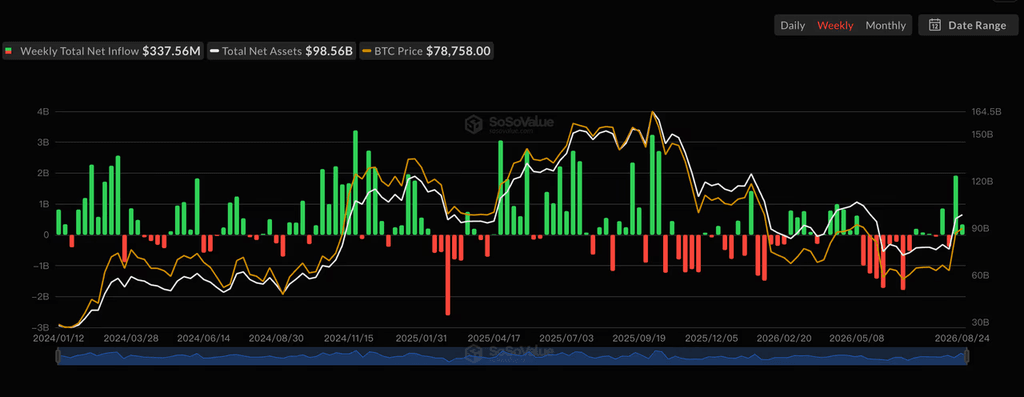
U.S. spot Bitcoin ETFs recorded approximately $1.9 billion in net inflows during the preceding week, marking the strongest weekly inflow since October 2025.
BlackRock’s IBIT accounted for a significant portion of this activity, suggesting that institutional demand has returned after a period of weaker flows.
The significance of ETF inflows is that they represent direct spot-market demand rather than purely leveraged positioning.
U.S. Bitcoin Demand Has Improved
Another important signal came from the Coinbase Premium Index, which turned positive for the first time in 98 days.
A positive Coinbase premium generally indicates that Bitcoin is trading at a higher price on Coinbase relative to major global platforms, suggesting stronger buying pressure from U.S.-based investors.
This shift adds further evidence that the recent rally is being supported by actual demand rather than short-term speculative activity alone.
Macro Liquidity Conditions Have Become More Supportive
Bitcoin has also benefited from changes in broader financial conditions.
Falling U.S. Treasury yields and expanded long-dated bond buybacks by the U.S. Treasury have improved liquidity expectations and contributed to a softer U.S. dollar.
The effect has not been limited to crypto. Equities, bonds, gold, and Bitcoin have all benefited from the same broader liquidity backdrop.
Short liquidations helped accelerate Bitcoin’s breakout, but institutional inflows and improving macro conditions appear to provide a stronger foundation for the move.
Could Short-Term Holders Create Selling Pressure?
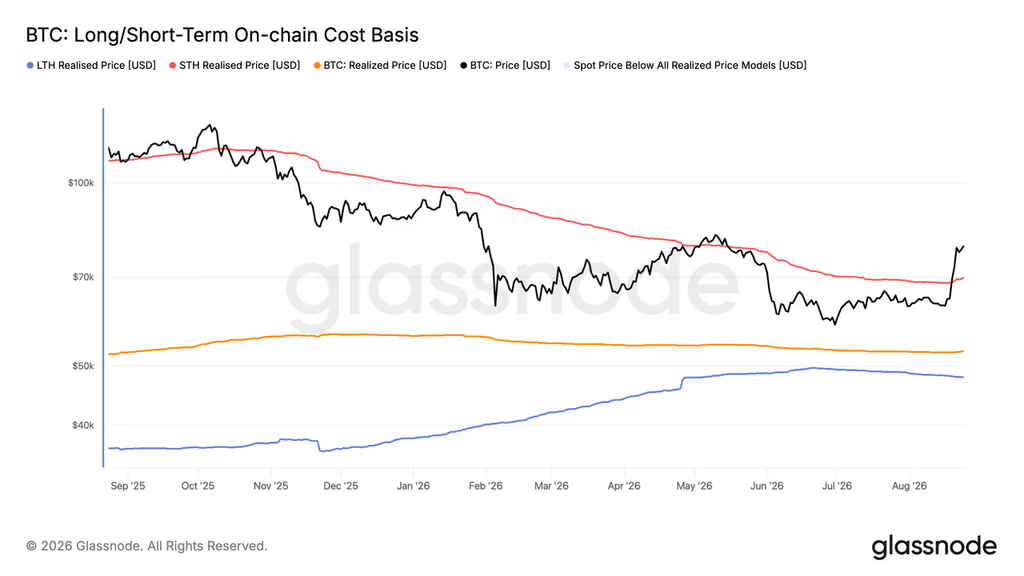
The current rally has pushed a large share of short-term Bitcoin holders into profit, which may increase the likelihood of profit-taking if momentum slows.
On-chain analysis generally separates Bitcoin holders into two broad groups:
-
Long-term holders: coins held for more than 155 days
-
Short-term holders: coins held for less than 155 days
The 155-day threshold is commonly used because the probability of coins being sold tends to decline significantly once they have remained unmoved beyond that period.
Short-term holders therefore tend to include newer market participants, swing traders, and investors who may react more quickly to price changes.
At present, approximately 85% of short-term holders are in profit.
That does not mean a sell-off is inevitable. However, when a large proportion of recent buyers are sitting on gains, the incentive to secure profits usually increases if price momentum begins to weaken.
Bitcoin’s rapid move from the low-$60,000 range into the high-$70,000s and above $80,000 has therefore created a market environment in which volatility could increase around major resistance levels.
Exchange inflows from short-term holders and the short-term holder spent-output profit ratio remain useful indicators for assessing whether profit-taking pressure is beginning to build.
What Could Determine Whether Bitcoin Reaches $90,000?
A move toward $90,000 remains possible, but the path is unlikely to depend on price momentum alone.
Two major mid-September developments could influence the next phase of the market.
Digital-Asset Regulation Remains a Key Catalyst
One important event is the upcoming procedural vote related to the Digital Asset Market Clarity Act.
The Senate returns on September 14, with a procedural step expected around September 15. A cloture vote would require 60 votes and would determine whether the chamber can formally proceed with consideration of the legislation.
This is an early legislative step rather than final passage, but it remains important because recent Bitcoin strength has partly reflected expectations that U.S. digital-asset regulation could become clearer.
On August 19, President Trump met with crypto-industry executives, including representatives from Coinbase and Gemini, and publicly encouraged Congress to advance digital-asset legislation.
Market sentiment improved in the following days. Because expectations are already elevated, disappointment around the September procedural process could trigger profit-taking.
Monetary Policy Could Influence Market Liquidity
The second major factor is the broader monetary-policy environment, including the FOMC meeting and expectations around future U.S. interest-rate cuts.
Bitcoin’s recent performance has been closely linked to liquidity conditions rather than crypto-specific catalysts alone.
Lower long-term Treasury yields, a weaker dollar, and increased Treasury bond buybacks have helped support risk assets across multiple markets.
If upcoming FOMC guidance changes expectations around future liquidity or interest rates, Bitcoin could respond even if the regulatory outlook remains unchanged.
For this reason, the move toward $90,000 should be viewed as conditional rather than automatic.
Sustained trading above the $80,000–$83,000 range would support the case for further upside. However, weaker regulatory momentum or tighter-than-expected monetary-policy signals could increase the probability of a pullback toward lower support levels.
How Can Australian Users Buy & Sell Bitcoin on KuCoin AU?
KuCoin AU provides several ways for eligible users to access Bitcoin without relying on complex trading products.
After completing registration and identity verification, users can fund their accounts and access Bitcoin through available KuCoin AU services.
Fund Your KuCoin AU Account First
Users can deposit AUD with zero fees using PayID or bank transfer or crypto assets into their KuCoin AU account before purchasing Bitcoin through available products.
During periods of elevated volatility, users should review current prices carefully and consider their own risk tolerance before making any purchase.
Buy Bitcoin Through Spot Trading
Users who prefer an order-book trading experience can access supported BTC Spot pairs on KuCoin AU.
Spot Trading allows users to directly buy and hold Bitcoin while using tools such as market and limit orders to manage execution.
Use Fast Trade for a Simpler Purchase Experience
For users who prefer a more straightforward way to purchase crypto, KuCoin AU Fast Trade offers a simplified purchase process using supported payment methods.
Fast Trade can be particularly useful for users who want to access crypto without navigating traditional order-book interfaces.
Should You Buy Bitcoin on KuCoin AU During a Strong Market Move?
Bitcoin’s return above $80,000 has brought renewed attention to the market, but strong price momentum does not remove volatility risk.
Users considering Bitcoin exposure should assess whether the current market environment aligns with their own investment objectives and risk tolerance.
KuCoin AU allows eligible users to access Bitcoin through Spot Trading and supported crypto purchase services such as Fast Trade, while providing real-time market information to help users monitor price movements.
Rather than reacting only to short-term price momentum, users should consider market liquidity, upcoming macro events, regulatory developments, and their own position sizing before participating.
Conclusion
Bitcoin’s move above $80,000 on August 25, 2026 marks an important recovery milestone after the cryptocurrency traded below $58,000 in late June.
The rally has been supported by several notable developments, including approximately $1.9 billion in weekly U.S. spot Bitcoin ETF inflows, renewed U.S. buying demand reflected by the Coinbase Premium Index turning positive after 98 days, and broader improvements in global liquidity conditions.
At the same time, approximately 85% of short-term Bitcoin holders are now in profit, increasing the possibility of profit-taking if upward momentum slows.
Whether Bitcoin can extend the rally toward $90,000 may depend heavily on mid-September developments, particularly progress around the Digital Asset Market Clarity Act and changes in U.S. monetary-policy expectations.
Bitcoin has regained a major psychological level, but the next stage of the rally will likely require continued institutional demand and supportive macro conditions.
FAQs
What price did Bitcoin reach on August 25, 2026?
Bitcoin moved above $80,000 on August 25 and briefly traded near the $81,000 level.
How much has Bitcoin recovered from its June low?
Bitcoin has gained approximately 38% from levels below $58,000 recorded near the end of June.
How large were recent U.S. spot Bitcoin ETF inflows?
U.S. spot Bitcoin ETFs recorded roughly $1.9 billion in net inflows during the previous week, the strongest weekly total since October 2025.
What does a positive Coinbase Premium Index mean?
A positive Coinbase Premium Index suggests Bitcoin is trading at a premium on Coinbase relative to major global platforms, often indicating stronger demand from U.S.-based participants.
Why are short-term Bitcoin holders important right now?
Approximately 85% of short-term holders are currently in profit. If market momentum weakens, some of these holders may choose to realise gains, potentially increasing short-term selling pressure.
Disclaimer: This article is for informational purposes only and does not constitute financial, legal, or investment advice. Always conduct your own research before interacting with digital assets.