

What Is a Crypto Debit Card? The Complete 2026 Guide for Australians
2026/04/27 18:00:00
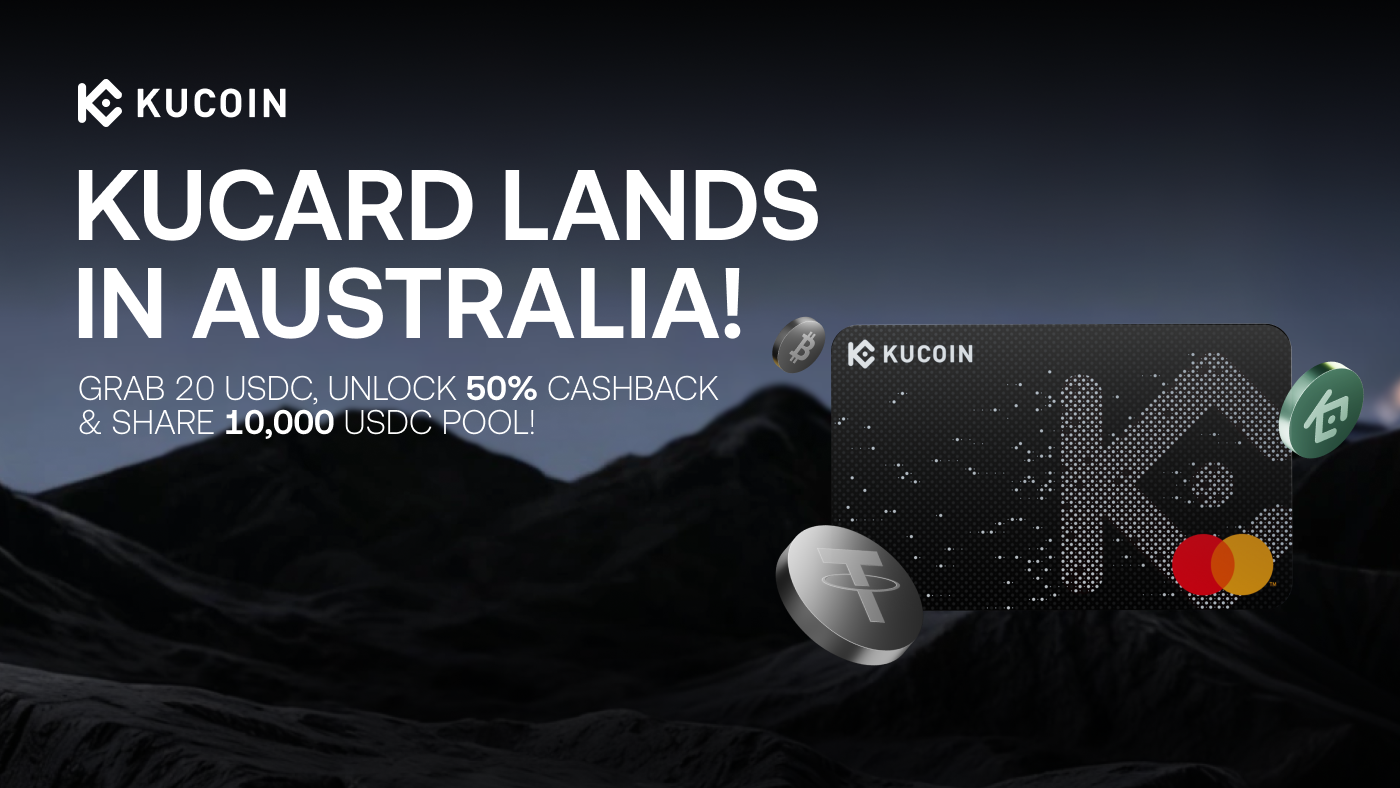
If you hold cryptocurrency and want to use it for day-to-day purchases — groceries at Woolworths, fuel at a service station, a restaurant bill, or an online subscription — a crypto debit card is one of the more direct ways to make that happen. Rather than selling your crypto through an exchange, waiting for funds to clear, transferring to a bank account, and only then spending, these cards handle the conversion from digital assets to spendable currency automatically at the moment of the transaction. From the merchant's perspective, the payment looks exactly like any ordinary debit card transaction.
In Australia, the market for crypto-linked prepaid cards has developed meaningfully over the past few years, with several Mastercard and Visa-based products now available to residents. KuCard-AU, issued through KuCoin Australia, is one such product. This guide explains what crypto debit cards are, how they work in practice, what fees and eligibility requirements apply to KuCard-AU specifically, how the card's cashback program is structured, and what considerations Australians should weigh before applying for any card in this category.
How Does a Crypto Debit Card Work?
A crypto debit card is a prepaid card linked to a digital asset account rather than a conventional bank account. When a cardholder makes a purchase, the card provider converts the required amount from the cardholder's crypto holdings into the card's settlement currency — typically a stablecoin such as USDC, or a fiat currency such as USD or AUD — and then processes the payment through the card network, Mastercard or Visa, just as an ordinary transaction would be processed.
The key distinction from a traditional debit card is the funding source. Instead of drawing directly on AUD held in a bank account, the card draws on digital assets held in the cardholder's exchange or platform account. The conversion from those digital assets into the payment currency happens in the background, at the time of each transaction, based on the prevailing market rate at that moment.
KuCard-AU operates on the Mastercard network. Its settlement currency is USDC. When a KuCard-AU holder pays at an Australian merchant — whether tapping at a supermarket terminal via Apple Pay, paying online, or using Google Pay — the system deducts the required amount from their KuCoin AU Funding Account. If the cardholder has USDC available and set as the first funding priority, the payment draws directly on that balance. If they have configured a crypto-asset such as BTC, ETH, or XRP as a funding source, the system converts the relevant amount of that asset into USDC at the prevailing sell rate at the time of the transaction, then settles the AUD-denominated payment through the Mastercard network.
Cardholders set a priority order for how payments are funded. The default sequence, if no custom order is defined, is USDC, then BTC, then ETH, then KCS. If the first-priority asset does not have a sufficient balance to cover the transaction, the system automatically moves to the next available asset in the defined sequence. One structural constraint applies: each individual transaction can draw on USDC and at most one other crypto-asset type simultaneously. Splitting a single purchase across multiple different crypto-assets is not supported (source: KuCard FAQ, KuCoin official documentation, 3/2/2026).
KuCard-AU supports a broad range of funding assets, including BTC, ETH, XRP, USDT, KCS, SOL, DOGE, LTC, LINK, and a number of others listed in the official KuCard FAQ. The card can be added to Apple Pay and Google Pay for contactless and mobile payments. Currently, KuCard-AU is only available as a virtual card. A physical card format has not yet launched.
KuCard-AU Fee Structure: What Applies to Australian Transactions
Understanding how fees work on a crypto debit card is important, because the cost structure differs meaningfully from a standard bank-linked debit card. On KuCard-AU, fees are applied at the transaction level rather than through monthly or annual subscription charges — but this does not mean transactions are cost-free.
The foreign exchange fee is the most commonly encountered charge. Because KuCard-AU settles in USDC, any transaction made in a currency other than USDC — which includes virtually all AUD purchases at Australian merchants — triggers an FX conversion. The KuCard-AU FAQ illustrates this as approximately 1% FX fee plus 0.5% transaction fee for an AUD-denominated purchase, calculated on the converted amount (source: KuCard FAQ, KuCoin official documentation, 3/2/2026). Additionally, when a volatile crypto-asset is used as the funding source rather than USDC, the conversion from that asset into USDC occurs at the prevailing market sell rate at the time of the transaction, which may include a conversion spread on top of the FX fee.
Two fee types can therefore apply in sequence to a single transaction: the crypto-to-USDC conversion step, and the USDC-to-AUD foreign exchange step. The combined effect means the total cost of a transaction may be higher than any single stated rate in isolation.
There is no annual fee and no monthly fee on KuCard-AU. However, an inactivity fee of 2 USDC per virtual card per month applies if a card records no completed transactions within 90 consecutive calendar days after activation. KuCoin notifies affected cardholders seven days before a deduction is scheduled. This charge is per card, meaning a user who holds multiple virtual KuCards and does not use all of them may be charged on each inactive card separately. Terminating unused cards is one way to avoid this.
The first virtual card is issued at no charge. From the second card onward, a fee of 9.99 USDC applies per card. A maximum of five virtual cards can be held per account. Spending limits are set at 20,000 USDC per day and 200,000 USDC per year, applied as an aggregate across all cards linked to the same account (source: KuCard FAQ, KuCoin official documentation, 3/2/2026).
The table below places KuCard-AU alongside two other Mastercard prepaid cards available to Australian residents — the Bybit Card (AU) and the Crypto.com Visa Card (AU) — to illustrate how fee structures vary across products in this category. The Crypto.com card operates on the Visa network, while KuCard-AU and the Bybit Card both operate on Mastercard.
| Feature | KuCard-AU | Bybit Card (AU) | Crypto.com Visa Card (AU) |
| Card network | Mastercard | Mastercard | Visa |
| Card format | Virtual only | Virtual + Physical | Virtual + Physical |
| Settlement currency | USDC | USD | Fiat (AUD/USD) |
| Issuance fee (virtual) | No charge (1st card); 9.99 USDC from 2nd | No charge (until further notice) | No charge |
| Issuance fee (physical) | Not yet available | USD 5 | Varies by tier |
| FX transaction fee | ~1% (illustrated in FAQ, plus 0.5% txn fee) | 1% on top of Mastercard reference rate | Varies by card tier; CRO staking affects rate |
| Crypto conversion fee | Conversion spread at market sell rate | 0.9% on top of One-Click Sell Rate | Applied at point of conversion |
| ATM withdrawal fee | Subject to KuCard Terms of Use | 2% on amounts above USD 100/month | Subject to Crypto.com tier and terms |
| Annual / inactivity fee | Inactivity fee: 2 USDC/month/card (after 90 days no use) | None | None stated at base tier |
| Cashback / rewards | Tiered cashback program (conditions apply; see below) | Points-based rewards convertible to USDT cashback (conditions apply) | Tiered cashback in CRO; CRO staking required for higher tiers |
| Staking requirement | None for basic card use | None | CRO staking required to access higher cashback tiers |
Fees and features are subject to change. KuCard-AU data sourced from KuCard FAQ (KuCoin official documentation, 3/2/2026). Bybit Card (AU) data sourced from Bybit Help Center (last updated 2026-03-23). Crypto.com Visa Card (AU) data sourced from Crypto.com Help Center (AU card fees and limits page). This comparison is for educational purposes only and does not constitute a recommendation of any product.
Australians who wish to check live crypto market data before deciding how to fund their card spending can do so on KuCoin Australia's price page.
Cashback and Rewards: How KuCard-AU's Program Is Structured
KuCard-AU includes a cashback program for eligible purchases, but its design involves conditions, caps, and distribution mechanics that are worth understanding in full before treating cashback as a predictable benefit.
Cashback rates are tiered by KuCoin VIP level and, within the VIP 0 tier, by the cardholder's total account asset level. At VIP 0 with account assets below 10,000 USDT, eligible purchases may generate cashback at a rate of 1%, subject to a monthly cap of 10 USDC in equivalent value. With account assets between 10,000 and 20,000 USDT at the VIP 0 level, the rate rises to 1.5% and the monthly cap to 20 USDC. Above 20,000 USDT at VIP 0, the rate reaches 2% with a 30 USDC monthly cap. At higher VIP levels, both the rates and caps increase further — VIP 11–12 users may access rates up to 8% with a monthly cap of 200 USDC (source: KuCard FAQ, KuCoin official documentation, 3/2/2026).
Cashback earned within a calendar month is distributed on the 15th of the following month. The distribution is made in the equivalent value of BTC, ETH, or KCS at the prevailing conversion rate at the time of distribution. This means the AUD-equivalent value of the cashback amount received will vary with the market price of whichever crypto-asset is selected.
Not all transactions qualify. USDC-settled transactions, ATM withdrawals, cash advances, balance transfers, banking and financial services transactions, and certain merchant category codes are excluded from cashback eligibility. The program is promotional in nature, meaning rates and terms may be changed or discontinued at any time. Cashback on KuCard-AU does not constitute a guaranteed financial return, and the crypto-equivalent value of any cashback received may fluctuate after distribution. Users who forfeit their KuCoin AU account or breach applicable program terms may lose accrued cashback.
For current program details and updates, the KuCoin Australia blog publishes educational resources relating to KuCard-AU features and promotions.
Eligibility and How to Apply in Australia
KuCard-AU is available exclusively to Australian residents. Applicants must hold a KuCoin AU account and have completed full identity verification (KYC) before they can apply. The KYC process requires an Australian-issued identity document — either an Australian passport or an Australian driving licence — along with a valid Australian residential address or proof of residence. Documents must be current and non-expired at the time of application.
The application is completed through the KuCoin AU app or web portal. The process involves navigating to the KuCard section via the More tab, selecting Apply Now, reviewing and accepting the KuCard Terms of Use and Privacy Policy, confirming a virtual card design, setting up a 3DS password for online payment authentication, and submitting the application. The 3DS password is used to authenticate online card transactions and must meet the format requirements specified during setup — applications may be rejected if this password does not conform to the required format.
Applications are subject to internal compliance checks in addition to document verification. KuCoin AU reserves the right to decline applications based on risk assessment, and approval is not guaranteed. Common reasons for rejection listed in the KuCard FAQ include invalid phone number formats, incorrect name formatting, incorrect date of birth information, insufficient balance to cover the applicable issuance fee (from the second card onward), and risk control determinations.
Australian residents who do not yet hold a KuCoin account can sign up for KuCoin Australia before beginning the card application process.
Considerations for Australian Users
Using a crypto debit card for everyday spending involves risks and practical factors that differ substantially from using a standard bank-linked debit card. Prospective applicants should consider the following before applying for any product in this category.
Crypto-asset price volatility. When a purchase on KuCard-AU is funded using a non-stablecoin asset such as BTC or ETH, that asset is liquidated at the prevailing market price at the moment of conversion. If the asset has declined in value since it was acquired, the effective cost of the purchase in AUD terms may be higher than anticipated. Neither KuCard-AU nor any card in this category can guarantee the conversion rate applied at the moment of any transaction.
Compounding fee structures. As noted in the fee section above, some transactions on KuCard-AU involve both a crypto-to-USDC conversion and a USDC-to-AUD foreign exchange step within a single payment. Both steps carry associated costs, and the combined impact on the effective transaction cost can be larger than any individual fee figure suggests.
Inactivity charges. KuCard-AU's 2 USDC per month inactivity fee — applied per card, after 90 consecutive days of no use — is a structural feature without a direct equivalent on some other cards in the Australian market. Cardholders who apply for multiple virtual cards and then use only some of them should be aware that inactive cards may accrue monthly charges.
Account-level suspension. If a KuCoin AU account is suspended or restricted for any reason, all associated KuCards are frozen accordingly and cannot be used until the underlying account situation is resolved. This dependency on the platform account is a characteristic of all exchange-linked crypto cards.
Tax obligations. The Australian Taxation Office (ATO) has published guidance indicating that using cryptocurrency to purchase goods and services may constitute a disposal of a capital asset, potentially giving rise to a capital gains tax event. This may apply to each transaction where a crypto-asset is converted — including at the point of a card payment. Cardholders should refer to ATO guidance on crypto asset taxation</a> and consult a registered tax agent for advice relevant to their individual circumstances. This article does not constitute tax advice.
Final Thoughts
Crypto debit cards allow Australian holders of digital assets to use those assets for everyday spending without a manual conversion step — but they are not without costs, conditions, or risks. The mechanics of conversion, the layered fee structures, the inactivity charge model on some products, and the tax implications of crypto disposals are all factors that Australian users should understand before applying.
KuCard-AU, available through KuCoin AU on the Mastercard network, represents one approach in this category: USDC-denominated settlement, a virtual-only card format, a broad range of supported funding assets, a tiered cashback program with conditions attached, and spending limits of 20,000 USDC daily and 200,000 USDC annually. As with all products in this space, terms are subject to change, and the cashback program does not constitute a guaranteed return.
Australians who are evaluating a crypto debit card should read the full Terms of Use and current fee schedule for any product they are considering, and verify that all information is current at the time of their application. To learn more about KuCard-AU and its current features, visit KuCoin Australia or use KuCoin Express to explore options for funding a card account.
Disclaimer
Axis One Markets Pty Ltd is a Corporate Authorised Representative of Immersve Pty Ltd (ACN 658 192 057, AFSL No. 545925) and is authorised to provide certain financial services in respect of 'KuCard' on Immersve's behalf, limited to the scope of its Corporate Authorised Representative agreement with Immersve Pty Ltd. 'KuCard' is issued or provided by Immersve Pty Ltd, and it is solely responsible for the issuance of that product, including all associated disclosures and obligations under its Australian financial services licence. Immersve Pty Ltd is not responsible for any financial products or services issued by Echuca Trading Pty Ltd. Before acquiring or using any such financial product or service, you should read the relevant Product Disclosure Statement ("PDS"), Financial Services Guide ("FSG"), Target Market Determination ("TMD"), and any other disclosure documents issued by Immersve Pty Ltd.