

Why the Share of Cashless Payments Dropped in Russia in 2026: Rising Demand for Cash and What It Means
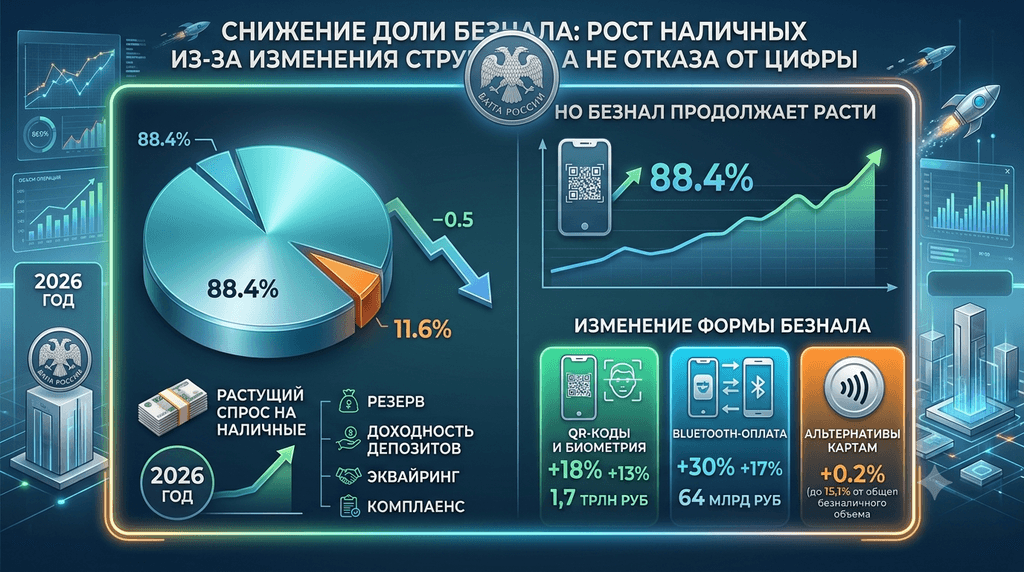
Can a country where cashless payments already account for nearly nine-tenths of retail turnover suddenly revert to cash? In Q2 2026, for the first time since observations began, the Bank of Russia recorded precisely this trend: the share of cashless transactions fell by 0.5 percentage points, from 88.9% to 88.4%. However, this does not signify that Russians are abandoning cards and digital payments. According to the regulator's data released on September 4, 2026, cashless transactions continued to grow, but cash usage expanded at a faster pace.
The main conclusion is that this is not a bank run or banking panic, but a slight structural shift in payment methods. Demand for cash is driven by a desire to hold a liquidity reserve against payment disruptions, changing deposit yields, business expenses on acquiring fees, stricter compliance enforcement, and a very high baseline of cashless penetration. Simultaneously, Russians are transitioning from physical cards to QR codes, biometrics, and Bluetooth payments.
The share of cashless payments declined because cash transactions grew faster than cashless ones in Q2. This is the exact explanation provided by the Bank of Russia in its report on payment trends for April–June 2026. It is crucial to distinguish between two metrics: the absolute volume of cashless transactions and their share in total retail turnover. The former can increase even as the latter temporarily falls if cash volumes grow at an even higher rate.
In Q2, bank clients—individuals and businesses—completed 32.1 billion transactions worth 491.5 trillion rubles. According to Bank of Russia data, compared to Q1, the number of transactions rose by 9.9%, while the total volume grew by 12.8%. Therefore, headlines reporting a decline in the cashless share should not be interpreted as a breakdown of digital payment infrastructure. It represents a statistical shift within a rapidly expanding market.
A drop of 0.5 percentage points also remains modest against an overall level of 88.4%. The Russian market has already reached an exceptionally high degree of cashless adoption. When penetration reaches around 85–90%, further growth runs into a high-base effect: even a minor rise in cash usage can noticeably alter the share, even though the overwhelming majority of purchases continue to be settled electronically.
Rising demand for cash alters the composition of the money supply, but it does not in itself prove an outflow of capital from banks, nor does it create extra demand for goods. In July, the Bank of Russia emphasized that shifting funds from bank accounts into cash form modifies the structure of the money supply, not its total volume. Consequently, an increase in cash in wallets and cash registers does not equate to a mass withdrawal of deposits.
According to RBC, citing the Bank of Russia, the volume of cash in circulation has grown by approximately 2.5 trillion rubles since the beginning of 2026 (including preliminary estimates for August). The strongest gains occurred in April (+678.7 billion rubles) and July (+618.4 billion rubles). In August, cash grew by another 443 billion rubles—roughly three times slower than in July.
The regulator also anticipates further nominal growth in cash in circulation as the economy and overall money supply expand. RBC cites Bank of Russia projections: total cash in circulation could reach 23.1 trillion rubles in 2026 and rise to 28.3 trillion rubles by 2029. To assess real risks, the key factors are not the total cash volume itself, but its share within the overall money supply and deposit behavior.
Available data does not support the scenario of a widespread banking panic. Increased demand for cash likely reflects the creation of a liquid reserve, seasonal spending, and consumer caution rather than account closures. With term deposit yields remaining high, a substantial portion of public funds stays securely inside the banking system: deposits generate interest, whereas cash offers immediate accessibility without yield.
Thus, it is more accurate to view this as a diversification of personal liquidity. Russians hold part of their money in deposit accounts, use part for routine cashless payments, and keep a fraction in physical cash in case of technical outages, connectivity restrictions, or merchant card acceptance issues. This behavior can be amplified following occasional disruptions in banking apps and payment gateways, but it does not indicate systemic distrust in banks.
The rise in cash usage stems from several concurrent factors, and no single reason offers a complete explanation. While the Central Bank explicitly highlights increased consumer demand for banknotes, secondary factors illuminate why this demand intensified at this specific time.
For some small businesses, cash helps lower transaction costs associated with card acceptance. Based on 2026 acquiring tariff reviews, standard interchange/acquiring fees hover around 1.2–2.5% per transaction, whereas processing payments via the Faster Payments System (SBP) QR code is often significantly cheaper. Amid high inflation, expensive credit, and compressed profit margins, this cost difference becomes material.
Consequently, some retailers and service providers offer cash discounts, restrict card payments, or actively promote QR codes. This does not necessarily signal illegal refusal of service; rather, businesses are seeking to substitute expensive card acquiring with lower-cost payment methods. To consumers, this can look like a return to cash, even though a portion of transactions is simply migrating from card channels to cash or SBP.
For the self-employed, sole proprietors, and small companies, an added factor is heightened caution regarding bank transaction monitoring. In 2026 compliance guidelines under Federal Law No. 115-FZ (AML/CFT), grounds for scrutiny include large cash withdrawals, frequent peer-to-peer (P2P) transfers to individuals, and transactions inconsistent with stated business activities.
It is important not to conclude that businesses are universally retreating into the shadow economy. However, fear of account freezes or documentation requests prompts entrepreneurs to reduce complex P2P transfers and opt for simpler settlement methods. In certain segments, this sustains cash turnover. At the same time, excessive cash usage carries its own tax and compliance risks, making it an imperfect solution.
Social welfare payments and state transfers to specific demographics can also temporarily spike demand for cash. This applies to families and recipients who prioritize physical liquidity for daily necessities or emergency reserves. After being credited to accounts, these funds are frequently withdrawn not due to bank distrust, but because cash is more convenient in specific local stores or regions.
Public Q2 statistics do not isolate the exact impact of each payment category on the final total. Therefore, this factor should be viewed as a potential contributor rather than a proven primary cause of the cashless share decline.
Russia's cashless infrastructure is so highly developed that previous growth rates are difficult to sustain. According to Central Bank data, the share of alternative non-card payment methods in overall cashless volume grew by 0.2 percentage points to 15.1% in Q2. This confirms that digitization has not stalled; its form is simply evolving.
Given such a high base, even a minor increase in cash turnover can trigger a drop in the cashless percentage share. This is a mathematical phenomenon, not an inevitable reversal of a long-term trend. If the economy and retail sales continue expanding, absolute digital transaction volumes can grow simultaneously with a temporary uptick in cash reliance.
The primary structural trend is that cashless payments are not disappearing, but rather transitioning into new digital channels. In Q2 2026, QR codes and biometrics accounted for 1.1 billion purchases totaling 1.7 trillion rubles. Compared to Q1, transaction volume via these methods grew by 18% in count and 13% in monetary terms, according to Bank of Russia data.
Bluetooth-based payments are also accelerating. Over the quarter, citizens completed 86 million Bluetooth transactions worth 64 billion rubles—a 30% increase in count and a 17% increase in value quarter-over-quarter. These figures demonstrate that consumers can move away from physical plastic cards without giving up digital payments.
| Payment Channel | Q2 2026 Results | QoQ Dynamics (vs Q1) |
| Cashless share of retail turnover | 88.40% | -0.5 p.p. |
| QR codes and biometrics | 1.1 billion transactions, 1.7 trillion rubles | +18% count, +13% volume |
| Bluetooth payments | 86 million transactions, 64 billion rubles | +30% count, +17% volume |
| Non-card alternatives share in cashless payments | 15.10% | +0.2 p.p. |
This data is critical for banks and retailers. Card transactions are now just one of many ways to execute a digital payment. When a customer pays via QR code, biometrics, or Bluetooth, it remains a digital transaction for the broader market, though bank revenues and technological costs are distributed differently.
For banks, the impact is manageable rather than critical. Rising cash turnover may temper fee income growth from traditional card acquiring, but it simultaneously stimulates demand for alternative payment services. Banks are actively promoting SBP, QR codes, biometrics, and proprietary digital wallets.
The financial impact can be divided into two main streams: Net Interest Income (NII) remains supported by lending activity and high asset yields, whereas Net Fee and Commission Income (NCI) is more closely tied to payment volume, acquiring rates, and service fees. Consequently, a slowdown in fee income does not translate to a proportional drop in overall bank profitability. For Sberbank and other major institutions, key indicators to monitor include overall income structure, credit portfolio quality, and funding costs, rather than the standalone cashless share percentage.
Market adaptation is exemplified by the shift toward SBP. Lower merchant processing fees make QR payments attractive during margin squeezes, while bank value shifts from single card transactions to keeping customers within their ecosystem. Therefore, rising cash demand can simultaneously accelerate competition between traditional acquiring, SBP, and emerging contactless technologies.
There is no direct link between the drop in cashless share during Q2 and the rollout of the Digital Ruble. The statistics cover April–June, whereas widespread readiness among major banks for Digital Ruble transactions only took effect on September 1, 2026. On August 21, the Bank of Russia reported that all 12 systemically important banks—representing over 80% of the payment market—were prepared to offer this option to clients.
Furthermore, claiming that the Digital Ruble remains a mere experiment is no longer accurate. In practice, its adoption by individuals is voluntary and being deployed in phases. While the Digital Ruble may reallocate future payment flows between cards, SBP, and the new platform, it does not explain the Q2 statistical shift.
Consequently, current cash dynamics should be analyzed independently of the Digital Ruble. In the short term, cash demand is driven much more strongly by precautionary holdings, acquiring costs, technical infrastructure availability, and broader money supply dynamics.
If you worry about the frequent ups and downs in the market, and pursue a more stable option to earn money passively, KuCoin is the right place to come:
Simple Earn: Deposit and withdraw tokens anytime, earning stable returns.
Kucoin Earn: Earn stable profits with professional asset management.
Hold to Earn: Earn rewards by holding assets in Funding, Trading, Margin, Futures, Mining, and Unified Accounts.
Staking: Unlock the earning potential of on-chain assets.
Advanced Investments: Advanced Investments offer a variety of structured products to help your money grow in any market.
Shark Fin: Principal Protection and Guaranteed Gains
Dual Investment: Buy low and sell high with transparent return calculations.
Snowball: High yields, with price protection.
Discount Buy: Buy crypto at discount prices.
KCS Loyalty: Level up to enjoy exclusive perks by staking ≥ 1 KCS.
KuCoin Wealth: Discover future value and begin your smart investing journey.
KCS Benefits: Hold and stake KCS to access benefits across the platform.
KCS Staking 2.0: Participate in KCS on-chain governance to earn yield.
The Bank of Russia recorded the first-ever dip in the cashless share of retail turnover: in Q2 2026, the metric decreased by 0.5 percentage points to 88.4%. The primary driver was that cash transactions expanded faster than cashless ones. Crucially, the overall cashless market continued to grow: total bank transactions reached 32.1 billion, with QR codes, biometrics, and Bluetooth reporting double-digit growth rates.
Rising demand for cash should not automatically be viewed as a sign of a banking crisis. It reflects precautionary reserve building, shifting deposit yields, occasional payment infrastructure glitches, small business acquiring expenses, stricter AML monitoring under 115-FZ, and a high baseline effect. Social welfare transfers can also cause localized withdrawal spikes, though public data does not identify this as the main driver.
For the banking sector, the fallout appears manageable: traditional card commission revenues may grow at a slower pace, but SBP, QR codes, biometrics, and Bluetooth offer promising alternative channels. The Digital Ruble may shape the market in the future, but it does not account for the April–June statistics. Ultimately, the situation is best described not as a retreat from digital payments, but as a minor, temporary adjustment in payment behavior.
No. While the cashless share dipped to 88.4%, both the total number and monetary volume of cashless transactions continued to grow. The shift simply means cash usage expanded at a slightly faster pace, not that citizens stopped using cards.
In Q2, the number of cash withdrawal transactions grew by 15%, and total withdrawal volume increased by 20% compared to Q1. However, cash withdrawals maintained a stable share of overall transactions—accounting for 1% of total transaction count and 10% of total volume.
QR payments via SBP are significantly cheaper than traditional card acquiring. They allow merchants to cut fee expenses while maintaining an electronic audit trail for transactions. As a result, businesses can simultaneously move away from costly card processing while still accepting digital payments.
Not necessarily. Funds can be temporarily transferred into cash reserves without closing fixed-term deposit accounts or signaling systemic distrust in banks. Assessing real financial risk requires analyzing overall deposit trends, bank liquidity, and the share of cash in total money supply, rather than focusing solely on withdrawal metrics.
No, rapid substitution is not expected. Although major banks began enabling Digital Ruble functionality for clients on September 1, 2026, adoption remains entirely voluntary for citizens. Moreover, the system could not have driven Q2 statistics, which were compiled prior to this launch phase.
Disclaimer : This material is provided for informational purposes only and does not constitute financial, investment, legal, or tax advice. Transactions involving cryptocurrencies and tokenized assets carry substantial risks — including price volatility, limited liquidity, counterparty exposure, and the potential for total loss of invested capital. Readers should conduct their own research and, where appropriate, consult a qualified professional before making any financial decisions.