

Perpetual Futures Explained: The Complete Guide for Australian Traders
Perpetual futures are crypto derivatives that let traders take long or short positions without owning the underlying asset or dealing with a fixed expiry date. For Australian traders, understanding perpetual futures starts with a few core ideas: funding rates, margin, leverage, position size, mark price and liquidation. This guide explains how perpetual futures in Australia work and the key terms traders are likely to encounter.
What Are Perpetual Futures and How Do They Differ From Traditional Futures?
A perpetual future, often called a perp, is a derivative contract that gives traders exposure to the price of an underlying asset without requiring them to own it. A BTC perpetual contract, for example, allows a trader to take a position based on Bitcoin price movements rather than buying Bitcoin directly in the spot market.
How Perpetual Futures Work Without an Expiry Date
The biggest difference between perpetual and dated futures is simple: one expires and the other does not. Traditional futures have a predetermined settlement or expiry date, and their prices generally move closer to the underlying spot price as that date approaches. Traders who want to maintain their exposure may need to close an expiring contract and open another with a later expiry, commonly known as rolling the position.
Perpetual futures do not have a fixed expiry date. A position can remain open while the trader continues to meet the required margin conditions, although it may still be closed voluntarily or liquidated if available margin falls too far. Because there is no expiry date naturally encouraging the futures price to converge towards spot, perpetual contracts typically use funding rates and reference-price mechanisms to help keep the two markets aligned.
Perpetual Futures vs Dated Futures: Key Differences
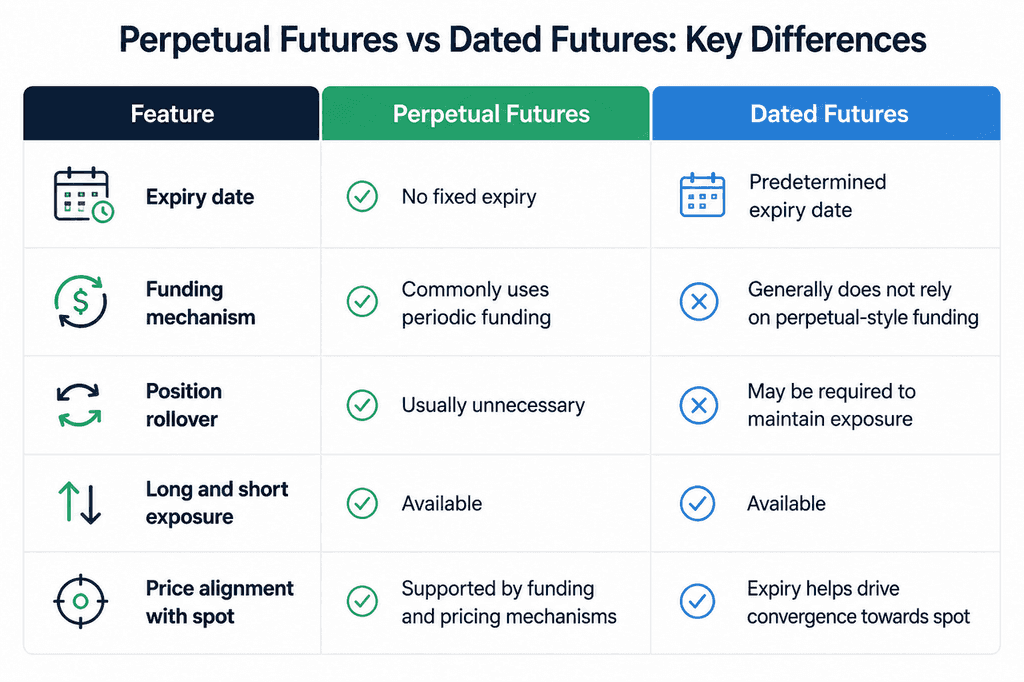
No fixed expiry can make perpetual futures more flexible, but the risks of leverage still remain. Margin requirements, funding payments, market volatility and liquidation risk continue to matter for as long as the position stays open.
How Funding Rates Keep Perpetual Futures Prices Close to Spot
Funding rates are a key reason perpetual futures can trade without a fixed expiry date. They determine periodic payments between traders holding long and short positions, creating incentives that help keep the perpetual contract price relatively close to its underlying spot market.
When funding is positive, traders holding long positions generally pay traders holding short positions. When funding turns negative, shorts generally pay longs. When too many traders crowd onto one side of the market, funding can make that position more costly to hold and encourage activity on the other side. KuCoin Australia's explanation of funding rates and funding fees describes how this mechanism is used to reduce the gap between perpetual contract and spot prices.
A simplified calculation is:
Funding payment = Position value × Funding rate
For example, if a position is worth A$10,000 equivalent and the funding rate is 0.01%, the funding payment would be A$1 equivalent. Whether the trader pays or receives that amount depends on the position direction and whether funding is positive or negative.
Funding rates can change with market conditions, and the interval may differ between contracts. This makes funding particularly relevant for positions held over longer periods, as repeated payments can affect the final trading result.
How Margin, Leverage, Position Size and Mark Price Work
Margin, leverage, position size and mark price all work together in a perpetual futures trade, but each affects the position differently.
Margin
Margin is the collateral used to support a leveraged position. Initial margin is the amount needed to establish a trade, while maintenance margin is the minimum required to keep it open. If losses reduce the available margin below the required maintenance level, the position may become subject to liquidation.
Leverage
Leverage allows traders to gain more market exposure than the amount of margin committed.
A simple way to understand the relationship is:
Position value = Margin × Leverage
If A$1,000 equivalent of margin supports a position at 2x leverage, the trader has roughly A$2,000 of market exposure before fees and other adjustments. If that A$2,000 position moves 5% against the trader, the loss would be about A$100 before funding or fees. That is a 5% move in the market position but 10% of the A$1,000 margin.
In practice, this means even a relatively small price move can have a much larger impact on the margin supporting the trade. Australian retail traders should also be aware that leverage rules can differ from those commonly advertised in global crypto markets. ASIC's current CFD product intervention order caps leverage on CFDs referencing crypto-assets at 2:1 for retail clients.
Position Size
Position size is the total market exposure of the trade, while margin is the collateral used to support it. Two traders can therefore hold positions of the same notional value while committing different amounts of margin. Using more leverage generally means less collateral is supporting each dollar of exposure.
Mark Price
The mark price is a reference price used in perpetual futures trading to calculate unrealised profit and loss and help determine liquidation risk. Unlike the last traded price, it is designed to reflect a more stable fair value based on the underlying market. KuCoin Australia's explanation of mark price in futures trading shows how mark price is used for key futures calculations, helping reduce unnecessary liquidations caused by short-term price spikes.
How to Open, Hold and Close a Perpetual Futures Position
Opening a perpetual futures trade usually starts with two decisions: which contract to trade and whether to go long or short. The trader then chooses a position size, allocates margin and selects permitted leverage according to the product's rules.
In simple terms, a trade usually follows five steps:
-
Choose the contract and direction. Select the underlying market and decide whether to go long or short.
-
Set margin and leverage. Decide how much eligible collateral will support the position.
-
Place the order. Enter the market using an available order type.
-
Monitor the trade. Watch unrealised profit or loss, mark price, margin, funding and liquidation risk.
-
Reduce or close the position. Use an offsetting trade to reduce or fully exit the exposure.
The order type can influence how a position is entered or closed. Market orders seek execution at available market prices, while limit orders let traders specify the price at which they are willing to trade. Stop and reduce-only orders can also play a role in managing an open position. KuCoin Australia's material on futures trading order types covers these order types in more detail.
Keeping a position open also requires ongoing attention. Funding payments may apply, adverse price movements can reduce available margin, and trading fees, spreads or slippage can affect the final result.
What Is Liquidation in Perpetual Futures and What Triggers It?
Liquidation in perpetual futures happens when a leveraged position no longer has enough margin to meet the required maintenance level. As the market moves against the trader, unrealised losses reduce the equity supporting the position. If the available margin drops too far, the trading system may automatically close part or all of the position.
What Can Trigger Perpetual Futures Liquidation?
Several factors can increase liquidation risk:
-
Higher leverage, because less collateral supports the same exposure
-
Larger position size, which can increase margin requirements
-
Initial and maintenance margin levels
-
Mark price movements, which can affect liquidation calculations
-
Funding payments and trading fees, which can reduce available margin over time
KuCoin Australia's guide to futures liquidation price calculations explains how position value, leverage, initial margin and maintenance margin can affect the liquidation price.
Liquidation is different from choosing to close a losing trade. A voluntary exit is controlled by the trader, while liquidation occurs when the applicable margin or risk threshold is breached.
Long vs Short Perpetual Futures: How Each Position Works
One of the main uses of perpetual futures trading is the ability to trade both rising and falling crypto markets without owning the underlying asset. A long perpetual futures position generally benefits when the market rises, while a short position generally benefits when it falls.
How Long and Short Perpetual Futures Work
If a trader opens a BTC perpetual futures long and Bitcoin rises after entry, the position generally gains value. If Bitcoin falls, the position moves into a loss. A short position works in reverse, generally benefiting from falling prices and losing value when prices rise.
Neither direction is automatically safer. Leverage, position size, available margin and market volatility can increase losses on either side. Funding rates matter too: positive funding generally means longs pay shorts, while negative funding typically means shorts pay longs.
For Australian traders, understanding long vs short perpetual futures is important before using leveraged crypto derivatives because both types of positions can face liquidation when the market moves sharply against them.
Perpetual Futures Glossary: Key Terms Australian Traders Should Know
Perpetual future: A derivative contract with no predetermined expiry date.
Dated futures: A futures contract with a specified settlement or expiry date.
Derivative: A financial contract whose value is linked to an underlying asset or market.
Underlying asset: The asset whose price the futures contract references.
Spot price: The current market price of an asset for immediate trading.
Index price: A reference price typically calculated using underlying spot markets.
Mark price: A calculated reference price used for purposes such as unrealised P&L and liquidation calculations.
Funding rate: The rate used to determine periodic payments between long and short perpetual positions.
Margin: Collateral used to support a leveraged position.
Initial margin: The margin required to establish a position.
Maintenance margin: The minimum margin needed to keep a position open.
Leverage: The relationship between total market exposure and the margin supporting it.
Position size: The total market exposure represented by a trade.
Notional value: The overall value of the exposure represented by a derivatives position.
Long position: Exposure that generally benefits from rising prices.
Short position: Exposure that generally benefits from falling prices.
Liquidation: Forced closing of a position after applicable margin requirements are breached.
Liquidation price: A reference level associated with when a position may become subject to liquidation.
Isolated margin: A structure where margin is allocated to a particular position.
Cross margin: A structure where eligible collateral can be shared across positions.
Unrealised P&L: Profit or loss on a position that remains open.
Realised P&L: Profit or loss recognised after exposure is closed or reduced.
Open interest: The amount of outstanding derivatives positions or contracts that remain open.
Conclusion
Perpetual futures offer a flexible way to take long or short market exposure without a fixed contract expiry. Before opening a position, it helps to understand how funding, margin, leverage, mark price and liquidation can change both the cost and risk of a trade. For anyone researching perpetual futures in Australia, these fundamentals provide a useful starting point for understanding how leveraged crypto derivatives work.
Frequently Asked Questions
What are perpetual futures in crypto?
Perpetual futures are derivative contracts that track the price of assets such as Bitcoin or Ethereum without a fixed expiry date. Traders can take long or short exposure without owning the underlying cryptocurrency.
Are perpetual futures available in Australia?
Perpetual futures may be available to eligible Australian traders through providers operating under applicable product and regulatory requirements. Access, leverage limits and eligibility can vary, so traders should check the conditions of the specific product.
What is the difference between perpetual futures and normal futures?
The main difference is expiry. Traditional futures have a predetermined settlement date, while perpetual futures have no fixed expiry and commonly use funding rates to help keep their prices close to the underlying spot market.
How does leverage work in perpetual futures trading?
Leverage allows a trader to take a position larger than the margin committed. It increases market exposure, but it can also magnify losses and bring a position closer to liquidation when the market moves against the trader.
Can you hold perpetual futures indefinitely?
Because perpetual futures have no fixed expiry, a position can stay open for a long time if margin requirements continue to be met. Funding payments, fees and market movements can still affect the position while it remains open.
What causes liquidation in perpetual futures?
Liquidation generally occurs when losses reduce the margin supporting a leveraged position below the required maintenance level. Leverage, position size, mark price movements, funding payments and available collateral can all influence liquidation risk.
Disclaimer: For Australian users, derivatives are issued by Echuca Trading Pty Ltd (AFSL 297499), with Axis One Markets Pty Ltd operating as its Corporate Authorised Representative. This article is for general information only and does not constitute financial or investment advice. Cryptoasset and derivatives trading involves significant risk and may result in loss of funds. Please review the relevant disclosure documents and consider seeking independent financial and tax advice before trading.